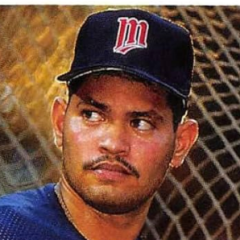
Cody Christie Twins Daily Contributor Posted 1 hour ago Posted 1 hour ago Image courtesy of Conor Lacefield, Midland RockHounds (photo of Marek Houston) The MLB Draft is built on projection. Teams aren't drafting finished products. They're betting on what players can become. That often means scouting reports focus just as much on perceived weaknesses as standout tools, especially for first-round picks expected to climb quickly through the minors. When the Twins selected Marek Houston with the 16th overall pick in the 2025 MLB Draft, there wasn't much disagreement about his greatest strength. Houston was widely viewed as one of the best defensive shortstops in the class, with instincts, hands, and actions that projected to keep him at the position for years. The debate centered on everything else. Could he hit enough? Was the power real? Would his speed translate on the bases? If those questions weren't answered, Houston looked like a high-floor utility infielder. If they were, the Twins may have landed an everyday shortstop with impact on both sides of the ball. One year later, Houston has done exactly what every organization hopes its first-round pick will accomplish: answer questions with production. The Power Looks More Sustainable Perhaps no criticism followed Houston more closely entering the draft than concerns about his power output. Keith Law of The Athletic wrote before the draft, "The power is kind of an illusion, as Wake Forest plays in a shoebox, and 11 of Houston's 15 homers this year came at home, mostly wall-scrapers that would be doubles or outs in a typical ballpark." That concern wasn't unreasonable. Houston's offensive breakout came relatively late in his college career, leaving scouts to wonder whether the power spike was more environment than development. Instead, his offensive game has continued trending upward in professional baseball. This year, Houston has produced 15 doubles, one triple, and five home runs while reaching base nearly 40% of the time. The home run total won't jump off the page, but that's also missing the point. Houston isn't trying to become a slugger. His offensive value comes from consistently finding barrels, spraying line drives around the field, and letting the extra-base hits accumulate naturally. His 121 wRC+ suggests he's been 21% better than league average offensively, while his .391 wOBA reinforces that his production isn't simply the product of luck. The next developmental step will be seeing whether some of those doubles begin turning into home runs as he settles into Double-A during the second half. Even modest gains in game power would raise his ceiling considerably. A Surprise Weapon on the Bases MLB Pipeline questioned another aspect of Houston's athletic profile before the draft, writing that "His speed plays better in the field than it does on the bases." College production supported that opinion. Houston stole fewer than ten bases in each of his first two collegiate seasons before breaking out with a 19-for-21 campaign as a junior. His first full professional season suggests that breakout was no fluke. Houston has already stolen 28 bases in 30 attempts, including a perfect 4-for-4 since arriving in Double-A. He's on pace to comfortably eclipse 40 steals while maintaining excellent efficiency. That's become an important part of his overall offensive value. Houston isn't simply getting on base; he's consistently turning singles and walks into scoring opportunities. Combined with his elite on-base skills (11.9 BB%), his aggressiveness has added another dimension to his game that wasn't expected a year ago. The Defense Has Been Exactly as Advertised Not every draft question needs a surprising answer. Some evaluations simply prove accurate. ESPN's Kiley McDaniel called Houston "a surefire shortstop" and argued that he "might be the best collegiate defender in this draft." The Twins have treated him accordingly. Houston has started all but one of his games at shortstop, briefly appearing at second base for the first time in his career. His .964 fielding percentage only tells part of the story. He's already turned 28 double plays while posting a 3.94 RF/9 and 3.72 RF/G, both improvements over any season he posted at Wake Forest. More than the statistics, Houston passes the eye test. His internal clock, first step, and ability to make difficult plays look routine continue to stand out. The Twins have consistently emphasized athletic defenders throughout the organization, and Houston looks capable of anchoring the infield for years. That defensive foundation also lowers the pressure on his bat. He doesn't need to produce like a corner infielder to become an above-average major leaguer because his glove already carries significant value. The Contact Skills Continue to Translate When Eric Longenhagen of FanGraphs evaluated Houston on draft day, he described him as fitting "Minnesota's wheelhouse as an up-the-middle defender with good contact performance." That prediction has aged particularly well. Houston posted an 80.6 Contact% during his 24-game professional debut in 2025. Through his first full season, that number has dipped only slightly to 79.4% despite facing progressively better pitching and earning a promotion to Double-A. He’s faced older pitchers in nearly 75% of his at-bats and is over two years younger than the Texas League's average age. His CSW% has remained nearly identical, moving from 27.0% to 26.8%. Those may seem like small differences, but maintaining that level of contact while climbing the minor league ladder is encouraging. Young hitters often sacrifice contact while searching for more power or adjusting to advanced pitching. Houston has largely avoided those growing pains. His disciplined approach is reflected in his .399 on-base percentage, which continues to be one of the biggest reasons his offensive profile is trending upward. The Twins May Have Found More Than a Safe Pick It's still far too early to declare Houston a major league success. Double-A is often considered the biggest proving ground for prospects, and the adjustments he'll face over the next several months will be significant. Still, the trajectory is difficult to ignore. One year ago, Houston entered professional baseball carrying the label of a defense-first prospect whose offensive upside would determine whether he became an everyday player or a valuable utility piece. Today, he's showing the ingredients of a complete player. The power has been more than adequate. The contact skills remain strong. His on-base ability has been outstanding. He's become one of the organization's best baserunners, and his defense continues to validate the glowing scouting reports that made him a first-round pick. If Houston continues producing at Double-A throughout the second half, a promotion to Triple-A sometime in 2027 feels like a realistic next step. This would follow a similar path to Kaelen Culpepper, Minnesota’s first round pick in 2024. From there, his path to Minnesota could move quickly. Given the Twins' organizational philosophy and Houston's polished defensive game, he profiles as the type of prospect who won't need hundreds of Triple-A plate appearances before forcing the conversation. The Twins drafted Houston because they believed there was more offensive upside than many public evaluators projected. One year later, that belief looks increasingly justified. Instead of simply validating his reputation as an elite defender, Houston is developing into one of the organization's most complete prospects—and one of the fastest-rising names in baseball's minor leagues. What have the Twins learned about Houston over the last year? When will he arrive in Minnesota? Leave a comment and start the discussion. View full article
Fatbat Verified Member Posted 39 minutes ago Posted 39 minutes ago With a .400 obp, his ceiling is sky high. Add in 40 steals per season and dozens of extra base hits, who cares if he only tops out at 15-20HR’s. We need his gold glove on varsity! If his bat had been developed sooner in college, he would have been a top 10 pick. We are lucky to have him in the organization!!
D.C Twins Verified Member Posted 5 minutes ago Posted 5 minutes ago He is currently in his biggest test for future MLB success. Can the hitting be sustained at the AA level? Jury is currently still out, but fingers and toes crossed. A young controllable star at SS would probably be the biggest accelerant toward a PLAYOFF competitive Twins team. Fatbat 1
tony&rodney Verified Member Posted 4 minutes ago Posted 4 minutes ago Houston has improved quite a bit at the plate in the last twelve months. Whether it was some coaching, personal small adjustments, or whatever, the bat that looked weak has been smoothed out and plays now. Keep an eye on Marek Houston.
Billy Amick Wichita Wind Surge - AA 1B/3B Despite hitting just .194, the 23-year-old ranks fourth in the Texas League in Home Runs (17) and sixth in RBI (50). Explore Billy Amick News >
Recommended Posts
Create an account or sign in to comment
You need to be a member in order to leave a comment
Create an account
Sign up for a new account in our community. It's easy!
Register a new accountSign in
Already have an account? Sign in here.
Sign In Now