

Twins Video
The Twins' offense has not been a strength this year, nor has it been a weakness. By wOBA and fWAR, they have been exactly average, ranking 15th out of 30 MLB teams. They are 10th overall in runs scored, thanks mostly to an unsustainable RISP rate that has faded in the second half, but have fallen to 23rd here in a month of August that essentially knocked them out of contention.
Next year's team is going to have legitimate contention hopes, and that's before you factor any offseason moves. It begins with their pitching staff, which figures to be extremely deep with Pablo López, Mick Abel, David Festa and others hopefully returning from injury. The bullpen has been given a year to develop and should be in a much better place entering the 2027 season versus 2026.
This has the makings of a good team. What will determine its true upside is how good the offense can be. Are we looking at another middle-of-the-road unit like we saw this year? Or can the Twins' lineup evolve into something special as young talent melds with veteran leadership?
Here's my early projection of a 2027 starting lineup for the Twins, along with some thoughts and questions we need to see answered in September and the offseason for each.
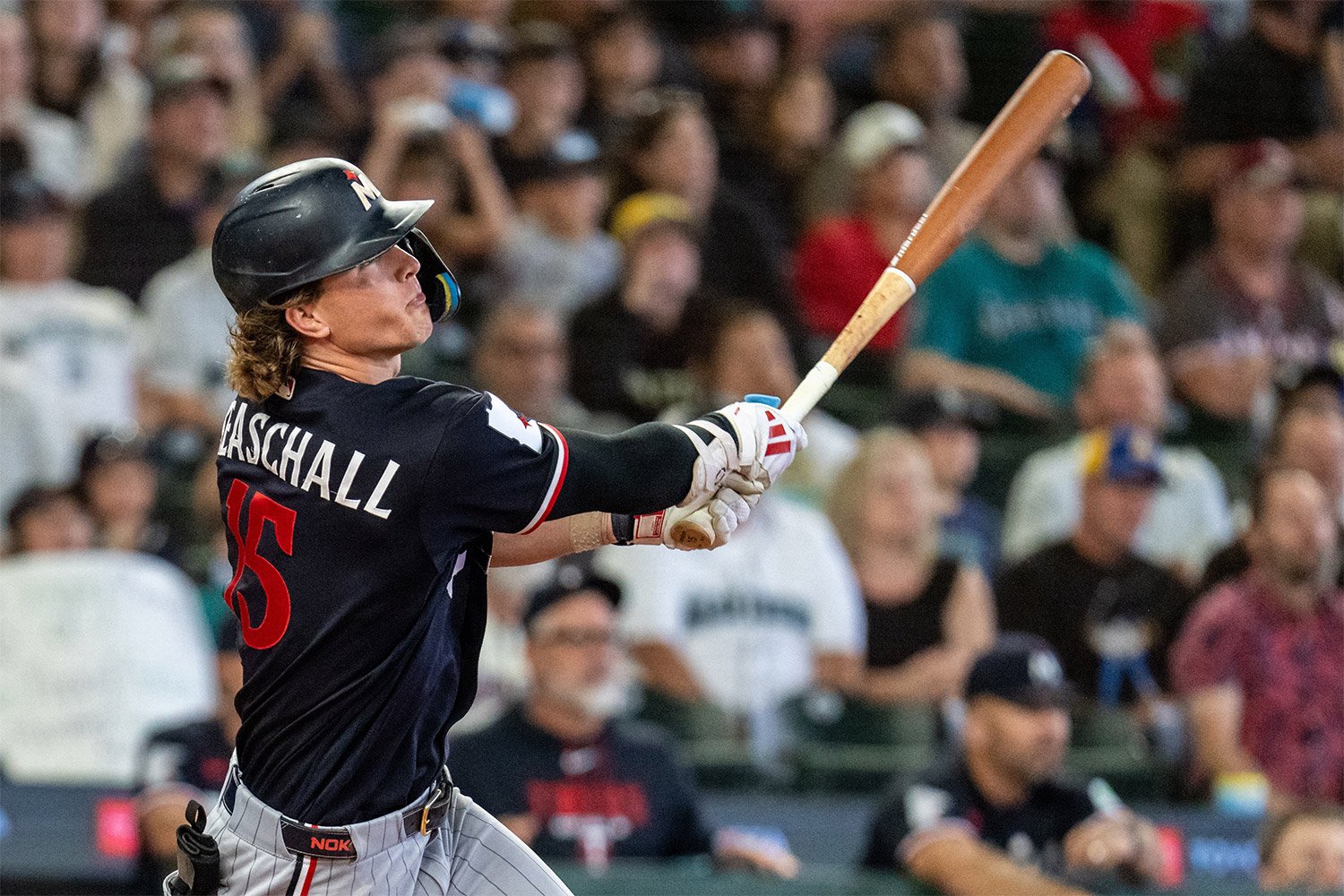
1. Luke Keaschall, DH
Keaschall has firmly established himself as the team's leadoff hitter, now and going forward. He's batted atop the order in 12 consecutive games and I'd be surprised if he moves away for anything other than an injury. The honor is well deserved for Keaschall, whose .416 OBP since the start of July ranks 3rd among MLB hitters.
He provides everything you'd want from a leadoff man, whether the role is being viewed through an old-school or new-school lens. He takes good at-bats, handles the bat, hits for average, runs well and sets the table for the best hitters in the lineup. The question, of course, is where he fits in defensively. For now I've got him pegged as a regular DH who slides into an outfield corner against left-handers.
What to watch for in September: Where the Twins play Keaschall in the field, offering clues about how they envision fitting his bat into the 2027 lineup without locking him into DH.
2. Walker Jenkins, RF
Jenkins has been appearing at the bottom the order initially to ease pressure on a 21-year-old seeing his first major-league action, but soon enough I think it will become clear he's the best all-around hitter in the lineup, and that is who belongs in the No. 2 spot. Already we've seen Jenkins' smooth swing and ability to control the zone, and even his ability to hang tough against southpaws.
He has the ability to do it all at the plate. I want to see his at-bats maximized. And slotting him in between two right-handed hitters will make it harder for opposing managers to play matchups in the late innings.
What to watch for in September: How quickly Jenkins adjusts to major-league pitching, particularly against left-handers, and whether he can already begin establishing himself as a fixture near the top of the order.
3. Byron Buxton, CF
A question mark at the moment, to be sure. Buxton is currently on the injured list for a third time in the past two months with a right hip impingement that won't go away. He's never been right since the issue first sprung up, slashing 172/.274/.203 in 74 plate appearances between IL stints. GM Jeremy Zoll has acknowledged that offseason surgery is on the table.
What really makes the situation frustrating is that, before his hip started barking constantly, Buxton was as healthy and productive as ever. He earned a third All-Star nod in the first half by slashing .271/.328/.575 with 25 homers. That's the definition of a No. 3 hitter, and the ideal kind of slugger to have lined behind Keaschall and Jenkins.
The hip thing does not look good for Buxton at the moment. But neither did his knee before October 2023 surgery to excise a plica finally resolved his recurring pain. Maybe he and the doctors can figure out some kind of similar course of action for the hip this offseason? For now that's what I'm banking on.
What to watch for in September: Whether Buxton returns at all, and if he does, whether his hip shows enough improvement to inspire confidence that rest and rehab can work, or further strengthens the case for offseason surgery.
4. Kody Clemens, 2B
The cleanup spot is the first one in the batting order that you come across and find a lack of credible fit among current options. It could have been Matt Wallner if he didn't fall out of the team's plans with a disastrous first half. It could eventually be Emmanuel Rodriguez. But for the moment, the most logical candidate would seem to be Clemens, who's made more starts at cleanup in 2026 than any Twin other than Josh Bell.
Clemens makes a lot of outs, which is what gives me hesitation about putting him in the top half of the lineup. His .293 OBP is 15th-lowest among qualified MLB hitters. But the power tool is legit: 22 homers, 21 doubles and six triples. His .459 slugging percentage ranks second among MLB second basemen. Plus, batting him after Buxton gives you the ability to go R-L-R-L in the top four lineup spots.
I view Clemens as a placeholder, in multiple senses: in the cleanup spot, until someone more deserving emerges, and at second base, until Marek Houston comes up and takes over at short.
What to watch for in September: Can Clemens can sustain his power production while improving his ability to reach base? This could determine whether he's viewed as a legitimate middle-of-the-order bat or more of a lower-lineup complementary piece.
5. Kaelen Culpepper, SS
In his limited time as a big-leaguer, we've already started to get a clear idea of who Culpepper is as a hitter. He's aggressive, he swings hard, and he hits the ball with authority. Culpepper has already notched two double and three homers, with bat speed and contact quality that jump out at you.
He also has a 16-to-4 K/BB ratio, which is the flip side to his offensive profile. I would expect him to be a power-first bat with a relatively low OBP, not unlike Clemens but hopefully with a little more discipline. Culpepper seems like a good fit to bat fifth, especially because it keeps with our pattern of alternating handedness.
What to watch for in September: How Culpepper's aggressive approach holds up as pitchers adjust to him, and whether he can tighten his strike-zone discipline without sacrificing the impact that has made his early arrival so encouraging.
6. Emmanuel Rodriguez, LF
Ready or not, here he comes. Rodriguez will be out of options next spring, meaning the Twins will have to bring him north out of camp. He's the major wild-card in my projected lineup as the only player who has yet to debut, and that's why I'd love to get a look at him in September.
The profile here is pretty unique, with maxed-out power and patience to go along with a rare level of swing-and-miss tendency. It's not hard to imagine him best-suited for the bottom of the order initially, given the potential for overwhelm as he deals with MLB pitchers who can dot the borders of the zone, but I think Rodriguez will give you enough big swings to justify placement in the middle of the order.
What to watch for in September: First and foremost, whether Rodriguez gets the call. If he does, how will his extreme three-true-outcomes profile translate against major-league pitching before he's forced onto the roster next spring?
7. Royce Lewis, 1B
Among players listed in this lineup projection, I feel least certain about Lewis being a member of the 2027 team. On the one hand, first base is a pretty easy position to address (see: Josh Bell) and Lewis has been rather unexceptional there. On the other hand, he'll still be relatively cheap via arbitration next year, and he's been decent enough to merit another attempt at unlocking his dormant upside. Especially given the lack of competing internal options.
At this time, I'd still be counting him in my plans, but Lewis has not shown enough offensively to deserve hitting in the top half of the order. I'm really interested to see how he finishes out this current season.
What to watch for in September: Whether Lewis can finally rediscover some sustained offensive impact down the stretch and give the Twins a compelling reason to keep betting on his upside in 2027.
8. Brooks Lee, 3B
An enigma. You look at Lee's underlying metrics and he grades out as one of the worst hitters in the league, with an xwOBA ranking in the 3rd percentile. And yet. He's tied for second among Twins position players in fWAR, and he's running an above-average .739 OPS. He doesn't do anything particularly well but he does everything well enough to be a productive and reliable starter in the infield.
Lee has a .287 career OBP and has yet to finish a season above .300. Until that changes, or he lifts his average out of the .240 range, I can't see much an argument for Lee hitting in a prime lineup position like he did on Sunday. But he's a relatively strong piece at the bottom of the order.
What to watch for in September: Whether Lee can finish the year with stronger underlying offensive indicators — more quality contact, more walks or simply more consistent production — to reinforce his case as more than a defense-and-versatility regular.
9. Victor Caratini, C
Outside of a hot streak in June, Caratini has been one of the worst hitters in baseball all year. I don't expect that to improve much heading into his age-33 season. But it bears noting that the bar for a No. 9 hitter is very low — the average MLB hitter in that lineup spot is slashing .228/.294/.349 this year.
For a catcher hitting at the bottom of the order, he's perfectly adequate. But it's certainly fun that the only clear-cut offensive liability in the 2027 lineup happens to play the same position as Minnesota's soon-to-be No. 1 prospect, Vahn Lackey, who is off to a ridiculous start in Cedar Rapids.
What to watch for in September: How much the Twins lean on Caratini down the stretch, relative to the outgoing Ryan Jeffers, and whether they use the fading stakes to audition Alex Jackson more seriously as a presumptive 2027 backup.
Looing ahead at the 2027 lineup, and even starting to map things out a bit further, we can start to see a compelling convergence of the past wave and the new wave. The top prospects have officially arrived, so we no longer need to discuss their fit as theoretical. Now the real work begins. How good can this lineup be?








Recommended Comments
Create an account or sign in to comment
You need to be a member in order to leave a comment
Create an account
Sign up for a new account in our community. It's easy!
Register a new accountSign in
Already have an account? Sign in here.
Sign In Now