


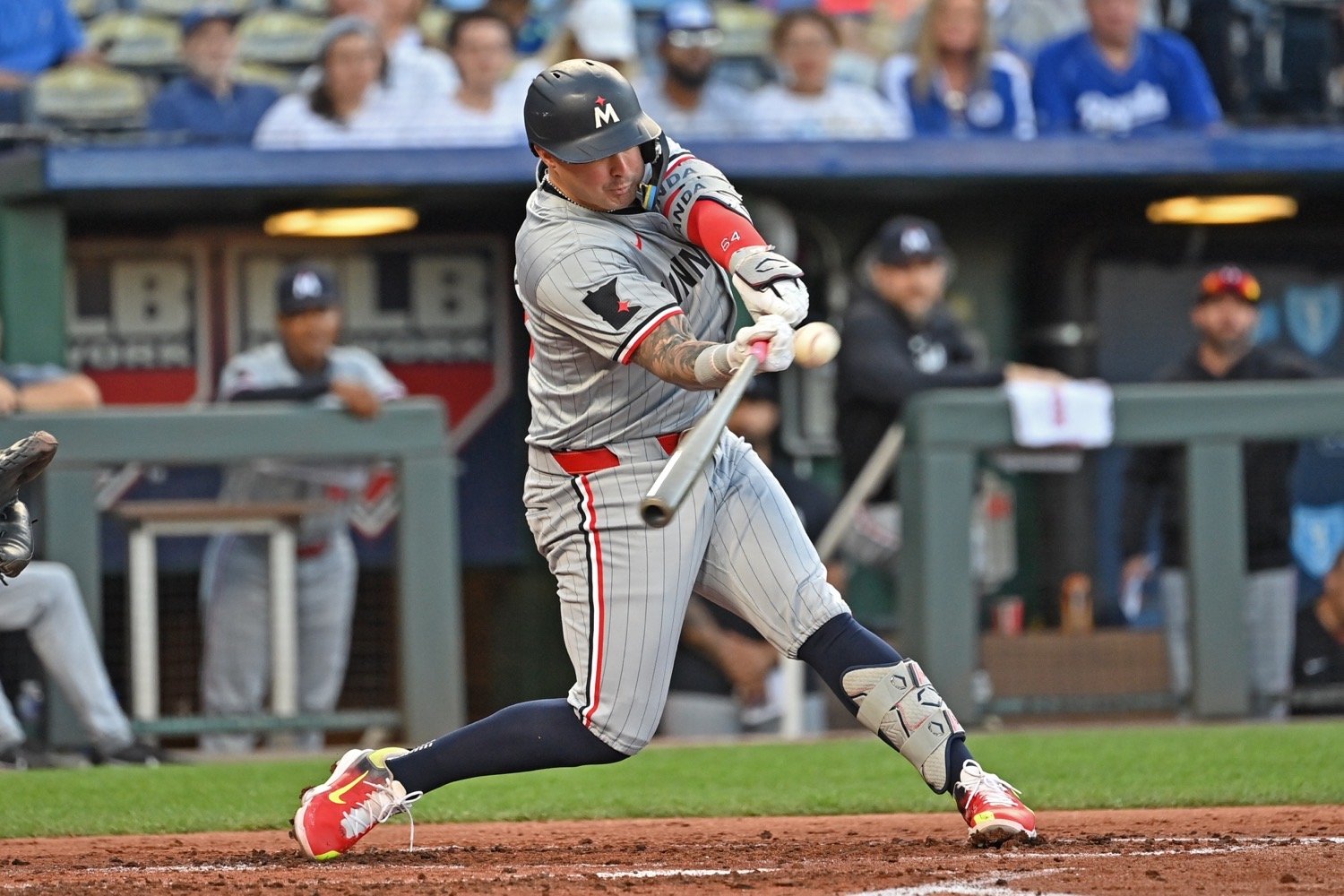
Twins Video
José Miranda was a relatively unheralded prospect prior to his 2021 breakout with the Twins' Double- and Triple-A affiliates. He carried that success into 2022, where he slashed .268/.325/.426 in 125 games, but then struggled in 2023, largely due to a shoulder injury that hampered him for most of the season. Entering his age-26 season, many wondered if he was a two-year wonder, or if he could re-establish himself as a long-term fixture in the middle of the Twins lineup. A month into the 2024 season, Miranda quickly answered the bell.
Through Aug. 17—prior, in other words, to the entire offense collapsing—Miranda slashed .308/.348/.490, with an impressive 14.3% K rate and a 137 wRC+. While he didn’t show the over-the-fence power he flashed in the minors in 2021 and in the bigs in 2022, he still provided plenty of gap-to-gap power, with 26 doubles and even two triples. While being one of the most consistent offensive contributors, he left more to be desired with his glove. Like, a lot more.
According to Baseball Savant, Miranda had the third-worst Fielding Run Value of any third baseman who played at least 500 innings. He had an even 0 FRV in a much smaller sample at first base, but in 2022, he posted a -4 there. In short, while Miranda was one of the best contributors at the plate, he’s a well-below-average player in the field, on a team that already has too many question marks around the diamond. Eduoard Julien, Alex Kirilloff, Brooks Lee, Austin Martin, Michael Helman, and even Royce Lewis are other infielders on the big-league roster with average or worse gloves, and that doesn’t even include Yunior Severino, who was added to the 40-man roster last winter as another positionless infield slugger.
While Lee and Lewis would return significantly more value than Miranda in trades, they are centerpieces of the Twins' current competitive window, as former first-round picks who are just 23 and 25, respectively. Moreover, their gloves also are far more passable and versatile; they're more likely to stay in defensive lineups throughout their big league careers. Miranda may be better off as a DH as he ages. Young, above-average hitters are always going to be valuable and have a job in Major League Baseball, so (despite his shortcomings in the field) I believe that Miranda would have quite a few suitors of the Twins shopped him around this offseason.
One caveat to add is that any player acquired in a trade is likely going to be more expensive than Miranda, who will be in his final pre-arbitration year and make around $800,000, but the Twins also have arbitration decisions to make on a handful of relievers who are projected to earn over $10 million via arbitration in total. If they can make a move on Miranda prior to the mid-November tender deadline, they will have better line of sight into which of those relievers they can “afford” to tender and which ones they may need to let walk. That also doesn’t take into account the roughly $3 million raise that Willi Castro is projected to get in 2025, and how those funds could be repurposed to fill an area of need if they decide to move on from the super-utility player.
Miranda's value might be in the sweet spot, where the Twins can get something helpful and shake up their positional group for 2025 without losing a player they view as indispensable. Much depends on how other segments of the market take shape in the weeks ahead, but this possibility bears watching.
Would you trade José Miranda or one of the other utility infielders mentioned in this article? If so, what position would you target? Join the conversation in the comments!
Which team do you dislike the most in the AL Central?
Follow Twins Daily For Minnesota Twins News & Analysis



- Cory Engelhardt, Karbo, nclahammer and 2 others
-
 4
4
-
 1
1


Recommended Comments
Create an account or sign in to comment
You need to be a member in order to leave a comment
Create an account
Sign up for a new account in our community. It's easy!
Register a new accountSign in
Already have an account? Sign in here.
Sign In Now