


Twins Video
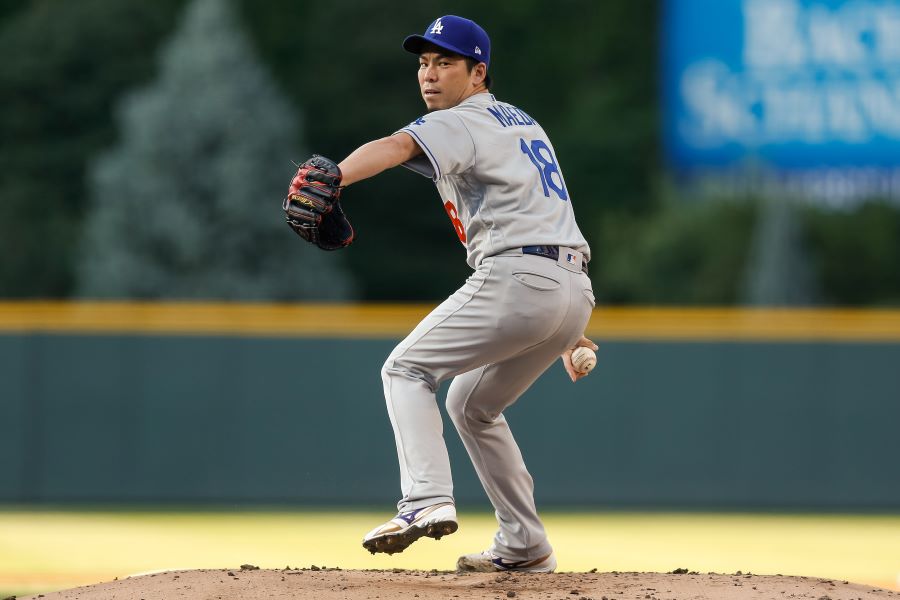
José Berríos is a more traditional workhorse. Jake Odorizzi has a deeper repertoire. Taylor Rogers is a relief ace. In the right mix, however, new acquisition Kenta Maeda can be better than any of them, and the erstwhile Los Angeles Dodgers swingman has landed on a Minnesota Twins team that suits him just as well as his old one did. While other pitchers might be more valuable in a vacuum, the specific context of the Twins pitching staff makes Maeda the most valuable hurler they have. That’s a bold claim, and the advisability of trading Brusdar Graterol for Maeda partially hinges on its viability, so here are five numbers to support it.
Of the 104 pitchers who threw at least 2,000 pitches in 2019, Maeda induced the sixth-highest whiff rate on swings. Opponents made contact on a lower percentage of their swings against Maeda than against Lucas Giolito, Chris Sale, or Jacob deGrom. Despite a fastball that averages 92.3 miles per hour, Maeda misses bats at an extremely impressive clip. When he threw a slider to right-handers in 2019, they whiffed 25.2 percent of the time—not on swings, but on all sliders. Left-handed hitters whiffed at his changeup 21.5 percent of the time. Those numbers are eye-popping.
Maeda has five pitches, but really, he throws just two against each type of batter. Righties see his slider 53.4 percent of the time and his fastball 33.2 percent of the time. To lefties, he throws 41.2 percent changeups and 34.6 percent fastballs. Because of that, of hurlers who threw at least 2,000 pitches, Maeda induced the seventh-highest swing rate on pitches outside the zone.
Against batters of each handedness, Maeda is more likely to throw his primary non-fastball pitch than his heater. His fastball only remains his most-used pitch because he throws it as a secondary offering against all batters. He’s highly unpredictable, and that draws hitters into chasing bad pitches. That unpredictability makes him hard to square up, too. His fastball has above-average spin, adjusted for its velocity, and while his spin doesn’t generate extraordinary movement, it does seem to help him limit hard contact.
Of 152 pitchers who allowed at least 250 batted balls in 2019, Maeda yielded the fourth-lowest average exit velocity. It’s not a coincidence that opponents have a .280 batting average on balls in play against Maeda over his 589 big-league innings, which is well below the typical .300. Nor has Maeda simply gotten lucky. He gets tangibly worse contact even when batters aren’t swinging and missing. He’s a fly-ball pitcher, but is one of the best pitchers in baseball at limiting exit velocity on those flies, which only makes him an even better fit for the Twins: their outfield defense is far better than the gloves on the infield.
Finding pitchers with both strikeout rates and contact management skills this far above average, while throwing more than one inning at a time, is virtually impossible. Yet, Maeda manages it, partially because he’s been used very strategically.
In all situations other than facing batters a third time in games as a starter, Maeda held opponents to a batting line of .199/.264/.343. The Dodgers’ plan with Maeda, for reasons both performance-centered and financial, was to minimize his exposure to opponents for the third time in any game. That prevented Maeda from running into trouble as batters grew accustomed to his two-pitch combinations. He only faced batters on a third trip through the order 104 times in 2019, less than half as many such plate appearances as he had facing them a second time. When restricted to that role, Maeda was dominant. The Twins, with such great bullpen depth in place, can afford to carry forward that strategy, which gives Maeda a chance to remain nearly unhittable.
The way Maeda slides between roles (however unhappy he might be about it), and the way he both punches batters out and makes things easy on his defense when they do put the ball in play, makes him a darling of the most advanced pitching metrics. Baseball Prospectus uses Deserved Run Average (DRA) to holistically capture a pitcher’s contribution to run prevention, and DRA- puts that contribution on a simple scale, where 100 is average and (for example) 80 is 20 percent better than average. Maeda’s 68 career DRA- is better than the same number for the best seasons of Berríos, Odorizzi, or Pineda. Among possible Twins starters, only Rich Hill has ever been better than Maeda, and Hill is unlikely to reach that level again at this late stage of his career.
It’s unlikely that Maeda will be as inexpensive as his contract first appears, because he’ll probably start for much of the season, and that will trigger a number of significant incentives. However, even at triple his base salary, Maeda is a bargain. He could be the Twins’ ace, especially because of the deep and highly modular group around him. His pitch mix is a perfect fit for the Twins’ evolving pitching philosophy, and his strengths match up with those of the team in ideal fashion.






Recommended Comments
Create an account or sign in to comment
You need to be a member in order to leave a comment
Create an account
Sign up for a new account in our community. It's easy!
Register a new accountSign in
Already have an account? Sign in here.
Sign In Now