


Twins Video
1. Byron Buxton and Carlos Correa are both on pace to finish with 1.2 fWAR.
This is the banner headline of the Twins season so far, and one that oddly seems to get buried amid complaints about bullpen management, lineup construction, Emilio Pagán lapses, prospect timelines, and otherwise.
I get it, because when things are going as poorly as they are, people want to project blame and assign villains.
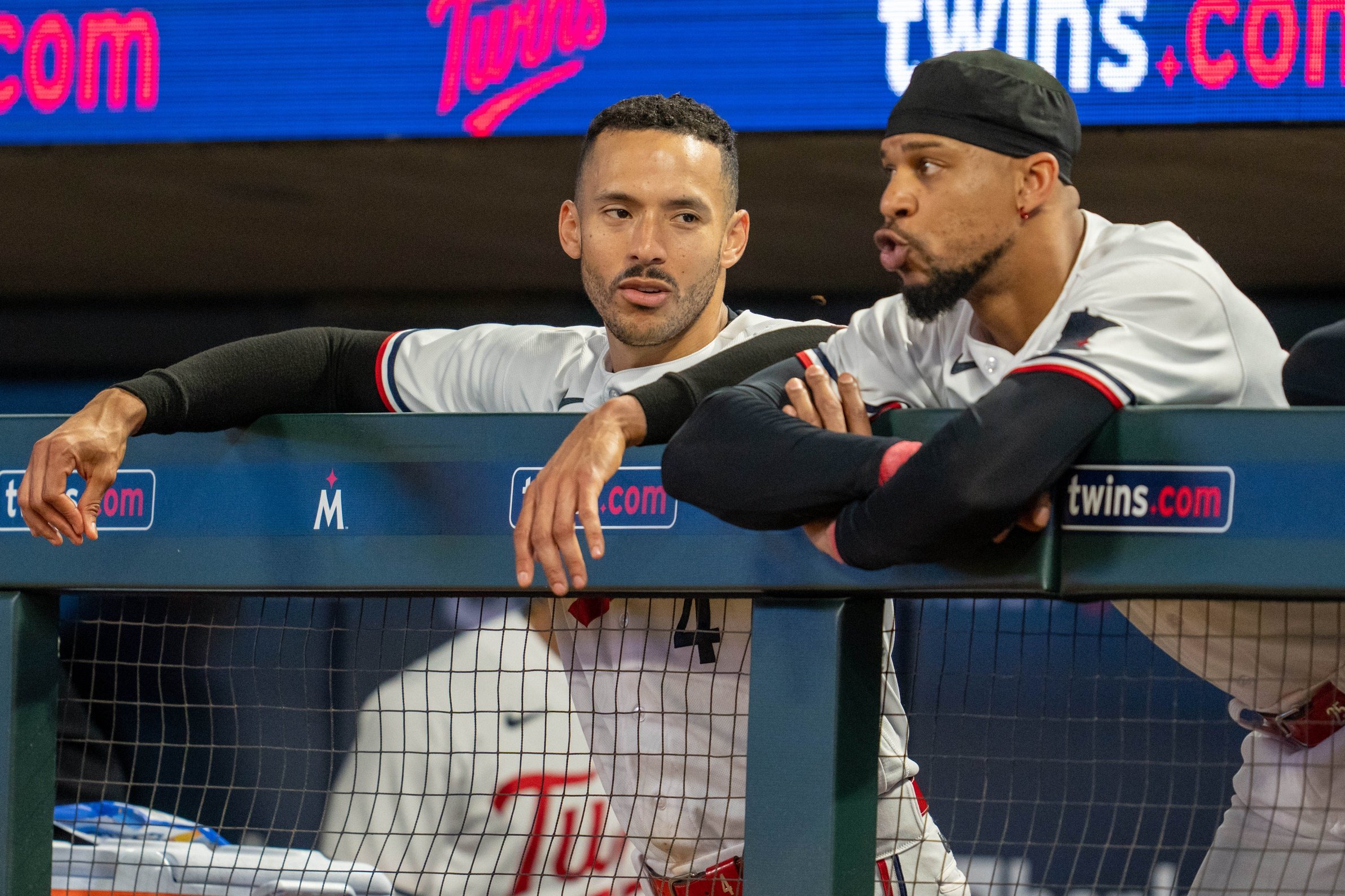
Unfortunately, to get to the bottom of what's fundamentally hindering this team, we need look no further than the promised heroes: two most talented, highly-paid, and (arguably) likable players on the roster. Correa and Buxton, earning a combined $50 million, have completely let this team down in the first half and there is no other way to put it.
To provide some context around this pitiful pace for 1.2 fWAR, which would be lower than Gary Sanchez's final mark as a Twin last year: it would be easily the lowest of either players' career in a remotely full season.
Here are Buxton's fWAR totals from the past four years:
- 2023, halfway: 0.6 (63 games)
- 2022: 4.0 (92 games)
- 2021: 4.1 (61 games)
- 2020: 1.2 (39 games)
- 2019: 3.0 (37 games)
Here's a comparative look at Correa's track record in fWAR:
- 2023, halfway: 0.6 (71 games)
- 2022: 4.4 (136 games)
- 2021: 6.4 (148 games)
- 2020: 1.2 (58 games)
- 2019: 3.8 (75 games)
Because they've historically offered outstanding defense at premium positions, Correa and Buxton have been consistent sources of value, even in injury-shortened seasons. That is not the case this year. Buxton's defensive impact has been eliminated by DH duty, while Correa's defense – still good, albeit not resembling its peak – doesn't do nearly to offset a .287 on-base percentage and abundance of GIDPs.
Two proven star players, in their prime, contributing like random role players, even as they've been able to stay on the field. It is a stunning and devastating failure from the duo in which this team invested its present and future hopes.
Twin tragedies. Can Correa and Buxton reverse this depressing storyline in the second half? If they don't, the Twins franchise will be in a dire state coming out of this season, regardless of what decisions are made in the fallout.
2. Willi Castro leads all Twins position players in fWAR (1.1) and is on pace for 382 plate appearances.
The downside of this note is that Castro – a minor-league signing during the offseason after being discarded by the lowly Tigers – has produced nearly as much fWAR in the first half as Correa and Buxton combined. And the fact that he's on pace for nearly 400 PAs says a lot about the team around him.
But it also speaks to how Castro has earned his way into a larger role than expected, providing reasonably decent offensive production, defensive versatility, and aggressive speed on the bases, where he is 15-for-15 on steal attempts.
For all the negatives across the position-player corps this year, Castro has been a legitimate positive, and one whose impact could stretch beyond this season as a controllable 26-year-old asset.
Theoretically, when the rest of the lineup gets going and Castro's role is reduced, he'll be a really nice bench piece to have around.
3. Joey Gallo is on pace to finish with 26 home runs ... and 52 RBIs.
Gallo's all-or-nothing production profile epitomizes that of the team at large, which is why he's grown so unappealing to watch. The veteran slugger can still take one deep from time to time – a 26-HR season is nice, on its own – but has almost no ability to contribute outside of these occasional pop-offs. Twenty-three of Gallo's 26 RBIs this year have come on home runs. And 14 of them came in the first month.
Since April 27th, Gallo – signed to be a run-producing power hitter – has produced 12 RBIs in 45 games. He opened up his second half by going 0-for-3 with three strikeouts in a shutout on Wednesday.
(By the way, the same dynamic is in play for Buxton, who's on pace for 26 home runs and 56 RBIs. In the first half, 23 of Buck's 28 runs batted in were on homers. These veteran players are figureheads for an offense that can't seem to accomplish anything outside of occasionally hitting the ball over the fence.)
4. Christian Vázquez is on pace to finish with 2 home runs.
The Twins didn't think they were getting any kind of offensive specialist when they signed Vázquez to a three-year contract during the offseason, but thought they were at least acquiring a competent hitter – part of the valuation that pushed them to $30 million in a competitive market. The free agent had slashed .271/.318/.416 over the past three seasons (94 OPS+), and even with a modest step back from that benchmark, he was still gonna be a quality two-way backstop.
Instead, Vazquez's offensive game has cratered in Minnesota, where he finished the first half with an OPS+ of 68. He slugged .292 with just one single home run in 180 plate appearances. In the past four seasons Vázquez hit 9, 6, 7, and 23 home runs. His power has suddenly vanished at the age of 32, which doesn't bode terribly well for the rest of his deal here.
To be fair, Vázquez's offensive numbers aren't that out of the ordinary for a catcher (the position as a whole is slashing .233/.300/.384 MLB-wide) and his good defense has prevented him from being a total negative. But so far, the Twins have gotten only half the player they hoped they were signing at a crucial spot.
5. Joe Ryan, Sonny Gray, and Pablo Lopez are all on pace for 4.4+ fWAR.
Hey, it's not all bad news! The Twins rotation was phenomenal in the first half, led by a trio of frontline-caliber arms who will set the club up well for a playoff series, if some of the above trends are to turn around. Ryan, Gray and Lopez all finished the first half with an fWAR of 2.2 or better, placing each among the top eight in the American League.
Here's a list of Twins pitchers who have finished seasons with an fWAR of 4.4 or higher in the past 25 years:
- Jose Berrios (2019)
- Phil Hughes (2014)
- Francisco Liriano (2010)
- Johan Santana (2004, '05, 06)
- Brad Radke (2001, '04)
That is a "who's who" of the best pitchers and pitching seasons in the post-millennial era of Twins baseball. Only once, in 2004, have the modern Twins had two pitchers of this caliber in same rotation, and never three.
If these three can continue to perform the way they have in the first half for the final three months, while Bailey Ober, Kenta Maeda, and others hold down the back end of the rotation, it's going be very hard to give up on this team.








Recommended Comments
Create an account or sign in to comment
You need to be a member in order to leave a comment
Create an account
Sign up for a new account in our community. It's easy!
Register a new accountSign in
Already have an account? Sign in here.
Sign In Now