


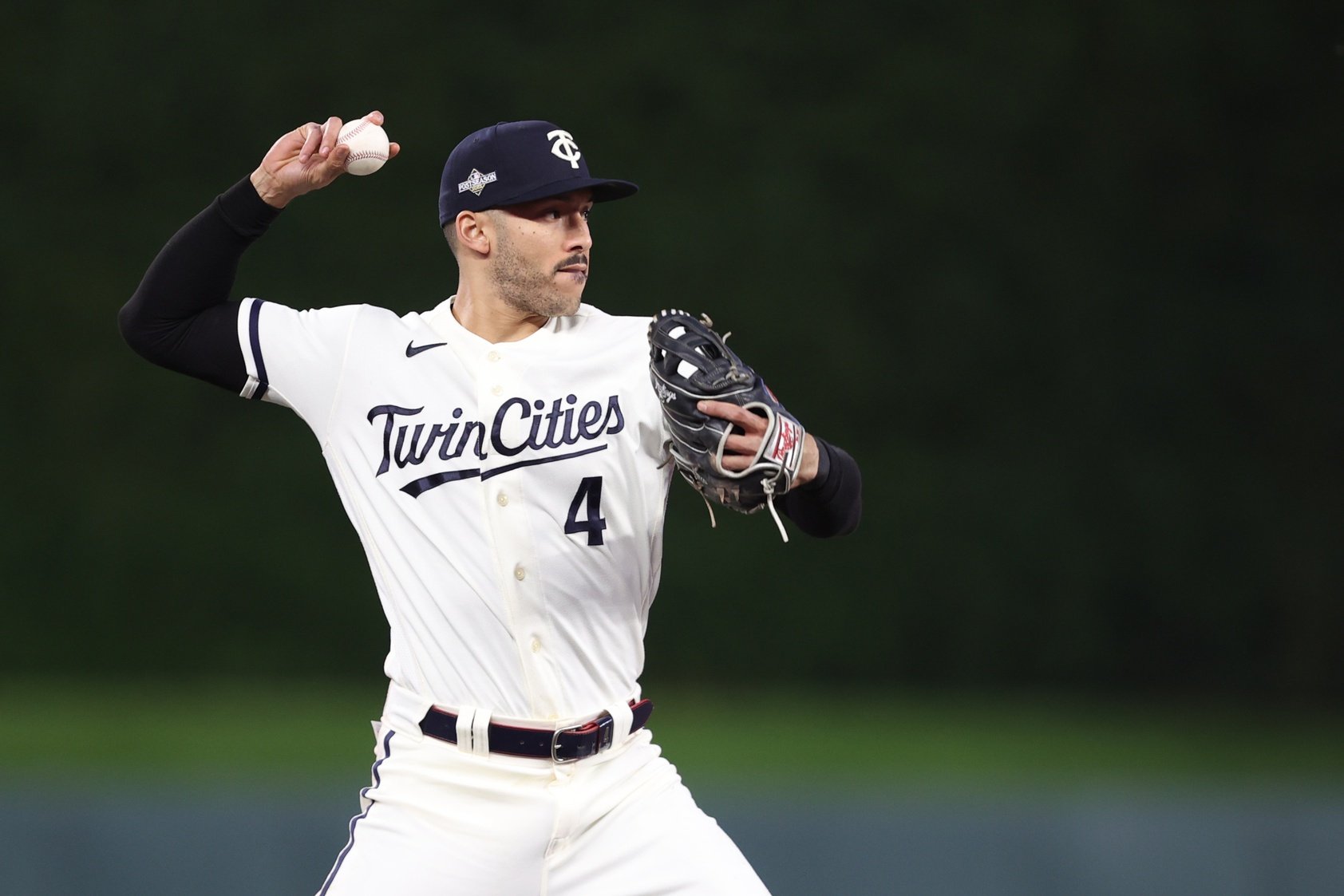
Twins Video
When it comes to defense in baseball, often the defensive metrics just don't match up to the eye test or general consensus. One famous example would be Derek Jeter, who won five Gold Gloves in his career and was widely considered a premier shortstop, despite the fact that fielding statistics consistently rated him as below-average.
Carlos Correa, conversely, is not a player whose fielding has been overrated relative to statistics. If anything, the opposite is true. Or it was.
Metrics like Outs Above Average (OAA) and Defensive Runs Saved (DRS) consistently viewed Correa as one of the most impactful shortstops in the league throughout most of his career. From 2018 through 2021, here's where Correa ranked among shortstops in OAA, and among all MLB players as a percentile factor.
- 2018: 23 OAA – 2nd in MLB, 100th percentile
- 2019: 11 OAA – 7th in MLB, 96th percentile
- 2020: 4 OAA – 9th in MLB, 94th percentile
- 2021: 10 OAA – 6th in MLB, 96th percentile
Genuinely elite defense, year after year. Aided by his incredible arm, quick reactions, and strong instincts, Correa overcame a lack of standout foot speed to continually rank as one of the rangiest shortstops in the game. Culminating with a Platinum Glove award in 2021 that recognized him as the best overall defender in the game, fielding was a huge part of Correa's value proposition when the Twins signed him in 2022, and then re-signed him to a historic long-term deal in 2023.
Yet, ever since joining the Twins, Correa's defensive metrics have been completely out of line with his previous track record. In his first season here, Statcast had Correa producing negative-3 Outs Above Average, which ranked 32nd among shortstops (100+ attempts) and in the 18th percentile among all big-leaguers.
We all wondered if perhaps that 2022 season would prove to be an outlier, and Correa's defensive numbers would bounce back toward career norms this year. Turns out he did, a little. Correa ranked 25th among shortstops with 1 OAA, a figure that placed him in the 64th percentile for big-leaguers.
Not bad, but much more average than great, and probably not a result that lines up to the eye test for most Twins fans and (apparently) Gold Glove voters.
Elsewhere, signs of a sudden yet sustained drop-off are even more vivid. Here's how Correa has rated out according to FanGraphs' Defensive Runs Above Average (DEF) metric over the past six years:
- 2018: 17.3 in 110 games
- 2019: 9.6 in 75 games
- 2020: 5.6 in 58 games
- 2021: 14.5 in 148 games
- 2022: 2.1 in 136 games
- 2023: 3.5 in 135 games
What to make of this stark decline in statistical defensive proficiency? It's hard to say that the metrics are missing something in Correa's performance given how consistently they assigned him massive defensive value prior to his time with the Twins.
I think there are a few different reasons that Twins fans might perceive Correa's defense as more positively impactful than it has verifiably been. One is simply reputation. When you're treated by media and popular narratives as a great defender, it's a rep that tends to gain traction and stick, regardless of evidence to the contrary. Jeter benefited from this.
Another thing is that Correa is just a really good, smart, smooth ballplayer. He doesn't commit many errors. It may not be all that visibly noticeable when he misses a grounder that he'd have gathered a few years ago, or that some of the other top shortstops in the league would get to. On any given play, the incredible caliber of his arm alone could easily convince someone he's a top-tier defensive SS regardless of any other data.
There's also this: Correa is a clutch. He steps up and makes big plays in big moments. We certainly saw that in the playoffs.
The Athletic's Eno Sarris wrote this week about the concept of clutchness in baseball. His data-driven analysis is an interesting one, but what I find most striking is the way performances in big moments shape our memories and perceptions.
As Eno put it in a radio interview, "If you have an emotion tied to a memory, you're going to remember it more." In this light, it's easy to see why momentous plays like Correa's game-ending backhand stab in Houston, or his heady throw home against Toronto – not to mention all those big-time highlights in years past – have an outsized influence on the way we think of him.
Emotions and subjectivity have a major impact on the so-called eye test, which is why many observers are prone to overrate Correa's current defensive impact just as they did with Jeter throughout his career.
So what does this all mean? Not a ton in the short term, necessarily. Even if you agree, based on the evidence, that Correa is no longer quite as strong defensively as his Gold Glove nomination would suggest, no one's arguing that Correa is a liability at shortstop, or that he should be moved somewhere else next year.
Even as his range diminishes, Correa remains a steady and sure-handed infield captain. His leadership and intelligence at a position where smart split-second decision-making is invaluable will help C4's continue to be an asset at shortstop even if his physical tools are beginning to dullen.
But the undeniable data trend does lead you to wonder. What's at the root of this statistical defensive decline? Is he already showing signs of aging at 29? Are the health concerns in his lower body – an ankle that's structurally worrisome, and now a nagging case of plantar fasciitis – taking their permanent toll?
These will be things to keep an eye on moving forward. It is worth noting that Correa was ready to move to third base if he signed in New York, and the nature of his contract with the Twins (salaries declining quickly in the later years) seems to imply that an eventual position switch is expected from all parties.
Everyone seems to understand that it's a matter of if, not when, Carlos Correa will stop playing shortstop. Even if he wins a Gold Glove this year, a deeper look his declining defensive value – not to mention the physical state of his body – makes clear that the day could come sooner than many anticipate.
Are you optimistic about the Twins right now?

Follow Twins Daily For Minnesota Twins News & Analysis



- mikelink45, Brandon, The Mad King and 6 others
-
 8
8
-
 1
1


Recommended Comments
Create an account or sign in to comment
You need to be a member in order to leave a comment
Create an account
Sign up for a new account in our community. It's easy!
Register a new accountSign in
Already have an account? Sign in here.
Sign In Now