


Twins Video
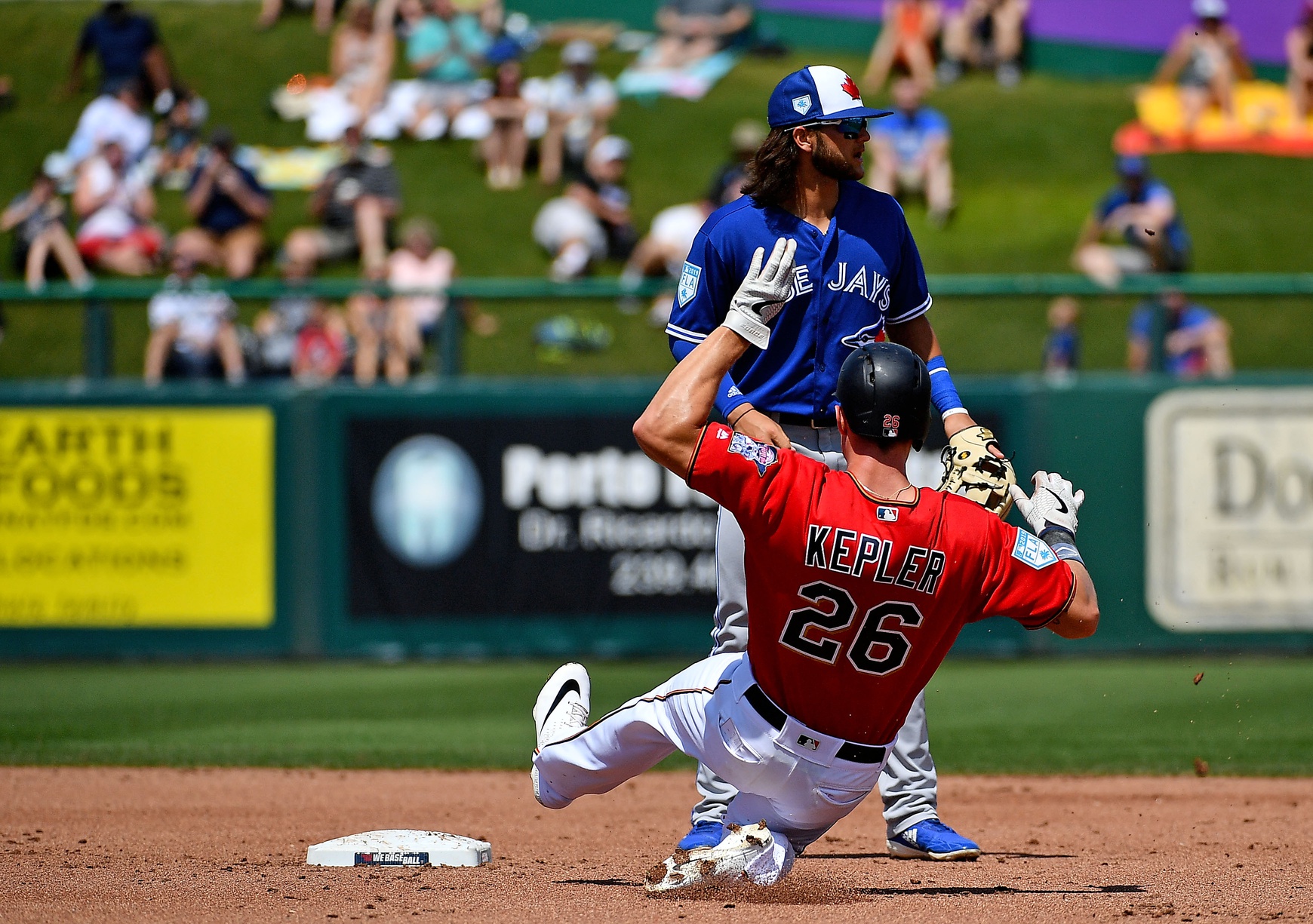
Leading Off: Max Kepler
Kepler has started 375 major-league games, and he has batted leadoff in a grand total of zero. In fact, it's the only lineup spot where he's never seen his name written in. But this spring he has found himself atop the order frequently. He was there Monday in Fort Myers, and he will be again Tuesday in Sarasota when the Twins face Baltimore.
In the past, Kepler has profiled as a poor fit for leadoff duties, so it's easy enough to see why he hasn't been used there. But his progression last year – namely in terms of plate discipline and at-bat quality, with his BB-rate rising dramatically – changes things. So does the lack of natural leadoff options elsewhere on the roster.
After the game, Baldelli made it sound like this new assignment might stick. "We saw this as an opportunity to get him into a spot where we could take advantage of some of his strengths," he explained. "He’s taken to it very well, he’s had very positive comments and remarks with all of us on the idea, and I think it’s something that we’re gonna see going forward."
Batting Second: Jorge Polanco
Polanco is the other most logical leadoff option, but as a switch-hitter with excellent contact skills, he might fit better in the two-hole. At least, this appears to be Baldelli's leaning. Polanco leads all Twins hitters in sacrifice hits over the past two years with 10, which is helpful to the extent his manager wants to use that tactic.
Last year at Baseball Prospectus, Aaron Gleeman wrote about the evolving view of #2 hitters around the league, noting that impact bats have replaced the conventional "bat handlers." In a sense, Polanco brings the best of both worlds. He has strong bat control and can lay down a bunt, but he's also a discerning hitter (he led the team in pitches per plate appearance last year, surpassing even Joe Mauer) with some pop.
You really couldn't go wrong with either arrangement of Polanco and Kepler in the top two spots, but I can see the wisdom in Baldelli's thinking.
Batting Third: Nelson Cruz
Pretty simple and straightforward here. Teams usually bat their best hitter and run producer third, where RISP opportunities tend to be most plentiful. Cruz is clearly the Twins' best hitter and run producer, averaging an .873 OPS and 93 RBIs over the past 10 seasons.
He still hasn't gone deep yet this spring – his opportunities have been limited as the Twins have eased the 38-year-old into action – but he came very close on Monday, driving a ball to the deepest part of the park in left-center and settling for an RBI double off the wall. Watching the guy take a few rounds of batting practice will leave no doubt that his prodigious power is still very much intact.
Batting Fourth: Eddie Rosario
Last spring, I noted that Rosario doesn't really fit the physical mold of a cleanup hitter. But Baldelli, like Paul Molitor before him, looks at Rosie and sees one.
He might not have the imposing stature of a Cruz or Miguel Sano, but Rosario's incredible power remains undeniable. He led the Twins in home runs with 24 last year and he's tied for the team lead this spring with four.
Here's how his first at-bat against Red Sox starter Nathan Eovaldi went on Monday:
Pitch 1: Rosario is just early on a fastball and sends an absolute rocket down the right field line, but it twists foul and sails out of play.
Pitch 2: Called strike
Pitch 3: Rosario drives another one to right, but this one stays fair and travels forever, eventually bouncing off the rooftop of a bar well beyond the fence
He's aggressive and highly dangerous. It also bears noting that Rosario grounded into just three double plays in 133 opportunities last year – the lowest percentage (3%) on the team after Robbie Grossman and Tyler Austin. So that's handy when coming up after potentially your three best OBP guys.
Batting Fifth: Marwin Gonzalez
On the surface, this seems like a somewhat odd choice. Gonzalez isn't the type of pure slugger you often find in the fifth spot in the order, but he does have power – he hit 16 homers last year after launching a career-high 23 in 2017. More importantly, he's a solid all-around switch hitter who's equally effective from both sides (.740 OPS as LHB, .730 as RHB). This creates late-game matchup problems for an opposing manager trying to navigate the middle of Minnesota's lineup.
Wanna go with a righty to try and neutralize Cruz? Okay, the reliever will have to deal with lefties Rosario and Gonzalez next. Want to use a righty against Cruz, then swap in a lefty for Rosario? Okay, now you've got righty-swinging Gonzalez due up, followed by two more RH bats.
Batting Sixth: C.J. Cron
Next up is Cron, who's coming off a 30-HR campaign for Tampa. While Austin has commanded much of the attention this spring, with his towering blasts and precarious roster footing, Cron has actually outperformed him with an extremely well rounded effort; even after Monday's 0-for-3, he is batting .333 with a .981 OPS, and his four walks are second only to Kepler (5) among players likely to make the roster.
Last year with the Rays, a majority of Cron's starts came in either the #2 or #4 spots, so if he's hitting sixth for the Twins regularly that's probably a pretty good sign. Last year, the #6 spot in Minnesota's lineup produced a .662 OPS, and in 2017 it was .705. Needless to say, getting a bat like Cron's (.816 OPS in 2018, .772 career) in there regularly could make a big difference.
Batting Seventh: Jonathan Schoop
In 2017, his best season as a big-leaguer by far, Schoop posted a .338 OBP, buoyed by a .293 average. Those were both career highs by a significant margin, so even if he rebounds, it's probably more realistic to expect something closer to his career .294 OBP. He can be a potent hitter when he's locked in, but generally Schoop makes a ton of outs, meaning it's only sensible to keep him lower in the order.
Batting him seventh reduces the impact of all those outs while still enabling his power to shine behind a string of quality bats. Across MLB last year, #7 hitters slashed .240/.307/.390. Schoop seems like a reasonable bet to at least approximate that production.
Batting Eighth: Jason Castro
This is simple enough. Castro is the least proficient hitter in the Twins lineup (though not terrible by the standards of his position), so you hide him near the bottom of the order. There's a case to be made for batting him ninth but, for the time being, I like the approach Baldelli seems to be taking there...
Batting Ninth: Byron Buxton
The #9 spot is sometimes referred to as the second leadoff hitter, because he will frequently bat ahead of your finest bats atop the lineup. Buxton showed again on Monday why he's the kind of dynamic player you want on base for guys like Kepler, Polanco and Cruz – he collected two hits, stole two bases, and also tagged up to take third on a fly ball to right. He's an energizing force at the bottom of the order.
"He's a really talented guy that can just do so many different things," Baldelli marveled after the game.
At some point, he'll hopefully move up to a higher spot. But given Buxton's recent history of struggles and lapses, it makes sense to limit his exposure and pressure out of the gates. And even in a somewhat reduced capacity, Buck can still be the most exciting, riveting, must-watch #9 hitter in all of baseball.





Recommended Comments
Create an account or sign in to comment
You need to be a member in order to leave a comment
Create an account
Sign up for a new account in our community. It's easy!
Register a new accountSign in
Already have an account? Sign in here.
Sign In Now