


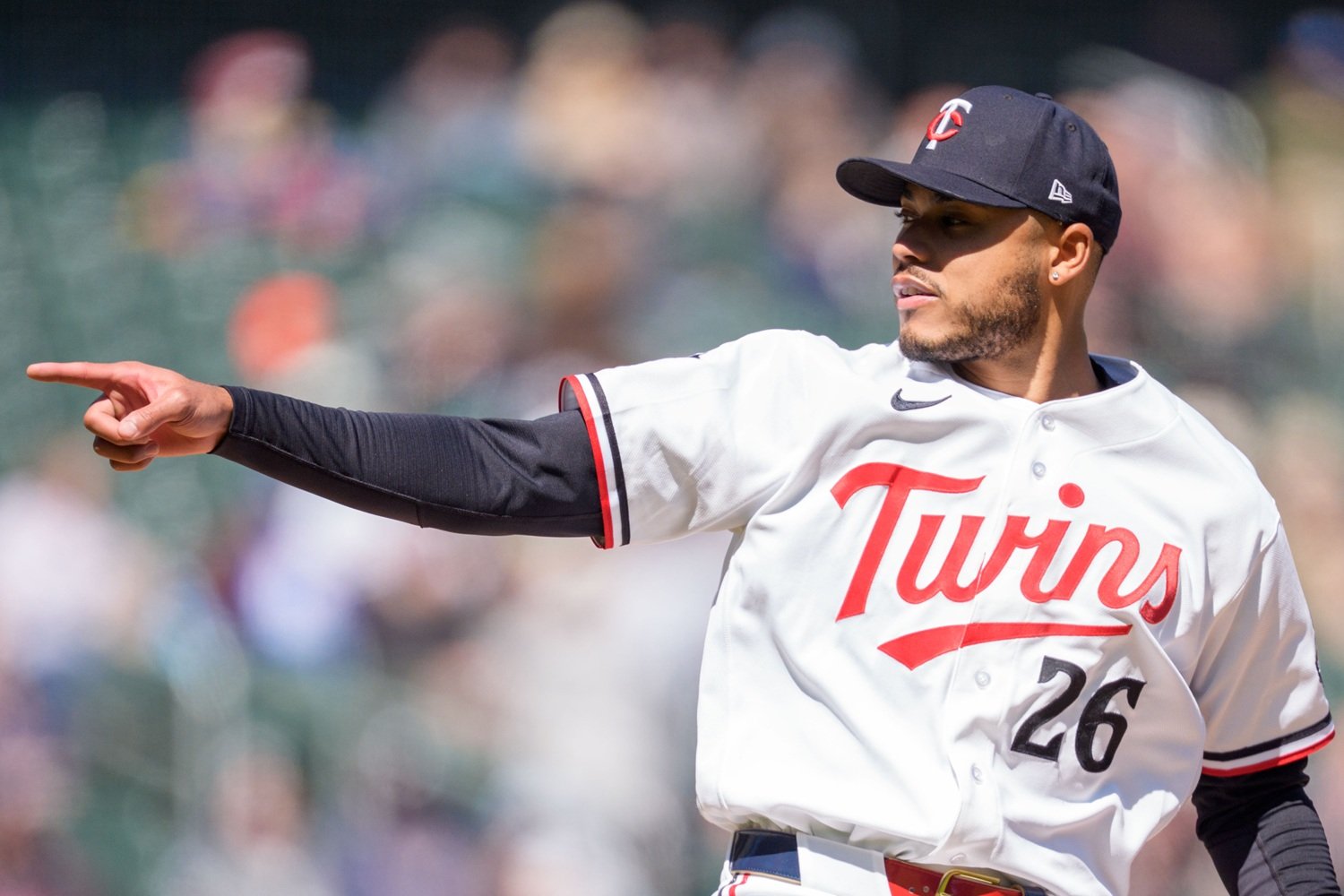
Twins Video
For the first month of the season, Taj Bradley looked like a legitimate ace. The Twins' right-hander was outperforming Joe Ryan, posting dominant stat lines in practically every start, and looking every bit like the frontline starter Minnesota believed he could be when they traded for him last summer.
Through his first five starts, Bradley carried a sparkling 1.63 ERA. Three of those outings were quality starts. He was generating whiffs at an elite rate, and opposing hitters looked completely overmatched. At the time, it felt like the Twins may have fleeced the Rays.
That still might end up being true. But over his last seven starts, Bradley has looked like an entirely different pitcher. Across 37 1/3 innings during that stretch, he's allowed 24 earned runs on 37 hits and 19 walks. His ERA has climbed from 1.63 to 4.02, and nearly every meaningful trend has moved in the wrong direction. The biggest reason for that decline isn't bad luck. It's command.
Only 46.7% of all pitches Bradley has thrown this year have landed in the strike zone. On its own, that number isn't necessarily alarming. Plenty of successful pitchers live outside the strike zone and rely on hitters chasing pitches they can't drive. The problem is that Bradley doesn't generate enough chase to make that approach work. Too many of his misses aren't competitive and end up nowhere near the strike zone.
In his latest home start last week against Chicago, multiple splitters were nearly missed by catcher Victor Caratini because they were so high. That's not an isolated occurrence, either. Similar misses have shown up throughout the season. There have also been several splitters and cutters that have bounced well in front of the plate, as well as too many fastballs that finish at a hitter’s eyes. Over this putrid seven-start stretch, his walk rate is 11.4%, which has dragged his seasonal walk rate to a career-worst 10.2%. The four starts he's made since returning from the IL in late May have been especially worrisome. Over a combined 18 innings, he's issued 12 free passes.
At times, it almost looks like Bradley doesn't know where the ball is going out of his hand, and that's not something that's popped up recently. That's been an issue plaguing him throughout the season, and his results are suffering as a result.
When a pitcher consistently misses by that much, he inevitably falls behind in counts. Once that starts happening, everything becomes more difficult. Hitters become more selective; pitchers are forced to throw strikes in predictable situations; and mistakes become far more costly. That's exactly what has happened to Bradley over the last month and a half.
While the raw hit totals aren't especially concerning, the quality of contact he's allowing has become a major problem. After not allowing a homer over his first five starts, he's surrendered nine in these last seven starts. Three Tigers long balls wrecked his start Tuesday night and put the Twins behind the 8-ball. Working from such a high arm angle, he's always going to be a fly-ball guy. He has to locate well to keep from being forced to throw meatballs, and to avoid running into barrels.
Once again, it all traces back to command—which is unfortunate, because the stuff itself remains outstanding. Bradley throws hard, and his pitches still move very well. When he's locating them properly, hitters rarely do much damage against him. That's what makes this stretch so frustrating. The raw talent is obvious. The ingredients that made him look like an ace in April haven't disappeared. But the command has.
There may also be a pitch-mix component worth discussing. Roughly 89% of Bradley's arsenal sits between 91 and 97 miles per hour, with his four-seam fastball, splitter, and cutter. That by itself isn’t necessarily a bad thing, and all three pitches move differently. But it’s a very small margin for error when they’re not landing over the plate. He'll mix in a curveball occasionally, but it's not a major part of his game plan. That leaves hitters seeing a lot of pitches with similar velocity profiles throughout an at-bat.
According to Statcast's new data on swing timing and miss distance, Bradley is pretty good at getting hitters to swing either too low or too high. The extreme movement separation of his four-seamer and curve, the deceptiveness of his splitter, and his comfort at the top of the zone with the heater make that happen. However, hitters are on time on 72% of their swings against him, which is far above the league average of 65%—and they get the right part of the bat on the ball more often than average, too.

Adding a slider or sweeper could help Bradley. Not only would it create a larger speed gap, but it would also give him another glove-side offering that moves differently than the rest of his arsenal, especially since his curveball is very up-and-down, with little horizontal movement. Those pitches would also offer more velocity separation than his cutter or splitter do, relative to the fastball, making it harder to time him up.
Would that solve all of the problems? Probably not, and it would probably be an offseason adjustment, anyway. But even if the Twins introduced another pitch tomorrow, Bradley would still need to locate it. The command issue remains the biggest obstacle standing between him and becoming the pitcher he looked like during the season's first month.
The solution isn't necessarily complicated, even if executing it is. Bradley has to throw more strikes. There have simply been too many hitter-friendly counts, too many free passes, and too many wasted pitches that force him into disadvantageous situations. If executing means sacrificing a mile per hour of velocity, it may be worth considering. His splitter and cutter are already good enough to generate whiffs when they're located properly.
The focus should be on getting ahead in counts, working at the bottom of the strike zone with those secondaries, and forcing hitters to react more defensively. If he can do that, the results should follow.
Bradley hasn’t lost his ability to pitch. Even with his struggles recently, there have still been outings wherein he looks dominant. His first two starts in May were exactly that, combining for just three earned runs over 11 innings with 15 strikeouts to four walks. He came off the injured list throwing 100 MPH. We know how talented he is. But none of that matters if you can’t find the strike zone.







Recommended Comments
Create an account or sign in to comment
You need to be a member in order to leave a comment
Create an account
Sign up for a new account in our community. It's easy!
Register a new accountSign in
Already have an account? Sign in here.
Sign In Now