


Twins Video
Baseball Savant began publishing swing data during the 2024 season. As such, we now have access to impactful metrics such as swing speed, swing length, and the solidity of contact for the second half of 2023 and all of last season, right at our fingertips.
Savant defines swing speed as the average velocity of the sweet spot of the bat during the top 90% of an athlete’s swings. They locate the sweet spot 6 inches from the top of the bat, and lop off that bottom decile of swings on the hunch that they're “non-competitive” attempts, such as check swings and bunts, which would artificially lower the average swing speed. There are two properties of physics that are important for understanding why an athlete’s swing speed is important: momentum and torque.
Momentum (often labeled as ‘p’) is simply the product of an object’s mass and velocity (p = mv). Essentially, an object will possess more momentum the faster it is moving, given its mass remains unchanged. This is true of a baseball bat; its mass does not change during a swing (assuming it doesn’t break), and therefore, a faster swing has more momentum than a slower one.
Torque (‘t’) is the force produced by an object as it rotates around a given point. As such, we can tweak Newton’s linear first law of motion (force is the product of mass and acceleration; F=ma) a bit to torque is the product of an object’s moment of inertia and angular acceleration (t=Iα). Moment of inertia can be expressed as the product of an object’s mass and the square of the radius of the circle about which it is rotating (I=mr2) and the rate at which that rotation is occurring (therefore, t=mr2α). (Note: I can already hear some of you physics types clacking away at the keyboard: “This is much too simplistic! A baseball bat isn’t a simple pendulum!” yada yada yada. Whatever, this simplistic version is good enough to get the point across.) [Editor's note: I can already hear some of you non-physics types cackling bitterly at the idea that what we just read is the simplistic version. Don't worry, Lucas is going to land this plane for us.]
What this means in English: Generally speaking, a faster swing will exert greater torque and momentum on the ball, and that will result in the ball registering a higher exit velocity. And we know that a harder-hit ball will more frequently result in a better outcome (i.e. home run, double, fielding error, etc.).
Additionally, these physics principles tell us that an athlete can improve their swing speed in two ways; they can rotate more quickly to accelerate the bat head faster (and achieve a greater velocity at any given instant; see: momentum) and/or they can increase the radius of the circle about which they are rotating (i.e. increase their swing length; see: moment of inertia). Doing either (or both!) will increase momentum and torque. (So, of course, would increasing the mass of your bat, i.e. swinging a heavier one—but only if doing so cost you little or no bat speed.)
We can see this theory in practice by looking at the relationship between average bat speed and average swing length among MLB hitters. The correlation between the two is 0.54, indicating a moderate (bordering on strong) relationship between the two variables. Basically, the longer an individual’s swing (i.e. the larger the radius of the circle), the faster their swing will generally be. However, swing length doesn’t fully explain swing speed (the correlation isn't 1.0, after all) because swing speed can be modulated by other variables, including how quickly a hitter accelerates their trunk.

Additionally, if we consider average bat speed and Statcast’s run value statistic, it can be said that faster bat speeds have a moderate correlation with offensive production (r = 0.41). Again, bat speed is not the sole determinant of offensive production (the correlation is not 1.0), but it is an important factor.

Increasing an athlete’s swing speed, either by tweaking their mechanics to increase swing length or by improving their ability to accelerate their trunk rotation via strength training, is of vital importance for individual and team success in the long term. (Yes, Luis Arraez exists. Yes, he has a slow swing speed. Yes, he is productive. Yes, he is an exception to the rule.) However, this also means the opposite is true: a decrease in swing speed would likely have a deleterious impact on offensive production in the long run.
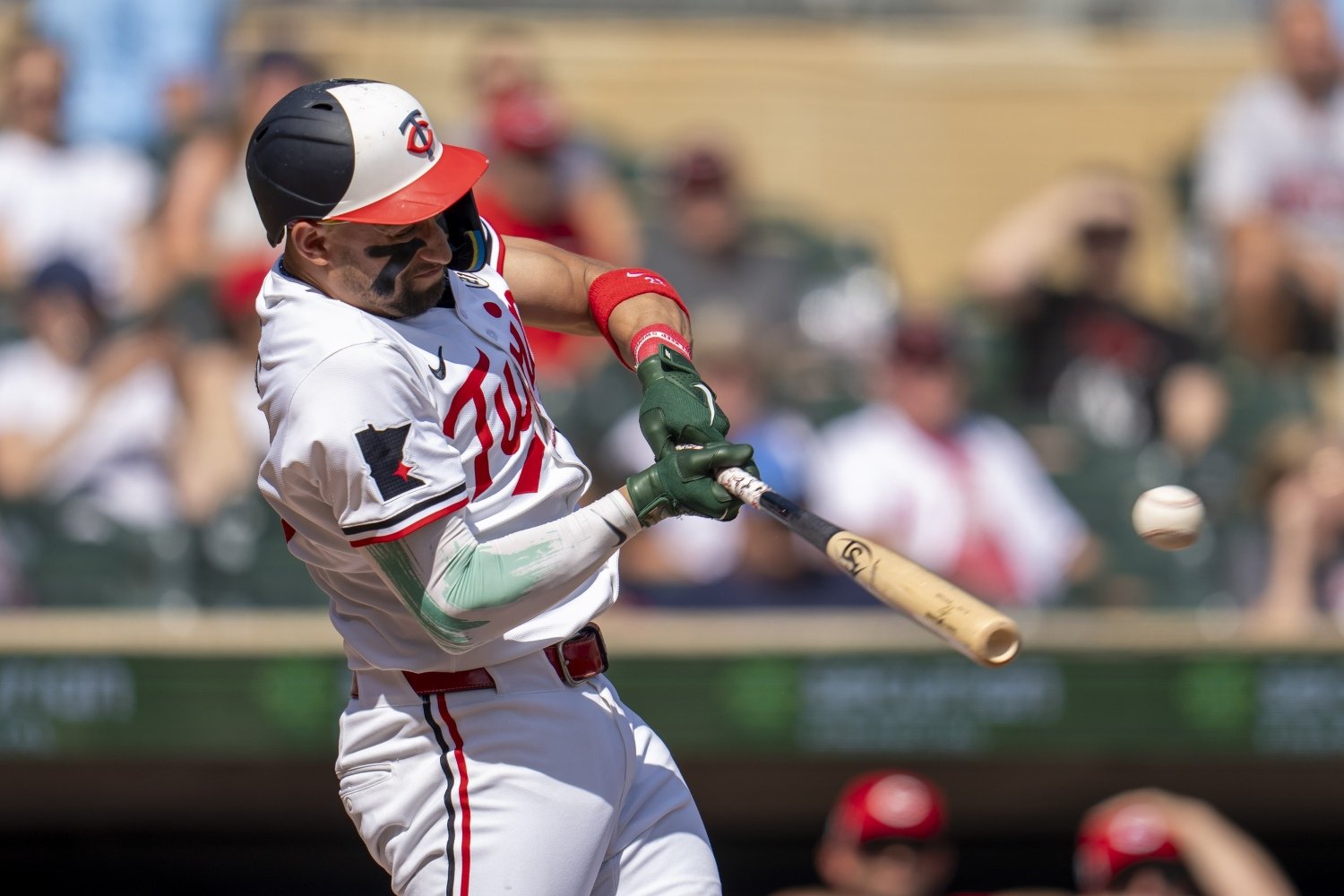
That brings us to Byron Buxton and Royce Lewis. Both Buxton (76.2 mph to 74.3 mph) and Lewis (75.1 mph to 73.3 mph) experienced a dip in swing speed in 2024, compared to the second half of 2023. (We don’t know how this trend compares to previous seasons because we don’t have that data.) However, it’s likely that their decreases were driven by different mechanisms.
Buxton has one of the longest swings (8 feet, in three-dimensional space, from the start of his swing to the front of the hitting zone) in baseball, which is the driving force behind both his prolific power and propensity to swing and miss. (In short, a longer swing not only causes a fast barrel but also introduces more difficulty in adjusting to a given pitch. The result: more dingers, but also more strikeouts.) From 2023 to 2024, his swing length actually increased from 8.0 feet to 8.1 feet, despite a 2-mph reduction in speed. This would seem to imply that the primary mitigating factor was that he was rotating his trunk more slowly in 2024.
Counterintuitively, it’s possible that this reduced reliance on trunk rotation was due, at least in part, to his right knee feeling better. The back leg (Buxton’s right) is important for generating force during a swing, and that force is modulated by the hips, core, and arms before being transferred to the ball on contact with the bat. When Buxton’s right knee was in pain, it’s possible that he compensated by increasing his trunk rotation acceleration to generate similar levels of force. As such, for Buxton to regain his swing speed, it’s likely that he will have to increase his trunk rotational power via strength and weighted-bat training.
Lewis, on the other hand, saw his swing length decrease from 7.9-feet to 7.7-feet. Because torque is proportional to the square of the radius of the circle about which he is rotating, a small decrease in swing length can lead to a large decrease in torque production (assuming he used bats of the same weight during both seasons).
Lewis saw his production crater during the second half of the 2024 season, as the Twins saw their playoff odds evaporate. It’s possible Lewis subconsciously reduced his swing length to allow for better barrel control, in an effort to improve his production and right the quickly sinking ship. However, doing so is antithetical to Lewis’ strengths, primarily that of quick-twitch power. Lewis is at his best when he's swinging for the fences, not trying to hit singles. For Lewis to regain his old form, it’s possible that he just simply needs to increase his swing length.
As we gain the ability to measure not just the outputs of players' movements (like velocity, spin rate, exit velocity, and others) but the movements themselves (like swing speed, arm angle, and more), we'll have to handle lots of new data carefully, and ask good questions about it. Buxton and Lewis exemplify the way changes in swing speed can speak to two different issues, with two different possible remedies—or even more possibilities, not fully unpacked here. Some players can't move a particular way. Others choose not to, for strategic reasons. Either way, it's helpful to understand how they're moving. From there, it becomes possible to convert problems into solutions.
Do you approve of Twins ownership?

Follow Twins Daily For Minnesota Twins News & Analysis



- Melissa Berman, arby58, DocBauer and 10 others
-
 13
13



Recommended Comments
Create an account or sign in to comment
You need to be a member in order to leave a comment
Create an account
Sign up for a new account in our community. It's easy!
Register a new accountSign in
Already have an account? Sign in here.
Sign In Now