


Twins Video
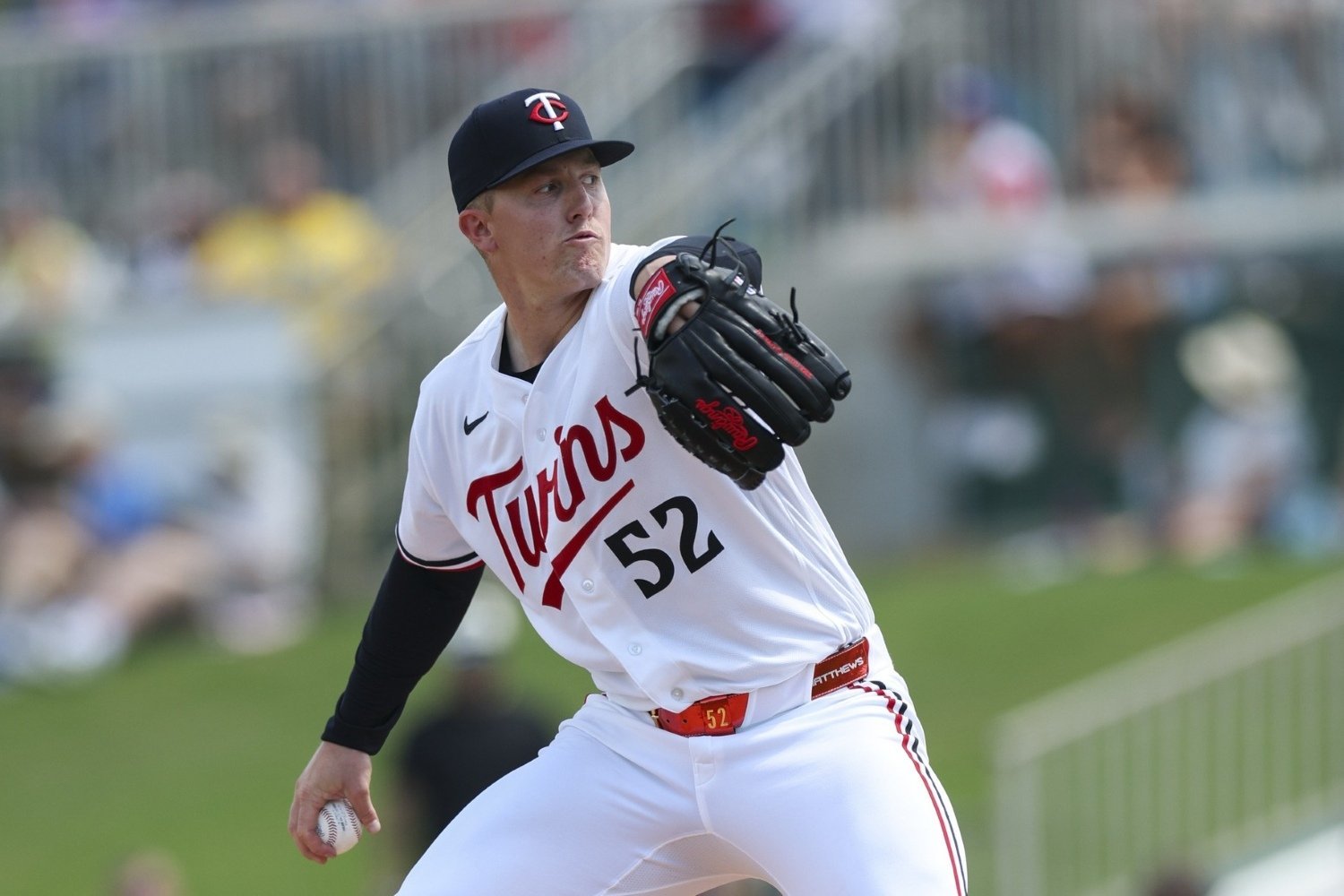
Coming into spring training, it seemed likely that Zebby Matthews would open the season in Minnesota’s rotation. Instead, a rough camp pushed him to Triple A St. Paul while younger arms moved ahead of him on the depth chart. By mid-May, Matthews suddenly found himself trying to prove he still belonged in the conversation.
Thursday was an important step in that process. Matthews delivered arguably the best outing of his Major League career in Minnesota’s 9 to 1 victory over Miami. He tossed seven shutout innings, allowing just four hits and one walk while striking out five. It was the longest scoreless outing of his career and the third time he has completed seven innings in the majors.
More importantly, Matthews looked completely in control from the opening inning. He needed only 83 pitches to record 21 outs, constantly getting ahead in counts and forcing weak contact. Matthews threw more than 67% of his pitches for strikes and never allowed Miami to build sustained pressure after the first inning. He opened at bats aggressively with his fastball, throwing 14 first-pitch four-seamers and landing 12 of them for strikes. For a pitcher whose biggest issue this spring was inconsistency in the strike zone and inability to finish hitters, it was a massive shift.
Matthews’ season at Triple-A did not start particularly well. He struggled in his first two outings (10 ER in 7 1/3 innings), and there were several possible explanations. Cold early-season weather likely played a factor, but there was probably also a mental adjustment involved after entering camp expecting to compete for a Major League role.
Since then, Matthews has looked much more like himself. Over his final five starts with St. Paul, he posted a 2.67 ERA with 28 strikeouts and eight walks. The raw stuff returned, but more importantly, there appeared to be a clearer plan behind his approach to hitters.
That plan showed up immediately on Thursday. Matthews leaned heavily on his four-seam fastball against Miami, throwing it 48.2% of the time compared to 41.2% last season. The velocity was actually lower than it was in 2025, dropping from 96.2 mph to 94.8 mph, but the pitch played up because of his command and sequencing. Matthews consistently located it early in counts and elevated it effectively once he got ahead.
The biggest adjustment may have been his curveball. Last season, Matthews barely used the pitch, throwing it less than 6% of the time. At Triple-A this year, it became a major area of focus, and the results were obvious Thursday. He used the curveball nearly 16% of the time and posted a 50% whiff rate on it, up from 32.1% last year.
Interestingly, the pitch is now slower than it was a season ago, dropping roughly 3.5 mph in velocity. That may actually be helping its effectiveness. The added separation from his other offspeed pitches gives hitters another speed band to consider, making the breaking ball harder to recognize and to stay back on.
His changeup also played an important role, particularly against left-handed hitters. Matthews used it regularly to neutralize left-handed bats, and while the only extra-base hit he allowed came on the pitch, the overall approach was encouraging. The pitch now carries more spin than it did last year, jumping from 1,499 rpm to 1,647 rpm, another indication that adjustments made at Triple-A may be helping him create better movement profiles across his arsenal.
What stood out most on Thursday wasn't necessarily overpowering. It was efficiency, confidence, and conviction. Matthews looked like a pitcher who understood exactly how he wanted to attack hitters. The Twins have always believed the talent was there for him to develop into a mid-rotation starter. Thursday served as a reminder of why that belief still exists.
Minnesota’s rotation picture has changed significantly over the last few months, and Matthews no longer enters the conversation as a guaranteed piece. But performances like Thursday’s make it difficult to ignore his upside. If the adjustments to his curveball usage, fastball command, and overall pitch mix continue to hold, Matthews may have forced his way back into a meaningful role much sooner than expected.
What stood out about Matthews in his first start? Can his adjustments help him stick in the rotation? Leave a comment and start the discussion.







Recommended Comments
Create an account or sign in to comment
You need to be a member in order to leave a comment
Create an account
Sign up for a new account in our community. It's easy!
Register a new accountSign in
Already have an account? Sign in here.
Sign In Now