


Twins Video
Michael A. Taylor, the Twins' primary center fielder during the 2023 regular season, has unexpectedly become one of the most talked-about names during the first wave of Major League Baseball free agency. Having already been linked to the Toronto Blue Jays, New York Mets, Boston Red Sox, Cincinnati Reds, and Los Angeles Dodgers, Taylor figures to sign soon, and the chances that it's a return engagement in Minnesota feel remote.
Taylor, 32, hit .220/.278/.442 with 21 home runs and 14 doubles in 2023, generating a 96 wRC+ and 1.7 Wins Above Replacement at FanGraphs (fWAR) over 388 plate appearances. He mixed his roughly average offensive numbers with impressive defense, evidenced by 9 Outs Above Average (OAA) and elite arm strength, to become an above-average role player.
Internal candidates to replace Taylor's production in center are Willi Castro, Nick Gordon, DaShawn Keirsey, and Austin Martin. Though Castro and Gordon will likely occupy 26-man roster spots in 2024, they are better utilized as nomadic utility players, used flexibly at multiple positions instead of being penciled in at the same position game-in and game-out. Keirsey and (most notably) Martin are young, talented prospects who garner optimism yet are unlikely to be handed significant roles on an American League Central title-seeking team out of spring training.
Martin, the Twins' seventh-ranked prospect, could make the Twins' Opening Day roster, but his skill set would be best utilized as a utility player, especially if the team trades from its infield depth to shore up the pitching staff. If he hits well and shows the necessary defensive tools to occupy center, then transitioning him to a full-time role could make sense. Until then, planning for Martin to be that player is merely wishful thinking, and not yet an appropriate course of action for a franchise attempting to make the playoffs for the second straight season.
Free-agent options Kevin Kiermaier, and Harrison Bader are enticing succession options for Taylor. The Twins were said to have expressed interest in Kiermaier, whose impending contract is expected to be within the organization's budget, in early November. Bader, who has struggled the past two seasons, is an intriguing low-risk, high-reward target. Yet, like with Keirsey and Martin, opting for a steadier successor would be in the organization's best interest.
So, what is the best course of action the front office could take? Signing Kiermaier to a one- or two-year deal feels like the wisest choice, but if he elects to sign elsewhere, the front office should search the trade market. Upon first glance at the trade market, one will find that Jake Meyers (Houston Astros), Johan Rojas (Philadelphia Phillies), Leody Taveras (Texas Rangers), and Jack Suwinski (Pittsburgh Pirates) are attractive options who might not require hard-to-swallow packages to acquire.
Although the four players listed are alluring trade candidates, their respective teams could easily elect not to trade them. Each provides valuable depth, while being affordable and possessing starting potential. Though the state these four franchises find themselves in makes it less likely they will part ways with young and inexpensive center-field talent, what if there was an organization that had a surplus of cost-effective young outfielders and an adequate amount of organizational depth to soften the blow of losing a young, starting-caliber outfielder?
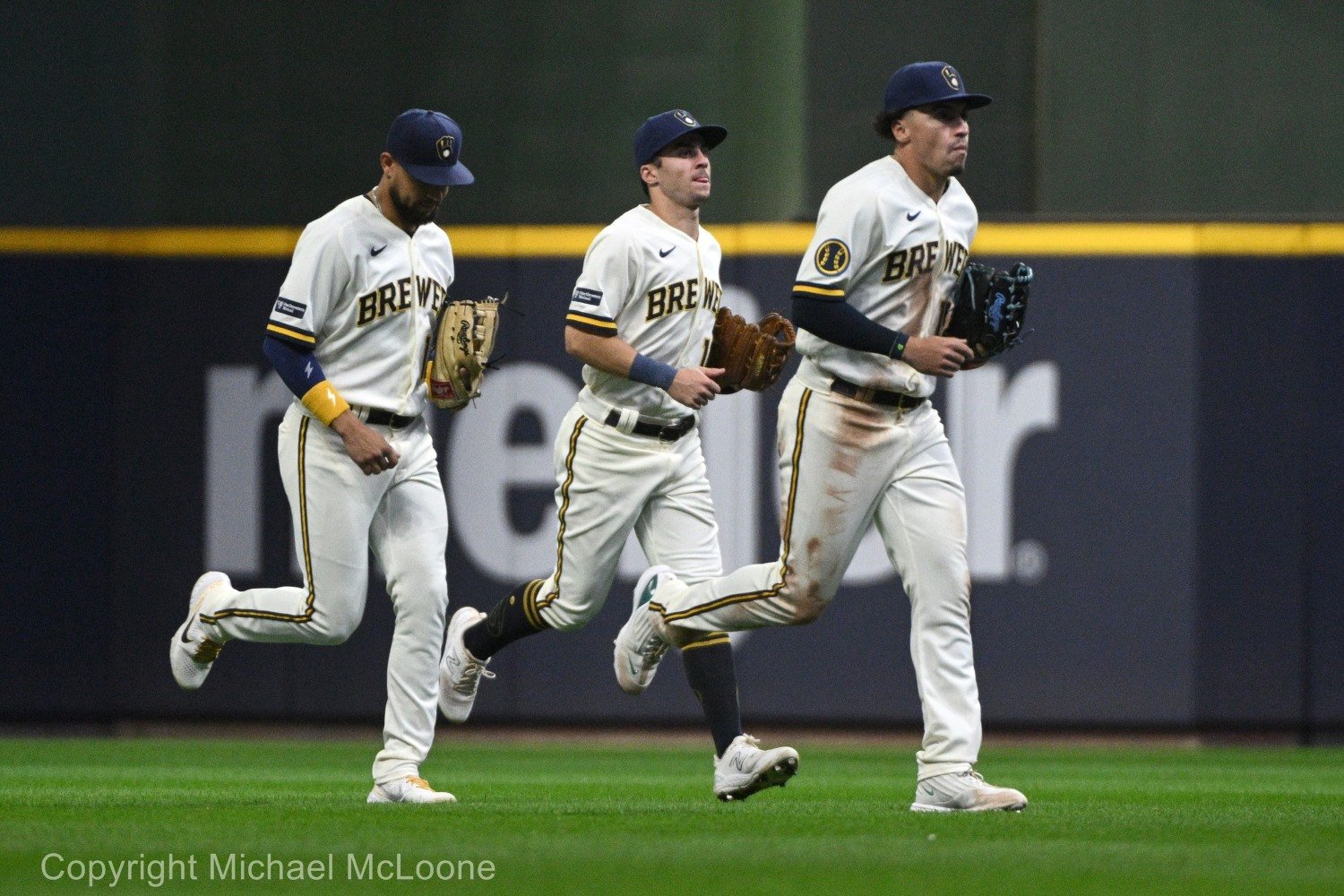
Enter the Milwaukee Brewers.
The 414's professional baseball club finds itself in a unique predicament. On Dec. 4, the club officially announced they had extended 19-year-old prized prospect Jackson Chourio to an eight-year, $82-million contract, effectively cementing him as the team's starting center fielder and a franchise cornerstone.
Not only is Chourio's extension a beacon for the Brewers organization, their fans, and Major League Baseball as a whole, but it also provides General Manager Matt Arnold the unique opportunity to ship off one or more of the team's other young outfielders (Garrett Mitchell, Tyrone Taylor, Joey Wiemer, or Sal Frelick) in exchange for an infielder who could immediately contribute to the big-league club. Coincidentally, the Twins have a surplus of infielders who would slot in as day-one starters for the Crew, in Jorge Polanco, Edouard Julien, Kyle Farmer, Jose Miranda, and potentially Brooks Lee.
The only infield position at which the Brewers have a clearly satisfactory option for 2024 is shortstop, with Willy Adames. The club's projected first, second, and third basemen are Jake Bauers, Brice Turang, and Andruw Monasterio, respectively. During the 2023 season, the three players generated a combined 0.1 fWAR over 1,035 total plate appearances. To contextualize their struggles, consider that Farmer, whom many perceived as having a down year in 2023, generated 1.6 fWAR over 369 plate appearances.
So, what would an ideal trade look like? Well, there are different tiers of trades, depending on how significant of a contributor each team wants to acquire.
Tier III Trade
- Brewers receive: Farmer - .256/.317/.408, 369 plate appearances, 11 home runs, 101 wRC+, 1.6 fWAR
- Twins receive: Taylor - .234/.267/.446, 243 plate appearances, 10 home runs, 88 wRC+, 0.8 fWAR
The first hypothetical trade scenario is a veteran one-for-one swap. The 33-year-old Farmer, with his $6.6 million projected 2024 salary, is the member of the Twins' crowded infield assortment most likely to be traded this offseason, even with recent news of the team receiving increased trade interest in Polanco.
Trading Farmer for Taylor would be a relatively simple swap for both franchises, and each player could seamlessly insert themselves into better-defined roles for their new club. Farmer could become the full-time second or third baseman if Turang or Monasterio struggle, or be utilized as an all-encompassing infield utility, as he did for the Twins in 2023. Taylor, who is under team control for three more seasons, could replace Taylor as Buxton's insurance policy, as he has logged 709 innings at the position over the past two seasons. A Farmer-for-Taylor swap would be a low-risk, moderate-reward swap that would benefit both franchises.
Tier II Trade
- Brewers receive: Polanco - .255/.355/.454, 343 plate appearances, 14 home runs, 118 wRC+, 1.5 fWAR
- Twins receive: Mitchell - .246/.315/.446, 73 plate appearances, three home runs, 103 wRC+, 0.4 fWAR
This move involves the longest-tenured active Twin and a former Brewers first-round pick. As noted earlier, the Brewers intend to compete in 2024, so going out on a limb and sending Mitchell to Minnesota for an All-Star-caliber, switch-hitting top-of-the-lineup cog could make sense as a "win-now" proposition.
Although parting with Polanco would be a blow to the Twins' culture and their fan base, netting a young, talented, cost-effective player like Mitchell under control through the end of the 2028 season would be a coup for the Twins. Along with Polanco, the Twins would likely have to part ways with a young pitcher with upside, like Cole Sands, Josh Winder, or Simeon Woods Richardson, to balance the deal, but parting with one of these young arms is a sacrifice most would be willing to make.
The speedy Mitchell would slot in as a long-term platoon partner and replacement for Buxton, depending on Buxton's health. Polanco would instantly become the Brewers' best offensive infielder and, barring injuries, could be a driving force toward their second consecutive National League Central title.
Tier I Trade
- Brewers receive: Julien - .263/.381/.459, 408 plate appearances, 16 home runs, 136 wRC+, 2.8 fWAR
- Twins receive: Frelick - .246/.341/.351, 223 plate appearances, three home runs, 92 wRC+, 1.4 fWAR
Admittedly, this would be brutal to come to terms with, as Julien is one of my favorite current Twins. Regardless, a Julien-for-Frelick swap could significantly benefit both franchises from a short- and a long-term perspective. To begin, both players, who were rookies in 2023, are young, cost-effective, potentially star-caliber players who are under team control through 2029. Julien, who improved defensively toward the end of last season, could become an above-average, potentially elite offensive second base/first base/designated hitter in the Brewers' presently unintimidating lineup. Frelick, on the other hand, could slot in as an elite defender and high-OBP center fielder who, like Mitchell, could eventually become the Twins' long-term answer there.
Julien and Frelick are two young players on the precipice of breaking out during their first full seasons at the major-league level. Though the Twins and Brewers are exhilarated by Julien and Frelick, respectively, if they were to exchange them, both franchises could benefit from each player's high upside at positions of greater need.
Moves like these sometimes make baseball executives (a conservative bunch, by nature) too nervous. The Brewers might prefer to stick with their young options around the horn, and the Twins might stay hopeful on Buxton's defensive future and let their utility men stop any gaps. Nevertheless, these neighbors have inverse team needs and are in a unique situation, where each organization could benefit from the other's surplus.
Should the Twins and Brewers execute an infielder-for-outfielder swap? Which hypothetical trade interests you the most? Join the conversation and comment below.
Do you approve of Twins ownership?

Follow Twins Daily For Minnesota Twins News & Analysis



- Stew, JK45 and Cory Engelhardt
-
 1
1
-
 2
2



Recommended Comments
Create an account or sign in to comment
You need to be a member in order to leave a comment
Create an account
Sign up for a new account in our community. It's easy!
Register a new accountSign in
Already have an account? Sign in here.
Sign In Now