


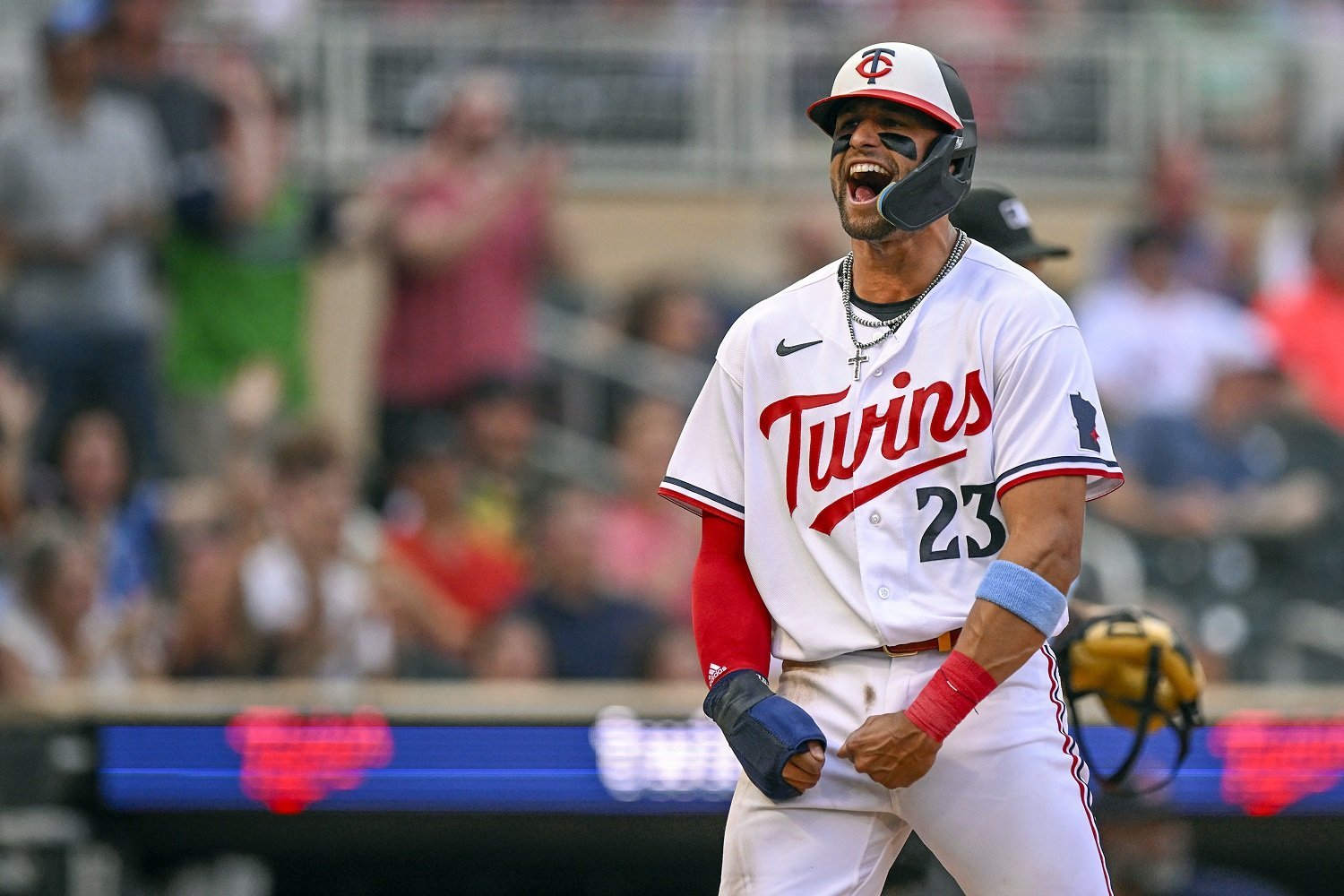
Twins Video
Is this offseason the last chance to lock up the natural-born leader and potential superstar, while the team still has a little bit of leverage due to lingering injury concerns and service-time realities?
The nature of Major League Baseball's service-time system (and the way it delays significant guaranteed paydays) creates interesting leverage dynamics when it comes to negotiating long-term contracts with young players.
These dynamics lead to things like Jackson Chourio signing an eight-year, $82-million deal with the Brewers. One might ask, on one hand, why a team would commit that much money to a 19-year-old who has yet to play in the majors. On the other hand, though, why would a budding superstar sell out multiple future free-agent years at a discounted rate, potentially costing himself tens of millions of dollars?
It's that dual uncertainty that makes possible a mutually desirable agreement. Chourio, the No. 2 prospect in all of baseball, would probably have been in line for an eventual megadeal, but not for many years. First, he would need to reach the majors, put in three full seasons of service at the minimum salary, and work his way through the arbitration process.
Much can happen between now and that theoretical free-agent windfall. By signing his deal, Chourio mitigates the risk of something unforeseen and secures life-changing guaranteed money. In exchange, Milwaukee buys out up to four extra seasons at a significant bargain.
The Atlanta Braves executed a similar blueprint with Michael Harris II during his rookie season in 2022, locking the young outfielder up through age 30 with an eight-year deal. This was different from the Chourio situation, in that Harris had already reached the majors and experienced some success (he was on his way to winning Rookie of the Year), but the premise was the same.
Before this season, inspired by Atlanta's extension with Harris, I pondered what it might look like for the Twins to explore a long-term contract with Royce Lewis. He's older and further into his career than Harris or Chourio, but the motivations are the same: security and risk mitigation. Even with all the major-league service time Lewis accrued while on the injured list over the past two seasons, he is at least a year away from being eligible for arbitration, and is not in line to become a free agent until after the 2028 season.
In his brief time on the big-league field, he has shown legit superstar ability, portending big arbitration salaries and a robust market down the line--if all goes to plan. But Lewis is more familiar than anyone with the harsh unpredictability of this game. Injuries robbed him of nearly two full campaigns, then almost forestalled his star turn in the playoffs.
"It definitely made me not take anything for granted, knowing how quickly this game could be taken away from you," Lewis said of those injuries, during the playoff run, "whether it’s an ACL, hamstring, oblique, whatever it may be, or just strictly performance.”
Minnesota's leverage to negotiate a long-term deal has diminished since before the season, no doubt, but I think it still exists. Lewis has emerged as a central part of the Twins' core alongside Carlos Correa and Byron Buxton. Could the front office lock him into a long-term deal alongside those of Correa and Buxton, to gain cost certainty amid revenue uncertainty?
In February, I laid out the framework for a hypothetical seven-year, $34-million Lewis extension, which included two team options at $12 million and $15 million. The Twins would now need to sweeten some of the proposed numbers in order to entice Lewis and his agent, Scott Boras, following a breakthrough in 2023, but the same basic approach might make sense. Offer big raises for the minimum-salary years, guarantee substantial money during the arbitration years, and then recoup that up-front overpay by buying out years of free agency at an affordable price.
Now, there's a major stipulation at play here: with one year and 142 days of MLB service under his belt, Lewis is very likely to qualify for Super 2 status in 2025, assuming he spends all of next year in the majors. That means he'll reach arbitration early and hit those escalating paydays more quickly, taking away from some of Minnesota's leverage.
Here's a framework for a deal that might make sense from both sides: a five-year, $40 million contract with team options for $20 million and $25 million tacked onto the back, for a total possible value of seven years and $85 million.
- 2024 (age 25): $3 million
- 2025 (age 26): $5 million
- 2026 (age 27): $7 million
- 2027 (age 28): $10 million
- 2028 (age 29): $15 million
- 2029 (age 30): $20 million team option
- 2030 (age 31): $25 million team option
The draw here for Lewis (and Boras) is that, in addition to nearly quadrupling his projected salary in 2024, he gets $37 million guaranteed in four years of arbitration, which is more than he's likely to earn during that span unless things go really well from a health and production standpoint.
The Twins, meanwhile, get a pair of team options that can buy out a couple of free-agent years while Lewis is still in his prime. I'd consider increasing those to $25 million and $30 million, and throwing in some healthy buyouts, too. You might wonder, is it that valuable to get Lewis at those big salaries for those seasons--especially since the idea of him as a $30-million player remains purely theoretical at this point? The key is that you're getting those extra years without needing to commit to a long-term deal that involves paying heavily into his mid-30s. This might be the last chance for Minnesota to set up any such arrangement.
It's basically a juiced up version of the extensions that Minnesota gave Max Kepler and Jorge Polanco at similar stages of their careers. The specific terms can be flexible, but the bottom line is that if Lewis is interested in the security of a long-term deal, I would be very amenable to that. For the record, here's how the team's books would map out long-term with the above deal added in:

What do you think? Would you be interested in exploring a contract extension of this nature with Lewis, or would you rather play it year-to-year?







Recommended Comments
Create an account or sign in to comment
You need to be a member in order to leave a comment
Create an account
Sign up for a new account in our community. It's easy!
Register a new accountSign in
Already have an account? Sign in here.
Sign In Now