


Twins Video
The Minnesota Twins did not expect Alex Jackson to factor into the major-league roster again this quickly. Baseball rarely sticks to the original script.
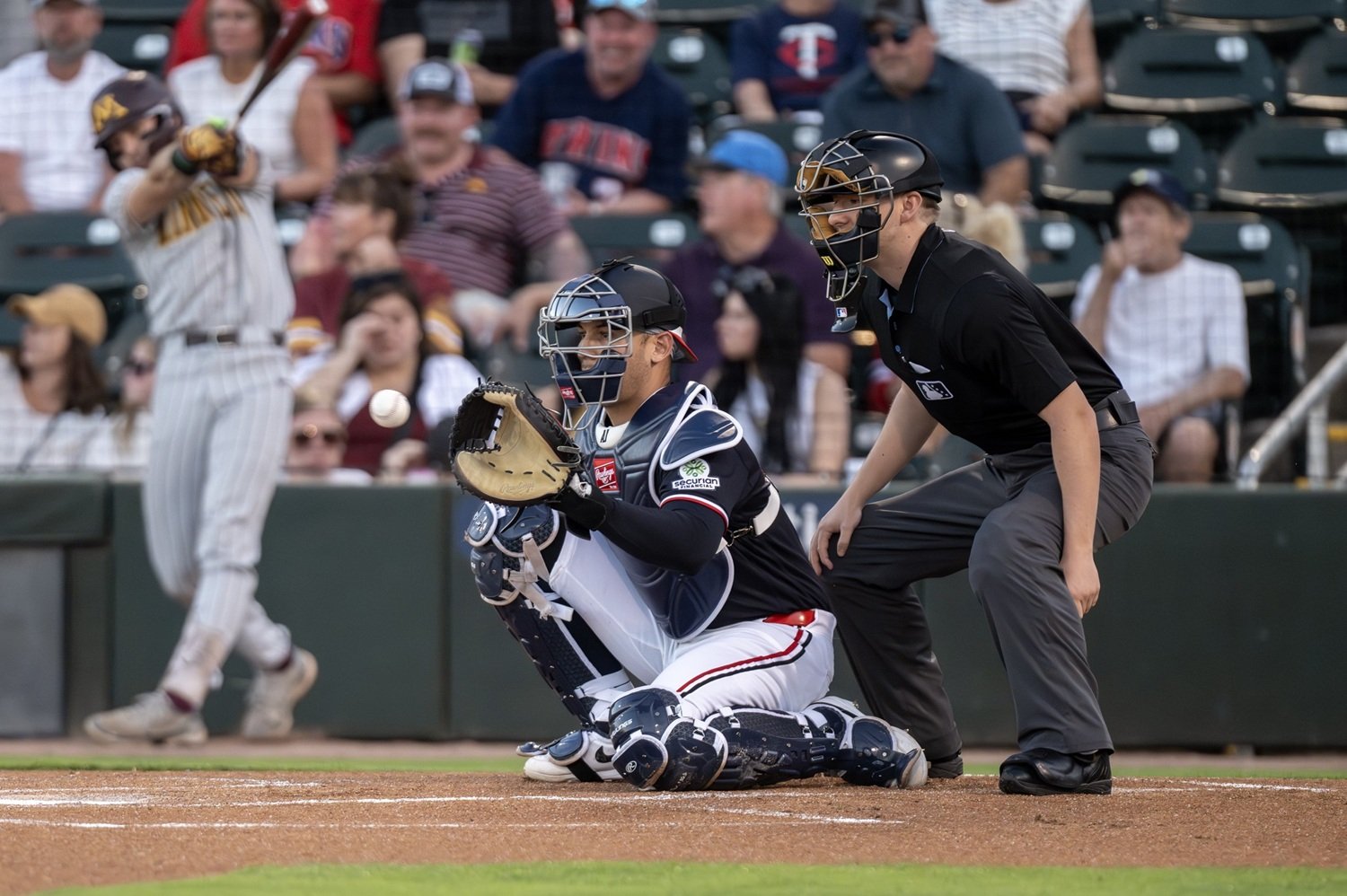
With Ryan Jeffers on the IL with a broken hamate bone, the Twins called up Jackson from Triple-A St. Paul to stabilize the catching situation as a complement to Victor Caratini. For Jackson, it represents another opportunity in a career that has taken plenty of unexpected turns.
Back in March, the Twins designated Jackson for assignment near the end of spring training. The writing was on the wall after the club signed Caratini late in the offseason, and Jackson no longer had minor-league options remaining. Minnesota reportedly explored possible trades before the DFA, but rival clubs were not eager to absorb his $1.35-million salary.
The Twins originally acquired Jackson from the Orioles during the offseason, in exchange for minor-league infielder Payton Eeles. At the time, Minnesota’s payroll situation appeared uncertain, while ownership discussions lingered in the background. Jackson fit the profile of a relatively inexpensive defensive catcher with some right-handed power potential.
For much of the winter, Jackson looked like the favorite to open the season as Jeffers’s backup. That changed once the Twins committed to Caratini for two years and $14 million. The early returns on that investment have not exactly inspired confidence. Through 34 games, Caratini owns a 50 OPS+ with negative WAR production—though he's been the best catcher in baseball at adding value via the ABS system, which counts for something.
Jackson’s career path has always carried intrigue. He was once viewed as one of the top prospects in baseball after being selected sixth overall in the 2014 MLB Draft. Scouts loved the athleticism and raw power, and his upside made him one of the most recognizable prep bats in the country.
The major leagues have been a different story. Across 440 plate appearances since debuting in 2019, Jackson has produced a .153/.239/.288 line, with 11 home runs. The power flashes occasionally appear, but the swing-and-miss issues have consistently overwhelmed the rest of his offensive profile. He has struck out in more than 40 percent of his major-league plate appearances.
Defensively, however, Jackson continues to earn praise around the league. Pitch framing and arm strength remain his calling cards, and those skills are ultimately what keep him employed, despite the offensive limitations. Teams view him as a serviceable depth catcher who can handle a pitching staff and provide occasional power.
After clearing waivers, Jackson reported to St. Paul and quietly put together one of the more productive offensive stretches of his professional career. In 24 games with the Saints, Jackson posted a .239/.295/.511 line with seven home runs and three doubles. The raw slugging numbers stand out, though the International League has become notoriously hitter-friendly. His 97 wRC+ suggests the overall offensive package is still roughly league-average, despite the home run surge—and a veteran putting up that number in Triple-A can't be counted on for much in the bigs.
Some familiar concerns remain underneath the surface. Jackson’s strikeout rate has climbed to 32.6%, roughly four percentage points higher than it was during his Triple-A stint last season. His walk rate has also dipped from 10.3% to 6.3%. The power is legitimate, but the offensive profile still carries very little margin for error.
The Twins’ lack of upper-level catching depth made the decision easy: Jackson was the only real option. Noah Cardenas has struggled badly at Triple-A, carrying a .470 OPS into the week. David Banuelos owns a more respectable .708 OPS but profiles more as organizational depth than as a true major-league option. If another injury occurs behind the plate, Minnesota could quickly find itself stretched thin at the position.
For now, Jackson gets the call. The Twins are not asking him to become an everyday offensive contributor. They simply need competent innings behind the plate while Jeffers recovers. If Jackson can provide steady defense, run into a few fastballs, and avoid becoming an automatic out, he may stick around longer than many expected when the organization designated him for assignment two months ago.
Baseball careers are rarely linear. Jackson knows that better than most. Now he gets another chance to prove he still belongs in the big leagues.
What stands out about Jackson so far in 2026? Leave a comment and start the discussion.
Do you approve of the job Derek Shelton is doing as Twins manager?

Follow Twins Daily For Minnesota Twins News & Analysis



- DannySD, mikelink45, glunn and 3 others
-
 6
6


Recommended Comments
Create an account or sign in to comment
You need to be a member in order to leave a comment
Create an account
Sign up for a new account in our community. It's easy!
Register a new accountSign in
Already have an account? Sign in here.
Sign In Now