


Twins Video
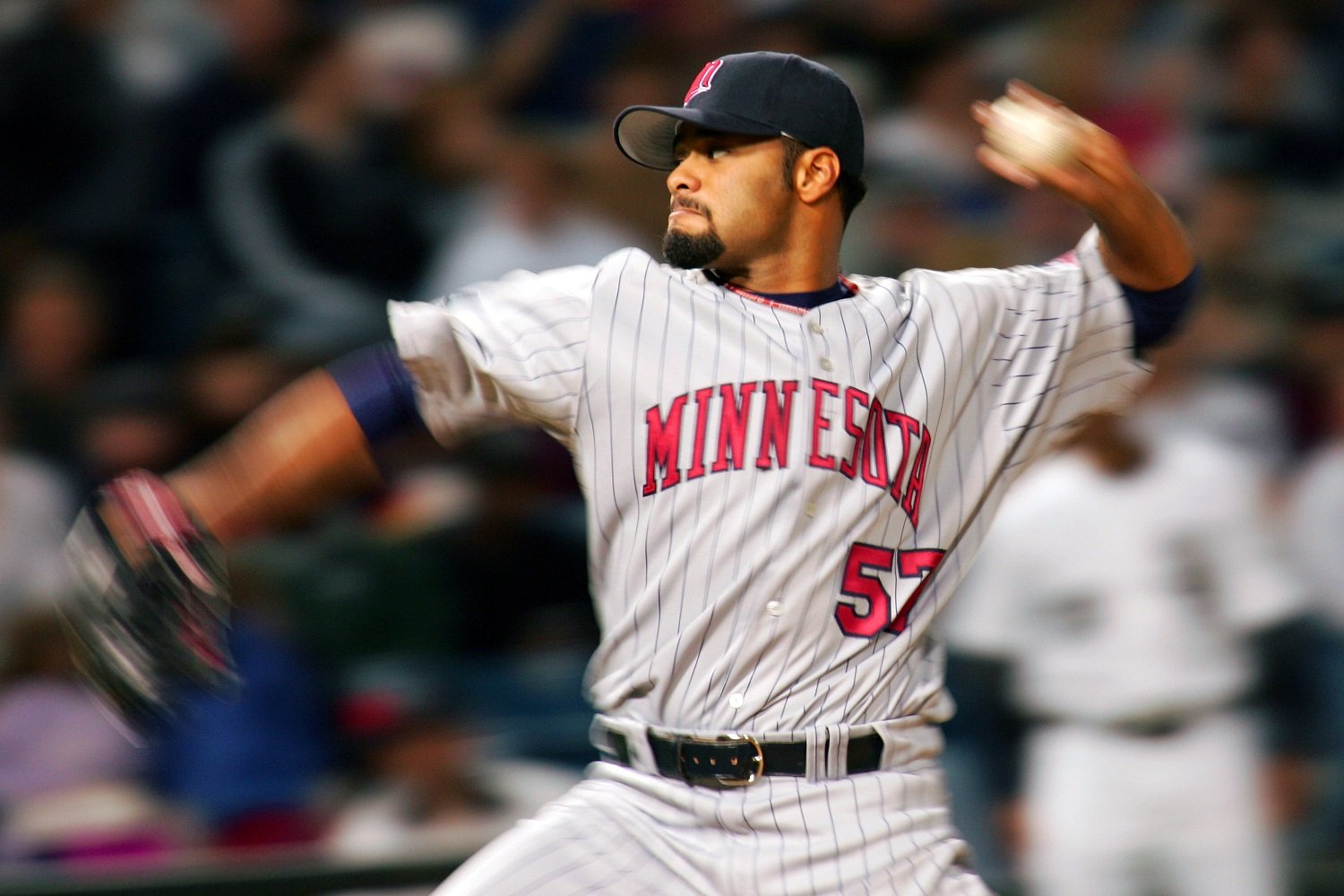
The 2026 season marks the 20th anniversary of Johan Santana capturing his second Cy Young Award with the Minnesota Twins. His dominance during the middle of the 2000s remains one of the greatest stretches by any pitcher in franchise history. Yet when evaluating Santana's Hall of Fame case, it's impossible to ignore one glaring question:
What if the voters had gotten the 2005 Cy Young race right?
Sandwiched between his unanimous Cy Young victories in 2004 and 2006, Santana produced another elite campaign in 2005. In many ways, it was every bit as impressive as the seasons that earned him the award on either side of it.
Santana led the American League in strikeouts (238), WHIP (0.97), hits allowed per nine innings (6.2), and strikeouts per nine innings (9.3). He threw 231 2/3 innings, posted a 2.87 ERA, and continued to establish himself as the most dominant starting pitcher in baseball. Still, when the voting was completed, Santana finished third.
The award instead went to Los Angeles Angels starter Bartolo Colon, while New York Yankees closer Mariano Rivera finished second. Santana received only three first-place votes and finished with 51 points. Colon collected 17 first-place votes and finished 67 points ahead of Santana, while Rivera earned eight first-place votes and finished 16 points ahead of the Twins ace.
Looking back through a modern lens, the results are difficult to explain. Colon certainly had an impressive season. He went 21-8 for a first-place Angels club and posted a 3.48 ERA across 222 2/3 innings. However, Santana outperformed him in nearly every meaningful category, except wins.
The gap becomes even more striking when viewed through today's advanced metrics. Santana finished with 7.1 fWAR, compared to Colon's 4.1 and Rivera's 2.9. That difference represents an enormous advantage. Of course, WAR was not part of the mainstream baseball conversation in 2005. Voters placed far greater emphasis on pitcher wins than they do today.
Even so, many of the traditional statistics favored Santana as well. He had a lower ERA, a lower WHIP, more strikeouts, a better strikeout rate, and allowed fewer baserunners than Colon. Santana also recorded seven complete games and two shutouts, demonstrating the type of workload that voters often celebrated during that era.
The biggest argument in Colon's favor was simple: 21 wins. The Angels won the American League West with a late-season surge, and Colon went 10-3 after the All-Star break while helping carry Los Angeles to the division title. Meanwhile, the Twins disappointed expectations and finished 83-79, placing third in the AL Central.
Team success often influences award voting, even when voters insist otherwise. There was also the narrative element. Colon had become one of baseball's most popular players. Fans appreciated his durability, personality, and unconventional physique. His story resonated in ways that statistics sometimes do not.
Santana, meanwhile, was quietly dominant. After making the first All-Star team of his career in 2005, he elevated his performance to another level during the second half. Over his final 13 starts, Santana went 7-2 with a 1.42 ERA and 89 strikeouts in 95 1/3 innings. Opponents managed only a .503 OPS against him, and he allowed one run or fewer in 10 of those 13 outings. It was one of the most overpowering stretches any pitcher produced that season.
Yet, it wasn't enough. The consequences of that vote became more apparent as Santana's career unfolded. Because shoulder injuries shortened his peak, Santana finished his career with two Cy Young Awards instead of potentially three. Had he won in 2005, he would have belonged to one of the most exclusive clubs in baseball history.
Only 11 pitchers have won three or more Cy Young Awards. Among them, only Roger Clemens remains outside the Hall of Fame, largely because of allegations involving performance-enhancing drugs. Clayton Kershaw and Max Scherzer are expected to be inducted once they become fully eligible.
A third Cy Young Award would not have guaranteed Santana a plaque in Cooperstown, but it almost certainly would have strengthened his candidacy.
Instead, his Hall of Fame case never gained traction with the Baseball Writers' Association of America. When he appeared on the ballot in 2018, Santana received just 2.4% of the vote and fell off after one year, far below the five percent threshold required to remain eligible.
His best path to Cooperstown now runs through the Era Committee, the same process that eventually helped Twins legends Tony Oliva and Jim Kaat earn induction. Whether that happens remains uncertain.
What is certain is that Santana's peak remains one of the most dominant stretches baseball has seen in the last quarter-century. From 2004 through 2008, few pitchers in history were better. Yet Hall of Fame debates often come down to milestones, awards, and résumé lines that voters can quickly recognize.
The 2005 Cy Young vote took one of those résumé lines away. Twenty years later, it remains one of the most debated award races of the modern era. It may also represent the single biggest reason Johan Santana is still waiting for his Hall of Fame call.
This version leans more heavily into the Hall of Fame implications throughout the story, rather than saving them for the end, creating a stronger connection between the 2005 vote and Santana's current Cooperstown outlook.
What do you remember about the 2005 Cy Young race? Leave a comment and start the discussion.
Do you approve of the job Derek Shelton is doing as Twins manager?

Are you interested in Twins history? Then check out the Minnesota Twins Players Project, a community-driven project to discover and collect great information on every player to wear a Twins uniform!
View The Players ProjectFollow Twins Daily For Minnesota Twins News & Analysis



- twinzcynic, arby58 and DannySD
-
 3
3


Recommended Comments
Create an account or sign in to comment
You need to be a member in order to leave a comment
Create an account
Sign up for a new account in our community. It's easy!
Register a new accountSign in
Already have an account? Sign in here.
Sign In Now