


Twins Video
As the clock struck 5 PM Central time on July 30, Twins Territory erupted in cheers, as a last-minute tweet from ESPN insider Jeff Passan appeared on their phone: "The Minnesota Twins have acquired starting pitcher Jack Flaherty, per sources." The organization defied all odds and widespread perception, acquiring a starting pitcher who will surely help them as they contend for the AL Central with the vaunted Cleveland Guardians while fending off the surging Kansas City Royals. Personall--ah, wait--Oh, okay. Sorry, never mind. Matt just informed me that I can't just make stuff up because it's what I wish happened. He's also telling me it's not a healthy coping mechanism. Okay, let me restart.
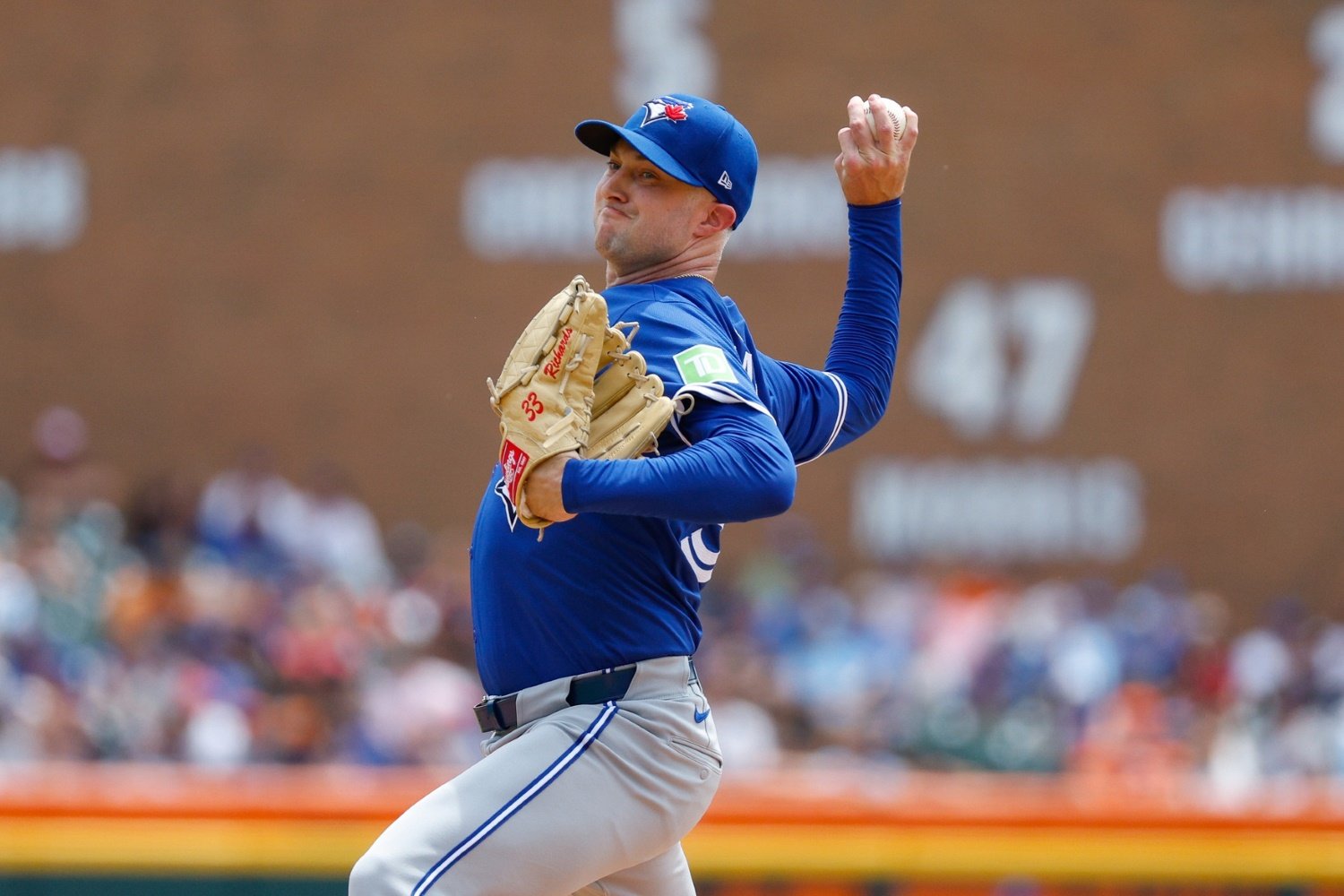
As the clock struck 5 PM central time on July 30, Twins Territory looked on somberly, as the only trade deadline acquisition the organization made was acquiring veteran right-handed reliever Trevor Richards from the retooling Toronto Blue Jays. The Twins sent infield prospect Jay Harry (who has a 91 wRC+ over 340 plate appearances at High-A) back to Toronto in the deal. Finances and lack of going "all-in" aside, the Twins acquired an arm who will play a consequential role in the team's ability to chase down the Guardians and fend off the Royals down the stretch. So, whom has the club acquired? And what role will he play as the regular season nears its triumphant conclusion? Let's take a look.
Richards, 31, was not selected by an MLB team in the 2015 MLB Draft. After playing one season for the Gateway Grizzlies of the independent Frontier League, he signed with the Miami Marlins. He pitched in their minor-league system for two years before debuting as a starting pitcher in 2018. Richards bounced between Miami, the Tampa Bay Rays, and Milwaukee Brewers as a reliever before finding a long-term home with the Blue Jays in 2021. Here is how Richards has performed the past two and a half seasons north of the border:
- 2021 - .143/.213/.339 opponent slash line, 3.31 ERA, 4.61 FIP, 37-to-10 strikeout-to-walk ratio, 32 2/3 innings pitched
- 2022 - .238/.332/.396 opponent slash line, 5.34 ERA, 4.07 FIP, 82-to-35 strikeout-to-walk ratio, 64 innings pitched
- 2023 - .228/.318/.424, 4.95 ERA, 4.22 FIP, 105-to-35 strikeout-to-walk ratio, 72 ⅔ innings pitched
Posting a combined 4.53 ERA over 169 1/3 innings pitched, Richards has been one of the top pen arms of an organization that made the postseason two out of the three seasons he was there. Here are the 31-year-old righty's career splits:
- Facing right-handed hitters: .249/.320/.438 opponent slash line, .324 opponent wOBA, 342-to-116 strikeout-to-walk ratio, 1,298 batters faced
- Facing left-handed hitters: .222/.313/.375 opponent slash line, .299 opponent wOBA, 256-to-121 strikeout-to-walk ratio, 1,044 batters faced
Despite having shakier command when facing left-handed hitters, evidenced by five more walks over 254 fewer batters faced, Richards has performed better against lefties. His tendency to perform better against opposite-handed hitters has been especially glaring this season. He owns a .183/.272/.268 opponent slash line against left-handed hitters, netting a 16-to-9 strikeout-to-walk ratio and holding them to a .247 wOBA over 82 batters faced. In contrast, he has allowed a .210/.306/.410 opponent slash line to right-handed hitters, netting a 28-to-15 strikeout-to-walk ratio and holding them to a .313 wOBA over 122 batters faced. One of the two primary positions the Twins needed to acquire at the deadline was a reliever who pitched well against left-handed relievers. While a left-handed reliever would have been ideal, Richards fits the bill nevertheless. He will likely become the primary reliever against left-handed hitters, meaning Steven Okert and Caleb Thielbar will be demoted from their current roles.
Richards's opponent slash lines are encouraging. However, his counting statistics tell a different story. Over his first 46 innings pitched, he netted a 2.54 ERA, 3.66 FIP, and a 45-to-16 strikeout-to-walk ratio over 178 batters faced. Despite sustaining a 4.16 xFIP, his start to the season was genuinely impressive, netting a 25.3% strikeout rate and leaving 71% of runners on base. Unfortunately, a flip switched, and the Drury University product's performance has significantly dipped as of late, netting a 19.89 ERA, 9.79 FIP, and a measly 4-to-8 strikeout-to-walk ratio over his last 6 1/3 innings pitched. His strikeout rate has plummeted to an uninspiring 10% while leaving just 41.7% of runners on base. He has also encountered a home run issue, generating a 16.7% home-run-to-fly-ball ratio and allowing two home runs in this stretch.
Now, many factors could be playing in his sudden decrease in performance. The Blue Jays have gone from contending with postseason aspirations to begin the season to being effectively out of the race, holding a 0.5% chance of making the playoffs, according to FanGraphs. They underwent a firesale of sorts, sending off veterans Yimi García, Nate Pearson, Danny Jansen, Yusei Kikuchi, Isiah Kiner-Falefa, Kevin Kiermaier, and Richards before the deadline. The team's dwindling postseason chances could have played into his recent struggles. Yet, there is real cause for concern, particularly with the quality of his pitches.
From Mar. 28 through July 4, Richards's fastball had a 5.4 Fastball runs above average at FanGraphs (wFA) over 38 appearances. Interestingly, his fastball had its most value in an appearance against the Twins on May 11, netting 0.8 wFA in one game. His changeup performed similarly well during the same stretch, manufacturing a 4.6 Changeup runs above average at FanGraphs (wCH). Like his fastball, his changeup performed its best against the Twins on May 11, netting 1.0 wCH in that appearance. It's impossible to know, but Richards performing so well against the Twins in that appearance could have played a role in the organization's interest in him. Nevertheless, the quality of his fastball and changeup have dropped over his past seven appearances, evidenced by a -5.7 wFA and -1.3 wCH in that stretch.
As inferred, Richards is a two-pitch pitcher who uses only a fastball and changeup when facing either-handed hitters. His changeup is his superior pitch, evidenced by a .147 opponent batting average over 530 pitches thrown compared to a .238 opponent batting average on his fastball over 397 pitches thrown. His reverse splits are the byproduct of his changeup suddenly dropping out of the zone of opposite-handed hitters and often forcing them to produce uncompetitive swings.
While his changeup is one of the more effective and competitive pitches in baseball, most of its positive results occur in moments with little weight. Of his 52 1/3 innings pitched, 33 have come in low-leverage situations. 22 1/3 innings have come in medium-leverage situations, and only 9 2/3 have come in high-leverage situations. Here is how Richards performs in each respective situation:
- Low-leverage: .182/.272/.281 opponent slash line, .253 opponent wOBA, 30-to-13 strikeout-to-walk ratio, 123 batters faced
- Medium-leverage: .167/.230/.444 opponent slash line, .328 opponent wOBA, 19-to-11 strikeout-to-walk ratio, 95 batters faced
- High-leverage: .324/.426/.622 opponent slash line, .433 opponent wOBA, 6-to-8 strikeout-to-walk ratio, 21 batters faced
Richards performs exceptionally in low-leverage situations, below average in mid-leverage situations, and poorly in high-leverage situations. His tendency to struggle in medium-leverage situations and downright flounder in high-leverage situations doesn't bode well for a team competing to win the AL Central and hold off teams like the Royals, Boston Red Sox, and Seattle Mariners for the second Wild Card spot. That said, he still performs better than the team's other primary relievers used against left-handed hitters. Here is how Okert has performed in medium-leverage and high-leverage situations:
- Medium-leverage: .333/.438/.630 opponent slash line, .447 opponent wOBA, 6-to-3 strikeout-to-walk ratio, 33 batters faced
- High-leverage: .423/.483/.615 opponent slash line, .472 wOBA, 4-to-3 strikeout-to-walk ratio, 29 batters faced
Here is how Thielbar has performed in medium-leverage and high-leverage situations:
- Medium-leverage: .269/.310/.269 opponent slash line, .261 wOBA, 6-to-2 strikeout-to-walk ratio, 29 batters faced
- High-leverage: .353/.500/.529 opponent slash line, .439 wOBA, 4-to-5 strikeout-to-walk ratio, 23 batters faced
Richards will presumably slot into a medium-leverage role, usurping Okert and Thielbar. He also will likely fall fifth in line in the bullpen's hierarchy behind present high-leverage relievers Jhoan Durán, Griffin Jax, Jorge Alcalá, and Cole Sands. He could earn a more prominent role if he performs well at the beginning of August. However, with the team having no long-term investment in the veteran reliever and him not performing well the past month, expectations shouldn't be too high. Nevertheless, he is presumably a better option against left-handed hitters than Okert, Thielbar, and Kody Funderburk (once he returns from the 15-day IL) and should be considered an improvement on the margins.
Which team do you dislike the most in the AL Central?

Follow Twins Daily For Minnesota Twins News & Analysis



- nclahammer, Jerr, glunn and 2 others
-
 5
5


Recommended Comments
Create an account or sign in to comment
You need to be a member in order to leave a comment
Create an account
Sign up for a new account in our community. It's easy!
Register a new accountSign in
Already have an account? Sign in here.
Sign In Now