


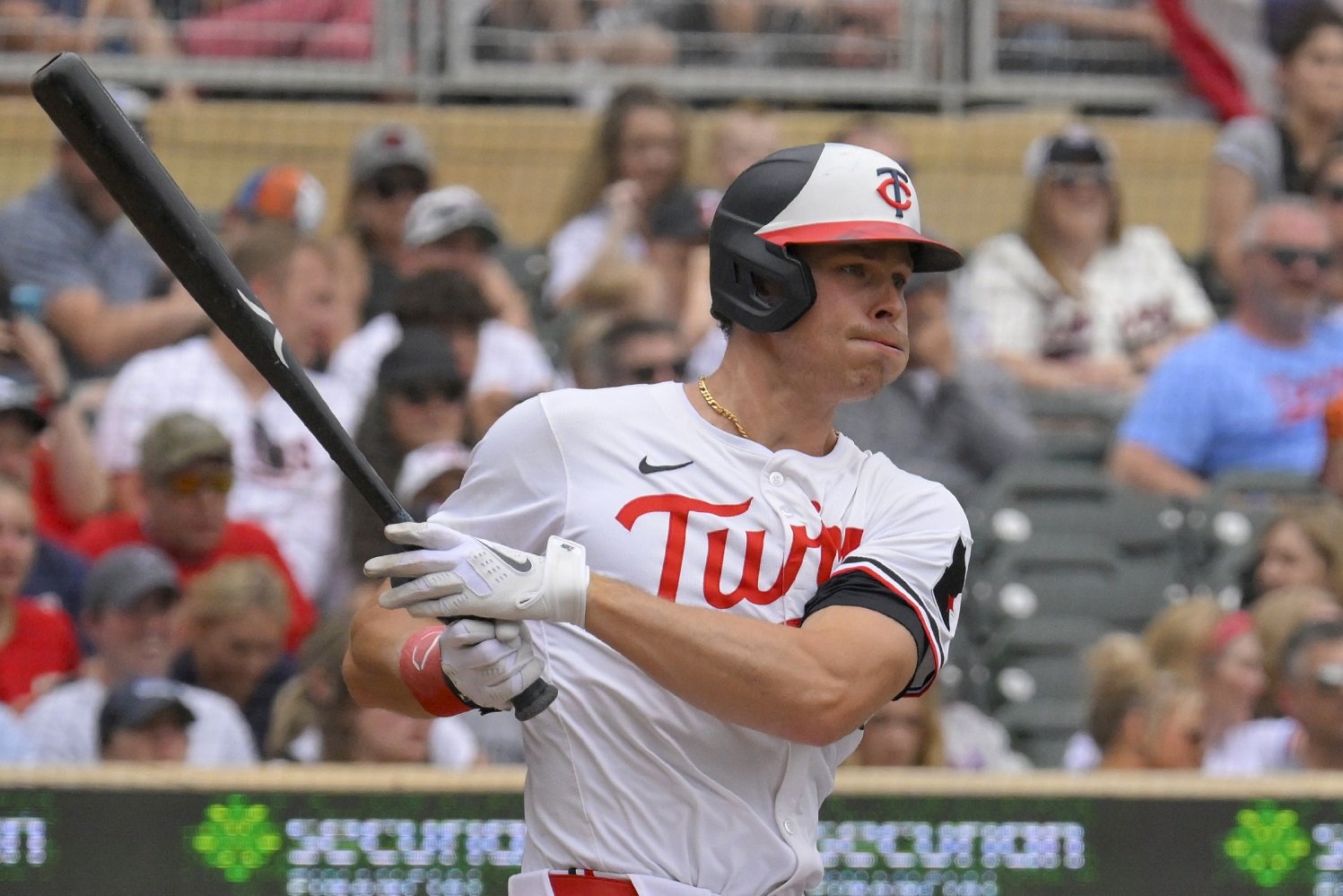
Twins Video
Max Kepler's OPS is 100 points above the anemic league average, and he’s playing his standard plus defense in right field. Kepler has continued the hot stretch that started in the second half of 2023, and there’s an argument that he should receive an offer from the Twins of over $20 million to play right field next year. Let’s break down that argument, in four parts.
What is a Qualifying Offer?
Let’s start with the technical mumbo-jumbo. A qualifying offer (QO) is a measure put in place to give teams a bit of a cushion when a top player is hitting free agency. Any team about to lose a player who has been on the team for a full year can extend a QO to the player on the way out, as long as he has not previously received one.
The amount of that offer is set each year as the average of the top 125 salaries the previous year. It’d be safe to assume that this fall's number would be around $21 million.
If an impending free agent is offered a QO, they have a decision: accept it—and return to the team for one year—or decline it and hit free agency. However, there’s a catch. If they do hit free agency, there will be compensation attached to them. The signing team will lose a draft pick, at minimum. The former team receives a compensatory draft pick after the first, second, or fourth rounds. Sonny Gray rejected the QO this offseason, and the Twins have the 33rd pick in the draft to show for it.
How Well Does Kepler Need to Play to Earn a Qualifying Offer?
That’s the (20-)million-dollar question.
Kepler is playing at an All-Star level—and has been since July of last year. However, he’s been a slightly above-average bat at an offense-heavy position, with borderline Gold Glove defense for his career. That doesn’t scream star—more of a solid regular. He’s had two very good seasons—2019 and 2023—and he’s off to a promising start in 2024.
It's hard to justify $21 million to a player for that. On the other hand, though, he’s playing the best baseball of his 10-year career right now, and that should be considered, given that it’s not a long-term deal; it’d just be for 2025.
So, let’s consider some comparable recent cases. Cody Bellinger, coming off two miserable seasons, rebounded with the Cubs in 2023 and earned himself a QO. He has hit about 15% worse than Kepler has, but he plays a good center field. Bellinger also has a better pedigree (as a former MVP), and he’s 28—three years younger than Kepler.
Bellinger is the kind of player you’d expect to earn a QO. However, Joc Pederson (2023), Brandon Nimmo (2022), and Michael Conforto (2021), each non-elite outfielders, received QOs. None had an OPS+ as high as Kepler’s has been over his last 100 games, though Nimmo (.800 OPS, 130 OPS+ in 2022) was a center fielder at that time.
The best match is probably Pederson—a largely platooned lefty corner outfielder with an .874 OPS (146 OPS+) in 2022 for the Giants. Kepler has an .834 OPS (130 OPS+) over the past two seasons combined, but that includes his awful start to the 2023 season (a .688 OPS in the first half). If Kepler continues to hit like he has this season (.912 OPS, 158 OPS+), he would outpace Pederson considerably—but he could always regress, as well.
There’s also the matter of team need. It’s why the Twins extended Jake Odorizzi the QO in 2019—they needed to solidify the rotation and were willing to overpay for a one-year deal.
The Twins certainly have possible in-house Kepler replacements, like Matt Wallner, Trevor Larnach, Alex Kirilloff, and Emmanuel Rodríguez. However, the first three have yet to prove themselves over the past several years, and Rodriguez is still in Double-A. The Twins may need one more year of Kepler.
Would Kepler Accept the Qualifying Offer?
Here’s the second step. There are a few things at work with this one. Kepler is heading into his age-32 season next year. Because he signed an ownership-friendly deal in 2019, he’s played for the Twins for 10 seasons. He might be focused on maximizing his own dollars this time around. A QO stands in the way of that. There’s a lot of time between accepting the QO and hitting free agency unfettered--an entire year of knowing you have to stay healthy and that each slump could be a $10-million problem.
He is around the point that he could be looking for his last contract. A 33-year-old commands less money; his best years are already behind him. It might not seem like a lot, but the difference between hitting the market at 32 and 33 is significant. A player in Kepler’s shoes may prefer even Andrew Benintendi’s five-year, $75 million ($15 million per year) deal over the richer 2025 and the subsequent stress of finding the long-term deal next year.
However, he may also value that money now. He might be confident that he can command more money next year without the attached draft pick compensation. He might like Minnesota. Who knows? The truth is, though, few players ever accept the QO. Only 13 of the 131 players who received the QO since 2012 have accepted it.
Notably, Kepler’s best recent comp—Joc Pederson—did accept his.
Can the Twins Afford It?
Yeah, okay, here’s the elephant in the room. Maybe “Can they?” isn’t the right question—it’s more like “Will they?”
Heading into 2024, the Twins cut $30 million in payroll. Given comments from ownership (and using the term “rightsizing”), fans probably shouldn’t expect a significant increase going into next season. I didn’t say that’s a good thing—it’s the reality.
Payroll is already poised to be a problem, even without a $20-million right fielder. Check out Peter Labuza’s discussion of next year’s payroll. The short version is that players like Carlos Correa and Pablo López are hitting the high points of their contracts, while prominent players like Royce Lewis, Joe Ryan, and Ryan Jeffers will see raises in arbitration. Payroll may be higher next season than this season, before the first addition is even made. That doesn’t include Kepler’s return, at $21 million.
A Kepler-accepted QO may make a considerable dent in the Twin's plans. Teams never (at least on record) offer the QO in the hopes that the player declines. And Kepler isn’t a no-doubt decline candidate, unlike Shohei Ohtani (2023) or Aaron Judge (2022). If they offer it, they accept the possibility that he’s back, and for the big bucks.
You may be thinking to yourself that Kepler could then become trade bait. However, that’s not an option, either (I think). Under the 2012-2016 collective bargaining agreement, players who accepted the QO could not be traded until after June 15, and there were limits on the amount of cash that could go back to the team—essentially preventing a team from trading a player they did not anticipate accepting the offer.
In updates to the system under the 2017 collective bargaining agreement, alterations to that trade timeframe are not mentioned. In line with this, only two players who accepted the QO were ever traded. Jeremy Hellickson (July 28, 2017) and Neil Walker (August 12, 2017) were both traded after June 15 in the year they accepted the offer.
Trading Kepler after the fact, then, is really not an option. Kepler can only get the QO if the team is actually ready to spend the money it represents.
So, will the Twins be allowed to spend the money associated with Kepler returning? Well…







Recommended Comments
Create an account or sign in to comment
You need to be a member in order to leave a comment
Create an account
Sign up for a new account in our community. It's easy!
Register a new accountSign in
Already have an account? Sign in here.
Sign In Now