


Twins Video
It's not always a well-received observation. When the fact that Byron Buxton's defensive metrics have gotten steadily worse over the years—indeed, that he's now roughly an average center fielder, and maybe not even that—came up on the Twins TV broadcast on Opening Day, Cory Provus, Glen Perkins and Justin Morneau practically rolled their eyes out loud. For many people who watch Buxton play every day, it's nigh unfathomable that he's no longer an elite defender. The very notion does more to dent their confidence in the endeavor of quantifying defensive performance than to diminish their faith in Buxton.
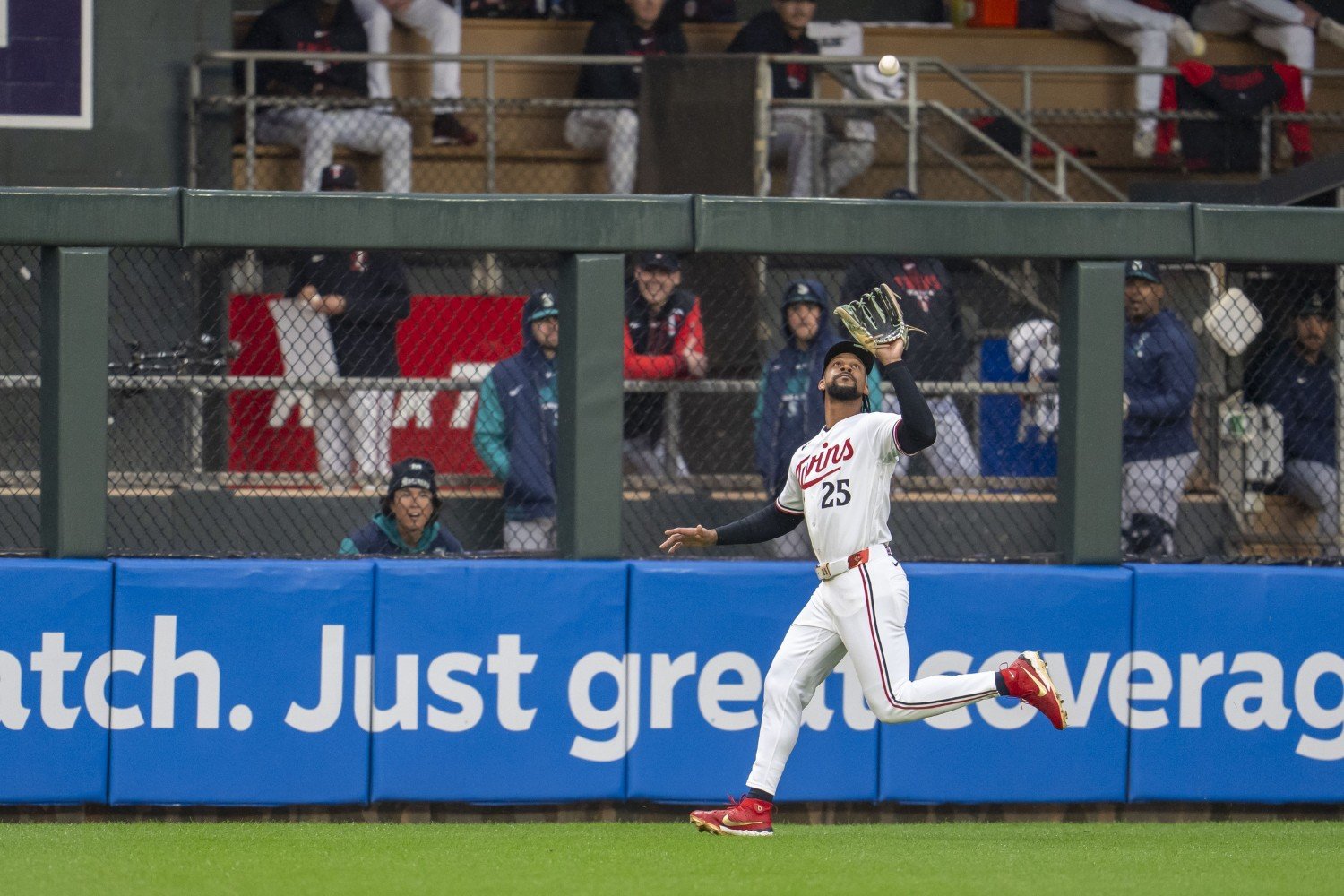
I think some of that is simple allegiance, and an unwillingness to see what's really going on. Some of it, too, lies in the fact that even at his best, Buxton was not the same kind of great center fielder as (say) Pete Crow-Armstrong or Kevin Kiermaier. Those two are exemplars of a version of center field defense that relies on an extraordinarily good first step and read of the baseball. Crow-Armstrong sometimes makes near-miraculous catches, but they don't look like the ones Buxton made at his peak. They tend to look a lot like this one.
That line drive was only in the air for 3.5 seconds. Getting to it required anticipation, exceptionally quick acceleration, and the ability to keep moving fast all the way through the point where his arrow-straight route intercepted the ball. At his very best, Buxton sometimes made that kind of play, but his highlights have always tended to look more like this.
This play is from June 30, 2019, when Buxton was 25 years old. He played, back then, like a man furious at any barrier that might dare impede him. He had the speed and the strength and the skills to make plays like this one; it seemed arbitrary and capricious to erect walls and permit hamstring strains. He played defense like a man fighting for his very way of life, because he sort of was. Buxton's ethos, back then, was that you have to be willing to run through a wall to earn your place on a big-league field. Being unable to do that is one thing; being unwilling to is another.
It wasn't all that uncommon to see Buxton take on a wall at full speed. He did it a few times a year. Here's an especially bone-crunching instance, from 2017.
It didn't always end that happily, of course. Here's another ball Buxton chased fearlessly into a fence in 2017, but in vain.
As we all know, collisions like that one also contributed to Buxton's major injury issues throughout those early years of his career. Yet, he kept doing it. As late as 2022, he would still tear across the ground like the Road Runner, leaving clouds of dust and throwing himself into walls when needed.
Since a nagging knee injury forced him to spend all of 2023 as a designated hitter, though, that version of Buxton has been gone. Since the start of 2024, Buxton has only caught one (1) of the 40 batted balls on which Statcast estimated the catch probability between 0% and 25%. Here's that one catch, from last May.
That's in the spirit of his old specialties, but it came with a bit less risk—and, again, it was in the air forever. It rated so well because Buxton ran nearly 120 feet to intercept it, rather than because he was extraordinarily quick in breaking for it or showed superhuman acceleration.
Buxton has, in fact, never gotten especially good jumps, by Statcast's measurement. Even in 2017, at the peak of his elite athleticism and in what remained the most complete season of his career for a long time, he covered 0.4 feet less than an average center fielder in the first 1.5 seconds after contact. That's a difference so small as to be nearly meaningless, so we can call him average, but bsck then, that was the only average thing about Buxton's defensive game, so it's notable, anyway. He had the speed, explosiveness and acceleration ability to cover a foot or two more than a typical cetner fielder, even in such a short amount of time. He didn't do it, though.
Instead, strategically, Buxton has always been a read-and-react fielder. Knowing that he has some of the best pure speed in the game, he prefers to wait a hair longer before embarking on his pursuit of the ball than most fielders would. He only graded out as essentially average, at his peak, because he made up for that partial beat of assessment within that teeny window. That's how quick and long his strides were.
That's no longer true, though. Buxton can still get up to nearly an elite spring speed, but it takes longer than it used to. Both his knee and his hip have taken enough damage over the years that he now gets underway a bit more slowly, and turns a bit less easily. Last season, Buxton lost 1.6 feet relative to an average center fielder in that first 1.5 seconds of a ball's flight. This year, it's 1.9 feet. He's become one of the slowest center fielders in baseball off the metaphorical block. In fact, only two outfielders have lost more ground in that crucial first instant: Phillies rookie Justin Crawford, and Buxton's teammate, Twins right fielder Matt Wallner.
Crucially, this doesn't mean Buxton is actually a bad center fielder. Part of his defensive decline is a conscious choice. He's been less daring, but another way to say that is, he's been less reckless. He's still presented with the occasional opportunity to plow into the wall; he still has the speed and the sense of how to adjust his body to secure a catch like that if he needs to. He just doesn't do it.
That was a relatively important play in the game, back on the first weekend of the season. The Orioles already led, but catching that ball would have significantly reduced the likelihood of an extra insurance run scoring in the frame. Buston pulled up near the wall, though, choosing to position himself to play the ricochet.
He's done this several times over the last two-plus seasons, and make no mistake: it's a matter of self-preservation. However, that doesn't mean it's selfish. Buxton has recognized that he's more valuable to the team on the field than on the injured list, and he's adjusting his risk management accordingly when he gets close to the wall. Here's another instance of the same calculation at work. He used to hurl himself into the wall on such plays; those days are gone.
Some of Buxton's lost value as a fly chaser, then, is a result of a conscious choice that helps the team in one way, even as it costs them in another. That makes it easy to forgive those non-catches. Even if you're predisposed to demand that a player leave it all on the field, we spent a solid half-decade watching Buxton actually break himself on the ground and against the fenses, and at a certain point, he's earned the right to stop doing so—especially because the team needs him on the field, and he can be on the field more often if he eschews those headlong collisions.
What's left is to understand what makes Buxton good, in some ways, even at this relatively late stage of his career—and, in the same moment, to grapple with the real ways in which he's now much less than an elite defender.
No one in baseball is better than Buxton at catching everything within the range he can reach. He's been above-average in getting to balls with a Catch Probability of 90% or lower in every season of his career, save 2025, in which he was exactly average. Meanwhile, he hasn't failed to come up with a ball that had a catch probability over 90% in almost exactly NINE YEARS, since getting turned around on this ball on May 4, 2017.
However, there are balls elite defenders can get to in center that Buxton simply doesn't. Often, they look utterly innocuous. Even the seasoned eyes of ex-players in the broadcast booth don't see them as opportunities, because they (depending on the nature of their experience in the game, or on their relationship with Buxton, or some of each) forgive the slightly late breaks he gets toward the ball, and don't see that if he'd gotten a better one, he could have turned what looks like an inevitable single into a spectacular out. Here, for instance, is a standard-issue hit to center from last April. It looks like nothign could possibly have been done.
However, that play was essentially identical—in terms of the hang time on the ball and the distance Buxton needed to cover, and even in terms of the angle he would have had to diagnose and take—to this play by Crow-Armstrong over the weekend.
There are wrinkles Statcast doesn't perfectly account for, like wind and field conditions and whether the ball left the hitter's bat with funky spin or was hit much harder or softer than it looked based on the swing, and they might explain the differences between any two given plays. However, there are lots of examples like there. Here's Buxton not quite flagging down a sinking liner in the gap in Kansas City.
Here's Kyle Isbel making (as nearly as you'll ever replicate such a thing) the same catch in the same stadium. Both even came off the bat of a left-handed hitter.
The difference is the same in almost any pair of examples you can pull for study: Buxton doesn't get the elite jump off the bat that Crow-Armstrong, Isbel, and several other outfielders do. In fact, he's about as slow to break for the ball as anyone in the league. His routes are better; his body control is better; and he's more sure-handed. Those guys are all, however infinitesimally, more likely to botch a routine play or drop a ball even after they flag it down than Buxton is. It turns out, though, that what they do well is more valuable than what Buxton does well, and when their respective strengths and weaknesses are weighed, the game's top center fielders all come out ahead of Buxton.
One reason, I think, why this has proved hard to accept is that it practically inverts our instinctive experience of Buxton as a defender. When we think of him in the outfield, we see in our minds the grace and the surety and the intelligence in his eyes, his gait and his glove. We see the blazing speed. We think, then, that he must be able to stretch the boundaries of a center fielder's range as well as anyone—that whatever he can't get to was ungettable. But it isn't so. As it turns out, Buxton—the guy who got famous by plastering himself on walls and flying like Super-Man to spear liners in alleys throughout the league—is an average-plus defender, but he derives all of his fielding value from his incredibly sound fundamentals. He's gone nearly a decade without missing a must-have ball, but it's been almost that long since he consistently demonstrated excellent range. He shores up his area gorgeously, but he doesn't extend it. He doesn't turn near-certain hits into outs; he just never turns near-certain outs into hits.
Things might be different if this older, wiser Buxton were a bit less bruised. He might be better at flipping his hips to chase the ball laterally, especially to his right. He might be more willing to run into a wall now and then, and thus take away one or two doubles per year that he's allowed to fall since coming back to the spot in 2024. Because he's doing everything he can to keep his superb bat in the lineup and be there for his teammates more consistently, though, he lets that bit of value leak away, and because he's aging and was never great at off-the-bat reaction, anyway, he can't make up for that value as well as he might like.
This revelation (some of which is new to me, too; I sat a long time with numbers and watched dozens upon dozens of clips to get a sense of how the data and reality interacted) does change some things. I've advocated moving Buxton to a corner spot, in the past. Barring the arrival of a player who shows that remarkable knack for stretching the range of the spot, I no longer feel that's necessary, or even prudent. There's much to be said for a generationally sure-handed center fielder who almost never even takes a shaky route. There's also some reason to doubt that a player who does his best work under high-arcing flies hit a long distance from him will be as good if moved to the corners, where the plays that separate good fielders from bad ones are more often sharp liners.
It's a joy to watch Buxton in center field. He's no longer elite, or even close to it, but he's an extremely dignified presence in the center of the Twins outfield. At this and all times, dignity counts for something. So do all of those plays between the routine and the spectacular, where Buxton still does great work and finds his own joy in the game.
Do you approve of Twins ownership?

Follow Twins Daily For Minnesota Twins News & Analysis



- Patzky, ToddlerHarmon, hybridbear and 7 others
-
 9
9
-
 1
1



Recommended Comments
Create an account or sign in to comment
You need to be a member in order to leave a comment
Create an account
Sign up for a new account in our community. It's easy!
Register a new accountSign in
Already have an account? Sign in here.
Sign In Now