


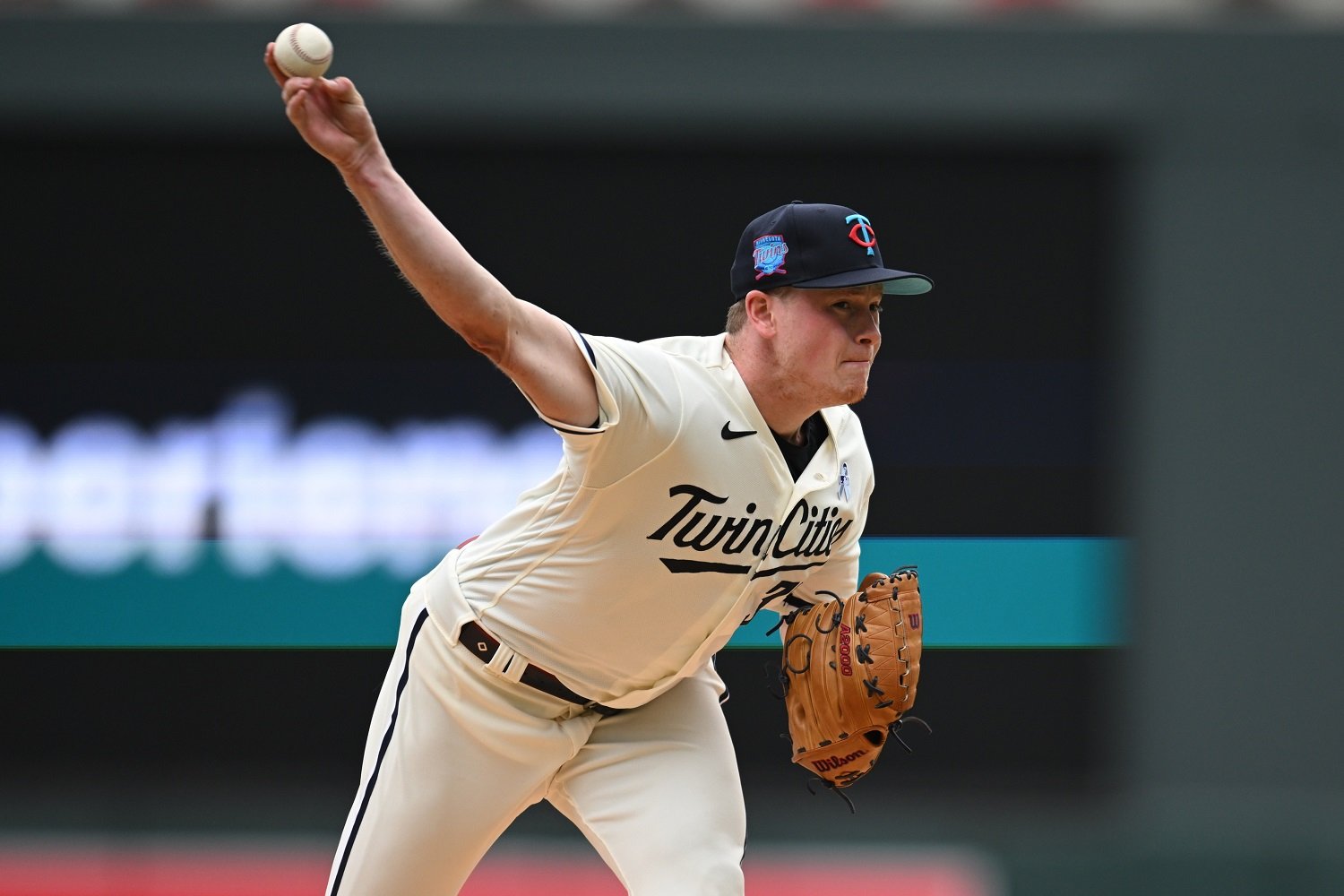
Twins Video
It’s frankly a compliment to the Twins’ front office, amateur scouts, and player development that we’re even having this discussion. As a 15th-round pick in 2019, the bar was pretty low, but he’s vaulted over it, and now coaches and executives have a tricky question: let him continue to develop as a starter or turn him loose in the bullpen.
Although Louie Varland was a relative unknown coming out of the draft, he has worked hard behind the scenes to add velocity to his fastball—which sat in the low 90s on draft day but now averages 95—and develop usable breaking pitches to add to his excellent control and extension.
He’s already had some success as both a starter and a reliever. Through his first 12 career starts between 2022 and 2023, he had a sub-4.00 ERA, though his FIP was about a run higher than that due to a homerun per nine innings rate of nearly 2.00. The wheels came off in his final three starts, giving up 17 runs and five home runs in 15 innings with an opposing OPS of 1.101.
Varland returned to St. Paul and stayed at the Twins’ Triple-A affiliate from June 18th until September 6th. Upon his return, a new Louie Varland was at manager Rocco Baldelli’s disposal, slinging his fastball up to the high 90s and touching 100. Over 12 relief innings, struck 17 batters out, holding them to a .471 OPS and allowing just two runs (1.50 ERA).
In addition to pumping his fastball velocity, working out of the bullpen has also allowed him to rely more heavily on his fastball. Since leaving Division II Concordia-St. Paul with only a fastball, he’s experimented with several off-speed pitches to mixed results. If he’s a reliever, there will be less emphasis on developing those secondary pitches, which is another tick in favor of leaving him in the pen.
However, there are two reasons that Varland should not be moved to the bullpen—just yet.
First, he deserves one more shot at being a starter—something he’s openly opined for himself—and the Twins need to ensure they don’t start the permanent transition too early. Does Varland project as a frontline starter? No. At present, he seems like a competent backend option. Depending on his ceiling in the bullpen, there’s absolutely a case to be made that he would be more valuable in the eighth inning.
However, the starting option should be exhausted before that move is made. With few exceptions, pitchers do not return from the bullpen to the rotation. If Varland can get his changeup or slider up to an above-league-average pitch, or if he further develops his cutter, he could have a role as a mid-rotation starter, and those do not grow on trees.
There are often two reasons a career starter is permanently moved to the bullpen—ineffectiveness and injury. Current Twins examples include Griffin Jax and Jhoan Duran, respectively. Jax was cartoonishly ineffective as a 26-year-old rookie starter in 2022 (after the first time through the order), but his fastball and slider played enough to warrant work in the pen. Duran endured several injuries as a starter, and his raw stuff was begging for an MLB job anyway.
Varland fits neither of those camps. Again, if he is revealed to be no more than a backend option, it’s probably time to let him cook as a reliever. However, given the time and effort he’s expended to get to the spot he’s in, few would be surprised if he took one more step and could be a mid-rotation arm. But to figure that out, the team must keep the toothpaste in the tube.
The second reason is more practical and logistical. The Twins don’t have the depth right now to remove him from the mix. All indications suggest that the team will acquire another starter this offseason, bumping Varland out of the rotation, but as recent history indicates, teams need more than five MLB starters.
Varland can slide into the next-man-up position occupied by Bailey Ober in 2023, on call in St. Paul until a rotation spot opens up—which is inevitable in modern MLB. He would be moved up from the seventh option that he occupied in 2023, a position that gave him 10 starts—and probably would have given him more opportunities were it not for Dallas Keuchel’s emergence as A Man Who Throws Innings midseason.
Currently behind Varland on that depth chart are arms like Simeon Woods Richardson, David Festa, Brent Headrick, and Randy Dobnak. You might have your favorite of that lot, but if forced up to the sixth option—which meant 26 starts for Bailey Ober last year—there’s reason to be worried about the rotation. Keeping Varland there and giving the other options more time to separate themselves in St. Paul, or simply continue to develop, is the safest course of action.
Another option is bringing in a veteran to occupy that sixth spot, which would make keeping Varland on standby less of a necessity, but that, too, is a logistic hard bargain. In order to bring a veteran in to sit in Triple-A, the organization probably needs to find a player with no offers to join a big-league team out of camp. That caliber of player is someone like late-career-Keuchel, Chi Chi Gonzalez, Aaron Sanchez, or Jose De Leon.
None of those names inspire the same amount of confidence that Varland does. Bringing in someone with an opt-out for that position may raise the ceiling a bit on the type of veteran who can be stashed in St. Paul, but that’s still someone like 2020’s Jhoulys Chacín (who did, in fact, opt out before the Twins had reason to call him up.
If starting pitching doesn’t work out for Varland in 2024, there’s plenty of room for him to transition. Shoot, even if he is an effective starter, he can still be bumped down to the pen in September for the playoff run, similar to how Kenta Maeda was handled in Los Angeles. It’s just not time to force it today.
Which team do you dislike the most in the AL Central?
Follow Twins Daily For Minnesota Twins News & Analysis



- Hrbeks Divot, Fatbat, nclahammer and 11 others
-
 12
12
-
 2
2



Recommended Comments
Create an account or sign in to comment
You need to be a member in order to leave a comment
Create an account
Sign up for a new account in our community. It's easy!
Register a new accountSign in
Already have an account? Sign in here.
Sign In Now