


Twins Video
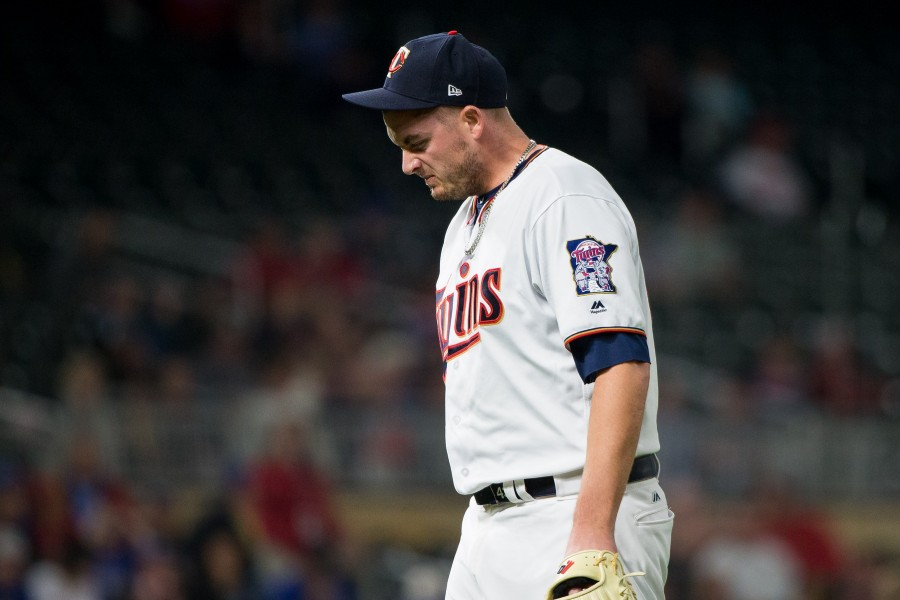
Wednesday night in Detroit was the culmination of a rough few weeks for Reed. Over his last 15 appearances (13.2 innings), he’s held a 5.27 ERA, 1.68 WHIP, and surrendered some key leads. Despite his season-long numbers being relatively in line with his career figures, any kind of digging into Reed’s numbers this season lead to an inevitable conclusion: he’s in rapid decline.
Peripheral Stats
Looking at the last 3 years lead to some worrying conclusions about Reed’s early season form with the Twins.

It’s worth pointing out that Reed and Ryan Pressly have been significantly over-worked by Paul Molitor this season in a similar fashion to Trevor Hildenberger in 2017. Both have taken significant steps backwards in the past few weeks. While Pressly’s peripheral numbers line up almost exactly with his current performance, the same cannot be said for Reed. While overuse is certainly a factor to consider with Reed, his effectiveness is also quite clearly decreasing. Reed has never been a ground ball pitcher, but everything he throws this year is getting hit in the air, with an increasing fly ball and HR rate, it has led to him being less effective, and more noticeably, in high leverage situations.
Let’s talk about WPA for a second. No it’s not a bougie craft beer, win probability added measures how much a given player increases or decreases their team's probability of winning. Reed has been especially brutal in high leverage situations. His figure of -0.62 is already two thirds of a win below league average. He has the 21st worst WPA in the entire league, right behind Blaine Boyer of the Royals (11.60 ERA). That is a problem for a pitcher Molitor frequently relies on as his ‘eighth inning guy’ who is constantly pitching in high leverage situations with the game on the line.
Velocity
Reed’s velocity has also been in steady decline over the last few years. In the last 3 years, Reed’s average fastball velocity has fallen from 93.2 mph (2016), to 92.8 mph (2017), to 91.8 mph (2018). While velocity isn’t everything, consider this; Reed’s fastball was worth 12.9 runs above average in 2017, through roughly one third of the season in 2018, it’s worth 0.5 runs above average. Reed’s decline in velocity, combined with a decreasing number of ground balls and no Byron Buxton, is hurting Reed’s 2018 effectiveness significantly.
Moving Forwards
It’s fair to say I’m picking on Reed in the middle of a rough patch. It’s also true that a stagnant Twins offense could have reduced his disappointing WPA by scoring more freely (or at all) against sub-standard opposing pitchers. The Twins bullpen in general has been poor in high leverage situations (not aided by very little margin for error). Moving forward I’d argue that Trevor Hildenberger should be pitching in as many close and late situations as possible. He the Twins’ leader in WPA at 0.37 (68th best in the league). Since struggling in the first month of the season, Hildy has been rolling. In May and June, he’s given up a .347 SLG and 3 ER in 20.2 IP. Reed can undoubtedly be effective contributor for the Twins over the next season and a half, but Minnesota would do well to move him to a less impactful spot in a bullpen which this year has very little margin for error.






Recommended Comments
Create an account or sign in to comment
You need to be a member in order to leave a comment
Create an account
Sign up for a new account in our community. It's easy!
Register a new accountSign in
Already have an account? Sign in here.
Sign In Now