


Twins Video
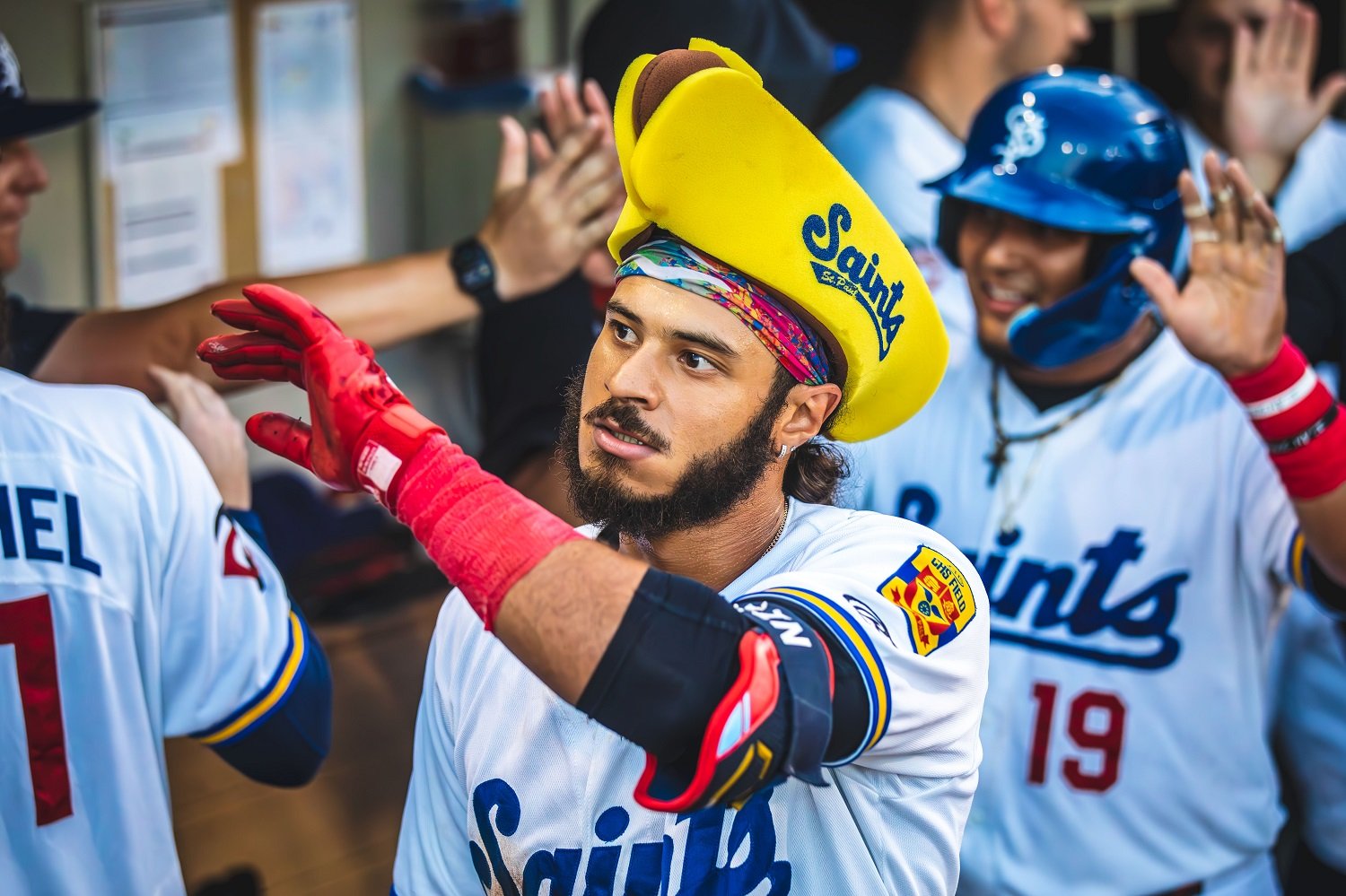
Austin Martin has become an interesting centerpiece of Twins-related offseason discussion. The ongoing TV ordeal has rendered a typically patient front office immobile, stifling momentum after an exciting 2023 campaign. Beyond the Twins' most glaring need (a pitcher capable of starting a playoff game), there remains the issue of center field depth. Harrison Bader and Kevin Keirmaier are off the board. While Michael A. Taylor is still available, Martin finds himself on the doorstep of the majors. Whether he can be more than a fringy role player in the big leagues is about to become an important question, so let's try to answer it.
Let’s start with the basics of Martin’s 2023 season. After overcoming injury and the Twins' failed attempts to get him to tap into more power and loft, Martin returned to form in the second half of the season. A .254/.373/.384 line with 6 home runs and 17 stolen bases (while getting increasing time in the outfield) leave Martin at the front of the queue for playing time, particularly if the Twins trade for starting pitching.
Despite having minimal power, Martin has a unique blend of skills that bring offensive value. In 2023, Martin saw an average number of pitches per plate appearance (3.9). His plate discipline is anchored by an exceptional 14.9% Chase%. This is approaching Edouard Julien territory; Julien led MLB in this category in 2023 at 14.3%. Martin couples this with a strong 82% contact rate on swings, much better than Julien’s 73% (and the MLB average of 75.1%). Not chasing pitches outside the zone and making contact with pitches in the zone is a strong platform, but what about the quality of that contact?
This is where we see a significant divergence between the two players. In 2023, Julien hit the ball at 95 miles per hour or harder at a 44% clip. For Martin, it was 29.5%. That’s a difference of about 24 hard-hti balls per 500 plate appearances. If we look at Barrel%, we see a similar story. TruMedia defines Barrel% as ball hit >95 mph between 10 and 35 degrees (as opposed to Baseball Savant, where they are derived empirically and the baseline rate for them is much lower). Julien’s Barrel% was 23.8% in 2023, to 14.2% for Martin, a difference of 18 Barrels per 500 plate appearances. But we already knew this. The comparison to Julien is useful when looking at plate discipline, but not batted ball events.
Martin’s average exit velocity in 2023 was 85.1 mph. That would rank him 196th in MLB, out of 212 hitters with at least 500 plate appearances. Martin has never hit the ball particularly hard, but can we point to examples of hitters with similar plate discipline who don’t hit the ball hard having significant offensive value in MLB?
Yes, but it’s a narrow path to success. Steven Kwan, Andres Gimenez, and Jeff McNeil all share the characteristics of low exit velocity and high contact rates, and all are hitters who make an offensive impact.
Martin’s excellent contact skills are consistent throughout the strike zone. As this heat map of his contact% below shows, there aren’t a ton of holes in his swing, with the exception of balls dotted on the bottom outside corner of the plate.

Where Martin will do damage, occasionally, is on pitches inside. All of his six home runs in 2023 went to the pull side. The graphical representation of his slugging average reinforces this. Five of Martin’s six Triple-A home runs were on sliders that stayed too far up. Indeed, Martin had a .532 SLG on sliders in 2023, and barreled them up at a 32.1% rate.

A lot of the rest of Martin’s contact is to the opposite field. The spray chart below displays his batted-ball events in 2023 (removing all those confined to the infield). We can see a skew toward the opposite field, which is magnified when looking at fastballs. As is true of most hitters, Martin pulls most of his grounders, so that skews the data a bit, but this still paints an important and accurate picture of his game.

The previous hitters mentioned (Kwan, Giménez, McNeil), to varying extents, gain value from their defense. We don’t know much about Martin’s defensive effectiveness in the outfield, yet. Good speed (and rule changes) should benefit him, as he stole bases at an 81% clip in 2023. A fringy arm may be an impediment. How effective his defense is will go a long way to determining the overall value he brings--particularly in 2024, as he adjusts to MLB pitching.
Martin’s 14.3% walk rate would be top-20 in MLB, if it transferred intact to the highest level. The strong on-base numbers should translate, albeit to a lesser extent, with an automated (and squeezed) strike zone amplifying the offensive environment in Triple A in 2023. If Martin’s long-term defensive home is in center field, his plate discipline, on-base skills, speed, and defensive potential should provide good value. At minimum, he’ll be a solid utility player who brings on-base value at the bottom of the lineup, with a chance for more.
What do you think Austin Martin’s offensive ceiling is in MLB? What are your expectations when he makes his MLB debut? Share your thoughts with a comment below.
Research assistance provided by TruMedia







Recommended Comments
Create an account or sign in to comment
You need to be a member in order to leave a comment
Create an account
Sign up for a new account in our community. It's easy!
Register a new accountSign in
Already have an account? Sign in here.
Sign In Now