


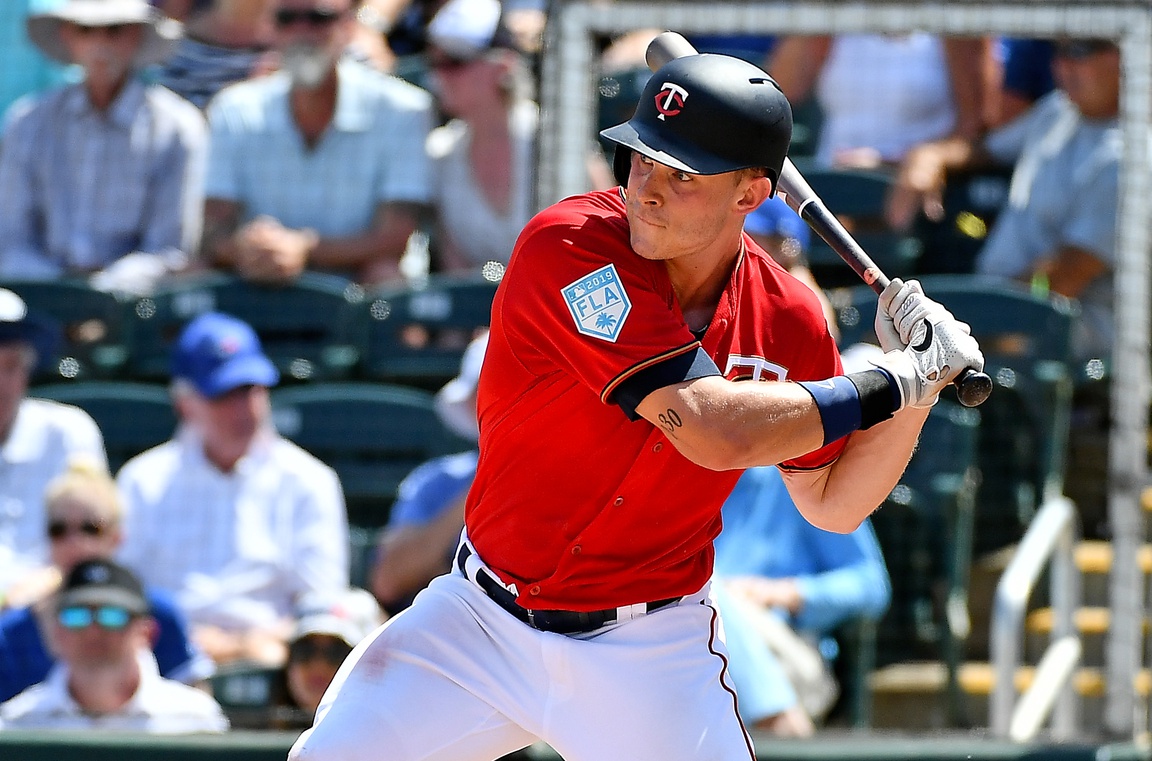
Twins Video
Projected Starter: Max Kepler
Likely Backup: Jake Cave
Depth: Eddie Rosario, LaMonte Wade Jr., Michael Reed
Prospects: Alex Kirilloff, Trevor Larnach, Brent Rooker
THE GOOD
Kepler is coming off a breakout season. It didn't show up on the offensive stat sheet but by any defensive measurement, the third-year player took a star turn. SABR's Defensive Index ratings (SDI) pegged him as the American League's third-best fielder in right, behind only Gold Glove winner Mookie Betts and runner-up Aaron Judge. FanGraphs' Ultimate Zone Rating had him second behind Betts. At the Minnesota Twins Diamond Awards, Kepler was recognized as the team's defensive player of the year.
Not only was Kepler a standout in right field, but he also looked quite sharp during stints in center. Given Byron Buxton's history of injuries, that's a valuable capability, and one that magnifies the importance of depth behind Kepler in right. On that front, the Twins happen to have another guy who was recognized at the Diamond Awards: Jake Cave, most outstanding rookie.
When both were on the field last year, it was usually Cave in center and Kepler in right (Paul Molitor loved his continuity), but I suspect roles we be reversed in the event of Buxton's absence this summer. Cave is better suited for right and his powerful bat certainly played there last year as he slashed .269/.316/.481 with 13 homers and 45 RBIs in 91 games. Not a bad backup plan.
But of course, we're all hoping Buxton stays in center and Kepler holds down his post in right field, where he offers an interesting mix of steady baseline production and simmering potential.
On the surface, Kepler's 2018 season at the plate looked like more of the same. His .727 OPS was nearly identical to his .732 mark coming in. In 611 plate appearances, he hit 20 home runs and 30 doubles – all in line with his career norms.
Yet, a deeper look shows us that Kepler drastically increased his launch angle and, as a result, hit way more fly balls than ever before. This didn't manifest in his production, largely because of a career-low .232 BABIP (it was in fact the third-lowest number among all qualified MLB hitters). Luck-based outcomes rise and fall, but the kinds of swing adjustments leading to increased elevation are bound to pay long-term dividends.
So too are Kepler's advancements with plate discipline. Last season saw him post career bests in K% and BB% – both by significant margins. His BB/K ratio ranked among the top 10 in the AL, sandwiched between MVP candidates Andrelton Simmons and Jose Altuve.
So what we've got here is a pristine athlete, entering his age-26 season, emerging as an elite defensive outfielder and showing every sign of an impending offensive breakout. That's not just my homerish opinion, it's a conclusion of any objective analysis. Which makes it all the more surprising the Twins were able to strike such a team-friendly extension. The outfielder's camp is surely aware of all these indicators, but his words upon signing the deal appear to ring true: "Honestly, I’m the type that would play for the minimum."
His long-term entrenchment could quickly create a logjam, with the organization's #1 prospect and 2018 first-rounder rising fast in right field. But the Twins will happily deal with that "dilemma" once they get there.
THE BAD
Through three seasons and 1,600 plate appearances, Kepler has been an astonishingly consistent hitter. Sure, there have been isolated streaks and slumps, just like for any other player. But from year to year, his OPS has always ultimately fallen within seven points of his career .730 benchmark. So while we can look at the underlying indicators of his 2018 season and forecast improvement (every projection system does), we do have to contend with the reality that Kepler hasn't yet demonstrated he can be more than a slightly below-average hitter for his position.
Granted, he also hasn't given us reason to expect any less than that, so the downside here is fairly minimal. Packaged up with his top-notch D and outfield versatility, Kepler's unspectacular standard production still makes him a solid regular.
THE BOTTOM LINE
I hesitate to use the phrase "embarrassment of riches," but only because it's an overused phrase. It's very accurate here. The Twins are loaded in right field. Their starter is one of the best defenders in the majors, and seemingly verging on an offensive breakthrough at age 26. He's also under ultra-reasonable control through 2023 at least. The backup, Cave, is coming off an excellent rookie year. Kirilloff, Larnach and/or Rooker could legitimately be knocking on the door late this summer.
Unless multiple things go awry, the Twins will soon be trying to sort through outstanding bats standing ready at this position. Which brings to mind another overused, yet fitting, adage: Good problem to have.
***
Twins 2019 Position Analysis: Catcher
Twins 2019 Position Analysis: First Base
Twins 2019 Position Analysis: Second Base
Twins 2019 Position Analysis: Third Base
Twins 2019 Position Analysis: Shortstop
Twins 2019 Position Analysis: Left Field
Twins 2019 Position Analysis: Center Field





Recommended Comments
Create an account or sign in to comment
You need to be a member in order to leave a comment
Create an account
Sign up for a new account in our community. It's easy!
Register a new accountSign in
Already have an account? Sign in here.
Sign In Now