


Twins Video
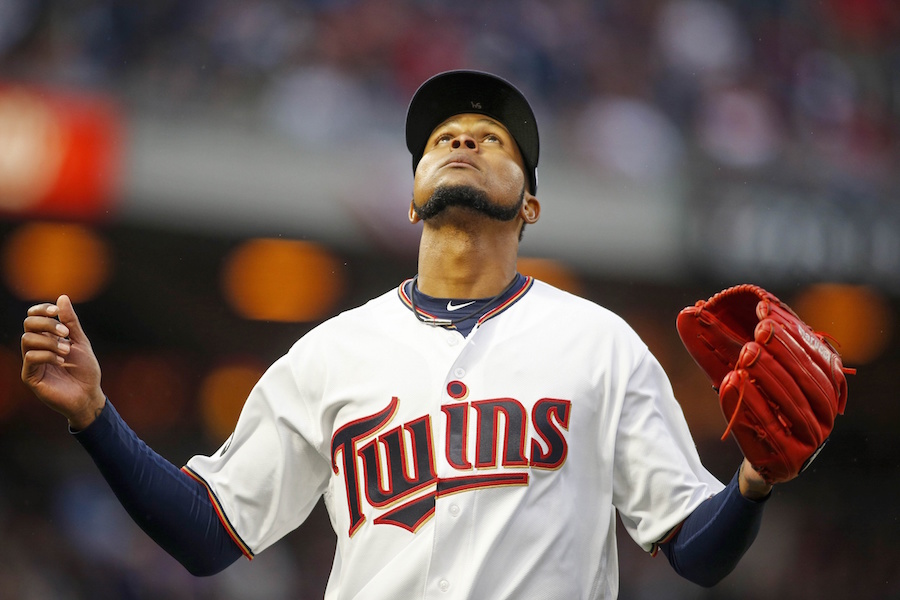
Throughout his entire career, Santana has been a very streaky pitcher, so in a sense we should not go crazy over his incredible start to the 2017 season. But then again, this is the form he showed for most of 2016. The veteran right-hander is (hopefully) heading into a fifth straight season of sustained health and quality production.
The improved results over this extensive stretch owe to more than just another hot streak. Since adding a new pitch to his repertoire, Santana has been a different player. A much better one, who shows signs of entrenching himself as a true No. 1 starter on a staff that desperately needs one to stick.
In 2012, Santana allowed a league-leading 39 home runs in just 178 innings while scuffling through his final year with the Angels, in which he posted a career-worst ERA+ of 74. Perhaps it was this that inspired him to add a two-seam fastball – more colloquially known as a sinker – to his mix the following year.
As you can see in the image below via Brooks Baseball, a new gray datapoint line starts appearing in 2013. This is when he started using the sinker, or at least in a way that caused it to register as such. The offering has been a noticeable difference-maker for him.

Santana has always been pretty good at limiting base-runners, evidenced by a 1.28 career WHIP. But in his down years, home runs have haunted, punishing him for the occasional walk or base hit. He's now in Year 5 since altering his arsenal, and there's been a distinct change.
Through 2012, Santana had allowed homers at a 3.2 percent rate, with a 4.33 ERA. Since then, 2.5 percent with a 3.39 ERA. It's only a piece of the puzzle, but the bottom line is that Santana has been a really good pitcher for quite a while now. He has basically neutralized his one weakness – the long ball – and after making that adjustment hasn't really had a bad season.
Since 2013, only 18 pitchers have thrown more innings with a better ERA, and they're all really damn good (surrounding Santana on the list are Jordan Zimmermann and Dallas Keuchel).
Now, this isn't to say that Erv is ace material, or the guy you ideally want in Game 1 of a postseason series. He's just an extremely reliable above-average starter – a commodity that's been in short supply around these parts. And at the price the Twins are paying ($13.5 million this year and next, with a $14 million option in 2019) he's a real bargain.
Naturally, this raises questions about how things might shape up at the trade deadline. Should the rest of the league become convinced of his value (and if he keeps pitching well for three more months, why would they doubt it?), Santana could bring back a decent haul. That's another asset for Derek Falvey and Thad Levine – already gifted the No. 1 overall draft pick and highest waiver priority – to keep in their pockets. Certainly a favorable inheritance for a new front office focused on building from the ground up.
Of course, right now, selling is not the mindset. The Twins are 7-5, and in second place. While the thrill of actually being relevant may be fleeting, it may not. Either way, we'll all ride it as long as we can, especially with Santana keeping the good times rolling each fifth day.





Recommended Comments
Create an account or sign in to comment
You need to be a member in order to leave a comment
Create an account
Sign up for a new account in our community. It's easy!
Register a new accountSign in
Already have an account? Sign in here.
Sign In Now