


Twins Video
Don't take Louie Varland's intensity, his work ethic, or his open-minded efforts to fix what went wrong for him last year for granted. The Twins have had multiple pitching prospects fall by the wayside over the past half-decade because they lacked those very qualities, and the fact that Varland is (by all accounts) desperate to be great will serve him well in the difficult weeks ahead. Those trials are no longer avoidable, though.
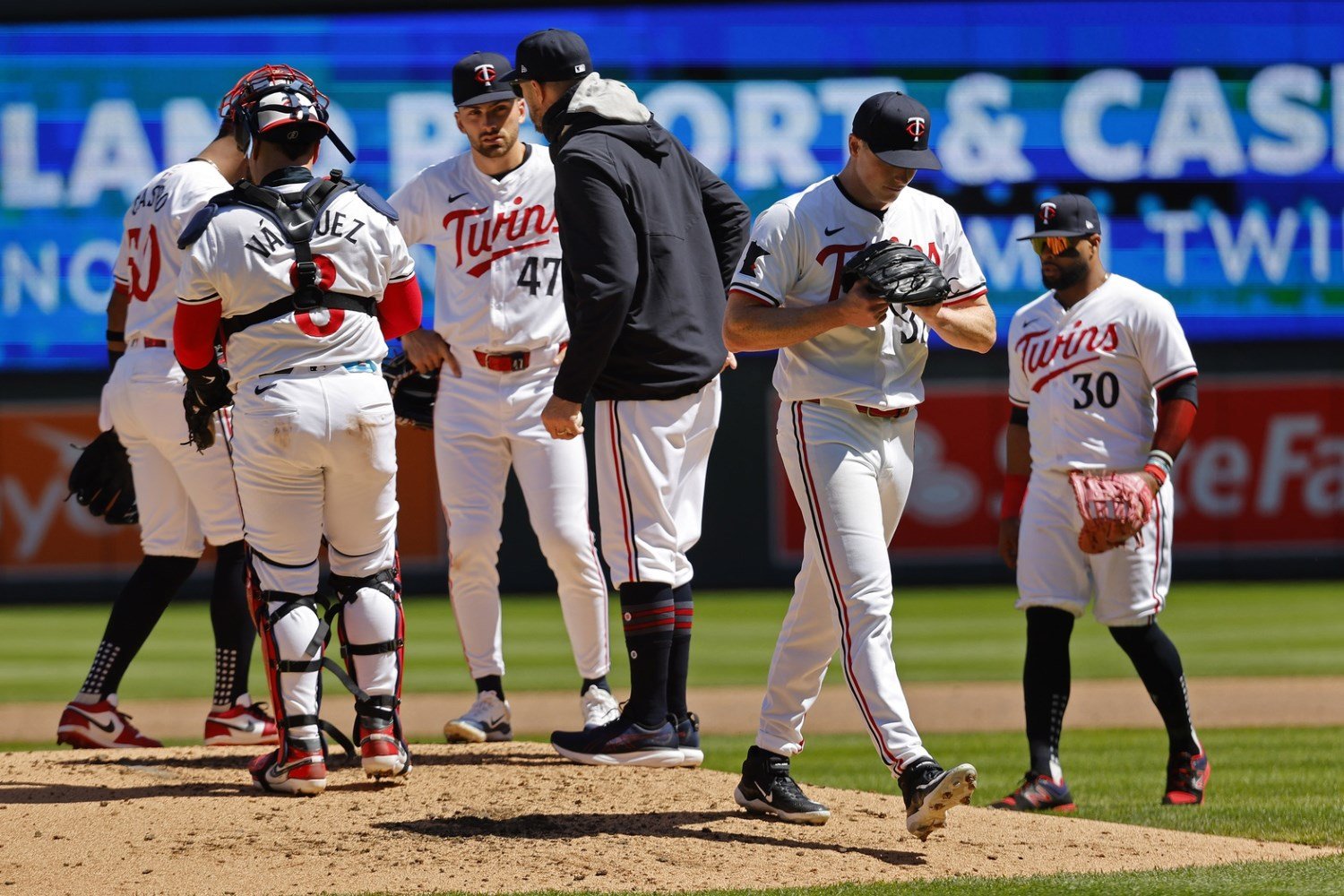
Manager Rocco Baldelli demurred on Varland's status as a member of the team's starting rotation after the latest in a string of brutal outings to begin what has been a brutal season in Twins Territory Sunday. It was a message sent as much in the reticence as in the recitation, because Baldelli's default posture is to back up and build up a struggling player. He knows his team can't continue to scramble for coverage early in what become blowout losses twice each time through the rotation, though, and for multiple reasons, demoting Varland (probably to Triple-A St. Paul, where he can remain stretched out and try to answer the troubling questions raised by this early turbulence) is much easier and more likely than doing the same with the unimpressive Chris Paddack.
Varland has a 9.18 ERA, and the Twins have lost all four of his starts. His velocity is actually up about one mile per hour, relative to his time as a starter last season, but it's done no good whatsoever. Other than that theoretical bit of good news, there is no good news at all. Of the 175 pitchers who have faced at least 50 batters this year, only 17 have a lower whiff rate on opponents' swings than Varland has. Only two hurlers have a lower chase rate on pitches outside the strike zone.
As we well documented this spring, Varland worked hard at some changes to his arsenal this winter that were designed to make him a more viable starter. He added a sinker, and he swapped out the sweeper he used in 2023 for a curveball, with a much more vertical movement profile. The sinkers were supposed to keep right-handed hitters honest, and looking inside more often. The curves were supposed to help him achieve greater split neutrality.
He's hardly thrown the sinker, which is a problem, but we'll come back to it shortly. The change of breaking ball profiles has worked out nicely, in a vacuum: the curve is outperforming last year's sweeper. His changeup, too, is getting fine results. It's just that everyone--lefties, righties, everyone--is obliterating Varland's four-seam fastball and cutter.
It's clear that Varland never got comfortable with the sinker, and while the Twins are trying not to be as mono-fastball as they've been for the last handful of years, they're still not going to be the team forcing a pitcher to go that direction. They like fastballs, especially ones with average ride from a low release point and with great extension, like Varland's. His four-seamer is, in some ways, what the Twins want all of their hurlers' fastballs to look like. That's what makes this so scary.
The heater itself hasn't changed shape this year, and as we said before, it's coming in harder. Hitters are hammering it, though, because Varland lacks command of the pitch. It wanders over the heart of the plate sometimes, and it misses the zone altogether sometimes. It rarely finds the nice, pitcher-friendly edges of the zone, this year.
His cutter has a bit more of a concrete issue with which to deal. That pitch has taken on a bit more velocity and a bit more horizontal movement. He's been trying to use it in the place of the sweeper from last year, against righties. He keeps missing with it to his arm side, which means right over the middle of the plate. Ditto for lefties, because he's trying to jam them with the pitch inside. The results, all the way around, are a devastating failure.
A sinker might, at least, engender a bit lower-quality contact. I spun up a statistic to measure the inverse of the sweet spot rate you sometimes see cited for hitters. It's the percentage of a pitcher's opponents' batted balls that leave the bat at an angle either below -10 degrees or above 45. Anything hit that way tends to turn into an easy grounder or a can of corn, so I named this metric Harmless %. Of the 175 pitchers mentioned above, Varland's Harmless % for 2024 ranks dead last. Hitters are generating power against him, and when they hit him hard, they're doing it right in the band of launch angles within which the damage is greatest.
This might yet be fixable, but there's a long road ahead for Varland. He's unlikely to find the same success as a starter that he had as a reliever, without changing his mix to reflect the different realities of those jobs. As enticing as the cutter seemed last year, it's not working in longer outings, without a triple-digit fastball to set it up. It'll be interesting to see whether the Twins elect to test their charge's feel a bit, by having him bring back the sweeper but keep the curve.
A four-seamer like Varland's could set up the sweeper to righties and the curve to lefties, without much need for the cutter. The changeup is just enough of a wrench in the works against lefties, and the sweeper and curve can work to righties in tandem, with the right pitch-calling. None of this will matter if he can't find a way to get outs with his fastball, but there's still plenty here. The Twins need to ask Varland to put the pieces of the puzzle back together elsewhere, but he's unlikely to fall out of their plans for the rest of the season. He just needs a chance to reset and evaluate the mistakes mixed into his latest round of adjustments.
Do you approve of Twins ownership?

Follow Twins Daily For Minnesota Twins News & Analysis



- tarheeltwinsfan, Dman, DJL44 and 1 other
-
 4
4


Recommended Comments
Create an account or sign in to comment
You need to be a member in order to leave a comment
Create an account
Sign up for a new account in our community. It's easy!
Register a new accountSign in
Already have an account? Sign in here.
Sign In Now