


Twins Video
It would be foolish to draw any sweeping conclusions from the first fortnight of Kaelen Culpepper's major-league career. The Twins called up their top prospect on August 7, and through his first 10 games, we're talking about a player who has barely had enough time to get comfortable in a major-league clubhouse, let alone establish what kind of player he'll become. Culpepper was a first-round pick and entered the season as a top-50 prospect in baseball for a reason, but none of that guarantees that he will live up to those expectations.
Ten games certainly aren't enough to answer the questions that followed Culpepper to this level, but they gave us our first look at some of the tools that made Culpepper such an intriguing prospect in the first place, as well as some of the adjustments he'll need to make if he's going to turn those tools into major-league success. So far, there have been plenty of reasons to be encouraged.
The most obvious one is that the underlying swing numbers on Culpepper are every bit as advertised. Culpepper has developed into a violent swinger as he's worked his way through the Twins' farm system, and that violence has carried over to the majors. His Statcast numbers back it up, with Culpepper's 74-MPH swing speed ranking in the upper quartile of major-league hitters. While plenty of his other statistics are impossible to trust as they're based on an extremely small sample size, swing speed is one of the measurements that stabilizes extremely quickly.
Bat speed also has a strong positive relationship with exit velocity and barrel rate, so seeing Culpepper come out of the gate with a swing speed in the neighborhood of hitters such as Byron Buxton, Miguel Vargas and Pete Alonso is exciting. We've also seen that swing speed translate into some legitimate impact. In just his second career at-bat, Culpepper launched a home run to left-center field after hitting the ball 100.2 MPH. A few days later, he doubled off Jesús Luzardo with a 103.4-MPH line drive.
Those are obviously just two swings, and it would be silly to extrapolate them into anything more than that. However, seeing Culpepper pair the elite swing speed with the ability to produce 100+ MPH exit velocities is exactly what you want to see from a young hitter with his profile. The power is not merely theoretical. We've already seen glimpses of it against major-league pitching.
The other side of the coin has been his plate discipline. Culpepper has struck out 11 times compared to just two walks through his first 10 games. His 43.4% chase rate would rank among the bottom 10 hitters in baseball if he maintained it over a full season. That's an area that will need to improve, but it's also an area where some growing pains should be expected. Plate discipline is often one of the biggest adjustments for young hitters making the jump to the majors. Major-league pitchers throw harder and locate more consistently. Breaking balls that might have been strikes in Triple-A suddenly finish outside the zone, while fastballs are coming in quicker than ever before. Young hitters have to learn which pitches they can damage and—perhaps just as importantly—which pitches they need to let go.
Culpepper is learning that lesson in real time, but the encouraging part is that he's already started to look more comfortable. After going 1-for-9 to begin his career, Culpepper has recorded a hit in each of his last seven games. That's still an incredibly small sample, but he has looked more confident at the plate as the month has progressed, which is exactly what you'd hope to see from a young player trying to make one of the biggest adjustments of his baseball career.
The defensive side has provided a similar mix of excitement and growing pains. Culpepper got an immediate introduction to the difficulty of playing shortstop in the majors during the fifth inning of his first career game, when he had two ground balls turn into singles that had sub-.200 expected batting averages, meaning they were plays that should have been outs.
The first came from David Hamilton, who hit a ground ball that Culpepper wasn't able to range to quickly enough. Culpepper was forced to backhand the ball and couldn't complete the play. A few batters later, Garrett Mitchell hit another ground ball, and Culpepper took some extra time gathering himself before making his throw. The hesitation proved costly against a player with Mitchell's speed, as the throw was late and Mitchell beat it out for another single.
Neither play is something the Twins should panic about, but both are good examples of what Culpepper is going to have to learn at the major-league level. Shortstop is a difficult position, and the difference between Triple-A and the majors can be exposed quickly. Runners are faster, balls are hit harder, and the window to make a decision and execute a throw gets smaller. Culpepper got a taste of that immediately.
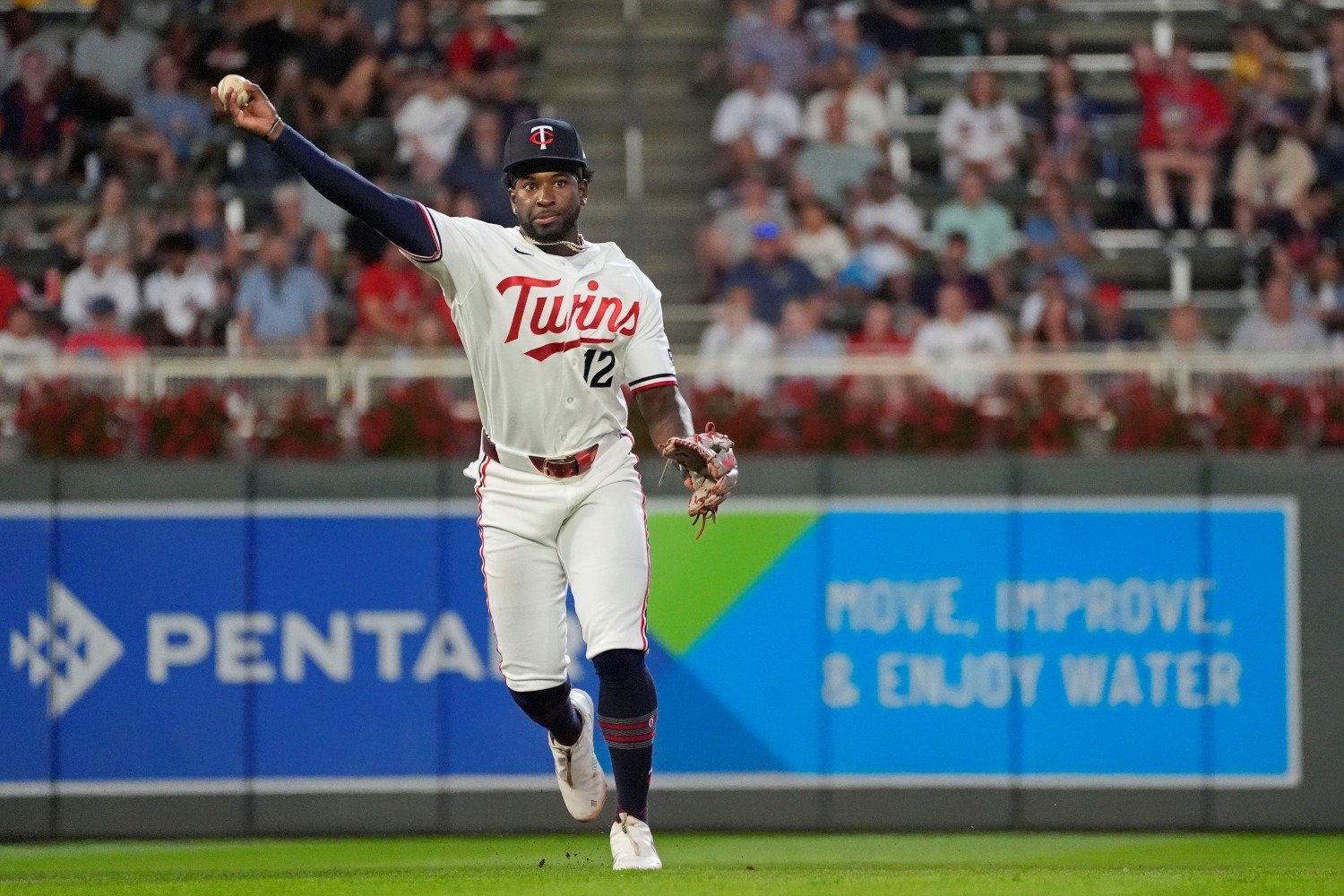
There have also been some clear positives defensively, particularly when it comes to his arm. That was one of the tools we knew Culpepper had coming into the season, and it's already translated to the major league level. He has recorded a max throw velocity of 86.3 MPH, although he doesn't yet have enough throws to establish a reliable overall arm-strength measurement. Still, the arm is clearly legitimate, as we saw on a strong throw to get Coby Mayo at first base.
That's ultimately what makes this first week so interesting. We're not learning that Culpepper is going to be an All-Star, that he's going to be the Twins' shortstop for the next decade, or that his current strikeout and chase rates are going to be permanent. What we are learning is that some of the tools that made him a first-round pick and a top-50 prospect are real.
The violent swing is real. The raw power is real. The arm strength is real. At the same time, we've seen some of the areas where he still has work to do. His plate discipline needs to improve, and he needs to become more comfortable with the speed and demands of major-league defense. That's perfectly normal for a young player making his debut.
He looks like a young player who has some legitimate major-league tools, and is now figuring out how to put them all together. That's about as much as we could reasonably ask for after a couple of weeks. Now comes the fun part: watching what he does with it.
What do you think of Kaelen Culpepper's first week in the majors? Are you encouraged by what you've seen so far, or are there areas that still concern you? Let us know in the comments.
Are you optimistic about the Twins right now?

Follow Twins Daily For Minnesota Twins News & Analysis



- DJL44, PerfectGame, nclahammer and 7 others
-
 8
8
-
 2
2



Recommended Comments
Create an account or sign in to comment
You need to be a member in order to leave a comment
Create an account
Sign up for a new account in our community. It's easy!
Register a new accountSign in
Already have an account? Sign in here.
Sign In Now