Jump to content
Twins Daily
  • Create Account
  • Twins News & Analysis

    Twins 2024 Position Analysis: Second Base


    Nick Nelson

    The Twins front office under Derek Falvey has gradually whittled away all of the quality talent they inherited in the middle infield, trading two All-Stars and a former top draft pick within the past year or so. 

    And yet, as the organization charts a new future at second base, its prospect-driven outlook is as bright as ever.

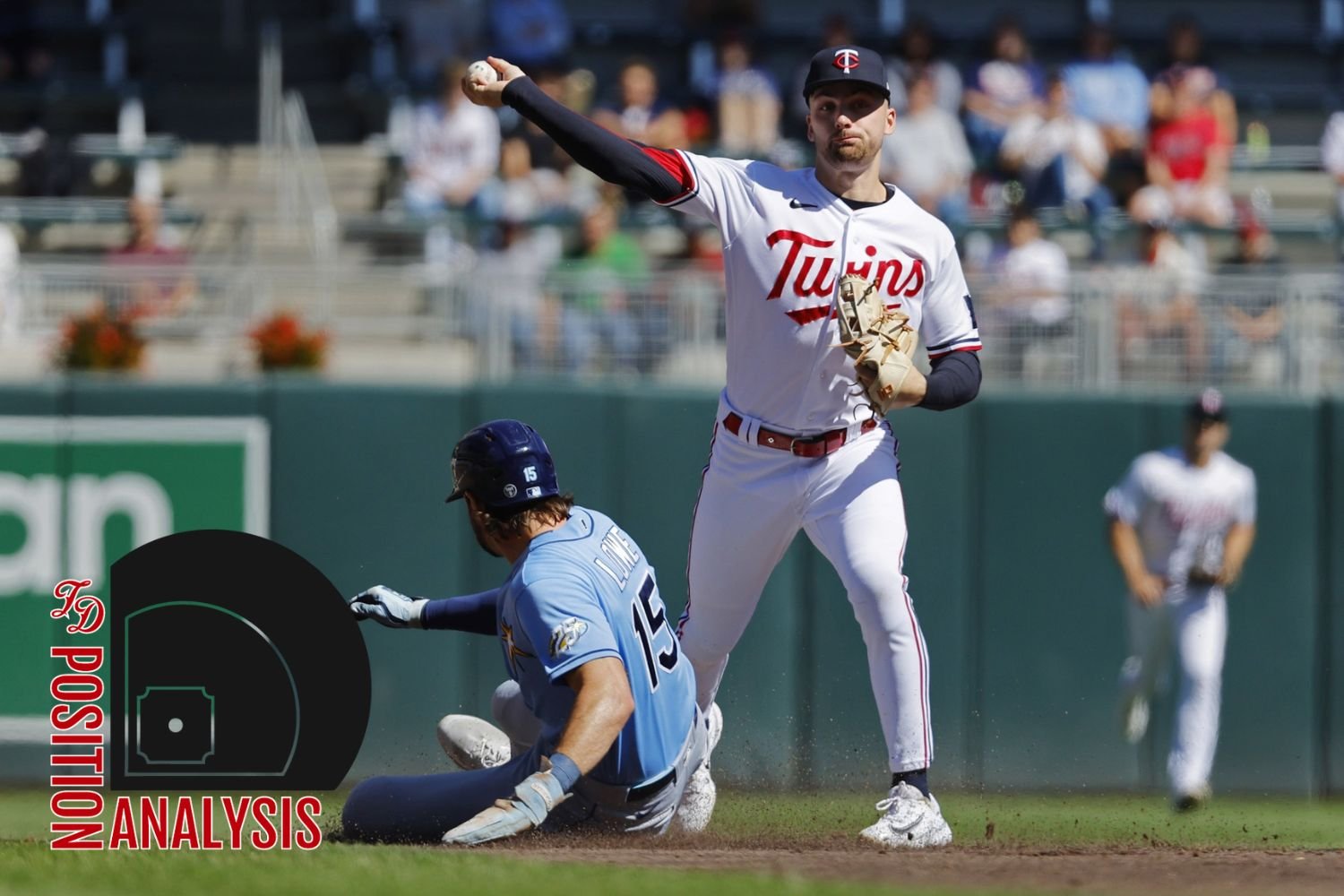
    Image courtesy of Bruce Kluckhohn-USA TODAY Sports

    Twins Video

    In 2022, the following three players combined to start 156 of 162 games for the Twins at second base: Jorge Polanco, Luis Arraez, Nick Gordon. One season later, all three holdovers from the previous regime are gone, as the front office embeds its own wave of talent in planning at second base. 

    This position was among the defining strengths for the Twins offense in 2023, ranking second among American League teams in wOBA and fWAR, behind only the world champion Texas Rangers. Can they maintain that advantage this year?

    TWINS SECOND BASEMEN AT A GLANCE

    Starter: Edouard Julien
    Backup: Kyle Farmer
    Depth: Willi Castro, Austin Martin, Michael Helman
    Prospects: Brooks Lee, Tanner Schobel, Luke Keaschall

    Twins fWAR Ranking Last Year: 3rd out of 30
    Twins fWAR Projection This Year: 14th out of 30

    THE GOOD
    Julien is legit. That much is impossible to deny after he carried over his impeccable offensive track record to the major leagues. He ranked seventh in the AL Rookie of the Year voting by slashing .263/.381/.459 in 109 games during his first go with the Twins. Unfazed by the big lights of October, the newcomer even posted a 1.043 OPS in the playoffs.

    Regression always has to be considered a factor for sophomore big-leaguers coming off monster partial rookie seasons – especially one who rose out of relative obscurity like Julien. But it's getting harder and harder to doubt the former 18th-round draft pick; he literally produces everywhere. Aside from an elbow injury that sidelined him for a year, there have been no real lapses since he joined the pro ranks. Julien's signature skill – unparalleled discipline at plate – has proven viable at every level, keeping pitchers on the defensive.


    This isn't to say Julien is a perfect offensive player. He does strike out a lot and benefitted from a .371 BABIP as a rookie. He needs to be executing on his plan to punish pitches in the zone in order for his approach to fully pay off. But he's already shown enough power put himself on another tier of upside compared to Arraez, and Julien should be viewed as a top-of-the-lineup cornerstone in the same way Arraez was. At least, against right-handed pitching.

    As good as he is against righties, Julien is pretty much unplayable against left-handers. He slashed .196/.229/.217 versus southpaws as a rookie after posting a .649 OPS against them in the minors the previous year. So it's very handy to have Farmer on hand as a platoon-mate with a reliable veteran glove and .825 career OPS vs. LHP.


    This is a strong setup out of the gates. How long it remains in place will be dictated by health, Julien's glove, and how hard the prospects are pushing from below. Specifically, Lee is trending toward an MLB debut by midseason after wrapping up 2023 in Triple-A. With third base and shortstop now occupied indefinitely, second base currently looks like the best path for the switch-hitting top prospect, whose glove would almost surely be superior to Julien's. At that point, first base or designated hitter become possible destinations for the latter.


    Down the line, the Twins have a pair of other promising talents rising through their system, with Schobel and Keaschall drafted out of college in the second rounds of successive drafts. The two sit at No. 10 and 11 in Twins Daily's preseason prospect rankings as they prepare to conquer the high minors. In short, the pipeline is loaded at this position.

    THE BAD
    Minnesota's front office traded away a great deal of established quality in their overhaul at second base. Arraez is a star and Polanco was an extremely consistent producer when on the field. Even Gordon had shown an ability to deliver value in the majors. The Twins have shipped these veteran players out while investing their future at second largely in the unknown.

    Farmer is the most proven commodity of the current crop but he's a backup-caliber player, turning 34 this season. The Twins are obviously hoping Julien will carry the torch, and as mentioned there's plenty of reason to believe, but he's not without drop-off risk. Also, it wouldn't be shocking to see his shaky defense deemed untenable with further exposure, forcing him off the position. 

    From there we are really putting a lot of faith in Lee. The Twins are propping up their No. 2 prospect as the heir apparent at second, with the left side of the infield now locked down by franchise players. It's important to remember, though, that even the most successful big-leaguers often experience a learning curve. Julien's immediate breakthrough last year was more the exception than the rule. FanGraphs projects a .245/.304/.379 slash line and .298 wOBA from Lee in the majors this season. It'd be an okay rookie year but underwhelming production from the primary starter at second, especially after Julien set the bar.

    I don't fault the Twins for trading players like Arraez, Polanco and Gordon proactively to get value for them while they can, but the downside of this plan is removing layers of depth and placing faith in inexperienced players, which has been a volatile proposition in the past. 

    THE BOTTOM LINE
    With one of their top prospects knocking on the door behind their reigning top rookie, the Twins feature premier young talent at second base. Polanco leaves big shoes to fill as a two-way player who powered the top of the lineup, but between Julien, Lee, Schobel and Keaschall, there's a bright future ahead, while Farmer, Castro, Martin and others provide quality short-term depth. I feel very optimistic about this unit compared to the middling projection from FanGraphs.

    Catch up on the rest of our position-by-position preview series:

    Follow Twins Daily For Minnesota Twins News & Analysis

    Recent Twins Articles

    Recent Twins Videos


    User Feedback

    Recommended Comments


    Featured Comments

    38 minutes ago, Linus said:

    This sums my feelings about defensive metrics quite nicely. The tip off for me is how much volatility there is in the rankings from year to year. Fielding in baseball would be something that gradually improves or declines. A good fielder doesnt become below average in one year and vice versa. 

    Part of the severe swings is opportunity based. If 2 players are both slightly below average defenders, but 1 gets the ball hit their direction more often he's going to show as a terrible defender depending on what metric you're looking at while the other guy just shows as slightly bad. OAA is a volume metric. It's not just judging how good you are in a general sense, it's counting the number of outs it believes you saved or cost.

    If you and I were to make all the exact same plays, but you made twice as many of them then you'd have twice as much OAA than me. Doesn't mean you're twice as good of a fielder, though. Polanco and Arraez could've been the same quality of fielder, but Arraez had 615 chances last year while Polanco had 236. Arraez had more chances to screw up so his OAA was significantly lower. 

    Defensive metrics have a long ways to go, and it's super important that people know what each metric is actually trying to tell you. OAA isn't great for just comparing generally what quality of fielder 2 players are because it's a chance driven metric. But most of the other ones are very limited in how they're judging defense. Defensive metrics need to be taken with a mountain of salt. They have a long ways to go. It's one part of the game that the eye test should still be the leading "metric."

    @RpR I don't generally question your "disagrees," but I'm curious in what you disagree with on my post about defensive metrics. Do you disagree that OAA is a counting metric? Do you disagree about how certain metrics are calculated? If you have differing info I'd love to hear what was wrong about my comment.

    One detail that caught my attention was "the left side of the infield now locked down by franchise players."

    That seems pretty nice and I hope it is true, but I wondered when was the last time the Twins and/or their fans considered a guy with 280 PA to be a franchise player. I can't remember one. It wasn't Killebrew, Oliva, Carew, Puckett, or Hrbek. Joe Mauer? Probably Joe. That is a high bar.

    Second base is pretty set. chpettit19 accurately depicts where baseball is on defensive metrics. Whenever i read defensive metrics and the comments using them exclusively it makes me think of those who only consider wins a good judge of a pitcher. I also wonder if the person commenting with their piles of metrics is searching through data while listening to the games. Now listening to baseball and looking through data are fine hobbies which I wholeheartedly approve of, but as chpettit19 has said above, the educated eye is still far, far ahead of metrics when it comes to judging defense in baseball.

    43 minutes ago, chpettit19 said:

    @RpR I don't generally question your "disagrees," but I'm curious in what you disagree with on my post about defensive metrics. Do you disagree that OAA is a counting metric? Do you disagree about how certain metrics are calculated? If you have differing info I'd love to hear what was wrong about my comment.

    Eye Test part, although Julien often fails the eye test.

    3 hours ago, RpR said:

    Eye Test part, although Julien often fails the eye test.

    The defensive metrics on baseball reference that you reference come from a room of poorly paid interns on computers clicking the spot they judge the fielder to have started then clicking the point where they judge the ball to have gone while also starting and stopping a clock to judge how quick the ball got there. Then those interns use the eye test to decide if it was an extraordinary play or just an ordinary play to either add a multiplier to it or not. 

    If you want to compare player's actual ability to field the eye test is a better tool than using counting metrics based on what I described above. Those metrics aren't telling you which guy can make a certain play and which one can't. It's why they fluctuate so much season to season. Defensive metrics are still very much questionable metrics. That's no shot at the interns, either. Those people do incredible work and it's not an easy job. But the metrics shouldn't be used as debate enders. 

    Glad to see most posters talking about defense instead of offense, but Julien's calling card is and will be his bat. And he needs to adjust at the plate or he will fall out favor, much like Miranda;

    April 12 - July 29 splits (57 games): .300/.388/.539 (.927 OPS) 10 HR, 18 RBI, 25/65 BB/K ratio.

    July 30 - Oct 1 splits (52 games): .222/.374/.367 (.741 OPS) 6 HR, 19 RBI, 39/63 BB/K ratio.

    Play-offs Games 1 -5: .214/.389/.286 (.675 OPS) 0 HR, 1 RBI, 4/7 BB/K ratio.

    Play-offs Game 6: 2-3, 2B, HR, RBI, 1/1 BB/K ratio.

    He was also often removed from games late for defense and didn't face LHP, including Play-offs. 

    .741 OPS from July 29 until the end of the season was league average (Gallo's full season OPS was .741, which equated to an OPS+ of 101, league average.). Including his first 5 Play-off games, he was slightly below league average over this period, but finished his season with a very good game against Houston.

    Just looking at the numbers, it would appear he tried to work deeper counts, which resulted in more walks and maintaining a high OBP, but came at the expense of a lower BA, a lower SLG%, and an uptick in SO's. He's young enough and skilled enough to hopefully turn it around (and he's off to good start this spring), but he could also turn into nothing more than a placeholder until Lee or someone else pushes him out.


    39 minutes ago, mnfireman said:

    Glad to see most posters talking about defense instead of offense, but Julien's calling card is and will be his bat. And he needs to adjust at the plate or he will fall out favor, much like Miranda;

    April 12 - July 29 splits (57 games): .300/.388/.539 (.927 OPS) 10 HR, 18 RBI, 25/65 BB/K ratio.

    July 30 - Oct 1 splits (52 games): .222/.374/.367 (.741 OPS) 6 HR, 19 RBI, 39/63 BB/K ratio.

    Play-offs Games 1 -5: .214/.389/.286 (.675 OPS) 0 HR, 1 RBI, 4/7 BB/K ratio.

    Play-offs Game 6: 2-3, 2B, HR, RBI, 1/1 BB/K ratio.

    He was also often removed from games late for defense and didn't face LHP, including Play-offs. 

    .741 OPS from July 29 until the end of the season was league average (Gallo's full season OPS was .741, which equated to an OPS+ of 101, league average.). Including his first 5 Play-off games, he was slightly below league average over this period, but finished his season with a very good game against Houston.

    Just looking at the numbers, it would appear he tried to work deeper counts, which resulted in more walks and maintaining a high OBP, but came at the expense of a lower BA, a lower SLG%, and an uptick in SO's. He's young enough and skilled enough to hopefully turn it around (and he's off to good start this spring), but he could also turn into nothing more than a placeholder until Lee or someone else pushes him out.


    This is an interesting take. When a rundown of third base happens will you remove the home runs that Royce Lewis hit to arrive at a similar conclusion? Consistency is a thing, right. 

    All of Jeffers, Kirilloff, Julien, Lewis, and Wallner as position players and Ryan, Ober, Paddack, Varland, Duran, Jax, Topa, and Jackson as pitchers have to prove that one or two good months or years is not a dream and that they can become successful athletic performers for a full season and then after that season after season.

    7 hours ago, mnfireman said:

    Glad to see most posters talking about defense instead of offense, but Julien's calling card is and will be his bat. And he needs to adjust at the plate or he will fall out favor, much like Miranda;

    April 12 - July 29 splits (57 games): .300/.388/.539 (.927 OPS) 10 HR, 18 RBI, 25/65 BB/K ratio.

    July 30 - Oct 1 splits (52 games): .222/.374/.367 (.741 OPS) 6 HR, 19 RBI, 39/63 BB/K ratio.

    Play-offs Games 1 -5: .214/.389/.286 (.675 OPS) 0 HR, 1 RBI, 4/7 BB/K ratio.

    Play-offs Game 6: 2-3, 2B, HR, RBI, 1/1 BB/K ratio.

    He was also often removed from games late for defense and didn't face LHP, including Play-offs. 

    .741 OPS from July 29 until the end of the season was league average (Gallo's full season OPS was .741, which equated to an OPS+ of 101, league average.). Including his first 5 Play-off games, he was slightly below league average over this period, but finished his season with a very good game against Houston.

    Just looking at the numbers, it would appear he tried to work deeper counts, which resulted in more walks and maintaining a high OBP, but came at the expense of a lower BA, a lower SLG%, and an uptick in SO's. He's young enough and skilled enough to hopefully turn it around (and he's off to good start this spring), but he could also turn into nothing more than a placeholder until Lee or someone else pushes him out.


    Julien and Miranda isn't a great comparison. Especially comparing an injured Miranda to Julien.  Juliens plate discipline is elite.  His chase rate was the best in MLB.  He has something that most hitters wish they had. Julien hasn't even gotten into his prime yet and he does make the adjustments he needs to. Its a good bet that he will continue to keep pitchers on the defensive. Thats what he does. 
    He wont always be our 2nd baseman, dor now he is. We need to enjoy the show in ‘24. The kid is gonna tear it up. 

    I have a feeling we will be seeing a similar article in TD a year from now. Julien is no doubt a very talented hitter, but I'm not so sure the second base will remain his position for the duration of this decade. At any rate, I think he's more comfortable at second going into this season, and I hope that reflects on his overall play. 

    14 hours ago, chpettit19 said:

    Part of the severe swings is opportunity based. If 2 players are both slightly below average defenders, but 1 gets the ball hit their direction more often he's going to show as a terrible defender depending on what metric you're looking at while the other guy just shows as slightly bad. OAA is a volume metric. It's not just judging how good you are in a general sense, it's counting the number of outs it believes you saved or cost.

    If you and I were to make all the exact same plays, but you made twice as many of them then you'd have twice as much OAA than me. Doesn't mean you're twice as good of a fielder, though. Polanco and Arraez could've been the same quality of fielder, but Arraez had 615 chances last year while Polanco had 236. Arraez had more chances to screw up so his OAA was significantly lower. 

    Defensive metrics have a long ways to go, and it's super important that people know what each metric is actually trying to tell you. OAA isn't great for just comparing generally what quality of fielder 2 players are because it's a chance driven metric. But most of the other ones are very limited in how they're judging defense. Defensive metrics need to be taken with a mountain of salt. They have a long ways to go. It's one part of the game that the eye test should still be the leading "metric."

    This is a good explanation.   It only stands to reasons that the number of opportunities a player has to get an out of create a DRS, the greater the +/-.  It’s a qualitative measure weighted by a quantitative measure.  

    What do you make of Arraez vs Julien?  Arraez had 433 attempts at 2B and had an OAA of -10.  Julien had roughly half the number of attempts (220) and posted an OAA of zero.  Theoretically, if Julien had double the attempts, the numbers would be precisely the same.  This also makes sense when one of the players is average.  Should we believe Julien performed better?  If we disagree with the rating, the problem is not quantity in this comparison.  It would have to be that the qualitative measures lack a level of accuracy that creates a false measure.  
     

    Next year if Kepler is gone, Wallner moves to right. Who plays left? Julien will be good at second this year, I'm not among those in a hurry to move him. If AK rips it up, Julien performs as I predict, Larnach doesn't claim left in '25, Wallner performs, Lee is ready and Kepler leaves, your hole is in left. In that case what do you do? I would move Lewis to left and put Lee at 3rd. Julien stays put. Lots of ifs, yes, my only point is I don't see why so many are in such a hurry to move Julien to 1st/DH. It's like they forget about AK. We will find out this year, but I think there is a good chance Kirilloff is healthy, he rakes and also shows he is a fine first baseman. 

    18 hours ago, Fatbat said:

    One of Schobel and Keaschall will definitely be traded. Maybe both but I can see one of them playing Farmers role in 2026 and beyond. Do we bring them to MLB to prove they can play first to raise their trade value? 

    Beating a dead horse here...... but using high draft picks on 2nd basemen is idiotic.

    18 hours ago, CCHOF5yearstoolate said:

    I have to completely disagree.

    Arraez is the worst defender of those 3 and it's not particularly close. Julien improved significantly as the season went on and was better than Polanco by the end of last year.

    I don't think Julien will be the long-term 2B, but that's only because Lee should be a very good defender and not because of Julien's skill. By the end of the season no one was talking about Julien's defense, which is a good thing. 

    I completely agree.  Let's also not forget that while Polanco was a great Twin, injuries and age are taking their toll.  I think Julien sticks at 2nd base this year unless he regresses, or Lee is simply unstoppable.   If all this plays out, then the trade deadline will prove very interesting with Farmer potentially on the block.

    9 hours ago, mnfireman said:

    Glad to see most posters talking about defense instead of offense, but Julien's calling card is and will be his bat. And he needs to adjust at the plate or he will fall out favor, much like Miranda;

    April 12 - July 29 splits (57 games): .300/.388/.539 (.927 OPS) 10 HR, 18 RBI, 25/65 BB/K ratio.

    July 30 - Oct 1 splits (52 games): .222/.374/.367 (.741 OPS) 6 HR, 19 RBI, 39/63 BB/K ratio.

    Play-offs Games 1 -5: .214/.389/.286 (.675 OPS) 0 HR, 1 RBI, 4/7 BB/K ratio.

    Play-offs Game 6: 2-3, 2B, HR, RBI, 1/1 BB/K ratio.

    He was also often removed from games late for defense and didn't face LHP, including Play-offs. 

    .741 OPS from July 29 until the end of the season was league average (Gallo's full season OPS was .741, which equated to an OPS+ of 101, league average.). Including his first 5 Play-off games, he was slightly below league average over this period, but finished his season with a very good game against Houston.

    Just looking at the numbers, it would appear he tried to work deeper counts, which resulted in more walks and maintaining a high OBP, but came at the expense of a lower BA, a lower SLG%, and an uptick in SO's. He's young enough and skilled enough to hopefully turn it around (and he's off to good start this spring), but he could also turn into nothing more than a placeholder until Lee or someone else pushes him out.


    This is a good summation in my opinion. I like Julien and credit him for the hard work involved in improving his fielding. However I’m not nearly as high on him as most here. His babip was really high last year so some regression is likely. How much will determine his effectiveness going forward. I disagree with the comparisons to Koskie as he was a really good athlete. Juliens ceiling as a defender is mediocre - his hands are not soft and he is stiff in movement. These factors combined with him not hitting leftys at all tells me he can be a useful but not great player. Having said that I admire his competitiveness when he steps in the box. 

    2 hours ago, miracleb said:

    Beating a dead horse here...... but using high draft picks on 2nd basemen is idiotic.

    2B is still an up the middle / important defensive position.   It's not as idiotic as picking Sabato in the 1st round and definitely not as bad as picking Cavaco over Carroll and Stot.

    15 hours ago, tony&rodney said:

    One detail that caught my attention was "the left side of the infield now locked down by franchise players."

    That seems pretty nice and I hope it is true, but I wondered when was the last time the Twins and/or their fans considered a guy with 280 PA to be a franchise player. I can't remember one. It wasn't Killebrew, Oliva, Carew, Puckett, or Hrbek. Joe Mauer? Probably Joe. That is a high bar.

    Second base is pretty set. chpettit19 accurately depicts where baseball is on defensive metrics. Whenever i read defensive metrics and the comments using them exclusively it makes me think of those who only consider wins a good judge of a pitcher. I also wonder if the person commenting with their piles of metrics is searching through data while listening to the games. Now listening to baseball and looking through data are fine hobbies which I wholeheartedly approve of, but as chpettit19 has said above, the educated eye is still far, far ahead of metrics when it comes to judging defense in baseball.

    I do know Oliva was kept in minors longer because he didn’t play OF anywhere near average. He then tore the League up as a Rookie in ‘64.

    Killebrew was too young to impress at that level for first 3-4 years.

    Mauer was pretty hyped and viewed in that light pretty much out of the gate regardless of the stats & early injury.

    Handful of Grand Slams and consistency during regular season, when in the line-up, has Lewis in that context………..particularly with his star play in the postseason. Definitely looks like he has “it”!

    20 hours ago, CCHOF5yearstoolate said:

    I have to completely disagree.

    Arraez is the worst defender of those 3 and it's not particularly close. Julien improved significantly as the season went on and was better than Polanco by the end of last year.

    I don't think Julien will be the long-term 2B, but that's only because Lee should be a very good defender and not because of Julien's skill. By the end of the season no one was talking about Julien's defense, which is a good thing. 

    To concur with this post and back it up

    Arraez

    IMG_1889.jpeg.23eb5e9fd124f3eca7006b0a0bdc944e.jpeg

    Polanco

    IMG_1890.jpeg.d0958cd517e95ace1a31a5163dad7bb7.jpeg

    Julien

    IMG_1891.jpeg.49c74bc2c1bc5a3aff62077df2133f1d.jpeg


    Arraez’ best year fielding 2B was ‘22 at 1 run above average, but the body of evidence, especially last year is a terrible 2B.

    Polanco was a -5 at 2B last year.

    Julien over the course of the season was a 0.

    average is a low bar, but better than -10

    18 hours ago, Linus said:

    This sums my feelings about defensive metrics quite nicely. The tip off for me is how much volatility there is in the rankings from year to year. Fielding in baseball would be something that gradually improves or declines. A good fielder doesnt become below average in one year and vice versa. 

    Fielding stats are subject to small sample size variation just like hitting stats are. Players at many positions get fewer fielding chances than at-bats. Most plays are routine and it is only a small percentage of difficult plays that separate players on the defensive metrics. An analogy would be if hitters hit off a tee for half their at-bats and a live pitcher for the rest.

    If players are good one year and bad the next there is often an injury (Correa's foot) that explains the difference.

    19 minutes ago, DJL44 said:

    Fielding stats are subject to small sample size variation just like hitting stats are. Players at many positions get fewer fielding chances than at-bats. Most plays are routine and it is only a small percentage of difficult plays that separate players on the defensive metrics. An analogy would be if hitters hit off a tee for half their at-bats and a live pitcher for the rest.

    If players are good one year and bad the next there is often an injury (Correa's foot) that explains the difference.

    Understood. Or they just aren’t that accurate. 

    20 hours ago, CCHOF5yearstoolate said:

    UZR is basically a decrepit metric by this point, and even before it fell out of any serious use it had pretty significant limitations like not accounting for any shifting. I have not considered UZR for years now, and I learned recently that prominent sabermetricians such as Tom Tango and Mike Petriello have done the same.

    Total Zone Runs and Range Factor are even more primitive measures of defense, and while they're basically the best we've got for players who played before 2003, these kinds of box-score metrics are too far removed from the game played on the field to be worth considering in my opinion.

    DRS is the main competitor to OAA (now FRV) in the space of advanced defensive metrics. Personally, I find too many large discrepancies between my own eye test and the general baseball media rating of fielders to really believe in it. Additionally, it uses a similar methodology to UZR - breaking down fielder responsibility by bucketing where balls are hit into zones and, in my opinion, not accounting for fielder positioning all that well. For instance, DRS graded Bobby Witt Jr. as one of the worst defensive SS in the league last season, Javier Baez was graded as worse than Corey Seager and Bo Bichette, Francisco Lindor has been around the 10th best defensive SS each year of his career, and Nolan Arenado's platinum glove 2021 season was the 8th best season from a 3B by DRS. 

    There's also a fairly significant element of human judgement built into the metric. Somewhat infamously, Trea Turner commented that he'd "turned around" his defensive metrics during the 2022 season by standing a few feet closer in which gave him more favorable grading.

    image.png.130f6178564058f3b0b211128f66ee9a.png

    Anyway, this got long-winded quickly, Defensive metrics are better than they were 10 years ago, but it's hard to really lean on any of them as definitive "proof" of defensive ability - OAA would have you believe Jonathan Schoop was the most valuable defender in the entire league in 2022. My eye test, along with input from Twins coverage that I trust, said that there was very clear defensive improvement from Julien last season - to the point that he'd become at least an average defender at 2B by September. Polanco was prone to flubbing too many easy plays, and Arraez has very limited range and a wild arm. 

    Long Winded or Not... It's a much needed gust of wind. I love this post and my sincere hope is that EVERYONE reads it and does their best to understand what you are saying. What you are saying is to quote Mona Lisa Vito in my Cousin Vinny "Dead On Balls Accurate".  

    It's important to understand how zone ratings work. They are thrown around like Candy and sometimes they taste like meat loaf. They are small sample sized volatile and yet get folded into WAR and over weighted in the process. 

    Because the majority of defensive plays are routine high percentage plays. A ball can land in a high percentage quadrant because of shifting and one ball that hits the ground in a high percentage quadrant can statistically act like a relief pitcher who gave up 6 runs without retiring a batter.

    Once a relief pitcher gives up 6 runs without retiring batter... It's going to take a lot of scoreless innings to get his ERA back to decent and a relief pitcher gets limited opportunity to throw the amount of innings to repair the damage so it takes a while. Same goes for the defender especially an outfielder who catches nothing but routine catches for 2.5 days before getting a chance to make a low percentage play. 

    Zone Ratings only start getting some kind of value after the sample size increases and I personally don't believe that a year provides a large enough sample and therefore you see a lot of instability in the stats... yet into WAR they go. 

    Also take into account who gets nailed when Kepler lays up so Julien can make a circus catch on a shallow fly. I saw that happen about 4 or 5 times last year. Kepler could have easily made the catch coming in like God intended... but he pulled up so the 2nd baseman could  try to make an over the shoulder catch that he doesn't make it. Kepler doesn't take the hit... the 2nd baseman does. I'm not saying that this is why Julien or Polanco have lower UZR and why Kepler doesn't. But I am saying... that this is just another example with the problem of zone ratings. 

    Anyway... Great Post. You are definitely someone that I will respectfully read on this site. 


    IMO... Julien made significant noticeable improvement as the season went on. 

    Julien is a capable 2B. He isn't Brandon Phillips but he is capable. 

    Bad and Good are not the only two levels of talent assessment. There is a whole bunch of space in between bad and good and sometimes bad players have great days and good players have bad days. 

    Julien is a capable 2B and I bet that he could be a capable 1B... maybe even a capable 3B or LF. 

    Let him play and drive that ball around the park and out of the park.  

    48 minutes ago, Riverbrian said:

    IMO... Julien made significant noticeable improvement as the season went on. 

    Julien is a capable 2B. He isn't Brandon Phillips but he is capable. 

    Bad and Good are not the only two levels of talent assessment. There is a whole bunch of space in between bad and good and sometimes bad players have great days and good players have bad days. 

    Julien is a capable 2B and I bet that he could be a capable 1B... maybe even a capable 3B or LF. 

    Let him play and drive that ball around the park and out of the park.  

    Julien just ripped one out of the park, lead off home run.

    in 8 at bats that don’t matter, Julien has. .625/.667/1.125/1.792 slash line 🎯👈🏻🤩

    14 minutes ago, Fatbat said:

    Julien just ripped one out of the park, lead off home run.

    in 8 at bats that don’t matter, Julien has. .625/.667/1.125/1.792 slash line 🎯👈🏻🤩

    I'm a big Julien fan however... I'd really like to hear that it happened against a left hander. 


    Create an account or sign in to comment

    You need to be a member in order to leave a comment

    Create an account

    Sign up for a new account in our community. It's easy!

    Register a new account

    Sign in

    Already have an account? Sign in here.

    Sign In Now

×
×
  • Create New...