


Twins Video
The Twins announced Friday that they were placing Trevor Larnach on the injured list with left wrist soreness, effectively bringing an end to his 2026 season with just nine games remaining on the schedule. Barring something unexpected, it also appears likely to bring an end to Larnach's time with the Twins. Larnach will have another year of arbitration remaining this offseason, but after his salary climbs from $4.475 million in 2026 to what could be somewhere in the $6.5 million to $7 million range, it is difficult to see Minnesota making that commitment to a player who has spent much of his career as a platoon outfielder.
But before we close the book on Larnach's time in Minnesota, it is worth looking back at the decision the Twins made last January to bring him back in the first place. At the time, there was plenty of uncertainty surrounding whether Larnach was a player worth bringing back via arbitration. He had been a solid, but not spectacular, player for the Twins, entering the offseason with a career 102 OPS+ and coming off a 2025 season in which he posted a 101 OPS+. There was little reason to expect a major offensive breakout, and the Twins had limited money to spend after another offseason in which payroll flexibility was going to be at a premium.
That made the Twins' decision to offer Larnach arbitration and bring him back for $4.475 million a surprising one. There were two obvious questions surrounding the decision. Did the Twins really need another left-handed outfielder on their roster, and was Larnach worth using a meaningful chunk of their limited payroll?
Regarding the roster, Minnesota already had a number of left-handed outfielders on the 40-man, including Hendry Mendez, James Outman, Alan Roden, Emmanuel Rodriguez and Matt Wallner. Walker Jenkins was not yet on the 40-man roster but was clearly part of the Twins' near-term plans as well. The organization had plenty of players who could potentially fill the role Larnach had occupied, and several of them were younger and considerably cheaper.
That made Trevor Larnach something of a luxury. If one of those players could provide similar production, the Twins could save the money, give a younger player an opportunity and use the roster spot somewhere else. For a team that didn't have much payroll flexibility, that seemed like a pretty reasonable argument.
Then there was the money. Larnach's $4.475 million salary represented a meaningful investment for a Twins team that had very little to spend. Even if the Twins believed Larnach could be a useful player, there was a legitimate question about whether that money could be better spent somewhere else. Minnesota needed help in multiple areas of the roster, and spending nearly $5 million on a player who had never produced more than a 116 OPS+ in a season was hardly an obvious decision.
The 2026 season, however, showed that neither of those concerns ended up being much of a problem.
Start with the roster.
Larnach ended up being by far the best left-handed outfielder on the Twins' roster. James Outman was designated for assignment early in the season. Alan Roden looked overmatched time and time again, posting a season-long OPS+ of 84 as of the time of this writing. Matt Wallner was sent to Triple-A early in the season because of his struggles. Emmanuel Rodriguez struggled with injuries, while Walker Jenkins showed why relying on young players to immediately establish themselves at the major league level can be risky.
The supposed glut of left-handed outfielders never materialized into a player who forced the Twins to regret keeping Larnach around. Instead, Larnach was the one who established himself as the most reliable option of the group.
The financial side of the decision also looks different with the benefit of hindsight. The Twins didn't actually have another $4.475 million to spend if they had let Larnach walk, because they still would have needed to pay the league minimum to whoever replaced him on the roster. That means the real amount available to redirect elsewhere was roughly $3.7 million.
Could the Twins have used that money on another player? Sure. But realistically, what were they going to get for it? Another bullpen arm was probably the most obvious possibility, particularly considering how much the Twins struggled with pitching throughout the season. But Taylor Rogers signed with Minnesota for just $2 million. For another $1.5 million on top of that, they weren't suddenly going to be shopping for an impactful reliever.
And then there was what Larnach actually did on the field.
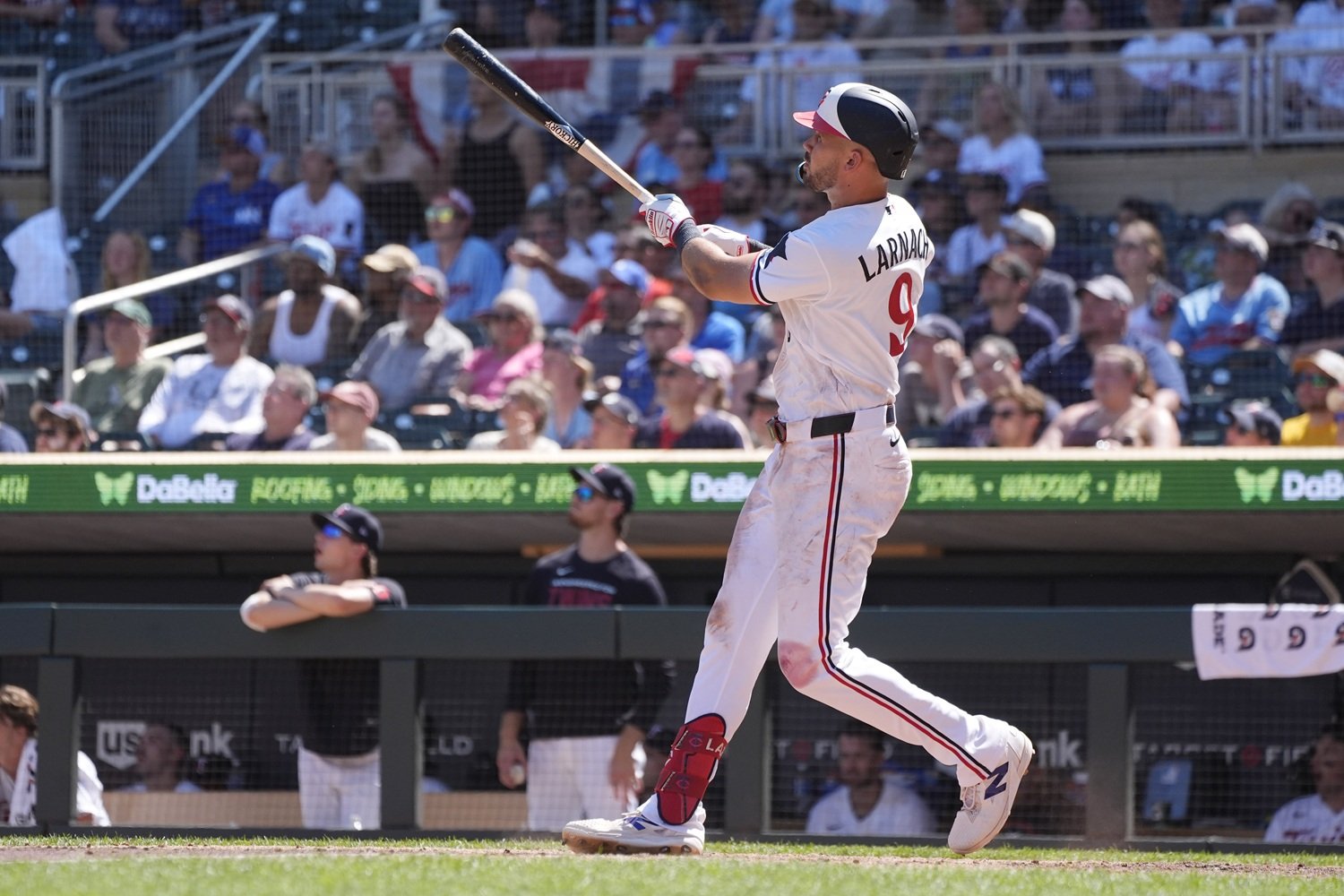
Larnach put together the best offensive season of his career. He posted a 121 OPS+, five points better than his previous career high of 116 in 2024 and finished with a career-best 2.2 fWAR. His home run rate was lower than in previous seasons, but he made up for some of that lost power by cutting down on his strikeouts while posting career highs in batting average and on-base percentage. Larnach sacrificed some power in favor of better plate discipline and getting on base more often.
For a Twins team that struggled with pitching all season, Minnesota needed to rely on its bats to win them ball games, and Larnach certainly did his part. According to FanGraphs, his 2.2 fWAR was worth approximately $17.9 million in value this season, while his 0.49 Win Probability Added ranked fourth on the Twins.
There were certainly some negatives. Larnach struggled defensively, posting career lows with -8 Defensive Runs Saved and -5 Outs Above Average. His offensive production also fell off considerably in the second half, with his .830 first-half OPS dropping to .703 in the second half. The wrist injury that ultimately ended his season may have contributed to those struggles, but regardless the drop-off happened.
Still, Larnach was equally as productive in the first half as he was disappointing in the second. Whatever the reasons for his late-season decline, the season as a whole represented the best offensive performance of his career, and the Twins got it for $4.475 million.
The Twins had questioned whether they needed Larnach when they already had so many left-handed outfielders. Those players never surpassed him. They questioned whether they could better use his salary elsewhere. There were no real alternatives for Larnach's salary number. And they questioned whether Larnach could take his offensive game to another level, which he certainly did.
That doesn't necessarily mean the Twins should bring him back again. Larnach will have another year of arbitration remaining next season, and his salary will likely jump into the $6.5 million to $7 million range. I don't expect the Twins to make that commitment. At that price, the calculus is different, particularly given his defensive limitations and the questions raised by his second half. Additionally, Emmanuel Rodriguez and Walker Jenkins have made the Majors and will be in the plans on Opening Day Next season.
Last January, bringing Trevor Larnach back looked like a questionable use of limited payroll and a roster spot that could have gone to one of the organization's younger left-handed outfielders. After watching the season play out, it looks like the Twins made the right decision. For this season, bringing Trevor Larnach back was worth it.
What do you think? Was bringing Trevor Larnach back for the 2026 season the right decision for the Twins? Leave a comment below and start the conversation!
Are you optimistic about the Twins right now?

Follow Twins Daily For Minnesota Twins News & Analysis



- thelanges5, verninski, nclahammer and 1 other
-
 4
4



Recommended Comments
Create an account or sign in to comment
You need to be a member in order to leave a comment
Create an account
Sign up for a new account in our community. It's easy!
Register a new accountSign in
Already have an account? Sign in here.
Sign In Now