


Twins Video
The Minnesota Twins have officially chosen their direction.
For weeks, the biggest question surrounding this club was whether it would buy or sell at the trade deadline. General Manager Jeremy Zoll answered that question on Wednesday when he told reporters the Twins intend to add to the roster, and Kody Clemens' dramatic walk-off grand slam on Thursday only reinforced why, and we saw the first domino drop Thursday night when the Twins made their first acquisition in left handed reliever AJ Minter. Minnesota is right in the middle of the American League playoff race and has every reason to push for October.
Bullpen help remains the organization's biggest need, even after the Minter acquisition. (Or does it?) The Twins could also use another frontline starter, especially because Joe Ryan has looked a little shaky to begin the second half. After all, the goal isn't just to make the postseason. While Taj Bradley gives the rotation another talented arm, this team could still use another true ace to lead a playoff rotation.
As it turns out, one may actually be available.
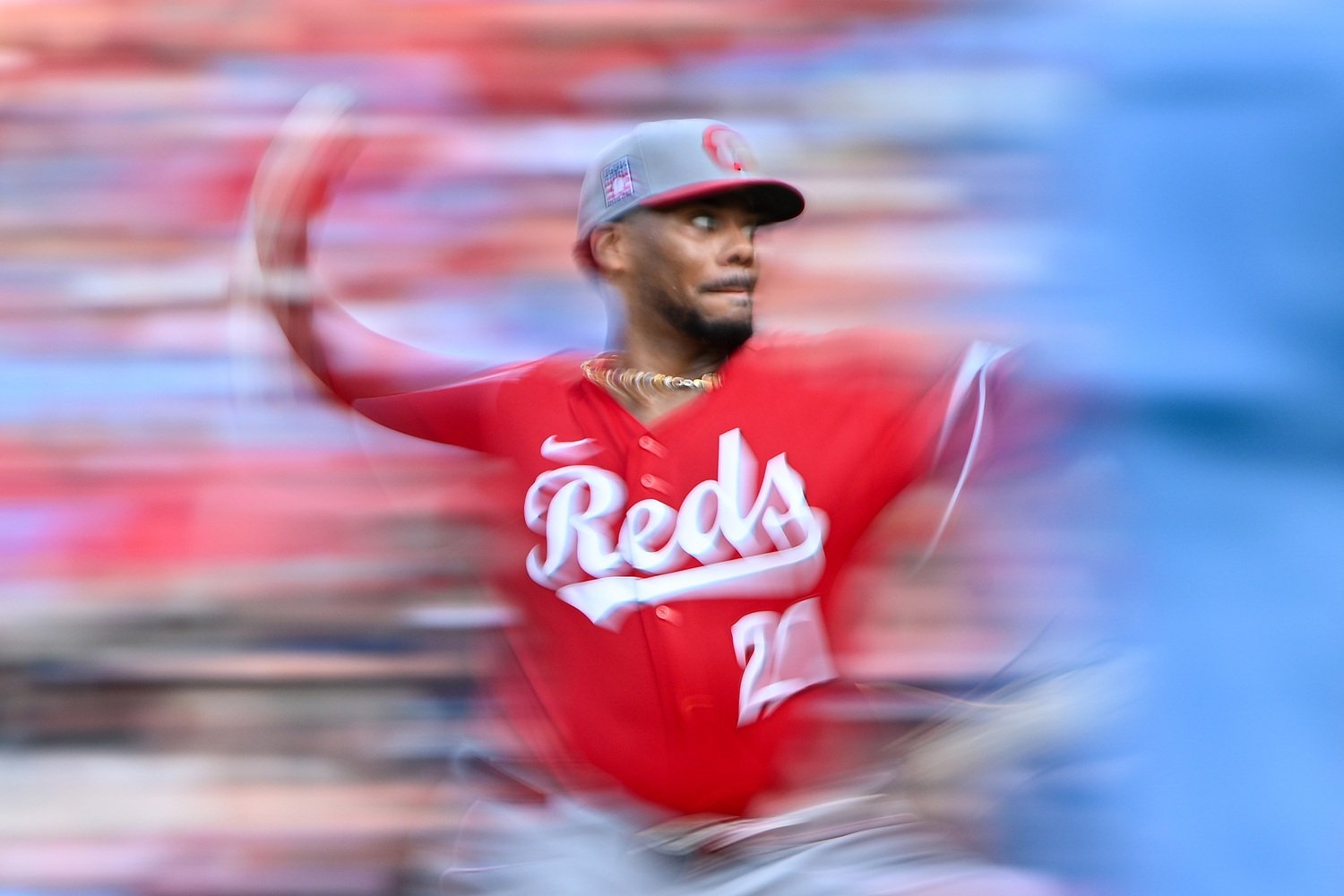
Hunter Greene has become one of the hottest names on the trade market over the last week, and on Thursday the rumors surrounding the Cincinnati Reds right-hander intensified. MLB.com senior reporter Mark Feinsand reported, "The Reds have received interest in former All-Star right-hander Hunter Greene, and according to a source, there's a '50-50' chance he could be moved this week."
If Cincinnati is seriously considering offers, Greene immediately jumps near the top of anyone's list of potential trade deadline targets, and should be considered by the Twins as well.
Greene entered professional baseball with sky-high expectations after being selected second overall in the 2017 MLB Draft, immediately behind Royce Lewis , whom the Twins selected first overall. Injuries slowed his development during the early years of his career, but once he finally stayed healthy long enough to establish himself, he looked every bit like the ace scouts envisioned.
His breakout came in 2024 when he earned his first All-Star selection and finished among the top ten in National League Cy Young voting. Greene posted a 2.75 ERA, accumulated 3.7 fWAR and threw 150 innings while establishing himself as one of the most dominant pitchers in baseball.
He followed that performance with another outstanding season in 2025, although injuries again interrupted things. Greene missed roughly three months with a groin strain, limiting him to just 107 2/3 innings, but he remained incredibly effective whenever he took the mound, posting a 2.76 ERA and an outstanding 0.94 WHIP. Unfortunately, the injuries continued into 2026 when Greene underwent elbow surgery during the offseason and missed the first three months of the year before finally making his season debut at the beginning of July.
There is no getting around the fact that Greene is an injury-prone pitcher. At the same time, there are very few pitchers in baseball with his combination of stuff, age, and upside. His fastball still lives in the upper 90s despite everything his arm has been through. He consistently posts strikeout rates north of 30 percent while pairing that swing-and-miss ability with impressive control, carrying a career walk rate of just 6.2 percent. When Greene is healthy, he doesn't pitch like a No. 1 starter. He pitches like one of the very best pitchers in the sport.
He's also still only 26 years old, and just as importantly, he's signed to one of the best contracts of any frontline starter in baseball. Greene agreed to a long-term extension before his breakout season in 2023 and is under team control through the 2029 season. He is scheduled to make $15 million in 2027, $16 million in 2028, and has a club option worth $21 million in 2029. That is an incredible bargain for an ace. Those salaries are much closer to what teams pay solid mid-rotation veterans like Mitch Keller or Michael Wacha than what they normally pay a pitcher capable of competing for Cy Young Awards.
Of course, there is a reason that contract looks so appealing. Greene's injury history is almost certainly the reason the Reds would even entertain moving him. Teams do not willingly trade away 26-year-old aces with years of affordable control. If Greene had been perfectly healthy throughout his career, there probably wouldn't be a conversation to have.
It's a situation that feels somewhat familiar. When the Twins signed Byron Buxton to his seven-year, $100 million extension, they were betting on elite talent despite an extensive injury history. That risk was exactly what made the contract possible in the first place. Had Buxton been perfectly healthy to that point, he almost certainly would have commanded significantly more money on the open market. The same principle applies here. Greene's durability concerns create substantial risk, but they are also the only reason a pitcher of this caliber is realistically obtainable.
So what would it actually take to land him?
Feinsand provided a useful comparison in his report.
"One American League executive pointed to the White Sox return from the Red Sox in the December 2024 Garrett Crochet trade, which saw Chicago land two Top-100 prospects (Kyle Teel and Braden Montgomery) along with two of Boston's other Top 15 prospects (Chase Meidroth and Wikelman González)."
That feels like a very reasonable framework. Crochet and Greene share several similarities. Both are young, controllable starters with ace-level ceilings and injury histories that add risk to their value. Acquiring either pitcher requires paying an enormous premium because elite starting pitching remains one of the hardest commodities to find anywhere in baseball.
Using that framework, it's possible to build a realistic proposal from Minnesota's perspective. Boston didn't surrender a top-10 overall prospect for Crochet. Instead, the package was built around players ranked No. 25 and No. 54 overall by MLB Pipeline, along with two additional top-15 organizational prospects.
The Twins have a remarkably similar group. Kaelen Culpepper and Emmanuel Rodriguez are currently ranked No. 29 and No. 55 overall by MLB Pipeline, making them the closest comparisons to Kyle Teel and Braden Montgomery. To round out the package, Minnesota could include top-15ish prospects like Khadim Diaw and Ryan Gallagher.
The hypothetical trade would look something like this:
- Twins receive: Hunter Greene
- Reds receive: Kaelen Culpepper, Emmanuel Rodriguez, Khadim Diaw and Ryan Gallagher
There is no sugarcoating it. That is a massive price to pay.
Parting with Culpepper and Rodriguez would sting. Both project as impact major leaguers and have become two of the most valuable prospects in the organization. But prospects ultimately exist for two reasons. Either they become stars for your club or they become the assets used to acquire established stars. There are few players worth cashing in that kind of prospect capital for; however, a 26-year-old ace signed through 2029 may be one of them.
The Twins are also in a position where they could absorb those losses better than many organizations. Marek Houston has enjoyed an outstanding season at Double-A and continues to strengthen his case as the organization's shortstop of the future. The system also features an abundance of left-handed hitting outfielders, making Rodriguez more expendable than he otherwise might be.
The reward could completely reshape Minnesota's future. This October, a playoff rotation featuring Ryan, Greene and Bradley would be capable of matching up with just about anyone in the American League.
Looking ahead to next season is even more exciting. With Greene under contract for three more years after this season, the Twins could enter 2027 with a rotation built around Pablo López, Ryan, Greene and Bradley while continuing to develop Mick Abel, Connor Prielipp and Kendry Rojas behind them.
None of this removes the risk. Greene's injury history is frightening, and there is a very real possibility the Twins could trade away four premium prospects only to watch injuries continue to derail his career. There is also another possibility. Greene stays healthy and pitches exactly the way he has whenever he has been available, like he did just two weeks ago when he threw seven shutout innings with 12 strikeouts against the Cubs. That is the pitcher the Twins would be betting on. If they get that version of Greene, they suddenly possess one of the most dangerous playoff rotations in baseball this season while adding a legitimate ace to build around for years to come.
Moves like this are uncomfortable because they carry enormous risk, but they also have the potential to completely change the direction of a franchise. If the Reds are truly open to moving Greene, the Twins should absolutely be one of the teams picking up the phone.
Would you make a trade centered around Culpepper and Rodriguez for Greene, or is that simply too much prospect capital to surrender? Leave a comment below and start the conversation!









Recommended Comments
Create an account or sign in to comment
You need to be a member in order to leave a comment
Create an account
Sign up for a new account in our community. It's easy!
Register a new accountSign in
Already have an account? Sign in here.
Sign In Now