


Twins Video
This is the second installment of a series looking at what potential trades may look like, should the Twins be buyers come August 3. The last article looked at dream scenarios, which are highly unlikely to happen for a bevy of reasons. Today’s iteration focuses on deals that are much more realistic. As I did last time, I encourage readers to focus less on the specific names and more on the ideas being conveyed by each. All proposed deals are compared to historical examples involving similar players; read more about the candidates referenced on our DiamondCentric Top Trade Candidates rankings.
Trade 1: Finally, a Right-Handed Power Bat At First
- Twins Get: 1B Christian Walker (1.5 years of control, $20 mil AAV) and cash considerations
- Astros Get: C Khadim Diaw, INF Quentin Young
Historical Comparison:
- Brewers Get: 1B Carlos Santana (expiring contract, 97 OPS+, 1.5 bWAR)
- Pirates Get: SS Jhonny Severino (rookie ball; toolsy mid-level prospect with power potential)
There’s a non-zero chance that Christian Walker is cooked, or at the very least well on his way to being so. He got off to a torrid start, posting an OPS of .918 in March and April, with seven home runs and strong defense at first base. But since then, his OPS has dropped every month, reaching its nadir of .599 in July. He also recently exited a game against the Baltimore Orioles with right hip tightness.
Yet, there’s also a non-zero chance that he would provide a significant upgrade at first base, especially on defense. Walker has provided positive value in every season he played as a regular, according to Baseball Savant’s outs above average metric, and ranks in the 77th percentile this summer.
Offensively, his right-handed bat would theoretically platoon well with the likes of Kody Clemens, Victor Caratini, and Josh Bell, though it should be noted that he hasn’t crushed lefties since 2023 (.922 OPS; .756 in 2024; .698 in 2025; .760 in 2026). On the positive side, his bat speed has largely stayed stable over the last three years, dropping from an average of 75.0 MPH in 2023 and 2024 to 74.3 MPH this summer, and his 111 OPS+ is bang-on his career average.
However, his chase rate (31.3%) is the highest it has been in a season in which he’s seen at least 1,000 pitches, and his slugging average (.446) has greatly outperformed his expected value (.374), suggesting a reduced pitch recognition ability and that his numbers have been inflated by luck.
Carlos Santana was also well into his 30s (37, compared to Walker’s 35) when he was shipped from Pittsburgh to Milwaukee at the 2023 deadline. Like Walker, he had a relatively disappointing first half of the season (.235/.321/.412; 97 OPS+), but he turned it around with the Brewers (.249/.314/.459; 108 OPS+). He went on to sign with the Twins during the offseason and grew into a Gold Glove-caliber first baseman.
As Santana was a pending free agent with middling numbers, Milwaukee only had to part with 18-year-old Jhonny Severino, who was rather raw but possessed significant power potential, not unlike Quentin Young. It’s unlikely the Twins would want to take on all of the roughly $26 million still owed to Walker over the remainder of his contract, so trading from their depth at catcher might entice Houston to eat some of his salary.
QuoteChristian Walker, Astros
1B Age: 35 FA: Nov 2027 Sal: $20m
In the first year of a three-year, $60-million deal with Houston, Walker looked like an absolute bust of a signing. But that was last year. This season, the strapping slugger is back to hitting just fine, even for a first baseman, and he once again looks like a plus defender at the cold corner, despite his age. Widely lauded for his makeup and approach to being a teammate, Walker seems to have gone through an unexpectedly tough adjustment to life in Houston and to the pressure of being a major offseason signing by a perennial powerhouse. Now, though, he’s resumed normal service—just in time, perhaps, for Houston to pounce on its chance to move on. With the Astros fading in even the tepid AL Wild Card race, a deal to get Walker onto a good team where he can have another big October moment seems wise for all involved. Knowing the risks are very real, though, any suitor is likely to ask that Houston pay down the money left on Walker’s deal.
Trade 2: A Fifth Starter for When the Fifth Starter Can’t Go
- Twins Get: LHP Foster Griffin (expiring contract, $5.5 mill AAV; 17.8% K-BB%)
- Nationals Get: INF Billy Amick, OF Luis Fragoza
Historical Comparison:
- Cubs Get: RHP Mike Soroka
- Nationals Get: OF Christian Franklin (team top 20-30 prospect), SS Ronny Cruz (18-year-old rookie baller who turned into a top 100-150 prospect)
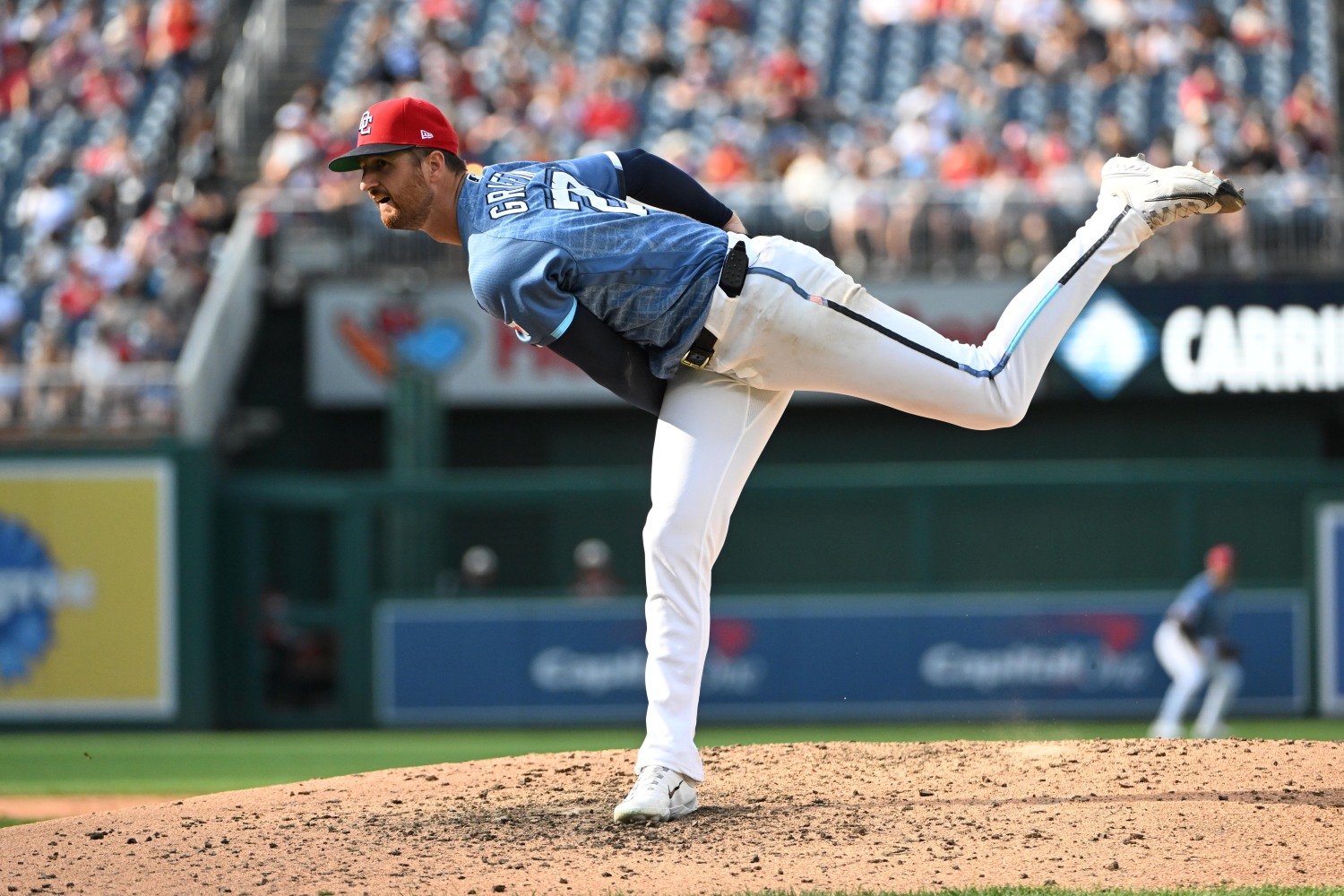
Foster Griffin played the previous three seasons in Japan after failing to earn a consistent role with the Kansas City Royals and Toronto Blue Jays. He has been an absolute revelation for the Nationals this summer, posting a 2.76 ERA across 124 innings to date, en route to being named to the National League All-Star team.
However, there is plenty of reason to be skeptical that his performance to date is legitimate. For starters, while his ERA is stellar, his xERA (3.93) and FIP paint an entirely different picture. His solid K-BB% is carried more by an elite walk rate (5.6%) than by his strikeout rate (22.6%). His cutter is a legitimately great pitch (+13 Run Value, .386 SLG, .279 wOBA) while his other six pitches are average, at best. In short, while his surface numbers propelled him to the All-Star Game, his underlying metrics suggest he’s much more of a backend starter.
Even so, Griffin would provide much-needed starter depth for the Twins, who have struggled to keep their pitchers healthy at times this season. Connor Prielipp is already reaching a new career high in seasonal workload. Mike Paredes filled in admirably as the team’s spot starter and occasional fifth option, but he's now out for what could be the rest of the season. Adding Griffin would give the Twins some breathing room, should another injury beset them.
Teams moving a fourth or fifth starter for a low-end prospect or two occurs multiple times at every trade deadline. For example, last year the Nationals sent former All-Star Michael Soroka to the Cubs for two low-end prospects. Soroka went on to throw only 8 ⅓ innings for Chicago, while Ronny Cruz developed into an interesting prospect in the Nationals system. Sometimes, that’s the game teams play when they trade teenagers at their rookie ball complexes. Most flame out, but some turn into good ballplayers.
QuoteFoster Griffin, Nationals
LHP Age: 30 FA: Nov 2026 Sal: $5.5m
With seven pitches and good enough command of the mix to limit walks, Griffin has been a revelation for the upstart Nationals, akin to when Erick Fedde first came back from Asia for the 2024 White Sox. Teams will take an interest in him, as they did with Fedde, but they’re likely to remain circumspect; Fedde (and some other pitchers of a similar echelon who came back to quick success after stints in either NPB or the KBO) crashed hard to Earth once the league got a longer look. Griffin’s arsenal is deep, but he doesn’t throw hard or miss a ton of bats. He’s a free agent at season’s end, though, and the contract he signed is extremely affordable. If Washington believes they can pursue their flickering chances in the NL Wild Card race just as well without him, they might be persuaded to deal him, and there are several teams for whom he’d be an upgrade at the back end of the rotation over the final two months. He might even make a profitable transition to the bullpen in October.
Trade 3: A Pulse In the Bullpen With a Chance to Stick Around
- Twins Get: RHP Antonio Senzatela (2027 club option, $10.1 AAV) and cash considerations
- Rockies Get: OF Yasser Mercedes
Historical Comparison:
- Cubs Get: LHP Taylor Rogers (2.45 ERA, 4.17 FIP, 10.3 K-BB%)
- Pirates Get: OF Ivan Brethowr (low-level prospect)
Antonio Senzatela is in the midst of the best season of his 10-year career, largely thanks to a move to the bullpen and a new reliance on his cutter. His cutter usage has jumped from 42 total pitches in 2025 to 233 in 2026, his second-most used pitch behind his no-good, very-bad four-seamer (it averages slightly north of 97 MPH, but it's the epitome of a “dead zone” fastball—at least in Colorado). It’s helped him produce a 3.53 ERA and 3.48 FIP, which would play very well in the Twins’ bullpen.
His K-BB% is a meager 13.7%—though that is the best mark of his career—and his HR/FB ratio is a likely unsustainably low 5.5%, ranking 31st out of 175 qualified relievers. He’s a classic example of a viable big-league bullpen arm who is probably outperforming his true talent and could be had for a reasonable price at the deadline.
Throw a stone, and you’ll hit a trade that compares to this one. Take the example above, in which an outperforming Taylor Rogers was swapped for a minor prospect 1.5 years from Rule 5 eligibility. These are the types of moves that teams who are looking for a cheap, high-ceiling, low-floor bullpen addition make all the time. The benefit for the Twins is that they’d have a few months to see if Senzatela would be worth picking up next year's club option. If not, it would be little skin off their back.
QuoteAntonio Senzatela, Rockies
RHP Age: 31 FA: Nov 2026* Sal: $12m
Quick, someone rescue this guy from Coors Field and see if there’s even more to unlock. After a career full of promise (enough so that he signed a long-term deal with the Rockies in 2021) but often sidetracked by injuries and/or pitching at elevation, Senzatela has embraced a move to the bullpen and taken off this year. He still throws 97 with his four-seam fastball, but now, he pairs that with a vicious cutter in the 92 MPH range, which both misses some bats and induces ample weak contact. If he never (or very rarely) had to pitch in Colorado, his four-seamer might even turn out to be the good pitch everyone briefly hoped it would turn out to be. He’s stuffed the strike zone and begun manipulating swings better by simply relying on power out of the pen. A team picking him up would have a chance to benefit from his experience working multiple innings come September and October, and in November, they’d even have a chance to retain him for $14 million in 2027. That’s a high price for a middle reliever, but if he shows you two months of relief ace-caliber work after escaping Colorado, you might give that a shot—or even move him back to the rotation at age 32.







Recommended Comments
Create an account or sign in to comment
You need to be a member in order to leave a comment
Create an account
Sign up for a new account in our community. It's easy!
Register a new accountSign in
Already have an account? Sign in here.
Sign In Now