


Twins Video
Not long ago, I made the case for appreciating Luke Keaschall as a bit of a throwback: a player who can really, really hit, and who is therefore worth making room for at all times—even though he's going to hurt you no matter where you put him in the field. However, that piece was about Keaschall, the defensive nomad, and especially Keaschall, the right fielder who might well become a left fielder next season. The time Keaschall spent in center field, while Byron Buxton was on the injured list, was on another level of awful—an untenable one, akin to his work at second base before the team moved him into the grass earlier in the season. Keaschall's bat is worth forcing into the lineup, but you have to do it by hiding him in a corner outfield spot, or at designated hitter. He can't be your center fielder.
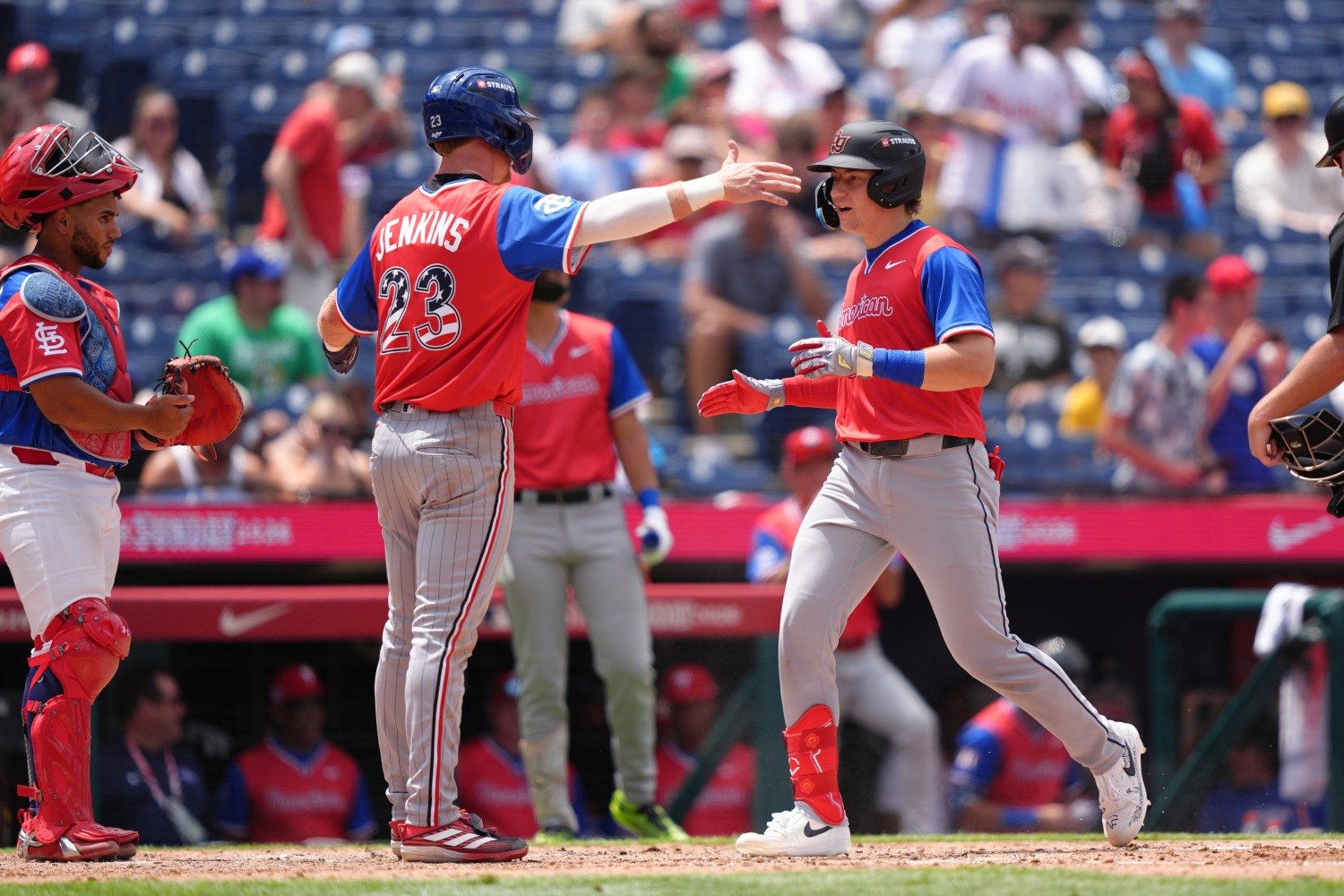
The Twins know that, too. Once Buxton returned from the IL earlier this month, they shunted Keaschall back to right. They kept playing Buxton in center whenever he was fit enough to be in the lineup, despite his own obvious limitations, because they knew they didn't have another viable center fielder on the active roster. All the while, momentum built toward a Walker Jenkins promotion, which would give the team a much more solid defensive option in center on non-Buxton days down the stretch. (For that matter, so would promoting Emmanuel Rodriguez.) If the team had been playing at home this week, Jenkins might have been called up already.
Instead, though, the team has been on a six-game, eight-day road trip to San Diego and West Sacramento. They clearly preferred to survive this trip with their existing outfield options, including Buxton, Keaschall, Trevor Larnach, Alan Roden, and utility men Kody Clemens and Ryan Kreidler. It sounds silly, but even in the midst of a pennant race, teams try not to turn the roster inside-out during trips that involve difficult or lengthy travel. It's not about costs, of course. It's a little bit about logistics. Most of all, though, it's about the rhythm of the season and the tenor of a clubhouse. Big changes work best when they happen on off days, and they work best when they don't change the layout of a clubhouse in which a team is already only spending a few days. That Minnesota was playing the Athletics in quasi-minor-league surroundings made that an especially important consideration this week.
Thus, when Buxton pulled up lame Tuesday night, it had to hit the top people in the Twins front office like a sock full of nickels. The timing was terrible. It was clear, even as Buxton limped off the field, that he would be unavailable Wednesday. That left the team with an unwelcome dilemma: make a quick move and get Jenkins (or Rodriguez) to West Sacramento in under 24 hours, only to leave town another few hours later; or ride it out for one more game without the only center fielder they really trust.
As you already know, they chose the latter. Keaschall started in center Wednesday night. It was a copout, in a way. The team was just kicking the can down the road. That's understandable, under the circumstances, and they could easily have gotten away with it. Unfortunately, the universe was in a bad mood, and it decided to punish their choice harshly. In fairness, though, Keaschall made them an appealing target for that kind of karmic thwack to the forehead.
The rubber game of a series the Twins could not afford to lose was decided in the bottom of the sixth inning. There was already danger afoot, some of it caused by Keaschall. The A;s had collected three hits in the frame, including one fly ball that landed well in front of Keaschall partially because Keaschall had been playing exceptionally deep. They'd pulled to within one run; it was 4-3 Twins. There were two outs and two on, and Andrew Morris just needed to find one more out to escape the jam. Alika Williams hit a long fly ball to center. You already know what happened.
Keaschall didn't take a good initial angle, and he didn't adjust quite enough. He still (basically) got there, though—and then failed to catch it, anyway. Statcast will be a bit more generous to him once it accounts for the fact that he was going back on the ball and was close to the wall, but its initial assessment is that the ball had an 85% catch probability, based on the hang time and where Keaschall began the play. Even if you call it a 50/50 proposition, the fact is that Keaschall didn't catch it. Two runs scored, and the A's had the lead they would hold onto for the rest of the game.
If that ball is caught, the Twins have a 70% chance of winning the game, based on win expectancy matrices from Tom Tango. Once he didn't, the A's had a 73.8% chance. That's a difference of 43.2% in win probability for the Twins, and if we call the play a coin-flip for an average center fielder, we can say that when the ball left Williams's bat, the game itself was a near coin-flip. Keaschall's failure to make the play had a -0.216 WPA, though official WPA only assigns value to hitters and pitchers and ignores defense. Having Keaschall in center cost the Twins that game.
In the wake of that loss, the team woke up Thursday with just a 7.1% chance to make the postseason, according to Baseball Prospectus's PECOTA-fueled projected standings. That figure was 31.5% just a week ago. Losing five of six on the road trip torpedoed the team's chances, and a major reason for one of those losses was a very avoidable failure based on the team being too patient—not quite desperate enough, to put it one way.
This isn't the only game Keaschall has cost the team with his glove this year. In addition to some atrocious plays at second and in right, he also failed to catch a ball that has to be caught in the bottom of the eighth inning against the Brewers earlier this month. It fell in front of him for a single, and that hit later turned into the game-winning run for the Brewers.
Playing Keaschall in center as much as they have is a case of the team being too willing to roll the dice and play the long game. That's part of the responsibility the front office faces, in a year when they're hardly a juggernaut. They have to think about the long-term future. This is not a year in which to go all-in. But another of their responsibilities is to recognize places where they can give this year's team the best possible chance to convert on their opportunity to reach the postseason, without hurting their future prospects. This was one of those chances. They should already have called up Jenkins, who could be taking playing time from their lousy left-hitting corner outfielders and covering for them defensively in center. They should certainly have called him up when Buxton got hurt Tuesday night. They didn't, and if they miss the playoffs by one game, we can also say they missed it by one play—a ball that should have been caught, and would have been, had the right player been placed there to catch it.
Do you approve of the job Derek Shelton is doing as Twins manager?

Follow Twins Daily For Minnesota Twins News & Analysis



- glunn, TNtwins85, Cory Engelhardt and 1 other
-
 4
4



Recommended Comments
Create an account or sign in to comment
You need to be a member in order to leave a comment
Create an account
Sign up for a new account in our community. It's easy!
Register a new accountSign in
Already have an account? Sign in here.
Sign In Now