


Twins Video
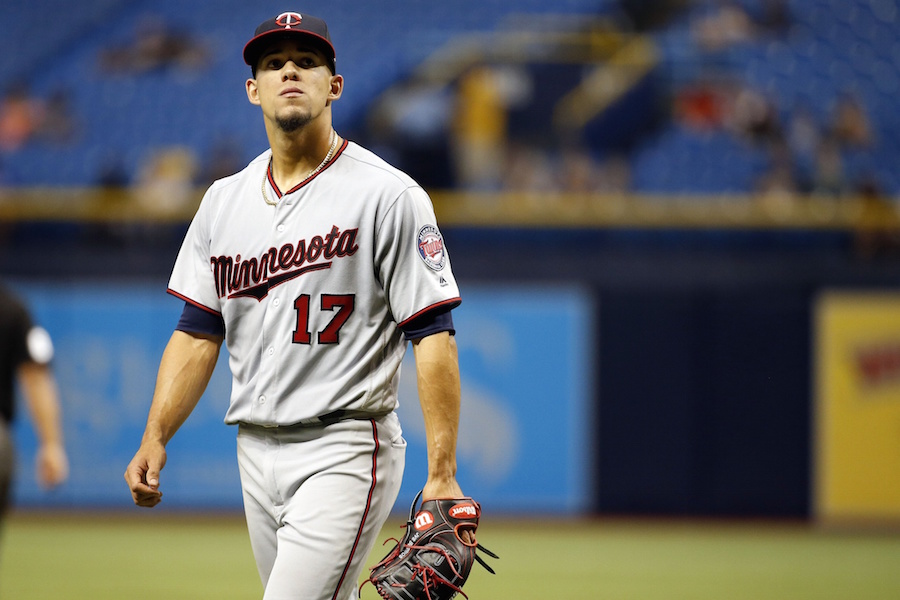
Jose Berrios arrived in the majors in 2016 at age 22. He went on to post an 8.02 ERA in 14 starts as a Twin. Must have been rushed.
Byron Buxton reached the big leagues a year earlier in 2015, at age 21. He posted a brutal .576 OPS in 46 games with Minnesota. Had to be rushed.
And last season, as Jorge Polanco slogged his way to the end of July, one of the worst hitters in baseball, we all found ourselves wondering: Should the 23-year-old really be playing at the highest level right now? (Not that the Twins had any choice in that case.)
The "rushed" narrative is convenient. But not always accurate.
Here's the problem: You send any of those guys back to Triple-A at the time they're flailing in the major leagues, and they dominate. Often to the point where you stop seeing any benefit.
Buxton is a .331 career hitter at Triple-A. What's he learning if you send him back there? Minor-league batters waved at everything Berrios threw. How's he going to improve his command when 10 inches off the plate works perfectly well? Would Polanco have had the same epiphany last August if he hadn't endured the humbling stretch of failure that led up to it?
These case studies hint toward a universal truth: Sometimes, the only way to become a successful big-leaguer is by working through your lumps in The Show. For a team like the Twins, deep into its rebuild-from-within, this presents a paradox.
An Inefficient Market
The immense value of an effective young starting pitcher in today's game is difficult to overstate.
Successfully develop your own quality rotation staple, and you get optional control over (roughly) ages 24-through-30, most likely the best years his arm will ever see. All for a bit more than Jordan Zimmermann will earn this year alone in Detroit at age 32.
Baseball's economics are out of whack, if you haven't noticed. If this was an elephant in the room, then the beast has now emerged into the sunlight.
There's a reason Lance Lynn and Alex Cobb continue to wallow in free agency, their demands unmet. There's a reason the Rays are able to command a kingly sum for Chris Archer. Teams are finally seeing the lopsided value chasm across the free agency divide. Or at least, they're finally awakening to the extreme financial implications.
My point here is that the Twins have every incentive to find out if Gonsalves or Romero – or Zack Littell, or Lewis Thorpe, or any number of other candidates – can become one of those treasured cheap young rotation staples. But finding out will require enduring some pain.
Fits and Starts
A few years ago, Peyton Manning retired with the most passing yards and touchdowns in NFL history. Nearly two decades prior, as a 22-year-old rookie, he threw a league-leading 28 interceptions as Colts fans endured a 3-13 death march.
In many cases, even the greats require seasoning at the highest level to reach their potential. Not everyone is LeBron James or Randy Moss or Madison Bumgarner. It's unlikely such a rare specimen is currently in the Twins system.
They have do have a number of guys capable of becoming quality big-league arms – perhaps even All-Stars. But history tells us it won't happen right away. Look back at virtually any big-name Minnesota pitcher you can think of from the past two decades – Francisco Liriano, Matt Garza, Johan Santana, Brad Radke – they all finished with ERAs over 5 in their first MLB seasons.
They call the pitching mound a "hill" partially because of its shapely resemblance, but also because reaching the top can be a strenuous climb.
Trouble with the Curves
Gonsalves is going to open this season in Rochester. Romero is likely ticketed for Chattanooga, but with two dozen starts already under his belt there, he'll move up quickly. They're both still only 23, but Minnesota's top two pitching prospects could be making cases for promotions by July or so. We'll undoubtedly start hearing calls for them if anyone in the Twins rotation isn't pulling his weight.
At that point, Twins decision-makers will need to weigh some difficult considerations. Do you leave these talented hurlers down on the farm, even if they're mowing down the International League, knowing the likely outcome of a call-up?
There's always something to work on, always something to improve. Nothing wrong with waiting another year until they're 24 and a bit more refined, right?
The problem here is that you might only be delaying the inevitable: a date with MLB's harsh learning curve. And there's another curve to think about here: aging. Pitchers generally experience their best years earlier than hitters. Velocity trends downward pretty much after age 20. If Gonsalves and Romero are healthy and throwing hard this summer, you don't necessarily want to waste a bunch of their bullets in the minors.
Derek Falvey's analytically-minded pitching brain trust has access to far more data than me, and I trust them to take it seriously. It will be interesting to see how these realities weigh against a variety of other factors – a team in contention, a potentially crowded rotation scenario following returns of Ervin Santana and Trevor May, the unique ability of a stud like Romero to impact a division race if he can buck the trend and succeed immediately.
Sometimes, you've gotta rush a little to get where you're going on time.





Recommended Comments
Create an account or sign in to comment
You need to be a member in order to leave a comment
Create an account
Sign up for a new account in our community. It's easy!
Register a new accountSign in
Already have an account? Sign in here.
Sign In Now