


Twins Video
If you've watched the Twins broadcast this season (or at least have fond memories, as it remains blacked out), perhaps you recall hearing Cory Provus say this (as I have noticed quite a few times): “And Santana will take it himself, as he often does.”
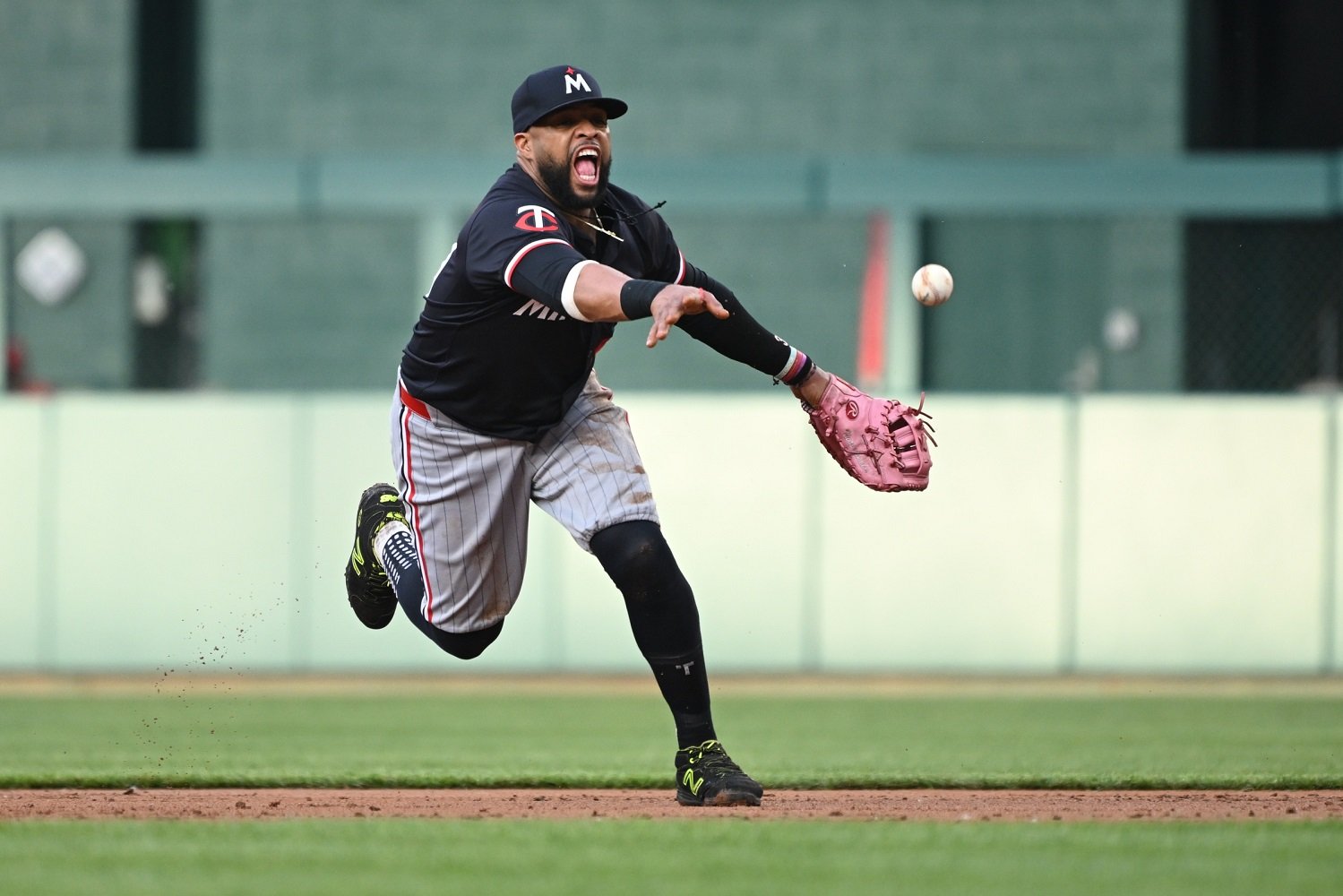
Provus is, of course, referring to the Twins' primary first baseman, Carlos Santana, whose excellent defense has made up for his lagging offense. But Provus’s point was getting at something different. If a grounder is hit at Santana near first, he is more likely to get up and make for the bag rather than make the toss to the pitcher to get the out.
Occasionally, as we saw in Thursday’s win over the Royals, this can be quite spectacular to watch:
But sometimes, in cases where a toss would be easier, Santana will take it himself:
But this remark got me asking: is it true? Does Santana actually lead the league in what TD Managing Editor Matt Trueblood and I have coined as the TiH (Take it Himself) Rate? Or is Cory Provus a liar, deceiving audiences everywhere with claims to create the wrong perceptions to poison this beautiful game? (If you’re reading this, Cory, this a joke and we love you here at TD. Even if Cory's not reading this, we love him.)
Choosing whether to make the run to first is a split-second decision. It depends on the position of the first baseman, the speed of the batter, whether the pitcher is hustling over, how the ball was hit, and well, a lot of things. It's always a risk. In one costly decision earlier this season, Santana tossed it to pitcher Simeon Woods Richardson, whose run had briefly paused earlier and thus allowed a single:
But sometimes Santana is just playing nice with the pitcher, who perhaps wants a reward for his little hustle:
In trying to look at the obvious statistics, such as Exit Velocity or Expected Batting Average, there was no obvious pattern to when Santana made which choice. But we can use two key stats from Statcast—hc_x and hc_y—alongside a little trigonometry to estimate the Spray Angle of the ball (with the higher number essentially closer to first base and the foul line). We can thus evaluate whether the proximity to first base matters:

As we can see here, the spray angle does certainly make a difference, though not always. In the examples closer to second, Santana usually waits a bit on soft contact to field the ball, thus requiring the pitcher to head over and the toss to be made:
But what is most remarkable in this data is the overlap space. And we can certainly see from the data points that Santana has a positive TiH. But does he have one higher than the rest of the league? What exactly is an average TiH%?
Using Baseball Savant, I was able to take every single grounder to first this season by any player (this data also removed singles and errors like the one with Woods Richardson above, so there is potential for more to be examined here). After removing those who had yet to have many opportunities, we can see where Santana ranks among this season’s first basemen:
| Player | Team | Opportunities | TiH Count | TiH% |
| Encarnacion-Strand, Christian | Cincinnati | 34 | 24 | 70.6% |
| Montero, Elehuris | Colorado | 32 | 22 | 68.8% |
| Cronenworth, Jake | San Diego | 57 | 38 | 66.7% |
| Díaz, Yandy | Tampa Bay | 42 | 27 | 64.3% |
| Olson, Matt | Atlanta | 56 | 36 | 64.3% |
| Walker, Christian | Arizona | 78 | 50 | 64.1% |
| Vaughn, Andrew | Chi White Sox | 50 | 32 | 64.0% |
| Santana, Carlos | Minnesota | 54 | 34 | 63.0% |
| Flores, Wilmer | San Francisco | 38 | 23 | 60.5% |
| Busch, Michael | Chi Cubs | 50 | 30 | 60.0% |
| Tellez, Rowdy | Milwaukee | 40 | 23 | 57.5% |
| Schanuel, Nolan | LA Angels | 40 | 23 | 57.5% |
| Naylor, Josh | Cleveland | 51 | 29 | 56.9% |
| Alonso, Pete | NY Mets | 56 | 31 | 55.4% |
| Mountcastle, Ryan | Baltimore | 49 | 27 | 55.1% |
| Torkelson, Spencer | Detroit | 50 | 26 | 52.0% |
| Goldschmidt, Paul | St. Louis | 58 | 30 | 51.7% |
| Lowe, Nathaniel | Texas | 37 | 19 | 51.4% |
| Guerrero Jr., Vladimir | Toronto | 34 | 17 | 50.0% |
| Bell, Josh | Miami | 33 | 16 | 48.5% |
| Harper, Bryce | Philadelphia | 64 | 31 | 48.4% |
| Pasquantino, Vinnie | Kansas City | 47 | 22 | 46.8% |
| France, Ty | Seattle | 56 | 23 | 41.1% |
| Rizzo, Anthony | NY Yankees | 57 | 19 | 33.3% |
| Freeman, Freddie | LA Dodgers | 64 | 19 | 29.7% |
| Wade Jr., LaMonte | San Francisco | 34 | 10 | 29.4% |
As it turns out, Provus is on the right track. Santana sits at 63%, in about the top third of regular MLB first basemen. His rate is especially high when compared to some of the league’s better-known first basemen like Freddie Freeman and Anthony Rizzo; the shorter and slower Santana is, in fact, more than twice as likely to hustle the ball to first than toss it to the pitcher.
Of course, 2024 provides a small sample size. What happens when we go back to the 2023 season and put Santana’s time between the Pirates and the Brewers in context?
| Player | Team | Opportunities | TiH | TiH% |
| Cronenworth, Jake | San Diego | 96 | 75 | 78.1% |
| Pratto, Nick | Kansas City | 79 | 61 | 77.2% |
| Flores, Wilmer | San Francisco | 73 | 53 | 72.6% |
| Cooper, Garrett | Miami / San Diego | 74 | 53 | 71.6% |
| Gurriel, Yuli | Miami | 73 | 51 | 69.9% |
| Abreu, José | Houston | 141 | 97 | 68.8% |
| Noda, Ryan | Oakland | 83 | 56 | 67.5% |
| Vaughn, Andrew | Chi White Sox | 146 | 98 | 67.1% |
| Olson, Matt | Atlanta | 169 | 112 | 66.3% |
| Walker, Christian | Arizona | 158 | 103 | 65.2% |
| Guerrero Jr., Vladimir | Toronto | 119 | 77 | 64.7% |
| Naylor, Josh | Cleveland | 94 | 59 | 62.8% |
| Wade Jr., LaMonte | San Francisco | 128 | 74 | 57.8% |
| Santana, Carlos | Pittsburgh / Milwaukee | 175 | 99 | 56.6% |
| Díaz, Yandy | Tampa Bay | 119 | 66 | 55.5% |
| Torkelson, Spencer | Detroit | 120 | 62 | 51.7% |
| Lowe, Nathaniel | Texas | 151 | 74 | 49.0% |
| Mountcastle, Ryan | Baltimore | 112 | 53 | 47.3% |
| Casas, Triston | Boston | 128 | 59 | 46.1% |
| Goldschmidt, Paul | St. Louis | 161 | 73 | 45.3% |
| Tellez, Rowdy | Milwaukee | 70 | 31 | 44.3% |
| France, Ty | Seattle | 152 | 65 | 42.8% |
| Freeman, Freddie | LA Dodgers | 160 | 67 | 41.9% |
| Smith, Dominic | Washington | 164 | 66 | 40.2% |
| Alonso, Pete | NY Mets | 163 | 62 | 38.0% |
| Rizzo, Anthony | NY Yankees | 122 | 38 | 31.1% |
Here we notice a few things. Firstly, Santana’s rate is notably higher so far this year than it was in 2023, only taking it to first base just over half the time (he also notably had the most opportunities for a TiH at 175). We also can see that for those with the most playing time—such as Matt Olson, Christian Walker, and José Abreu—a top rate ends up around 65-69%, which Santana currently sits just under for the season. The exception is Jake Cronenworth, who both this and last year is a league leader in TiH%. That might make sense—the former shortstop has been an elite second baseman for the team but currently finds himself over at first due to an influx of shortstop prospects on the team.
So, Santana has been "better" (more TiH-y, anyway) this year, but what can we expect career-wise? Santana began playing first base with regularity in 2015, so we can look at his historical TiH% with each team he’s played with:

Here we can see that once Santana got to a point of playing first base with some regularity, he has always been above-average in TiH rate. It seems to vary by team, and while we might speculate that the Guardians and the Mariners have above-average pitching (and thus create above-average TiH rates), nothing can explain Santana's monster 2021 season--wherein he Took It Himself on 92 of 122 opportunities (the Royals had an abysmal pitching staff that year).
But then there’s one last question: where does Carlos Santana rank among the Twins greats? Provus has been calling for the squad since 2011; surely he knows a high TiH-er when he sees one. This is where things are a bit surprising:
| Player | Opportunities | TiH | TiH% |
| Miranda, Jose | 63 | 54 | 85.7% |
| Sanó, Miguel | 170 | 132 | 77.6% |
| Arraez, Luis | 51 | 39 | 76.5% |
| Cron, C.J. | 118 | 86 | 72.9% |
| Cuddyer, Michael | 172 | 117 | 68.0% |
| Vargas, Kennys | 102 | 69 | 67.6% |
| Kirilloff, Alex | 92 | 61 | 66.3% |
| Parmelee, Chris | 117 | 75 | 64.1% |
| Santana, Carlos | 54 | 34 | 63.0% |
| Colabello, Chris | 51 | 30 | 58.8% |
| Morneau, Justin | 639 | 354 | 55.4% |
Santana ranks near the bottom in TiH Rate for Twins first basemen, notably lagging behind recent regulars like José Miranda and Luis Arráez (who has played notably less first base this year, but has a perfect 12 for 12 TiH Rate in 2024). However, Santana does rank behind both Minnesota greats, including Cory’s broadcast partner Justin Morneau, who put up a middling 55%. Does Cory mention it less when Glen Perkins or LaTroy Hawkins is in the booth instead? Perhaps Cory’s comments are meant to remind Justin how little he hustled in his career! (Justin, if you're reading this, this is also a joke. If Justin isn't reading this, though, screw him.)
We do have to finally ask: is there any value in TiH%? Are you more likely to win a Gold Glove with a high TiH%? That might require a further study to link up the quality of first basemen and other defensive metrics with their actual performance. On the other hand, TiH could also be described as the ultimate eyewash. After all, Freddie Freeman is considered one of the best first basemen in the game, and he has one of the lowest TiH rates in the game. Watch Anthony Rizzo make the game's most frequent, fluid, flawless feeds to pitchers a handful of times, and you could convince me that that toss is an art form as worthy of praise as the hustle and assertiveness of Taking It Oneself.
There's no reward for TiH, or for the pleasing parabola of a Rizzo flip—each way results in an out. But maybe it can tell us something a little about the stylistic choices of first base defense. If nothing else, it's a fun thing to file away, as a fan trying to get into closer contact with the game.
So here’s to you, Cory! You (mostly) got it right about Carlos. And we’ll be watching TiH% throughout the season, and we hope you will keep up as well.







Recommended Comments
Create an account or sign in to comment
You need to be a member in order to leave a comment
Create an account
Sign up for a new account in our community. It's easy!
Register a new accountSign in
Already have an account? Sign in here.
Sign In Now