


Twins Video
Statcast has provided fans with an inside look at some of the metrics teams have had access to in recent years. Defensive metrics, batted-ball data, and movement profiles on pitches have helped to bring deeper baseball conversations to the forefront for everyone from diehard to casual fans. Obviously, some fans don’t care about the game’s minutiae, but it’s reassuring that more fans have access to the data if they want to find it.
Earlier this week, Statcast released a new baserunning metric called Baserunning Run Value. It goes far beyond just stealing bases and taking an extra base on a hit to the outfield. So, how does Statcast describe its new metric?
Quote
What is this? A Statcast metric designed to express the overall value of a baserunner, measured in runs created (or lost) via stealing bases and taking extra bases on the basepaths.
How this works: Each steal opportunity is assigned a probability of being successful or not based on several inputs, including the speed of the runner and his lead distance. Each successful or failed steal attempt is assigned a run value, with a stolen base or advance via a balk worth +0.2 runs for the baserunner and a caught stealing or pickoff worth -0.45 runs.
For non-steal baserunning plays, an estimated success probability is generated for each opportunity using inputs that include runner speed, outfielder throwing arm, runner position on the basepaths and outfielder distance from both the ball and the bases. That can be translated to a run value based on whether the runner successfully takes the extra base, is thrown out or does not attempt to advance (holds).
How to read it: Baserunning Run Value is a combination of both categories of baserunning -- stolen bases and extra bases taken -- into one overall value number.
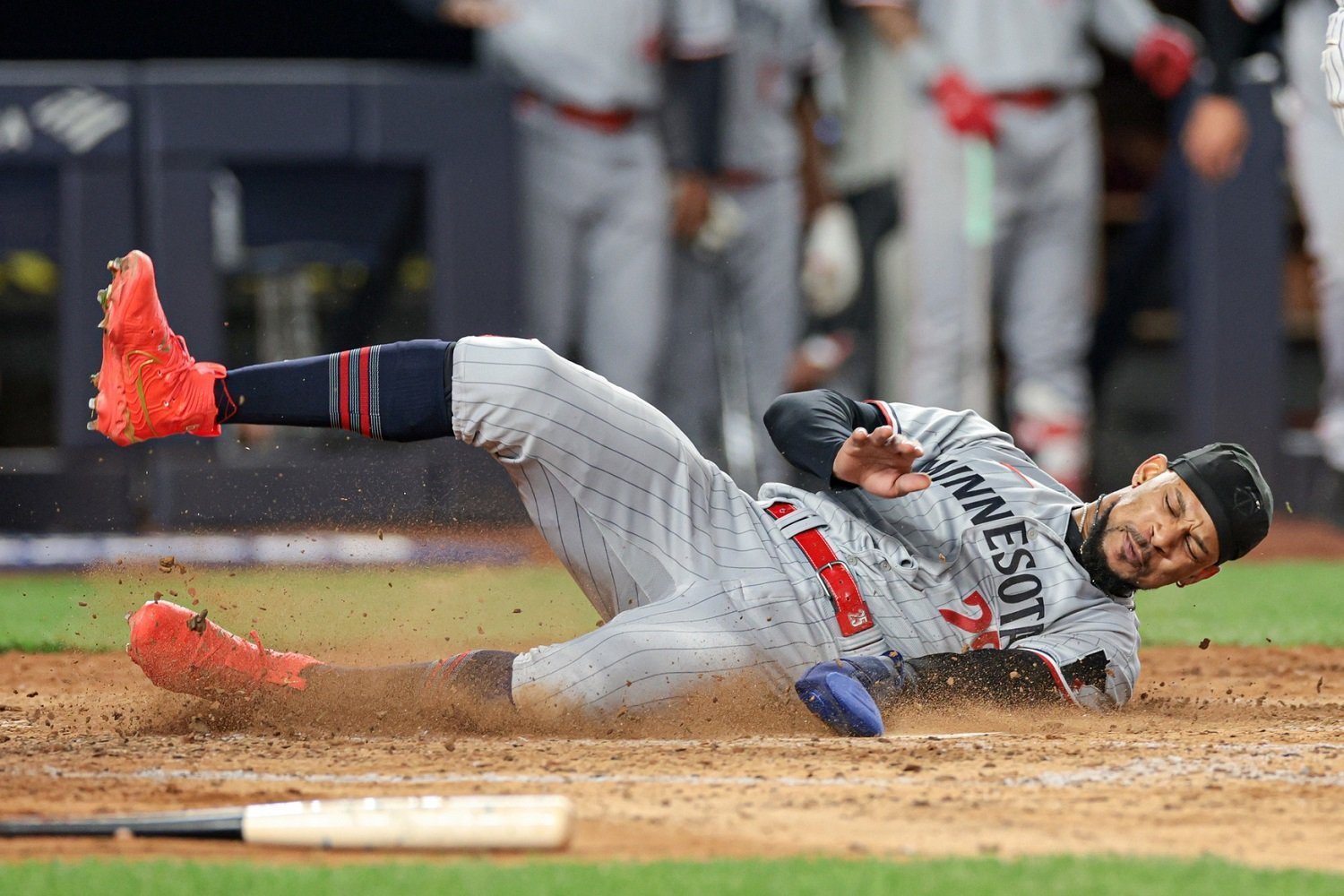
According to Baserunning Run Value (BRV), the Twins had three positive runners in 2024, with Byron Buxton leading the team (3 BRV), followed by Austin Martin (1) and Manuel Margot (1). All three runners earned their value by taking extra bases, as none provided any net value from stolen bases. Buxton isn’t a surprise to anyone as the team’s best baserunner, but Martin and Margot are slightly surprising guys to find near the top of the team’s leaderboard.
On the opposite end, there were eight players with negative Baserunning Run Value for the Twins. José Miranda had the lowest total, with -2 runs via extra bases taken and -1 runs via stolen bases. Kyle Farmer and Christian Vázquez finished with -2 Baserunning Run Value, which shouldn’t come as a surprise based on their player type. However, there were some surprises on other parts of the leaderboard.
Willi Castro was a revelation on the bases during the 2023 season, his first with the Twins. He stole a career-high 33 bases, and he and Buxton joked about how many bases they would steal during spring training last year. Instead, Castro struggled on the bases in 2024, going 14-for-23 in stolen base attempts. His BRV was -1, with -3 runs tied to his stolen base attempts. During the 2023 season, Castro finished in third place on the Twins with 3 BRV, with only Michael Taylor (4 BRV) and Buxton (4 BRV) ranking ahead of him.
Royce Lewis is another surprising player, because of the type of player he was in the minor leagues. When the Twins drafted Lewis, he was one of the organization’s fastest players, and many envisioned him as a top-of-the-order hitter who would be a baserunning threat. After two ACL surgeries, Lewis bulked up, which slowed him down. He provided -1 BRV on taking extra bases and stolen bases in 2024. Some other injuries hampered him, and he’s working to be more loose this winter.
MLB’s Statcast Era stretches back to 2015, painting a more extensive picture of the team’s baserunning highs and lows during that time. Buxton is by far the team leader in BRV, with four times as many runs (28 BRV) as the next-closest Twins player. Brian Dozier (7), Jorge Polanco (5), Taylor (4), and Eddie Rosario (3) round out the team’s top five. Miguel Sanó is the team’s worst base runner in the Statcast era, with -10 BRV. Others at the bottom of the leaderboard include Vázquez (-6), Nelson Cruz (-6), Carlos Correa (-6), and Joe Mauer (-5). The majority of these negative runs are tied to players attempting to take extra bases.
Minnesota’s front office has clearly focused on a specific player type when building a big-league roster. The Twins have favored players who hit the ball hard, and that often comes by sacrificing speed. Buxton has been the lone exception during his career, but even he is a different player type than Twins fans imagined when he was drafted over a decade ago. Baserunning Run Value points to some of the team’s flaws from last year, and where they can improve in 2025.
Which runner’s ranking is most surprising? Who can improve the most in 2025? Leave a comment and start the discussion.








Recommended Comments
Create an account or sign in to comment
You need to be a member in order to leave a comment
Create an account
Sign up for a new account in our community. It's easy!
Register a new accountSign in
Already have an account? Sign in here.
Sign In Now