


Twins Video
At the start of each new year, I take a shot at creating a hierarchical inventory of the top 20 players in the Twins organization, based on their distinct value to the franchise and its future. While far from a scientific exercise, it provides an opportunity to think about all players and prospects through a strategic lens. Accounting for age, contracts, control, scarcity, and – above all – talent, which players are most indispensable to the front office's vision for winning a championship?
This process always creates some challenging decisions: How do you compare the value of a top prospect who hasn't reached the majors (but will eventually have six-plus full years of team control), versus a highly-paid veteran who lacks those traits but has proved his mettle in the majors?
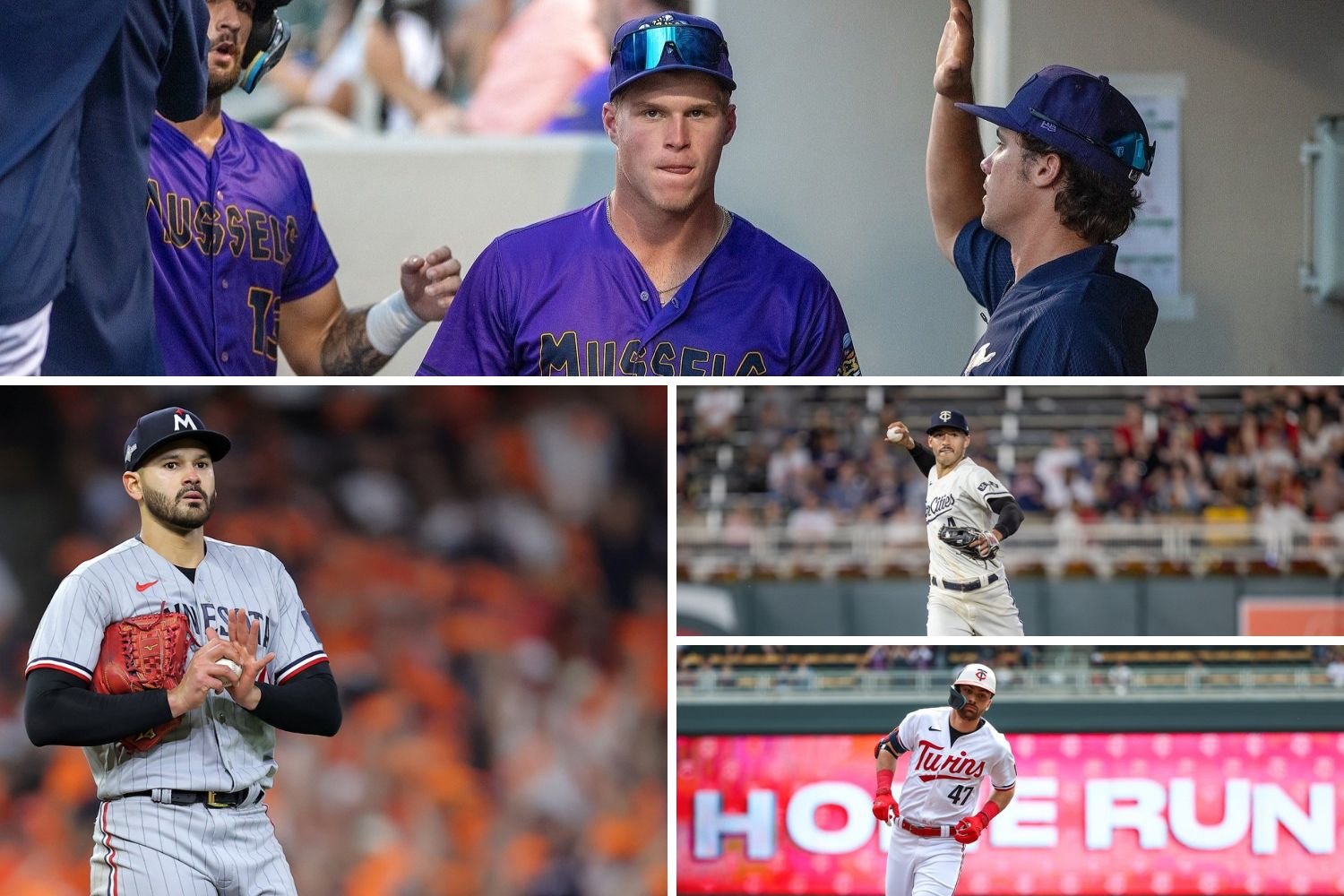
I'll talk through a few of those decisions, plus some revelations that struck me as I went through this exercise, shortly. But first, here's a recap of the full list, which I rolled out in four installments: Part 1 (16-20), Part 2 (11-15), Part 3 (6-10), and Part 4 (1-5). Listed next to each player is his method of acquisition.
20. Chris Paddack, RHP (Trade)
19. Austin Martin, CF (Trade)
18. Max Kepler, RF (Int'l. Signing)
17. Alex Kirilloff, 1B (Draft - 1st Rd)
16. David Festa, RHP (Draft - 13th Rd)
15. Louie Varland, RHP (Draft - 15th Rd)
14. Jorge Polanco, 2B (Int'l. Signing)
13. Marco Raya, RHP (Draft - 4th Rd)
12. Matt Wallner, RF (Draft - 1st Rd Supp)
11. Jhoan Durán, RHP (Trade)
10. Joe Ryan, RHP (Trade)
9. Emmanuel Rodriguez, CF (Int'l. Signing)
8. Edouard Julien, 2B (Draft - 18th Rd)
7. Bailey Ober, RHP (Draft - 12th Rd)
6. Carlos Correa, SS (Free Agent)
5. Ryan Jeffers, C (Draft Pick - 2nd Rd)
4. Brooks Lee, SS (Draft Pick - 1st Rd)
3. Pablo López, RHP (Trade)
2. Royce Lewis, 3B (Draft - 1st Rd)
1. Walker Jenkins, CF (Draft - 1st Rd)
At a high level, as I look at these rankings and compare them to last year's, the first thing that strikes me is how much the overall talent level in the organization has improved in 12 months' time. While there was one staggeringly steep drop-off at the very top, which I'll address shortly, we also find a lot of newcomers in the top 10, including a few players who emerged last year to distinguish themselves as true franchise cornerstones.
In particular I'm thinking about these three new arrivals in the top five: Lewis (No. 6 last year), López (No. 9 last year, after I updated the rankings), and Jeffers (No. 16). Having Game 1 battery-mates and a versatile lineup centerpiece like Lewis in these spots is a very favorable setup. All three are in their mid-20s; under team control for three or more years; and coming off excellent seasons in the majors. As I look at the Twins franchise at this moment, that trio represents the foundation for stability and success, with Jenkins and Lee mixing in as elite prospects on the way (or, trade chips to support the cause right away).
The Just-Missed List
There were a lot of players who floated around the fringe of this top 20 in my mind and were strongly considered for inclusion, but didn't quite make the cut. This group included, in no particular order: Jose Miranda, Kody Funderburk, Charlee Soto, Griffin Jax, Brock Stewart, Trevor Larnach, Jair Camargo and Willi Castro.
The "just-missed list" did not, however, include last year's No. 1-ranked player, who sadly cannot really be viewed as having positive asset value as we speak.
Bye Bye Buxton
Buxton ranked No. 1 when I compiled these rankings last year. Although some fans act like his contract is some sort of debilitating hindrance, that's not true at all. His annual guaranteed base of $15 million is not prohibitive in today's MLB economy. Coming off back-to-back 4-WAR seasons and his first All-Star appearance, I didn't find it too controversial to view him as the organization's most treasured player asset a year ago, even while acknowledging the historical availability limitations.
Unfortunately, Buxton's 2023 season more or less represented a worst-case scenario, which tanked his stock and sent him spiraling out of the top 20. Even as one of the world's foremost Buxton cheerleaders, I can't deny the reality: He's impossible to confidently plan around in any way at this point. Last year, he tried battling through severe knee pain and was reduced from superstar center fielder to mediocre DH—and still failed to reach 100 games played.
The Twins are hopeful that he can bounce back and return to center field next year. As is Buxton; as am I. But I try not to let hopefulness guide these rankings. Right now, Buxton is owed $75 million over the next five years and his future is in limbo.
Contemplating Correa's Value as an Asset
Correa, whom I ranked No. 2 behind Buxton last year on my revised list after he signed, also saw a drop this year (to sixth), but not nearly to the same degree. He, too, is coming off a pretty crummy season, but it wasn't nearly as worrisome as Buxton's. One player was starring in the playoffs, while the other was limited to a single meager pinch-hit appearance, and that's the most current image we have of both. Remember: these rankings are a snapshot in time.
I considered moving Correa down further, because he's owed a lot of money for the next several years and that's a big factor, given Minnesota's self-imposed financial constraints. But at the end of the day, I have to remind myself: This is a caliber of player to whom the Twins almost never have access, who ended up back here due to a borderline miracle with a contract most organizations would happily take. I believe the Twins, in spite of their newfound spending concerns, are still very glad to have him, price tag and all.
Looking Back at the López Trade
Thinking about players through this lens of asset evaluation can be a really interesting way to judge trade outcomes, because it puts the result in plain terms: Did you end up with something more valuable to your organization than what you gave up? If you did, then you can pretty safely say it was a good trade.
Last year, before the trade, I had Luis Arráez ranked 10th among Twins player assets. I was probably lower on him than most, weighing his marginal defensive value and physical breakdown concerns alongside the system's array of potential replacements. Arraez went on to have a fantastic year for the Marlins—one that surely would've raised his stock this time around if he were still here. Nonetheless, it's hard to deny that the Twins are in better position after making the move.
In my revised rankings following the trade, I had López ninth, viewing him as similar in value to Arraez. (Sign of a quality trade.) López went on to raise his stock massively in the 2023 season, transforming into the rarest of commodities: a legitimate ace starter in his prime. His performance, especially along with a contract extension that keeps him in Minnesota for the next four years at a very reasonable rate, vaulted him to the No. 3 spot in this year's rankings.
In addition to López taking that step forward, we also saw Eddie Julien's breakthrough on the big-league stage. He narrowly missed the top 20 a year ago but finds himself now firmly in the top 10 after a convincing debut. I have Julien ranked higher now (eighth) than I had Arraez last year, because he's basically a 1:1 replacement, with more team control and fewer injury concerns. He has a similar defensive profile and similar offensive production (albeit a very different way of getting there). The Twins have Julien for six more years, compared to the three they had remaining for Arraez.
Is Brooks Lee the Team's Best Trade Bait?
For many MLB organizations, it seems fair to say that Lee would rank No. 1 on a list like this. He's the No. 18 prospect in all of baseball, according to MLB Pipeline, and he's pretty much major league-ready. Yet, here we find him ranked fourth in the Twins organization.
It's not a knock on the kid, whom I'm extremely high on. It's just that I couldn't sell myself on him being more indispensable than any of the three above him (López, Lewis, Jenkins), especially because Lee projects to play one of several infield positions—third, short, and second—that are currently occupied by apparent long-term fixtures for Minnesota
When I notice that a player is ranked lower on this Twins-specific list than he would be in many other organizations, it's a good indicator that the player could be viewed as a valuable trade chip. The same logic led me to name Arráez as one of the team's most likely trade candidates when recapping last year's list, days before he was, in fact, dealt.
Let's Talk Walker at No. 1
As a final topic to dissect, I want to unpack the decision to rank Walker Jenkins as the organization's No. 1 player asset heading into 2024. Many commenters objected to the idea of a barely-tested teenager who's not close to the majors outranking players like Lewis and López—star players in their primes who have already arrived and are making it happen.
I get it! Trust me. I wrestled a lot with where to rank Jenkins (and Lee, for that matter), given the inherent uncertainty of the prospects and future promises in baseball. The thing is, if you take a scrutinizing eye to anyone on this list, you're going to find blemishes or shades of reasonable doubt.
Lewis has been constantly besieged by injuries for three straight years. (Sound familiar?) López has had one complete season of truly elite pitching, and there's no guarantee that he repeats it. Jeffers, Julien, Ober, Wallner? Regression could strike any of these guys, with their limited track records.
You could argue that the "shiny new toy" effect is in play with Jenkins, and it is! But it's legitimate. Not only were the Twins and their fans watching with awe what he did during this pro debut, but the baseball world at large stood shoulder-to-shoulder with them. People in the organization are out of their minds about the North Carolina product. MLB.com's Jim Callis recently predicted that Jenkins will be the No. 2 ranked prospect in all of baseball by the end of 2024.
It's very possible Jenkins's stock will never be this high again. Probable, even. But if it maintains, given the established MLB talents he is edging in these rankings, we are in for a hell of a ride over the next decade. The random twist of fate that pushed Minnesota from 13th to fifth in the 2023 draft order could end up as a truly franchise-altering moment, with epic consequences.
Right now, we can dream. That's the fun part about these rankings: a snapshot in time, to start the new year. Bring on 2024.
I'd love to hear your thoughts on the overall rankings, notable omissions, or changes you would have made. Huge thanks to everyone who's followed along and shared their thoughts. I read and enjoy every comment for this series!







Recommended Comments
Create an account or sign in to comment
You need to be a member in order to leave a comment
Create an account
Sign up for a new account in our community. It's easy!
Register a new accountSign in
Already have an account? Sign in here.
Sign In Now