


Twins Video
As we have discussed at length, the Twins have repeatedly traded to upgrade their starting pitching. They acquired Joe Ryan in a great value deal for a few months' worth of Nelson Cruz. Pablo López was the return for Luis Arráez, in one of the most balanced 'challenge' trades in recent memory. Chris Paddack was acquired right as the Twins were starting the 2022 season, in a trade that may pay enormous dividends for Minnesota. In Bailey Ober and Louie Varland, the Twins have drafted and developed a further contingent of starting pitching contributors.
It's also often noted that the Twins' development staff consistently add velocity to pitchers as they develop. Pierson Ohl is an excellent example of this. When drafted as a 14th-rounder out of Grand Canyon University, Ohl's fastball was around 88 mph. Fast-forward a few years, and it's sitting at 93-95 mph, while he's one of the better-performing pitchers in all of Double-A ball.
Suppose we stitch the starters acquired by trade and the homegrown rotation members together. In that case, we can identify two facets of pitching development the Twins repeatedly tap into: outstanding extension and effective velocity.
Extension quantifies how close the pitcher's release point is to home plate. Typically, taller pitchers have better extension, as longer levers allow them to cover more ground coming down the mound before releasing the ball. The advantage is straightforward: the longer the extension, the shorter the distance the ball travels to cross home plate, and thus, the less time a hitter has to react, making the pitch velocity appear greater.
You won't be surprised to know there's a helpful metric that sums up this phenomenon. Effective Velocity estimates the speed the hitter faces by adjusting raw velocity for the difference between the pitcher's extension and the league average in that category. The greater the extension, the greater the differential between effective and release velocity, which we'll call added velocity.
Let's look at the Twins rotation members' extension and effective velocity to identify some organizational preferences, in addition to helping us find the starting pitching trade target that best suits them.
|
Pitcher |
Fastball Velocity (mph) |
Extension (ft) |
EffectVel (mph) |
|
Joe Ryan |
92.3 |
6.55 |
92.7 (+0.4) |
|
Louie Varland |
95.1 |
6.83 |
96 (+0.9) |
|
Chris Paddack |
95.4 |
6.92 |
96.5 (+1.1) |
|
Pablo López |
94.9 |
7.19 |
96.5 (+1.6) |
|
Bailey Ober |
91.4 |
7.3 |
93.1 (+1.7) |
Joe Ryan is a helpful starting point for our discussion, as he has almost precisely average extension. Ryan doesn't benefit much from his extension. As detailed extensively elsewhere, his fastball has unique traits underpinned by a low release point and the 'rising' effect tied to spin efficiency. Ryan is a solid baseline for extension and effective velocity in the Twins' rotation. Below, you'll see a side-view representation of Ryan's release point and a good representation of his extension (and his low release).

The rest of the group can be categorized as good (Varland and Paddack) and great (López and Ober) when gaining an extra tick on their fastball through extension. Varland and Paddack, on average, gain one mile per hour on their fastball through their comfortably above-average extension. That brings Paddack to 96.5 mph, on a pitch that has been inconsistent throughout his career. In Pablo López and Bailey Ober, the Twins have two starters with exceptional extension (7.2 and 7.3 feet, on average). Respectively, this adds 1.6 mph and 1.7 mph to their fastballs, if we look at their Effective Velocity. Ober is likely the most significant beneficiary here, as the difference between 91.4 and 93.1 mph is substantial. But what are the tangible impacts of outstanding extension?
For every full tick of increase in Added Velocity, modeling suggests a pitcher will gain approximately 0.3 runs per 100 pitches thrown. If we apply that to the number of fastballs each highlighted pitcher threw in 2023, we see the cumulative impact of a rotation with good-to-great extension. (We'll remove Chris Paddack from the following graphic, as his sample size was too small in 2023 to be meaningful.)
|
Pitcher |
Fastballs Thrown |
Added Velo |
Runs Gained |
|
Joe Ryan |
1558 |
+0.4 |
+1.87 |
|
Louie Varland |
1100 |
+0.9 |
+2.97 |
|
Pablo López |
1043 |
+1.6 |
+5 |
|
Bailey Ober |
1241 |
+1.7 |
+6.32 |
Here, we clearly illustrate the impact of average-plus extension, versus elite extension. López and Ober gained 5 and 6.3 runs throughout a season, just from their fastball's Effective Velocity, through outstanding extension and releasing the ball closer to home plate. You can see why this is an organizational preference. The Twins have repeatedly shown the ability to add velocity through the development of young players. Elite extension is a way to add velocity without adding velocity, particularly for players you are targeting or acquiring via trade, as we see from the side-view of Ober's extension below, which is noticeably closer to home plate than Ryan's.
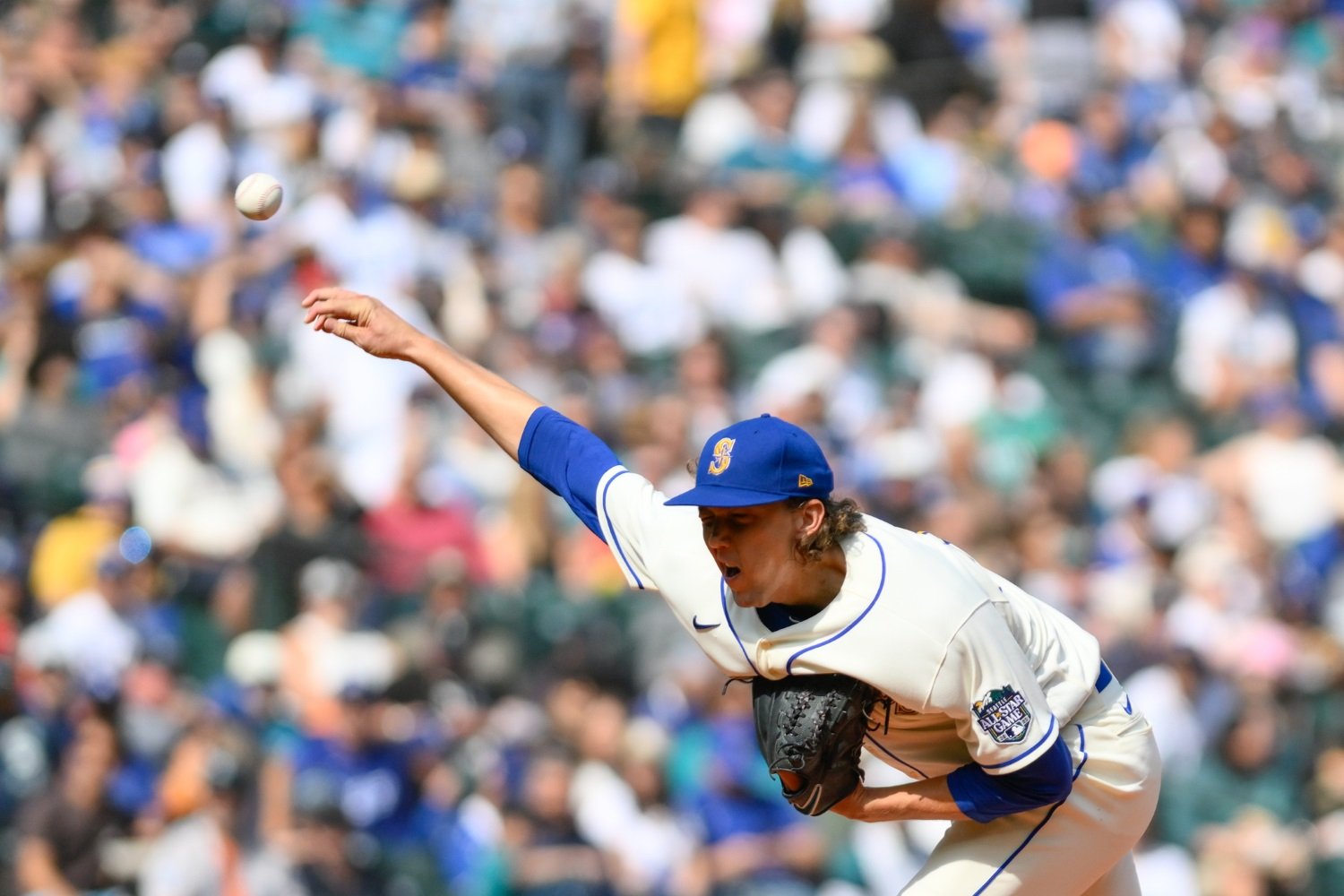
With all of this in mind, it is time to turn our attention to a Twins trade candidate, Logan Gilbert. Gilbert has the best extension in baseball (7.5 feet on average in 2023). He's in a different category from Ober's initial fastball velocity (95.7 mph on average). Gilbert gains a whopping 2.2 mph in added velocity per fastball thrown, leading to approximately eight runs gained on his fastball per season (using his 2023 numbers as a proxy for 2024).
|
Pitcher |
Fastball Velocity (mph) |
Extension (ft) |
EffectVel (mph) |
|
Bailey Ober |
91.4 |
7.3 |
93.1 (+1.7) |
|
Logan Gilbert |
95.7 |
7.53 |
97.9 (+2.2) |
Here, we can see from the side just how far Gilbert gets towards home plate when he releases the baseball.
|
Pitcher |
Fastballs Thrown |
Added Velocity |
Runs Gained |
|
Bailey Ober |
1241 |
+1.7 |
+6.32 |
|
Logan Gilbert |
1224 |
+2.2 |
+8.07 |
There are plenty of reasons the Twins won't trade for Gilbert. Given that he isn't a free agent until 2028, the price would be astronomical, and more than the Twins will want to pay.
Acquiring starting pitching is risky and challenging, which is a good reminder that Derek Falvey deserves credit for his success doing it during his tenure as Twins POBO. If the Twins are going to engage in a big trade this offseason, give me the guy who makes 95 mph look like 98.
What would you give up to land Gilbert? Let's talk about pitching in the comments.
Research assistance provided by TruMedia
Do you approve of the job Derek Shelton is doing as Twins manager?

Follow Twins Daily For Minnesota Twins News & Analysis



- Oldgoat_MN, Cory Engelhardt, Karbo and 3 others
-
 5
5
-
 1
1


Recommended Comments
Create an account or sign in to comment
You need to be a member in order to leave a comment
Create an account
Sign up for a new account in our community. It's easy!
Register a new accountSign in
Already have an account? Sign in here.
Sign In Now