


Twins Video
In January, I wrote a piece here remarking about how drastically the Twins transformed their identity in just a five-year span, and how jarring this felt for an organization so steeped in stability. My primary focus there was the pitching staff, which has evolved from a group of contact-heavy soft-tossers to an amalgamation of stuff, velocity, and whiffs.
But I also made note that in 2013, Minnesota had zero players hit 20 home runs. It was par for the course; the previous year they hit the fewest homers in the league, and for almost the entirety of Terry Ryan's tenure as GM, they were always reliably in the bottom half. This is team that went from 1988 through 2005 without seeing a single 30-HR season. Whether it wasn't a priority or they just didn't know how to teach it (likely a combination of both), the Twins never featured power as a true strength.
The new front office signaled early on their intent to alter this distinction. With an analytical new-age mindset, Derek Falvey and Thad Levine started populating the org's ranks with analytical thinkers and Ivy League degrees. The new braintrust studied league-wide trends deeply, and slowly began to optimize the roster for what it saw as the future.
“The uppercut swing is like the three-point shot in the NBA,” director of baseball operations Daniel Adler told Adam Platt of Twin Cities Business ahead of the 2018 season. "When they go in, you get 50 percent more points. Fly-ball-based hits become home runs, which justify [a swing that gives up the opportunity for] ground-ball-based hits.”
Makes sense! But of course, deciding you want to hit a lot of home runs isn't the same as actualizing such a plan. Efforts to translate these beliefs to the field obviously came up short last year, sabotaged by Logan Morrison flaming out and various mishaps afflicting the team's core. Here in 2019, it's all coming together.
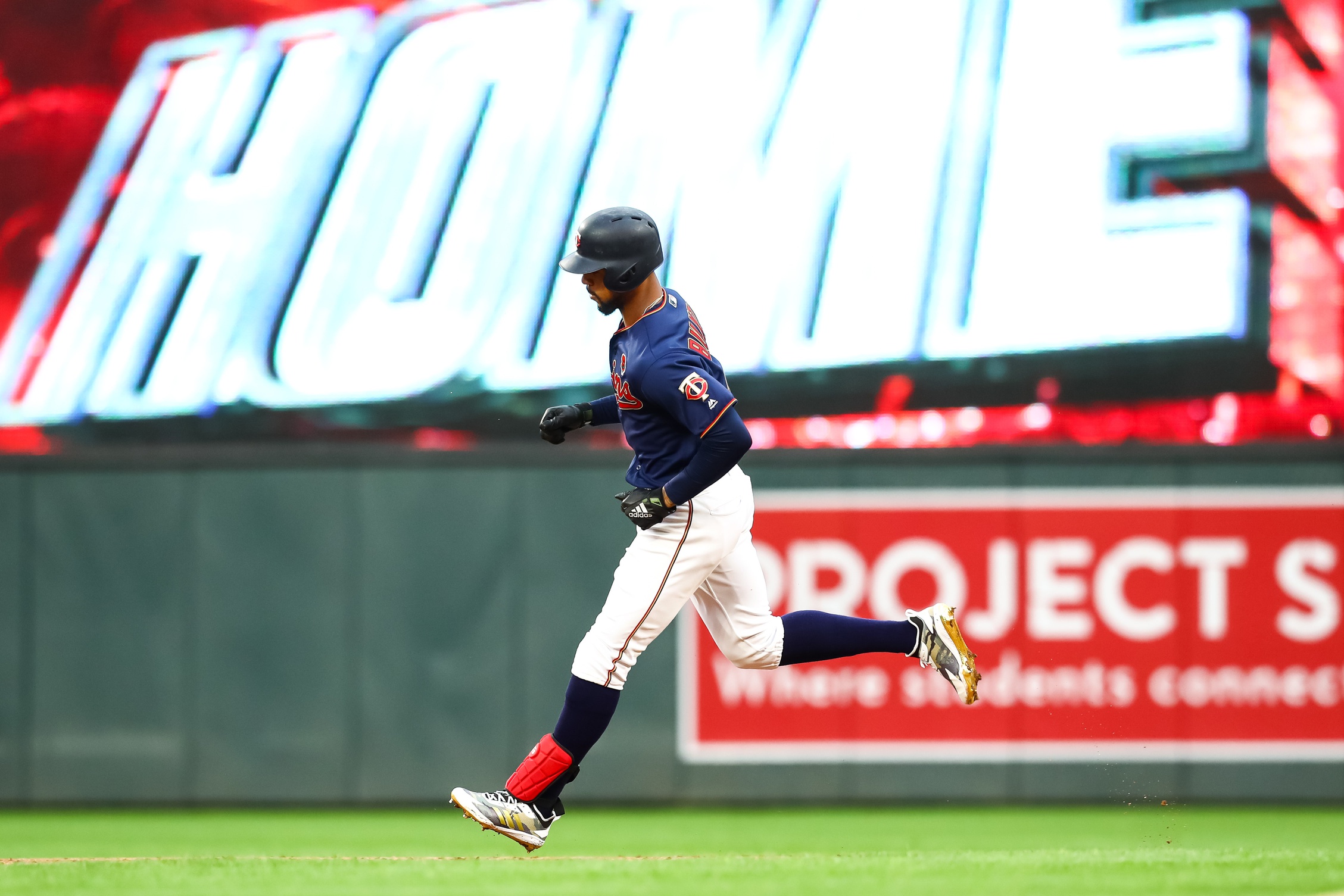
Through 52 games, the Twins are on pace to shatter the league's precedent for home runs in a season. Last year the Yankees set a new MLB benchmark with 267 bombs, topping the long-standing record of 264 set by the 1997 Mariners. At their current rate, the Twins will finish this year with 324.
With those previous standard-bearers, you could look at the rosters beforehand and envision historical home run totals. The '97 M's featured Ken Griffey Jr., Jay Buhner, Edgar Martinez, Alex Rodriguez. Last year's Yanks had Giancarlo Stanton, Aaron Judge, Gary Sanchez, Didi Gregorius.
But the 2019 Twins? I mean sure, many of us contended this group could challenge the franchise home run record. But to suggest they might blow past that number by 100? It was inconceivable. It still feels inconceivable, even as I watch it play out before my very eyes – the scrappy little Twins outbombing the Bombers. Such a scenario would require almost every hitter on on the roster to either max out or redefine his slugging prowess and, well, that's exactly what is happening.
Nearly each Twins regular is on track for a career-high in homers. Some cases are flat-out stunning, like Mitch Garver (already at nine after totaling seven as a rookie) and Eddie Rosario (presently on pace for 50). Others are more or less culminations of best-case scenarios – we all plausibly hoped that Jorge Polanco, Max Kepler and Byron Buxton could sometime join the ranks of top sluggers at their respective positions – but to see it all happen at once? While C.J. Cron brings in a 40-HR pace and Jonathan Schoop recaptures his prime production?
Like I said, inconceivable. I keep using that word, and I'm starting to think it doesn't mean what I think it means. Because this is happening. The Twins just keep bombing away, night after night, with a lineup that shows no relent. They have seven or eight different position players who could plausibly garner All-Star consideration.
Such a confluence of outstanding results requires a medley of contributions. So many factors have played a role, from the unseen to the more obvious, like coaches who get through and talented players who execute. But ultimately, it all ties back to a front office that had a vision and saw it through. They put data analysts and instructors in place who could materially elevate performance. They inherited a roster and customized it to their own specifications, removing final traces of the previous regime's imprint when Joe Mauer and Brian Dozier completed their contracts last year.
This front office's influence has even made an impact on those purportedly uncontrollable variables – namely, health. It's been a key driver of the offense's success, and while luck obviously plays a big part in that, the new leadership has totally retooled Minnesota's training and medical staffs. Worth noting as we see Garver preparing to return in about half of his estimated timeline.
Meanwhile, it's not entirely coincidental we've seen so few players go down to begin with. Rocco Baldelli makes a point of giving his players ample rest, and has championed the idea of rotating three catchers to keep all their legs fresh. The conservative approaches to bringing Sano and Nelson Cruz back from their ailments have been emblematic. Then there are the subtler things, like Buxton being asked to play a little further back in center field, lessening the frequency of blindsidings from the wall.
I've been a vocal fan of this front office since very early on, and they continually reaffirm my faith. Falvey and Levine have built a cutting-edge baseball operation where useful data guides the ship, and advantages are sought in every element, from every corner. It's impossible for an outsider to even divvy up credit amongst Falvey, Levine, Adler, Baldelli, and the many others involved. This has truly become a collaborative administration, as promised – one that's reinventing the Twins as a modern championship contender, out-slugging every club to come before it. To try and keep this article somewhat focused, I haven't even mentioned the organization's pitching turnaround, which is arguably even more impressive.
For those of us who spent years lamenting the Twins' relative antiquation and insularity, begging for an increased emphasis on analytics, this is especially rewarding to watch. Much credit belongs to Jim Pohlad, Dave St. Peter, and other top executives who embraced this thinking and orchestrated a miraculous transition: from lagging behind the pack to leading it in just a few short years. Plenty of baseball clubs have looked admiringly at teams like the Astros, hoping to replicate their success, but no one's done it this well.
The good vibes ringing out around the Twins right now are well deserved. And the folks who set this machine into motion, by putting their faith in the right people and providing the necessary resources, will themselves be richly rewarded as fans pour into Target Field this summer. What we saw this past weekend was only the beginning.
These 2019 Minnesota Twins aren't assured anything with two-thirds of the season left to go. But by now we can safely label them a power to be reckoned with, risen from a prolonged era of perpetual irrelevance.






Recommended Comments
Create an account or sign in to comment
You need to be a member in order to leave a comment
Create an account
Sign up for a new account in our community. It's easy!
Register a new accountSign in
Already have an account? Sign in here.
Sign In Now