


Twins Video
Royce Lewis hasn't spent much time at first base. He doesn't even really think of himself as a first baseman; he still longs to get back to the left side of the infield. The reality, though, is that he's not the athlete or the thrower he would need to be to return to shortstop or third base—and, unfortunately, Saturday delivered an excruciating reminder that he's not the quick processor required even of a right-side infielder.
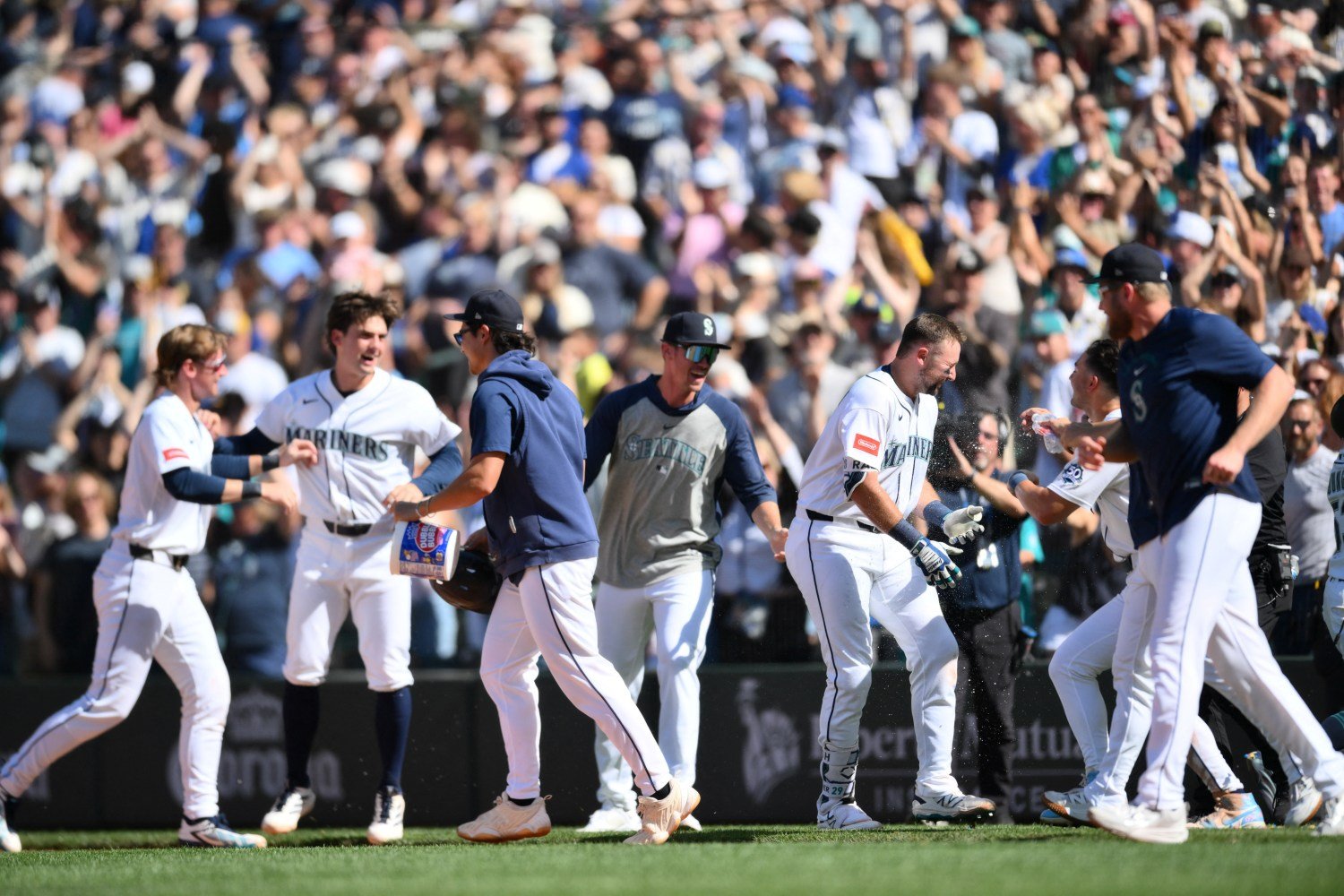
The situation demanded a lot of him—maybe more than can fairly be asked of a guy who was still all the way across the diamond three months ago. With a runner on third base and one out in the bottom of the ninth, the Twins went to a five-man infield and issued an intentional walk, bringing Cal Raleigh to the plate with runners on the corners. Randy Arozarena, at third, carried the winning run, so the idea in issuing Julio Rodríguez an intentional walk was to set up a double play on the big-dumpered Raleigh. Everyone involved had to understand, though, that the right way to make the play would depend on the specific play that happened. Each infielder's responsibility, in the very short time they had, was to arrange the field in their minds and to visualize the variety of plays that might present themselves. There was no one correct thing to do; what was correct would depend on the batted ball.
Lewis didn't have a robust enough set of plans. The ball came his way, and he made the wrong play. Raleigh hit a one-hop smash, 105.4 miles per hour off the bat. Lewis's reflexes were fine; those have never been his problem. He lunged to his left, speared the ball cleanly, and managed not to go all the way to the ground. He'd been crowding the line, with two other infielders on his side of the second-base bag, so the ball took him right to the first-base bag. Right away, though, you could see him thinking—and not in a good way.
As Lewis took the step and a half left to reach the base after fielding the ball, he turned to look over his left shoulder to find Rodríguez. That was smart, really. It was one of those plays where, if he hadn't picked up Rodríguez and the Mariners outfielder had been especially wily, he could have snuck back into first base after Lewis tagged it. Because he had been so concerned about getting down the line and minimizing the risk of a double play, though, Rodríguez never even thought about a retreat. Therefore, as Lewis stepped on first, his eyes took him toward second, where Rodríguez was charging for the base and two teammates awaited a throw. That caused all kinds of trouble.
First, as soon as Lewis started moving toward first and turned away from third, Arozarena could break for the plate freely. If Lewis gets up and stomps on the pillow while staring down Arozarena, the chance for a double play is likely lost, but the result is the second out and a chance to get out of the inning by retiring the next batter.
However, you can make the play the way Lewis initially did and still get the double play. Once he turned his back to third, Arozarena was going, but if Lewis merely uses that turn to check for a dive-back by Rodríguez and then pivots to the plate with his eyes and mind clear, he retires Arozarena easily. Alas, we're all wired a certain way, and the way Lewis is wired is to be captured a bit by his own gaze. He turned and saw Rodríguez far enough short of second to be beaten by a good throw, and for a fatal half-second, he planned to make that throw. His eyes committed him to it.
His brain kicked in. It overrode that command and turned him to the plate, and he threw. That throw was a bit later than it should have been, but if it had been strong and accurate, Arozarena still would have been out. Instead, it was to the first-base side of the plate, and Victor Caratini was unable to position himself to receive it and make a tag in time. The game was over.
Though his arm has never been great—that's a big part of why he's no longer on the left side—Lewis is capable of that throw, physically. The problem, again, was mental. He wasn't fully turned, wasn't fully targeted. Having cost himself a moment with the mistaken pump toward second, he rushed the process of lining up his throw to the plate.
After the game, manager Derek Shelton said the right play would have been to throw to second when Lewis got the ball. That could have worked, but it would have been risky. Shelton might not have appreciated how much of Lewis's momentum had to move toward first base to snare the ball. Turning that momentum and making a good throw to second, then aligning oneself for the return throw to double up Raleigh, would have been tough. Lewis isn't a good enough infielder, regardless of position, to do that; throwing to second right away wouldn't have been the right play. What needed to happen, rather, is what I described above. That's an unusual play, though—a rare progression. It demands that a player be a fast and confident processor of information during a play. Lewis isn't that, either.
Rocco Baldelli talked about this on a much different (but not so different, really) play last season, when Lewis was playing third with the bases loaded and had to decide between trying to turn a double play and taking the out at the plate. He saw, and articulated, that Lewis is not the kind of processor who can reliably make that difficult series of incredibly fast decisions. Shelton hasn't put it the same way, but it's clear that the organization feels that way as a group. They're right.
That leaves the team in a bit of a quandary. Lewis remains endlessly self-assured, at least before and after each difficult play that comes his way. He's been better at the plate since returning from his demotion to Triple-A St. Paul. However, he looks unlikely to be a competent defender at key moments, anywhere on the diamond. The closest thing to a position he can play well might be second base. The Twins simply don't have enough instinctive, intelligent and skillful defenders to fill out a lineup; they have to make do with Lewis, Luke Keaschall and others who lack that nous. As Saturday suggests, that could be what costs them a playoff berth this season. Hopefully, they can overcome that shortcoming, but sometimes, the ball finds you.
The same things are true at the trade deadline. It's not the wrong decision that costs you; it's the quick decision not made, or the balk and non-committal move right after it. The sport comes down to quick decisions and to the hard work of being decisive under pressure—even off the field.
Which team do you dislike the most in the AL Central?
Follow Twins Daily For Minnesota Twins News & Analysis



- glunn, Cory Engelhardt, Patzky and 1 other
-
 4
4


Recommended Comments
Create an account or sign in to comment
You need to be a member in order to leave a comment
Create an account
Sign up for a new account in our community. It's easy!
Register a new accountSign in
Already have an account? Sign in here.
Sign In Now