


Twins Video
Athleticism spreads across a baseball diamond in predictable ways. There are always outliers, because some geniuses find ways to succeed in unexpected places via their savvy, and because teams sometimes align their talent in strange ways for any number of reasons, but we know where the best athletes need to be during baseball games—and which kinds of athletes are most needed in which places. For instance, your tall, languid guy usually shouldn't be at third base. Nor should your fast but underpowered guy play there. No, speed goes in the outfield, and it goes up the middle. Arm strength is important on the left side of the infield and in the outfield.
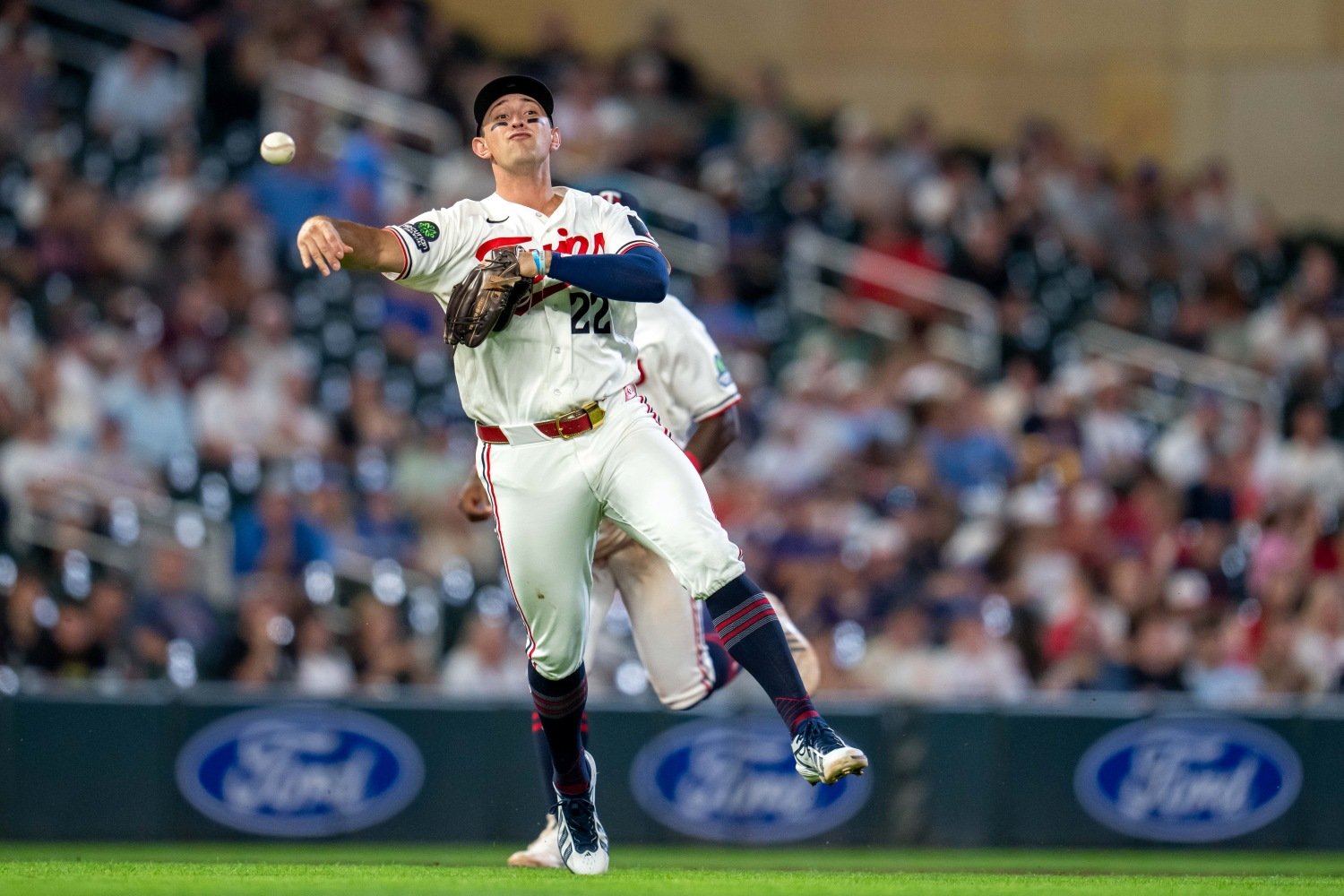
Those are extreme examples, and extremes always make things seem obvious. Most real-life cases are more nuanced. Take, for instance, Brooks Lee. A stocky but strapping switch-hitter, Lee entered professional baseball as a shortstop. That was where he played in high school and in college, where he was an elite athlete. Even in the minors, he was an above-average runner and thrower (and hitter, for that matter), relative to all the players around him. Eventually, though, he came to the big leagues, and compared only to the 50 or so best players at each position in the Western hemisphere, his profile becomes a bit less impressive.
As we know, the Twins tried Lee at shortstop. It didn't work. In fact, it didn't work twice, but the team only fully recognized the failure the second time, when he cost them several runs over the first month and a half of the 2026 season. That's when they moved him to third base, and everything changed.
In 400 innings at shortstop this year, Lee was worth -9 Defensive Runs Saved (DRS), according to Sports Info Solutions. In 738 innings at third base, he's been worth 7 DRS. The change is enormous. Only J.P. Crawford and Trea Turner have hurt their teams more as shortstop defenders than Lee did, despite how short a time he spent there. Only Matt Chapman, Alex Bregman, Caleb Durbin and Maikel García have saved their clubs more runs at the hot corner than Lee has, despite 16 players logging more innings at the position than he has.
Lee, as it turns out, is an extremely good fit for third base, even though he was an extremely bad fit for the spot that neighbors it on the infield. The values are extreme; so is the difference in the eye test. Yet, the reason for it is that Lee isn't extreme, himself, in any regard; he's just above- and below-average at things that make him much better-suited to one place than to the other.
Here are the average sprint speeds and arm strengths of players at each position, for 2026.
| Position | Sprint Speed (ft./sec.) | Arm Strength (MPH) |
| Catcher | 26.1 | 80.3 |
| First Base | 26.3 | 79.4 |
| Second Base | 27.7 | 79.2 |
| Third Base | 27.1 | 84.9 |
| Shortstop | 27.9 | 86.2 |
| Left Field | 28 | 87.6 |
| Center Field | 28.7 | 89.5 |
| Right Field | 28.1 | 90.5 |
| D.H. | 26.1 | — |
| Pitcher | — | 94.7 |
As you would have guessed if I had asked you to do so blindly, outfielders are the fastest players on the field. Catchers, first basemen and designated hitters are the slowest. There's also an interesting hierarchy among the three more difficult infield spots, though. Shortstops are the fastest, with second basemen close behind; third basemen can be (and are) slower.
Reading the arm strength column is trickier. As anyone familiar with the game already knows, outfielders need strong arms, but they also enjoy the benefit of being able to load up and fire on their most important throws, generating greater raw arm strength readings than one finds on the infield—where a quick exchange and release is paramount. The latter is even more true of catchers, whose most important throws come when trying to throw out basestealers. Thus, while infielders generate lower raw velocity readings, it's safe to say that shortstop and catcher are the positions (other than pitcher, of course) where arm strength is most important, and where teams put their strongest arms, all else equal.
Even between infielders, though, these averages are apples and oranges. Players who play both second base and third base tend to throw 5-7 MPH harder from third than from second, for the obvious reason: the throw is longer. That means that it takes more oomph to get the ball to the first baseman, and that the runner has a greater chance to beat out a weak throw from the left side than from the right. We see a lower average arm strength among second basemen than among third basemen for the same reason as that which leads the same player's average throw to be harder from third than from second.
Compare shortstops and third basemen, though, and the dynamic changes. As you can see, shortstops have stronger arms, on average. That's because, though the third baseman is all the way across the diamond, they're often playing shallower than a shortstop; they more often make relatively short throws with their momentum taking them in the general direction of first base; and their longest, toughest throws tend to come from more set positions and after ranging less far than a shortstop's longest and toughest throws. Yet, of the seven players who have spent meaningful time at both third and short this year, none throw harder when playing short than when playing third. On the contrary:
- Two (Willi Castro and J.P. Crawford) throw almost exactly as hard, regardless of position;
- Three (Kevin McGonigle, Bo Bichette and Joey Ortiz) throw between 1 and 2 MPH faster when playing third base; and
- Two (David Hamilton and Lee) throw over 3 MPH harder from the hot corner.
The game demands that exceptional athletes with elite throwing arms play shortstop. It does not, however, demand that those players use every ounce of their throwing power on most plays. In fact, third base requires a stronger arm on a median play than shortstop does. The shortstop just has to be a better thrower in order to convert the occasional, fairly extreme play.
Lee is an interesting case study, then. His sprint speed (26.4 feet per second) is virtually untenable for a shortstop, but just barely below-average for a third baseman. His arm is far below the average shortstop's, but not far at all below the average third baseman's—not because he's unable to uncork a strong throw, per se, but because he throws so much harder from third than from short. And why is that? Now, we've arrived at the crux of it. It's because Lee isn't fast enough. A lot of the balls on which Lee should have had to make stronger throws from shortstop ended up in left field, because he never got to them. Some others ended up in his glove, but he didn't even make a throw because he'd had to leave his feet to make the play and felt he had no chance to get his man.
There were still times, even at short, where you could see that Lee is a fine low-to-the-ground athlete and has a strong arm, just as he has above-average bat speed and surprising power at the plate. He does, theoretically, have the arm for short; the raw strength and rotational capacity is there. He just needed to have the advantage of having been shaded into the hole, so he could actually reach a ball that otherwise would have eluded him, and so that he could set his feet to make that throw.
Shortstops, who tend to have both kinds of baseball athleticism bound up into one body, can make that same play after having started the play a step farther toward second base. They'd have the area to their left better-covered, and they could still flag down this ball, turn enough to be accurate, and uncork a strong throw without being in the strong position Lee enjoyed when he threw out Ernie Clement on this play. That's what's missing for Lee. When he must throw on the move, he can't get much on it. When he must move a lot to get to a ball in the first place, there's a good chance he won't reach it. At shortstop, those are fatal flaws. At third, they're fairly unimportant. Most of the throws he makes on the move some as he ranges to his left, and are therefore short and fairly easy. Most of the balls that test his range are to that side, too; he can use the foul line as an extra defender.
For some players forced to move off shortstop, second base makes more sense. For some, playing third doesn't solve many problems, because they have extremely good arm strength (good enough for short, even) but not the hands or the decision-making ability to be any better elsewhere on the dirt than they are at short. Lee is not elite, because his arm is still average or worse, but he's a very good third baseman, because his only shortcoming as a shortstop is being a step too slow. He's showed the utility of his arm since moving to third, and even a slight reduction in the range required of him has turned him from subpar to superb.
In the long run, Marek Houston and Kaelen Culpepper might conspire to threaten Lee's playing time even at third. For now, though, he's entrenched, and his job security is well-earned. He's not a great hitter, but he looks to be above-average in the right role, batting higher in the lineup against right-handed pitchers and lower against lefties. He's already hit a career-best 22 home runs this year, and has a good chance to get to 25. On both sides of the ledger, having the right things asked of him has revealed the best version of Lee, lending us insight into what makes various roles on a team different and interesting. He began the year a fringe big-leaguer who was a drag on the team. He could finish it as a solid prospective piece of an evolving roster.







Recommended Comments
Create an account or sign in to comment
You need to be a member in order to leave a comment
Create an account
Sign up for a new account in our community. It's easy!
Register a new accountSign in
Already have an account? Sign in here.
Sign In Now