


Twins Video
Day One of the 2024 MLB Draft is in the books. Prior to the 2023 draft, Twins Vice President of Amateur Scouting Sean Johnson conducted an annual interview with Darren Wolfson at Target Field. In his comments, he noted, "We want to lean into the strength of the draft." That played out in 2023 with a strong prep class, and it’s true again in 2024, with a strong collection of college bats in the top 75 or so players.
What can we make of the Twins' four Day One selections? What are their strengths and opportunities for improvement, as they begin their journey in pro baseball? Let’s dig in. For each pick, you'll find their position, age, school, height, weight, handedness, and position on our consensus board listed under their name.
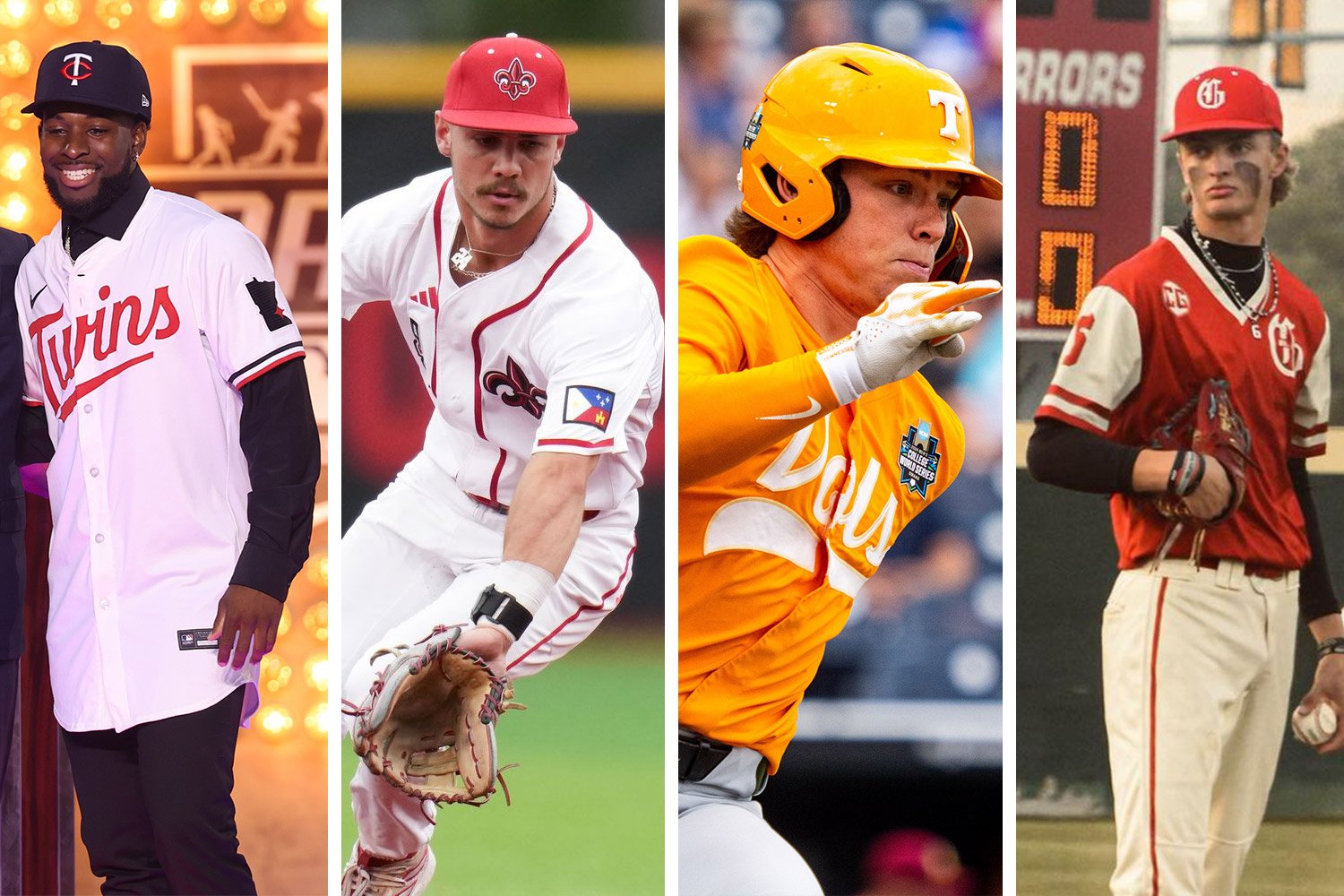
Kaelen Culpepper, 21st Overall Pick
SS, 21 Kansas State, 6’0, 190, R/R (35)
Culpepper (insert DJ Khaled ‘another one’ gif) had a productive 2024 season at Kansas State, sliding over from third base to shortstop and handling the transition well. He buoyed what is a thin crop of college shortstops, typically a coveted demographic.
Culpepper had a productive 2024 season, slashing .328/.419/.574 with 11 home runs, 35 walks, and 41 strikeouts in 61 games for Kansas State. Culpepper has a simple, direct right-handed swing and manipulates the barrel of the bat well. He hits the ball hard often, maintaining a good average exit velocity without reaching upper-echelon watermarks that mark some of the other first-round college bats.
Culpepper pulls his fly balls less than an average hitter (41st percentile), and much of his hard contact is to the opposite field. I think the Twins will feel that tapping into more pulled fly fly-ball batted ball events can unlock more power for Culpepper. While the power may never be plus, it should be average, giving him a 50 grade or better on every tool.
Culpepper’s biggest opportunity is to rein in an overly aggressive approach at the plate. He chased 27% of the time in 2024, and has a particular tendency to go after breaking pitches. This habit seems to be more rooted in an aggressive approach than a challenge picking up spin.
Defensively, the arm, actions, and athleticism will play at shortstop. I think Culpepper has a good chance to stick there. It will all play somewhere else on the dirt as an above-average defender, if he doesn’t. Culpepper profiles as a relatively low-variance college bat who should accrue consistently solid value--if he can tamp down the overly aggressive approach at the plate.
Kyle DeBarge, 33rd Overall Pick
SS, 21, Louisiana-Lafayette, 5’9, 175, R/R (50)
DeBarge is an undersized college shortstop who had a major power breakout in 2024, hitting .356/.418/.699 with 21 home runs (43 XBH), 24 walks and 30 strikeouts in 60 games. DeBarge posts good bat speed and his swing, in combination with his athleticism, give him some of the best bat to ball skills in the entire draft class, with an in zone contact rate north of 90%.
I don’t think DeBarge’s power breakout is going to translate to professional baseball. He has already maximized his ability to pull the ball, with a pulled fly ball rate that outstripped the average in college baseball in 2024. He profiles as a line drive, doubles hitter as a pro, and a challenging out for pitchers with plus speed to boot.
Defensively, while DeBarge doesn’t have the best arm, he makes up for it with excellent twitch and athleticism that allowed him to handle shortstop well in college. It’s good actions and range at the position. He might slide to second base ultimately.
Big picture, the Twins first two picks give some indicators about on field preferences for hitters. They value swings they think can be effective, and strong bat-to-ball skills. Other aspects of offensive profiles (like a high chase rate) they believe they can reign in and help prospects improve. These tendencies won’t ever apply to every prospect drafted (see Amick below) but the Twins first two picks indicate that solving for poor contact ability is a challenging developmental hurdle.
Billy Amick, 60th Overall Pick
3B, 21, Tennessee, 6’0, 210, R/R (40)
Unlike the Twins first two picks, Amick doesn’t fit the trend of valuing strong contact skills. It’s a power over hit profile here. Amick was ranked 40th on the consensus board and had been mocked to the Twins in the first round. I didn’t love it at 21, but it’s great value at 60.
Amick played third base for the national champion Tennessee Volunteers, helping anchor the most prolific offense in the country. He hit .306/.387/.639 (1.026) with 23 home runs (38 XBH), 29 walks and 53 strikeouts in 65 games.
Power is the calling card here. Amick has easy raw power and was 97th percentile in 90th percentile exit velocity in college baseball this year (just south of 110 mph). Amick is a machine in terms of pulling fly balls. He is a perfect fit for how the Twins want hitters to deploy power.
There’s certainly warts with Amick’s profile, though, specifically his hit tool. Amick’s bat to ball skills are the first potential challenge here. His overall contact rate in 2024 was 70% (81% in zone). Both of those figures are on the low end for college baseball. Amick also chases a ton (over 30% in 2024). That’s potentially a dangerous combination and he’ll have to improve one of those two aspects of his offensive profile to be a viable MLB bat.
Amick handled third base decently in 2024. For me, he’s a strong value play at 60. He’ll certainly be fun to watch when he debuts.
Dasan Hill, 69th Overall Pick
LHP, 18, Grapevine HS, TX, 6’5, 175, L/L (58)
Dasan Hill profiles as the Twins most intriguing day one pick. It’s a fool's errand to speculate on bonus demands, but I think it’s likely the Twins saved some money with their first two picks, so a prep arm felt like it was coming.
Hill is the ultimate projection arm you can dream on. He’s listed at 6’5, 175 pounds, and the fastball is already up to 97 mph. Even if he’s not maintaining that type of velocity through the end of starts, it’s easy to imagine where the fastball might get to with added weight, strength, and given the Twins ability to add a few ticks.
Hill throws two distinct breaking pitches (slider and a curveball) with both generally being deemed above average. There’s also a changeup with good fade in his arsenal. Fangraphs scouting report on Hill (their number 24 prospect) describes him as having ‘a feel for location uncommonly good for a pitcher his size and age’. That feels extremely relevant. If we can highlight a Twins tendency when drafting pitchers, it’s drafting strike throwers whose stuff they can augment. Zebby Matthews and Andrew Morris are recently drafted examples. Mapping that principle onto a 6’5 lefty who has a four-pitch mix with a fastball that’s been up to 97 mph is compelling, to say the least.
What did you make of the Twins day one picks? Who are you excited to see debut in pro ball? Join in the discussion with a comment below.
How many games will the Minnesota Twins win in 2026?
Check out our 2026 MLB Draft tracker, with scouting reports, player information, total pool allotments, and much more!
View The 2026 Draft Tracker






Recommended Comments
Create an account or sign in to comment
You need to be a member in order to leave a comment
Create an account
Sign up for a new account in our community. It's easy!
Register a new accountSign in
Already have an account? Sign in here.
Sign In Now