


Twins Video
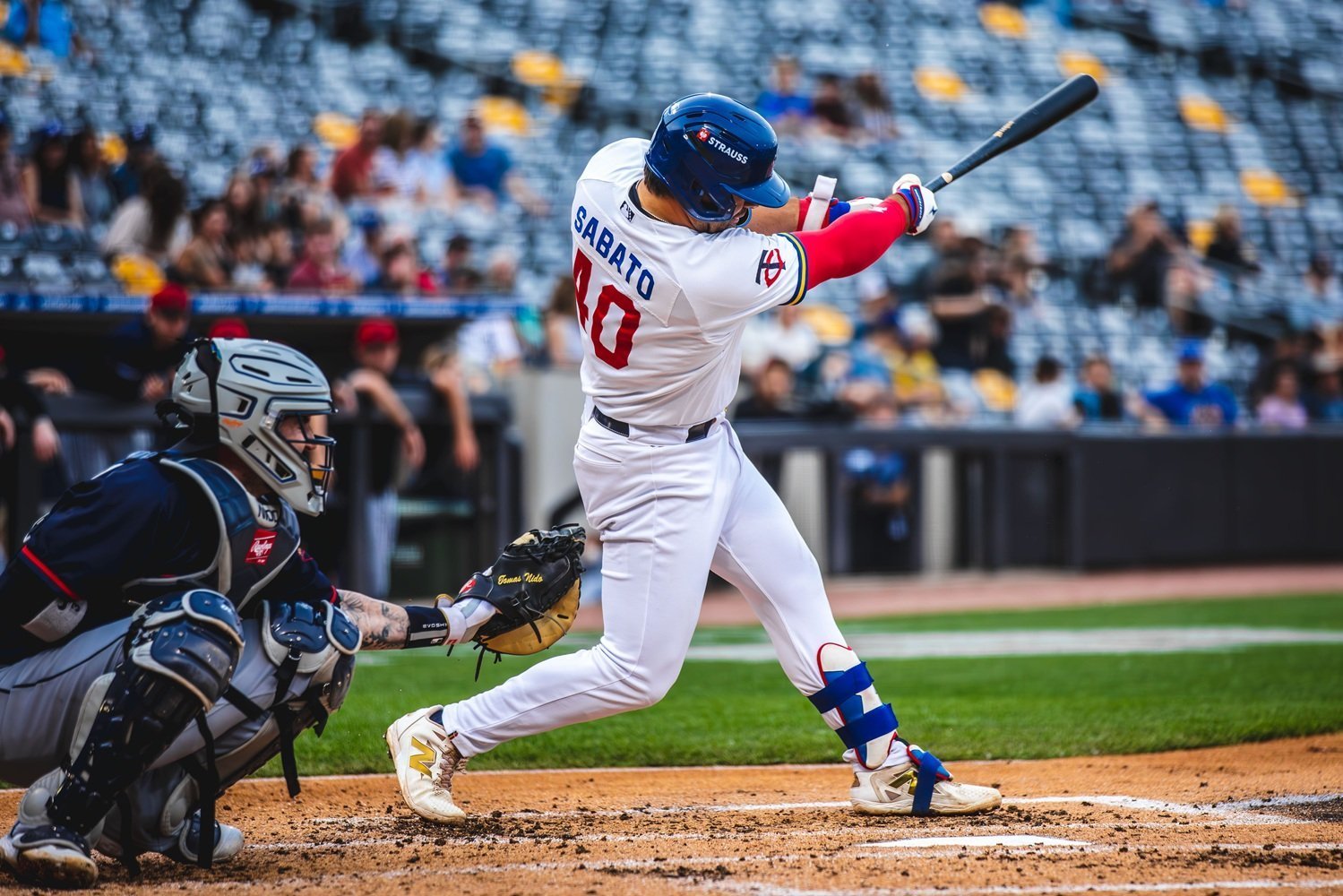
Aaron Sabato has spent most of his professional career trying to convince the Twins that he could become more than organizational depth. Now, he's finally doing everything they could reasonably ask from a first baseman. The problem? It may have come too late.
Lightly recruited out of Connecticut, Sabato transformed himself into one of college baseball's premier power hitters at the University of North Carolina. He announced his arrival by setting the Tar Heels' freshman home run record with 18 long balls in 2019. Shoulder surgery prevented him from playing summer ball, but he returned in the pandemic-shortened 2020 season and launched seven home runs in just 19 games. That performance was enough for the Twins to select him with the 27th overall pick in the first round of that shortened draft. Minnesota didn't select Sabato because of his defensive versatility or athleticism. They drafted him because they believed the bat would carry him to the big leagues. That has always been the challenge.
First base is the most unforgiving position in baseball when it comes to prospect evaluation. Teams can tolerate a light-hitting shortstop because of premium defense. Catchers can stick around thanks to their work behind the plate. Center fielders can survive offensive slumps if they save runs defensively. A first baseman doesn't have that luxury. If the bat isn't playing, there's nowhere else to hide.
For much of Sabato's professional career, the offensive production simply wasn't good enough. He spent parts of four seasons with Double-A Wichita, posting a .749 OPS while struggling to stay above the league-average line. It felt like he might need a permanent mailing address in Kansas.
Everything finally clicked in 2025. Before earning a promotion, Sabato dominated Double-A pitching by slashing .305/.399/.574 with 14 home runs in just 39 games. His .973 OPS translated to a 165 wRC+, forcing the Twins to see whether the breakout was real.
The results after his promotion were considerably more modest. The International League has earned a reputation as one of the most hitter-friendly environments in affiliated baseball, yet Sabato hit just .245/.288/.453 with a .741 OPS over his final 65 games. Fourteen home runs showed the power remained intact, but with an 86 wRC+, he wasn't exactly knocking down the door to Target Field.
Entering his age-27 season, it became easy to view him as little more than experienced organizational depth. Instead, he's responded with perhaps the best sustained stretch of his professional career. After opening the season in a part-time role, injuries throughout the St. Paul roster created regular opportunities. Sabato has taken full advantage.
Through 57 games, he's hitting .284/.346/.581 with 14 home runs, 20 doubles, and a .927 OPS. His 129 wRC+ ranks comfortably above average, and there are encouraging signs beneath the surface that suggest this isn't solely a product of favorable hitting environments.
Perhaps most importantly, he's making more contact. Sabato has trimmed his strikeout rate from 28.7% last season to 25.0% this year. That's still higher than ideal, but every percentage point matters for a player whose value depends almost entirely on his offensive production. At the same time, his .298 isolated power is the highest mark he's posted since the lower levels of the minors, showing that the power hasn't disappeared despite the improved contact.
Interestingly, his hard-hit rate has actually declined by 4.2 percentage points compared to last season. Rather than hitting the ball harder, Sabato appears to be hitting it better. His average launch angle has increased by 2.5 degrees, helping him elevate the baseball more consistently and maximize the raw power that made him a first-round selection in the first place.
Minnesota has spent years cycling through veteran first base solutions. Carlos Santana, Ty France, Josh Bell, and Kody Clemens have all received opportunities while the organization searched for consistent production at the position. The Twins have generally preferred experienced options because Sabato never forced the issue with his minor-league performance.
Now, he finally is. The timing could prove interesting. If Minnesota falls further out of contention, veterans like Bell or Clemens could become trade candidates before the deadline. Even Royce Lewis could draw interest if the front office decides to reshape the roster. A combination of those moves would create an obvious opening for Sabato to receive his first extended major league opportunity.
Under normal circumstances, a 27-year-old first baseman tearing up Triple-A might earn that chance. But baseball doesn't always reward timing as much as talent.
Sabato has spent six years trying to prove he belongs in the Twins' long-term plans. He's playing some of the best baseball of his career, and the numbers suggest this version is more complete than the one that reached Triple-A a year ago. Whether that's enough to change Minnesota's opinion may be the biggest question of all.
Will Sabato get a chance with the Twins? Leave a comment and start the discussion.
Do you approve of Twins ownership?

Interested in learning more about the Minnesota Twins' top prospects? Check out our comprehensive top prospects list that includes up-to-date stats, articles and videos about every prospect, scouting reports, and more!
View Twins Top ProspectsFollow Twins Daily For Minnesota Twins News & Analysis



- DocBauer, nclahammer, glunn and 1 other
-
 4
4


Recommended Comments
Create an account or sign in to comment
You need to be a member in order to leave a comment
Create an account
Sign up for a new account in our community. It's easy!
Register a new accountSign in
Already have an account? Sign in here.
Sign In Now