

Twins Video
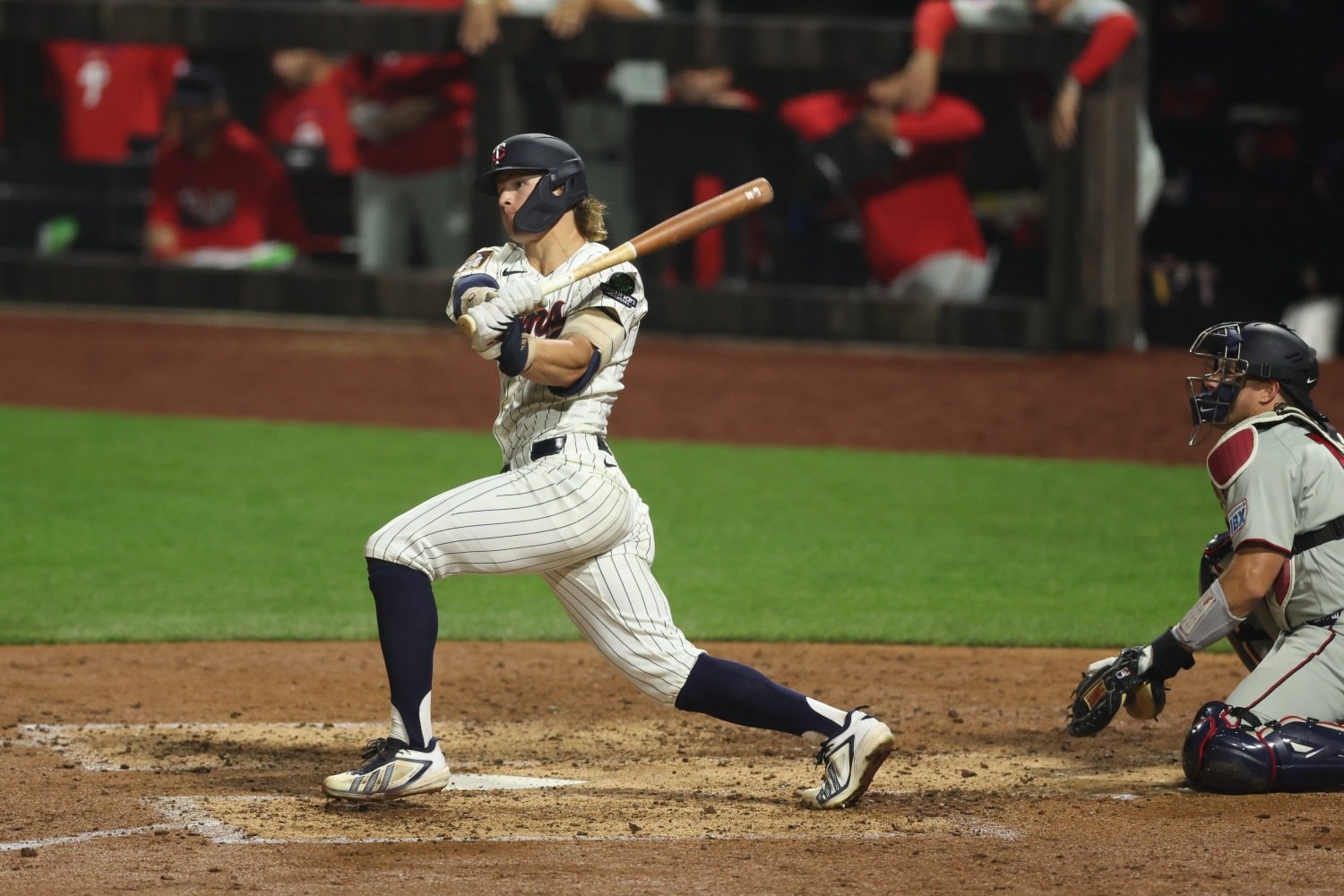
Luke Keaschall has quickly become one of the more fascinating players on the Twins roster. There is a very clear reason to want him in the lineup, and an equally clear reason to wonder whether the team can actually afford to play him.
The good news is that Keaschall has continued to show that his rookie season was not a fluke. After posting a terrific 130 OPS+ during his rookie campaign, Keaschall got off to a slow start in 2026, but he's been much better at bat as the season has progressed. Since June 1, he's posted a .826 OPS, bringing his OPS+ for the full season to 108. Through 164 games as a Twin, Keaschall has shown that he can be a productive major-league hitter. Keaschall gets on base, and when he does, his speed can immediately become a problem for opposing teams. He has the ability to create value without hitting for a ton of power; there's plenty to like about what he brings to the Twins offensively.
The problem is that finding a place for that offense has become increasingly difficult, because of his defense. The issues initially surfaced at second base, where Keaschall played all of last season and began the 2026 campaign. It did not take long for the Twins to decide they were uncomfortable with him there. By the end of June, Minnesota had moved him off the position, and other than one emergency mid-game appearance in July, Keaschall has not returned to second base.
At this point, it's fair to assume that chapter of his career is closed. Over the last two seasons, Keaschall has accumulated -9 Outs Above Average at second base, and the Twins clearly do not believe the position is a viable long-term home for him.
When Keaschall moved to the outfield, the idea was that things would get better. His speed could become an asset, and playing in the outfield would seemingly allow him to use his athleticism without asking him to handle the responsibilities of the middle infield. That has not happened.
Since moving off second base, Keaschall has bounced between center field (filling in for Byron Buxton) and right field. He's struggled defensively in both spots. Defensive metrics are far from perfect, especially when a player has limited time at a position, but when multiple metrics are telling the same story, it becomes difficult to dismiss the numbers.
In just two months as an outfielder, Keaschall has posted -3 OAA and -3 DRS in center field and -2 OAA and -4 DRS in right field. Combined with his work at second base, his defensive metrics paint a pretty ugly picture. Keaschall currently ranks as the sixth-worst defender in baseball in terms of Outs Above Average this season.
Again, OAA is not a perfect statistic, and there is plenty of room to debate exactly how much weight should be placed on any individual defensive metric. But the numbers also match what has been visible on the field. Keaschall has looked overmatched at every defensive position he has played for the Twins. Moving him from second base to the outfield was supposed to solve the problem, but instead, it has created the same questions in a different part of the diamond.
That leaves the Twins with a very interesting problem. What do you do with a player who can clearly hit, but cannot seem to find a defensive position? The obvious answer is to put Keaschall in the outfield and live with the defense. The problem is that there may not be a natural opening for him, long-term. Byron Buxton is going to occupy one of those spots, and Walker Jenkins appears destined to occupy another once he inevitably debuts next season. That leaves one corner outfield spot for a Twins system that has plenty of options.
The Twins could give that spot to Keaschall and simply accept that they're going to sacrifice defense in order to keep his bat in the lineup. There's a precedent for teams doing exactly that. Players such as CJ Abrams and Junior Caminero have significant defensive shortcomings, but their offensive production is MVP-level and their teams live with those defensive problems. If Keaschall's bat develops to anywhere near that level, the defensive concerns become much easier to overlook. The question is whether Keaschall's bat is good enough to justify doing that, or can get anywhere close to it.
A 108 OPS+ is certainly useful. His OBP is exactly .400 since the start of May; that carries great value. But that's not necessarily the level of offensive production that makes a player with significant defensive deficiencies an obvious everyday player. If Keaschall is going to be a liability wherever he plays, the Twins need his offense to provide enough surplus value to make the tradeoff worthwhile.
There is also another possibility: designated hitter. A DH role would allow the Twins to put Keaschall's best skill on display without worrying about where to hide his glove. With Royce Lewis establishing himself at first base, that position does not appear to offer an obvious alternative. The DH spot may ultimately be the cleanest way to get Keaschall's bat into the lineup. But that comes with its own problem. A player who is going to occupy the designated hitter spot has to really hit. There's little value in carrying a full-time DH who is merely a good (as opposed to very good, or great) hitter, especially when the Twins could use that lineup spot to rotate players through the position or to keep another regular healthy.
For now, Keaschall's role is likely to stay the same, but it should be modified to tip the share of his contributions to the game from defense toward offense. Since July 1, he's batted second once and fifth once, but otherwise, he's slotted in sixth or lower in the batting order. That's the worst possible way to handle a bat-first player. If the team believes enough in what Keaschall has done at bat over the past three-plus months to keep him in the lineup, he should bat higher. Move him up three spots, and you raise the chances of him getting one extra plate appearance in a game by 33%. He also gets each of his at-bats earlier that way, so if you get a mid-game lead and want to switch to a defensive mode, you can lift Keaschall after (say) three plate appearances in six innings, rather than only getting two from him by then or needing to play him an extra frame or two in the field to get a third.
This question becomes even more pertinent as we look to the future, though. Do they put him in the third outfield spot next season and simply accept the defensive shortcomings in hopes that his offense can outweigh them, withholding someone like Emmanuel Rodriguez in the meantime? Do they move him into a full-time DH role and bet on his bat taking another step forward? Or is there another solution the Twins should explore?
Keaschall has proven that he can be a productive major-league hitter. Now, the Twins have to figure out how to get the most out of that production without allowing his defense to overwhelm everything else he brings to the table.
What do you think the Twins should do with Luke Keaschall? Let us know in the comments.
Do you approve of Twins ownership?

Follow Twins Daily For Minnesota Twins News & Analysis



- thelanges5, ToddlerHarmon, Patzky and 2 others
-
 5
5


Recommended Comments
Create an account or sign in to comment
You need to be a member in order to leave a comment
Create an account
Sign up for a new account in our community. It's easy!
Register a new accountSign in
Already have an account? Sign in here.
Sign In Now