


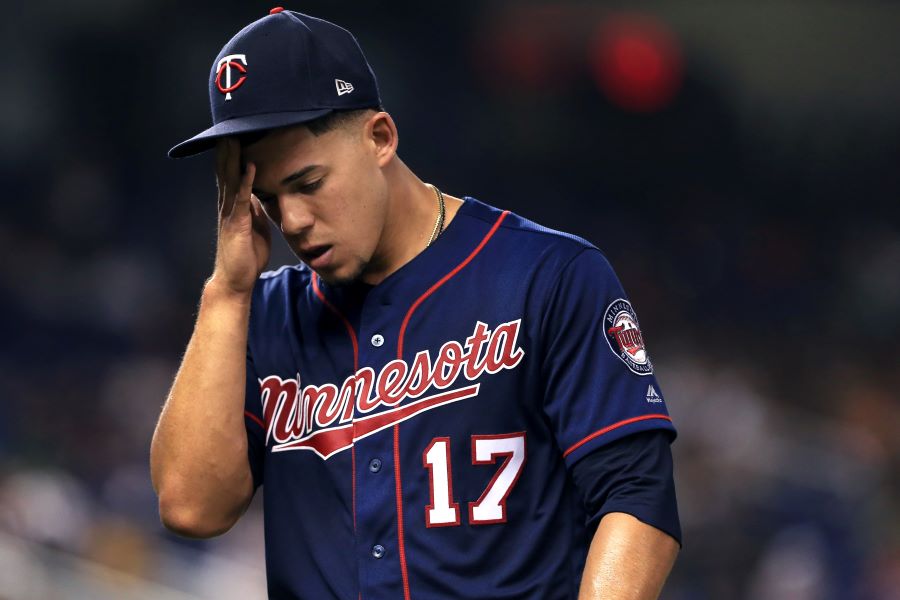
Twins Video
In general, extending young players is a great way to ensure that teams can keep young players that are entering their prime years under team control. This is especially important for smaller-market teams like the Twins, who risk not being able to afford a player once they reach free-agency. Kepler and Polanco’s extensions already look like absolute steals and Sano doesn’t have to do much to make his extension worthwhile. So, extending a 25-year-old team ace like Jose Berrios should be a no-brainer, right?
If we look a little closer at the numbers, there are a few concerns which make extending Berrios more questionable than the others. The first, and possibly most concerning is his decreasing yearly velocity. Berrios started out with plenty of velo, but he’s trending in the wrong direction and reaching a point where his results could begin to diminish.
Here’s Berrios’s average four-seam and sinker velocity from 2016 -2019:

Each season we see a further decrease in velocity for both pitches. Pitching coach Wes Johnson is well-known for his ability to get his pitchers to maximize their velocity, but in his first year under Johnson, Berrios’s velocity continued to decline. This wasn’t the case with his teammates, as Jake Odorizzi’s four-seamer went from 91.1 mph in 2018 to 92.9 mph under Johnson, while Martin Perez increased from 92.8 mph to 94.2 mph. The fact that Berrios’s velocity is continuing to dip under a pitching coach whose modus operandi is getting some extra oomph out of his pitchers is not a good sign.
The problem with losing fastball velocity is that batters’ ability to both hit the ball and hit it with power increases as velocity decreases. Here is a chart from a FanGraphs article, looking at how isolated power (slugging % - batting average) corresponds to fastball velocity:

Clearly the more velocity the better. Here’s a chart of Berrios’s ISO allowed by season:

We can see that the ISO started moving in the wrong direction in 2019.
In both 2018 and 2019 Berrios also lost spin on both his four-seamer and curve. His fastball spin is in just the 26th percentile while his curve is in the 28th. Combined with his now slightly below average fastball velocity (46th percentile) Berrios’s stuff is not heading in the right direction.
Berrios’s seemingly annual second-half struggles are also a concern. Although he reached 200 IP for the first time in his career, Berrios had a brutal August (7.57 ERA) and a 4.64 second-half ERA, compared to a sterling 3.00 ERA in the first-half of the season. Unfortunately, this has been a theme throughout Berrios’s young career and brings into question his ability to remain effective when he is most needed by his team.
Berrios is famous for his intensive offseason workout routine and stays in great shape. During last season’s August slump (in which he saw a velocity drop) some wondered if Berrios’s intense workout regimen was responsible for his late season struggles. He has altered his workout routine some this offseason (Cody Christie gives his ideas for mitigating Berrios’s second-half slides here) and began focusing more on recovery at the end of last season (incorporating deep tissue massage). Maybe the Twins and Berrios have found a way to keep him going strong through the season, but what if Berrios was already getting the most out of his size and talent? Since being drafted, there have always been questions as to how well his body would hold up due to his size. It seems just as reasonable that his advanced fitness level and impeccable work ethic have allowed him the amount of success he has had rather than hold him back.
Now, with all this said, Berrios is still Minnesota’s staff ace and should continue to be a good pitcher in 2020. Encouragingly, he used his changeup more in 2019 and it got great results (check out Matthew Trueblood's recent piece for more on that). Berrios seems a good bet to be a top of the rotation pitcher for the remainder of this three years in Minnesota and the Twins should count themselves lucky to have him. However, due to his smaller stature and already decreasing velocity, some level of decline seems more likely than not.
Minnesota and Berrios were unable to come close to any kind of extension agreement last offseason and there haven’t been any rumors of an extension this year. Berrios recently lost his arbitration hearing against the Twins, but it seems he was just trying to set a new precedent for other players and doesn’t hold any grudge against the team. However, Berrios would definitely be more expensive than his recently-extended peers and seems more likely to bet on himself by waiting for free-agency.
For a team that has been as starting pitcher deprived as the Minnesota Twins, not extending a young and talented arm like Berrios may seem crazy, but they do have him under team control for the next three seasons. A lot can happen in three years. If Berrios’s velocity continues to drop, he becomes less and less likely to take the next step forward and more likely to take a step back. For three years that should be okay, but anything beyond that becomes a risk Minnesota need not take on.
MORE FROM TWINS DAILY
— Latest Twins coverage from our writers
— Recent Twins discussion in our forums
— Follow Twins Daily via Twitter, Facebook or email





Recommended Comments
Create an account or sign in to comment
You need to be a member in order to leave a comment
Create an account
Sign up for a new account in our community. It's easy!
Register a new accountSign in
Already have an account? Sign in here.
Sign In Now