Jump to content
Twins Daily
  • Create Account
  • Twins News & Analysis

    The Twins Aren't Shying Away from Strikeouts. Are They Right?


    Nick Nelson

    The Twins front office are sticking to their guns, following a record-setting season of strikeouts at the plate. Let's examine the merits of this approach, and the thinking behind it.

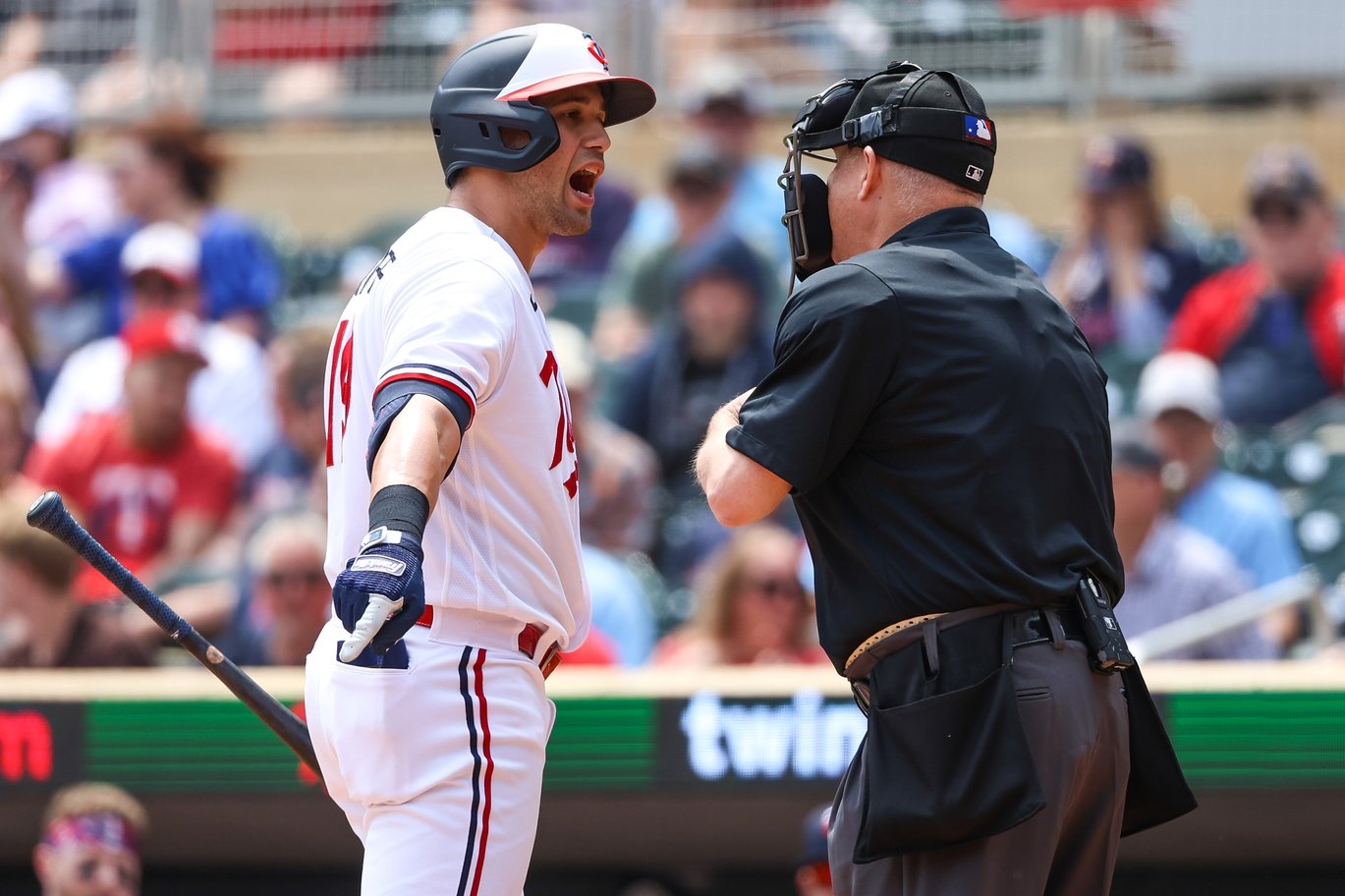
    Image courtesy of Matt Krohn-USA TODAY Sports

    Twins Video

    Fans were understandably exasperated by the amount of whiffing they witnessed from Twins hitters this year. Minnesota set Major League Baseball's all-time strikeout record in the regular season, and the team's playoff run ended with a parade of punchouts as they scrambled futilely to get a runner on base and mount a threat. If you asked random local baseball fans what they'd like to see from next year's club, "fewer strikeouts" would probably be a common refrain.

    That's why it's interesting that Twins leadership is making no bones about their intention to stick with the same basic philosophy that guided them in 2023, even if it means plenty more strikeouts are in the cards. 

    In mid-October, shortly after the team was eliminated by Houston, Bobby Nightengale wrote a piece for the Star Tribune titled, "Strikeouts or not, Twins will not stop swinging for the fences." More recently, MLB.com beat writer Do-Hyoung Park echoed a similar sentiment with last week's headline, "Do Twins need to cut down on strikeouts? Not necessarily." Both articles include quotes from Derek Falvey and Rocco Baldelli firmly vouching for the controversial approach spearheaded by David Popkins and the hitting group. Our Matthew Trueblood looked at the same subject back at the beginning of the team's playoff run, for Twins Daily Caretakers.

    "Of course, it’s a very easy blinking light that everyone can look at and talk about,” Baldelli said of the strikeouts. “There are certain points in every game where you do want to find a way to put the ball in play. But in the vast majority of at-bats, that’s not part of the conversation. I would rather have a guy have a great at-bat and go deep into a count and possibly strike out, but give us a chance to actually give us a baserunner or actually look for a ball in the middle of the zone and pulverize it."

    As Baldelli outlines, the strikeout isn't any kind of aspiration, but rather an accepted risk to achieve the kinds of outcomes they want: walks and home runs. The Twins ranked second among AL teams in walks and tied for first in homers.

    “We weren’t trying to strike out more,” said Falvey. “But at the same time, we were trying to find ways to get to more power. We’ve all observed these playoffs to this point. What’s mattered most is power, the ability to hit for power. The reality is that striking out less this postseason has not led to more wins.”

    According to Park, Falvey is fond of pointing out that statistically, hitting home runs in the playoffs has proven to be more beneficial than striking out is detrimental. In 2023, postseason, teams that out-homered opponents went 29-7; those who struck out less went 17-19.

    Obviously, it would be ideal to have players throughout the lineup who can hit for power and draw walks without striking out frequently. But guess what? Those hitters are among the most valuable in baseball. They're really hard to find and really expensive to sign or acquire via trade. For a team in Minnesota's position, scaling back an already limited payroll, attempting to assemble an elite lineup through this means is essentially a non-starter. They can try to develop bats like that from the top of the draft (and hopefully have a couple on the way, in Brooks Lee and Walker Jenkins), but otherwise, they have to take the bad with the good.

    How bad are strikeouts, really? That's the question that folks like Falvey and Baldelli would pose, and challenge you to think more deeply about. It does seem telling that Minnesota's offense was well above average, in terms of runs scored and OPS, despite striking out more than any other club in baseball history. Maybe it's also noteworthy that, despite this ignominious distinction, these Twins were the ones to finally break through in the playoffs. 

    Meanwhile, if you want to see the opposite end of the spectrum, look no further than across the division to the rival Cleveland Guardians. They struck out fewer times than any other team in the majors this year, and their offense was completely punchless and ineffectual. Cleveland hit the fewest homers in the American League, had the second-lowest slugging percentage, and scored the fourth-fewest runs.

    No matter how annoyed you were watching the Twins offense hack through one of its sleepy stretches of nonstop strikeouts, it was better than watching the Guardians feebly tap into an endless parade of groundouts and weak fly balls, all year long. Cleveland produced the lowest Barrels per plate appearance, lowest Hard Hit rate, and lowest average exit velocity of any major-league team this year. Now THAT is an unwatchable lineup.

    Yes, the Twins need to cut back the strikeouts to some extent. That's bound to happen organically, with the departure of Joey Gallo and his 300-plus plate appearances moving the needle on its own. But the coaching staff and front office is making it clear: we should not expect the team to fundamentally pivot away from a philosophy that prioritizes power at the expense of contact. 

    And if we're taking an honest look at the evidence, I'm not sure we should want them to.

    Follow Twins Daily For Minnesota Twins News & Analysis

    Recent Twins Articles

    Recent Twins Videos

    Twins Top Prospects

    Brandon Winokur

    Cedar Rapids Kernels - A+, SS/CF
    Winokur has had multi-hit games in five of his past six games. In that stretch, he is 13-for-23 (.565) with two doubles. He homered in the 8th inning to give the Kernels the lead. Had 4 hits on Saturday.

    User Feedback

    Recommended Comments


    Featured Comments

    1 hour ago, Cory Engelhardt said:

    I'm HOPEFUL a healthy-ish Buxton also won't strikeout at the same rate as last year. He has been better in the past when both his knees were healthy.

    Also, Julien; he struck out looking all the time it felt like. I'm curious if that is something he is working on this offseason?


    1 hour ago, Richie the Rally Goat said:

    Julien, while also a 3 true outcomes hitter, took a different approach to get there

    One thing to remember about Julien's approach is he knows what pitches he can hit. He can't hit the ball pitched inside and off the plate worth a damn and knows he's better off taking that pitch. That led to several strikeouts looking when he didn't get the call from the umpire but the alternative was probably a strikeout swinging at a borderline pitch.

    27 minutes ago, tarheeltwinsfan said:

    If the hypothesis in the article above, that batters striking out, but at the same time swinging hard, is not as harmful to a team's chances of winning, as is batters who have weak swings with resulting weak contact, which lessens a team's chances for victory,  then I ask this question: Should the Twins pitching staff be built to induce weak contact, rather than trying to achieve strikeouts ? 

    What is Rick Anderson doing these days? 😉

    49 minutes ago, DJL44 said:

    He won't be a rookie next season which should help him get better calls from the umpires.

    To follow up on this point, how many times did Julien get called out looking and the pitch tracker showed the pitch was a ball?  I'm not sure he will get better calls until robo-umps are introduced.

    An increase in talent will lead to a decrease in strikeouts. The Twins have the same approach as all the best offenses in baseball: look for pitches you can drive and don't swing unless you get one of those pitches, then swing to do damage. The Twins problem isn't the strategy it's the lack of skill to be able to do damage on more pitches in more areas of the zone and to make their swings count more often. Although, I do think they can get a little passive at times looking to raise pitch counts.

    I'd also like to see some better situational hitting, but that's also easier said than done. Yes, they're all major league hitters, but, as others have pointed out, pitchers these days are really good. "Just learn to go the other way" is all well and nice, but when a ball is coming in at 90+ MPH while moving 12 inches vertically and horizontally it's not so easy. And as Washington and Cleveland helped show us last year, simply putting the ball in play doesn't actually lead to good things happening frequently like people like to pretend it does. It's not that easy to be Luis Arraez. If it were there'd be more Luis Arraez's. It's really hard to succeed in MLB while making soft contact.

    The current 3 true outcome style of game is far less entertaining than the strategies of old. It's a problem the league should definitely be trying to find ways to fix. But I don't know why we'd want the Twins to put themselves at a disadvantage by changing to a strategy that would make it harder for them to score runs. Would people really be happier watching the Twins lose more simply because they struck out less? I'll take the wins from the runs with the Ks over the losses from the lack of runs with the weak contact.

    The Twins certainly WEREN'T shy about strikeouts, but I'm going to hold judgement about whether they still are until after we see what new offensive additions are brought in this year. If nothing else positive can be said about this front office, they are more than willing to adapt from what went awry the season prior. 

    Considering there's been next to no mention of a reunion with Michael Taylor, I suspect they are at least looking to keep the strikeouts in check next year. I'm setting my mental barometer to a 25% K rate. If new additions are all under that mark, I'll presume they are making an attempt to fix the problem. If they bring in a JD Martinez or Teoscar Hernandez, yeah, then they're doubling down on the strikeout method again.

    The 2 articles you mentioned are basically FO's defense of their stance but don't really give us a big picture of reality. 

    Quote

    No team through the first two rounds of the postseason totaled more strikeouts (73) or walks (27), but the Twins ultimately were doomed by hitting a dismal .132 with runners in scoring position.

    You can't argue with facts. I don't care how many HRs you hit in a blowout game, it's winning the close games with clutch hits that matter not keep striking out in those situations.

    They defended themself by stating that CLE was at the bottom of the list of striking out. I protest that CLE's problem was not that they didn't strike out enough but that they didn't have the offense, plus other things. And that not striking out was one of their positive attributes. 

    https://sports.yahoo.com/mlb/stats/team/?sortStatId=STRIKEOUTS

    At the top half of the list, we mainly see poorer teams except MN & the weird duck PHI which is still a few teams lower than MN. Looking at the bottom half of the list we see mostly good teams where teams like HOU, and AZ are close behind CLE, & ATL & TOR are not far behind. What I think is interesting is that CLE who was dead last in HRs & SOsdidn't end up as the worst team in the MLB & AZ which was towards the bottom on the list of HRs & SOs, went to the World Series. It goes to prove that they were able to win the close games

    I'm not against HRs but I'm totally against the Twins' hitting philosophy of an all-or-nothing approach. We have the offense, the problem is our hitting philosophy. What gets me is that this FO will double up serving their Kool-Aid even when it's obvious that they are wrong. 

    39 minutes ago, Doctor Gast said:

    They defended themself by stating that CLE was at the bottom of the list of striking out.

    I don't believe the front office ever mentioned Cleveland. 

    I believe Nick brought it up as a valid consideration to express the complexity of the issue.  

    4 hours ago, Blyleven2011 said:

    How can you say the strikeouts has its merits ...

    3 strikeouts at target field in the bottom of the ninth  inning ended the playoffs for the Twins  ...

    Yes pitch counts might have merit but no adjustments to hitting with 2 strikes  has no merit as they strikeout and no contact made ...

    Would you have felt better about it if they hit a grounder and a couple pop-ups? All three hitters in that inning took very good ABs and got beaten on full counts by one of the greatest postseason relievers in modern MLB history.

    Meanwhile, this team did break a long-time curse and win three playoff games thanks in large part to its ability to hit for power, which is the trade-off they're making for Ks.

    Depends.   It’s a viable strategy over a long season.

    But, we saw how well it worked out in the playoffs.  You still have to be able play fundamental baseball, move runners over, etc.  We couldn’t do that and struck out too often with RISP.  It cost us the series.

    Some of these metrics and stats are great.  But, you also need situational context.  Theory is one thing, real life with human elements is another.

    3 hours ago, DJL44 said:

    That is not even close to the same MLB. DiMaggio routinely faced pitchers throwing fastballs in the upper 80s and nobody had a slider above 90MPH.

    Nor was it a time when every pitcher blew out their arms to satisfy a radar gun

    3 hours ago, twinzcynic said:

    One of the things that bothers me most about this regime is this:

    On offense, K's are no big deal. In fact they're borderline encouraged!

    On pitching: K's are the most important thing. Sell out for K's regardless of the outcome.

    This is an interesting point, but I'd note that strikeouts from the pitching side tend to correlate a lot more with success than strikeouts from the hitting side correlate with failure. Why is that?

    I would suggest - because pitchers on balance have less control over what's happening with balls in play compared to hitters, who are aiming to maximize power and exit velocity when they make contact.

    You could say the Twins are obsessed with getting strikeouts on the pitching side but I think it's more about limiting contact and especially hard contact, which they did a reasonably good job of. Twins pitchers ranked 7th among MLB teams in barrels/PA, 8th in hard hit %, 14th in exit velo. From 2021 to 2023 they improved from 28th to 14th in HR rate. 

    11 minutes ago, Beast said:

    Depends.   It’s a viable strategy over a long season.

    But, we saw how well it worked out in the playoffs.  You still have to be able play fundamental baseball, move runners over, etc.  We couldn’t do that and struck out too often with RISP.  It cost us the series.

    Anecdotally this makes sense, but does reality bear it out? I'm not sure. You saw Falvey's stats shared in the article about HRs vs Ks and how they correlate with playoff success. That holds true in a multi-year sample. 

    Almost all the runs scored in the Twins playoff games this year came on home runs - for both sides. Failing to hit with RISP or move runners over isn't necessarily some failure by the hitters; you're going against the best pitchers and defenses in the game. 

    34 minutes ago, Nick Nelson said:

    Anecdotally this makes sense, but does reality bear it out? I'm not sure. You saw Falvey's stats shared in the article about HRs vs Ks and how they correlate with playoff success. That holds true in a multi-year sample. 

    Almost all the runs scored in the Twins playoff games this year came on home runs - for both sides. Failing to hit with RISP or move runners over isn't necessarily some failure by the hitters; you're going against the best pitchers and defenses in the game. 

    I get what you’re saying,  but it’s not in a vacuum.  That’s where these stats lose some applicability in some cases.

    There is middle ground (which is lost on most people, in most topics, these days).

    Its completely unreasonable to say your approach should be the same in the 3rd inning, 0-0 game, runner on 1st, 2 outs vs. 8th inning, 0-0 game, runner on 3rd, 1 out.  Any reasonable person would agree.

    As I said, it’s a viable strategy over a large enough sample.  Samples are also statistically different and are weighted differently.  1 set of 162 games isn’t the same as dozens of separate sets of 7 game playoff series.  What’s a large enough sample?  How much data is actually there?  What is the context of the HRs vs. Ks?  Who were the players/pitchers involved?How many is these events occurred in a specific situation? (Example, tie game, runner on 3rd, 1 out, bottom 8).

    Who is at the plate?  Clearly there’s a difference in Carlos Correa vs. Willy Castro.

    I agree with the premise in general.  But, it’s clearly more statistically nuanced than just saying swinging for the fences all the time leads to more playoff wins.  There are situations when it doesn’t make sense.  

    And, no, Falvey’s generalized statistics don’t disprove that.  And, yes, not hitting with RISP is a failure by the hitters by definition.  Doesn’t matter who you’re hitting against.  You can’t say, “this is the strategy to win a championship, except when you’re facing better players.”  Then, you’re just not good enough to win a championship and the underlying stats and strategies don’t matter no matter what you’re doing.  It’s the MLB playoffs, you’re a spending a lot of time hitting against the best pitchers.  Which. Further reinforces that sometimes you just sacrifice a potential 500 ft. HR to manufacture a run.

    I don’t think these takes are in any way unreasonable or statically invalid.  I’m actually agreeing that it should be employed….just maybe a slightly more limited basis depending on the situation.


    4 hours ago, tarheeltwinsfan said:

    If the hypothesis in the article above, that batters striking out, but at the same time swinging hard, is not as harmful to a team's chances of winning, as is batters who have weak swings with resulting weak contact, which lessens a team's chances for victory,  then I ask this question: Should the Twins pitching staff be built to induce weak contact, rather than trying to achieve strikeouts ? 

    This would be a great subject for your blog.

    3 hours ago, DJL44 said:

    One thing to remember about Julien's approach is he knows what pitches he can hit. He can't hit the ball pitched inside and off the plate worth a damn and knows he's better off taking that pitch. That led to several strikeouts looking when he didn't get the call from the umpire but the alternative was probably a strikeout swinging at a borderline pitch.

    This flies in the face of the old school “2 strikes approach” but it was really effective for Julien. His patience paid off with more mistake pitches too.

    4 hours ago, DJL44 said:

    That is not even close to the same MLB. DiMaggio routinely faced pitchers throwing fastballs in the upper 80s and nobody had a slider above 90MPH.

    The mound was higher and there were genuine Knuckle Ball pitchers.

    There are no Satchel Paige quality pitchers now.

    For fun here is % of PA's resulting in either a BB and SO created simply by adding BB% and SO% together. 

    Do these numbers suggest which batters are working the counts or missing meatballs. 

    Do these numbers suggest which batters hit those mistake pitches or made weak contact with balls they shouldn't have touched. 

    What worked for Julien did not work for Gallo or Larnach. What worked for Lewis did not work for Correa or Vazquez. 

    I draw no conclusions.  

    Gallo - .573

    Julien - .471

    Larnach - .467

    Garlick - .434

    Wallner - .425

    Buxton - .415

    Taylor - .402

    Luplow - .383

    Jeffers - .377

    Polanco - .362

    Kirilloff - .339

    Castro - .325

    Lewis - .314

    Solano - .311

    Kepler - .308

    Correa - .308

    Vazquez - .301

    Farmer - .295

    Stevenson - .250

    MIranda - .217

    Gordon - .129


    2 hours ago, Riverbrian said:

    I don't believe the front office ever mentioned Cleveland. 

    I believe Nick brought it up as a valid consideration to express the complexity of the issue.  


    Quote


    "We were trying to find ways to get to more power," Falvey said. "We've all observed these playoffs to this point. What has mattered most is the ability to hit for power. The reality is that striking out less this postseason has not led to more wins."

    The Cleveland Guardians compiled the fewest strikeouts in the majors this year, and they scored the fourth-fewest runs.


    I see that I made a mistake & I apologize. I took Strib's comment about the CLE correlation injunction with Falvey's comment as all of Falvey's comments. But that doesn't take away from what I said about the invalid correlation between CLE's SOs. I'm curious though where the Strib & Nick came up with the same correlations. & who sourced it?

    I will acknowledge that there isn’t a linear correlation between strike outs and runs scored. There does seem to be a benefit to balance. Sort the teams in the AL last year by strikeouts and then look to the average line. You will find the two teams that scored the most runs on each side of the average line. In the NL it was the second and third ranked teams surrounding the average strikeout line. Teams that strike out too often need more balls in play to move runners. Teams that don’t strike out and put balls in play too often don’t have the power to bring those runners in. A balanced line up or at least a line up that avoids the extremes seems conducive to scoring runs. The Twins disrupted that balance last year replacing Arraez with Gallo at first base. They did rebound in the second half but that coincided with less time for Gallo.

    Are they working this year to achieve better balance? 

    I agree that the primary issue is the personnel, i.e. the talent, and not necessarily the approach. That said, the personnel isn't likely to change much, so the question really becomes at what point does that risk start to outweigh the reward? I'd argue that most of last year we were treated to the former and not the latter. How many times last season did we watch this team look inept (especially against LH pitching) for lengthy stretches and then explode? So sure, on average, things might look perfectly fine, but that type of inconsistency is exactly what sunk this club in the postseason. 

    Also, we need to acknowledge how heavily OPS values HRs when using it in this context. It's funny that Gallo was mentioned as addition by subtraction. He was considered league average by OPS+ last year. If you watched even semi casually you know that's nowhere close to true. Matt Wallner isn't a stranger to K's. Julien hasn't shown (in a very limited SS) any ability to put together competitive ABs vs. LHP, and neither of the two finished last year on a particularly strong note. Lewis's run in the 2nd half is very likely unsustainable, and he has (again in small samples) put together some high K stretches. That doesn't mean this offense is doomed but I'm not sure things are markedly better. 

    As a side note, yes I would rather see this team win than struggle to scratch across runs a la Cleveland, but the Twins played a pretty unwatchable brand of baseball themselves for a large part of last year as well. 

    Does a developing player's high strikeout rate present a red flag on potential MLB success?

    Roster Resource projects starting roles for Minnesota's Matt Wallner and Seattle's Dominic Canzone, same-age lefthand-hitting outfielders selected out of college in the 2019 draft.

    This year Wallner impressed in his MLB debut with a wRC+ of 144 and 1.9 fWAR  in 76 games while Canzone disappointed with a wRC+ of 79 and a negative 0.5 fWAR n 56 games.

    One difference, however, was Wallner's strikeout rate of 31.5 percent and Canzone's strikeout rate of 17.6 percent.

    Despite the contrasting 2023 debuts, Steamer projects Wallner with a 2024 WAR of 1.2 in 110 games and Canzone with a 2024 WAR of 1.1 in 109 games.

    We fans don't have the data Steamer does and Steamer does not have the same data MLB front offices do.

    But does the difference in strikeout rates impact the projections?


    Quote

    The Cleveland Guardians compiled the fewest strikeouts in the majors this year, and they scored the fourth-fewest runs.

    Curiously, SOs are very desirable for pitchers yet for hitters it doesn't matter? RBIs (runs) or the lack thereof by many experts are not important but according to this comment, it's insinuated as very important?

    1 hour ago, Doctor Gast said:


    I see that I made a mistake & I apologize. I took Strib's comment about the CLE correlation injunction with Falvey's comment as all of Falvey's comments. But that doesn't take away from what I said about the invalid correlation between CLE's SOs. I'm curious though where the Strib & Nick came up with the same correlations. & who sourced it?

    Not sure about the Strib or Nick but It was a topic here on TD awhile back when Ashbury provided some interesting data nuggets on Cleveland/Washington K rates in comparison.

    It was a very interesting conversation that could only go so far because you would have to lose your soul to enter what I assume was an enormous rabbit hole that Ashbury pointed at. 

    I take Falvey's comments as nothing more than a general explanation on how a patient team that works the count is going to pile up strikeouts... it makes perfect sense to me but to me it's like someone saying,.. I drove my car 400 miles a day as an Uber driver, and I have to fill up every day and therefore spend more in gas. 

    My bottom line opinion, The Twins set an all time record in strikeouts for a season. It was way too much... It must be fixed.

    In other words: Get a vehicle that gets better miles to the gallon, go hybrid, go electric.  


    2 hours ago, RpR said:

    The mound was higher and there were genuine Knuckle Ball pitchers.

    There are no Satchel Paige quality pitchers now.

    Knuckle ball pitchers aren't known for their strikeouts. They're known for inducing weak contact.

    There are dozens of Satchel Paige quality pitchers in any given season but very few with Satchel Paige longevity. Greinke might be the closest equivalent. I do think DiMaggio would have had more strikeouts if they hadn't banned Paige from pitching against him for most of his career.

    Unfortunately, striking out 12 times in a game is like starting the game on offense in the fifth inning.  You have reduced the possibility of scoring considerably as a result of wasting 1/2 the offensive innings that your team has for the game.  Strikeouts are the easiest out of the game for the defense. . Further, if the team becomes homerun dependent to score. what happens in the games that they don't hit any?  The objective  of the game of baseball is to score more runs than the other team does.  It doesn't make much difference how that gets done.  Just so it gets done.  To me. a variety of offensive tools/approaches is better than being one dimensional.

    26 minutes ago, DJL44 said:

    Knuckle ball pitchers aren't known for their strikeouts. They're known for inducing weak contact.

    There are dozens of Satchel Paige quality pitchers in any given season.... I do think DiMaggio would have had more strikeouts if they hadn't banned Paige from pitching against him for most of his career.

    LOL, really now.

    image.png.7c8321a1e2fabde220ac7f4ccfe243a2.png

    Was Satchel Paige the best pitcher ever?
     
     
    The Greatest Pitcher Ever | KC History
     
    His legacy was best summed up by baseball greats Joe DiMaggio, Ted Williams, Dizzy Dean, and Bob Feller, who all proclaimed Satchel Paige to be the greatest pitcher ever.


    Create an account or sign in to comment

    You need to be a member in order to leave a comment

    Create an account

    Sign up for a new account in our community. It's easy!

    Register a new account

    Sign in

    Already have an account? Sign in here.

    Sign In Now

×
×
  • Create New...