


Twins Video
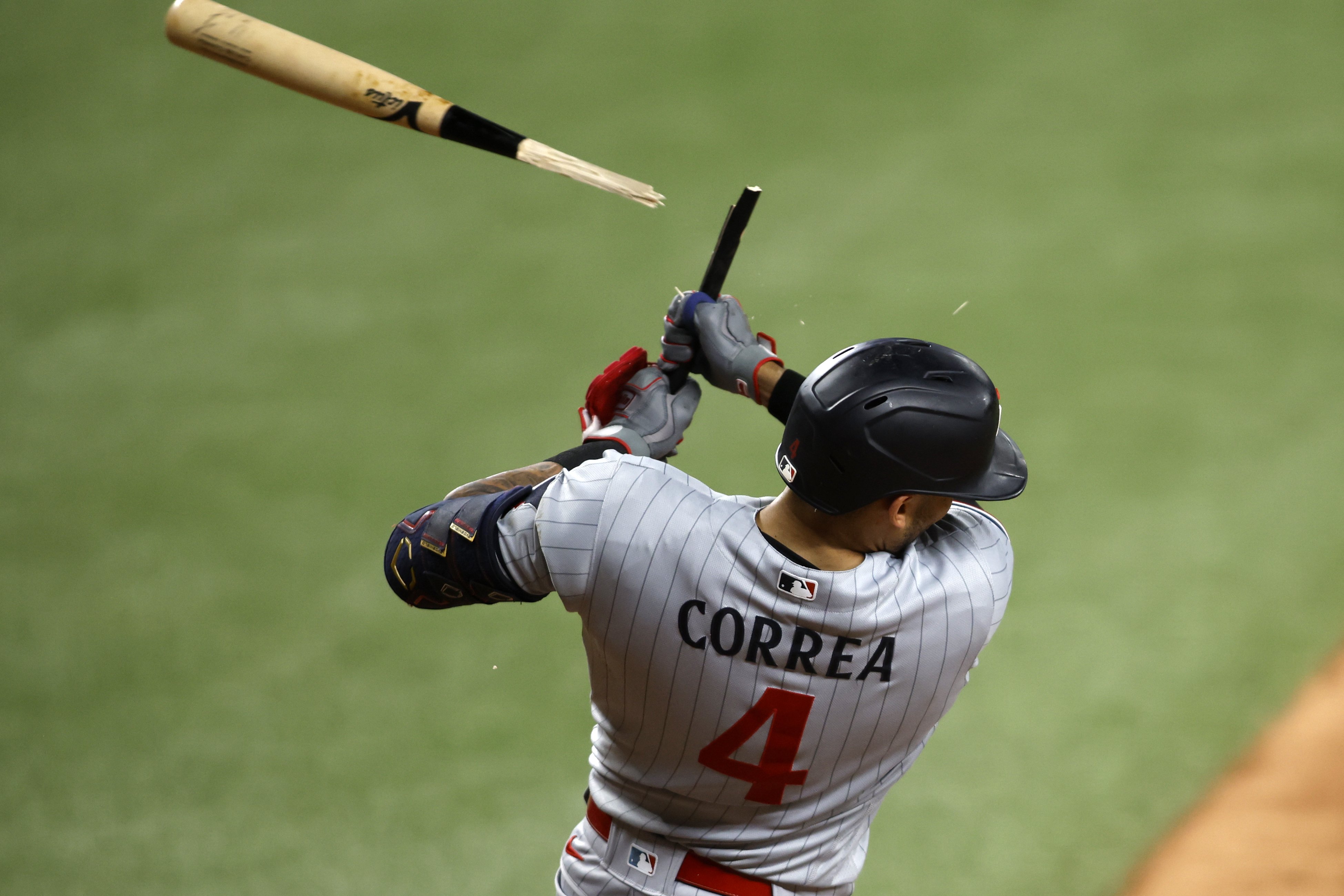
Just one year into the largest contract ever given out by the Minnesota Twins, Carlos Correa is chasing history. His performance over the next few weeks can etch his name into the record books.
Carlos Correa has a double-play problem. He's addicted to them. Not only can his cannon of an arm turn some impressive double plays on defense (he's sitting at 47 turned thus far in the season), but he's also on pace to ground into more than 30 of them.
If you're unaware of how monumental that number is, only 18 times in MLB history has a player hit into 30 double plays in a season. Correa sits at 29, tied at 19th all-time with 13 others. He already sits atop the Twins all-time single-season record book, having passed Trevor Plouffe and Harmon Killebrew last week. There are 22 games left in the season.
He's on pace to hit into 34 double plays, which would land him in sole possession of third place on the all-time list. The record is 36, held by 1978 American League MVP Jim Rice, who set it in 1984 and followed it with a season that landed him at second all-time with 35 in 1985.
Rice was an All-Star in both those years and those preceding and following—1983 and 1986. He won a Silver Slugger in 1984, hitting .280 with 28 home runs and 102 RBI. Some of that was likely due to his reputation, but he still graded out 12% above a league-average hitter by OPS+.
Grounding into a lot of double plays isn't necessarily an indictment of a player's talent. Rice was an MVP and occupies the top two spots. Cal Ripken Jr. (1985) and Miguel Tejada (2008) are among those tied for third at 32, though they're tied with the likes of Billy Butler (2010) and Ben Grieve (2000), players for whom no one is anticipating a trip to Cooperstown.
The all-time career record book for double plays hit into is adorned with some of the greatest of all time. It takes a long career to hit into 426 double plays as Albert Pujols did. Among the top five are Miguel Cabrera and Hank Aaron, two of the greatest righthanded hitters of all time; Ivan Rodriguez; and Ripken. In six years, all five of those players will be enshrined in Cooperstown.
In addition to their long careers, the four share a few commonalities: they were slow, right-handed hitters who hit the living snot out of the ball. Carlos Correa shares those same traits. He's a righty (meaning he starts a few feet farther from first base than a lefty does) who is in the top third of the league in hitting the snot out of the ball (which makes it easier to turn double plays when the ball is fielded in the infield) and in the bottom third of the league in speed.
Correa hasn't always had a double-play problem, though. The most he'd ever hit into in a season was 18 in 2022. He's on pace to almost double that figure this year. So, what's changed?
Correa hasn't necessarily been fast since around the 2016 season, according to Statcast. From 2017 to 2019, he was consistently ranked in the top third of the league, though right on the edge around the 67th percentile in sprint speed. As he's aged, he's gotten slower, having been right around league average for the past couple of years.
The wheels have come off this year, though, no pun intended. Correa has dropped into the bottom third of the league in sprint speed, in no small part due to his season-long battle with plantar fasciitis—an injury to a ligament in the bottom of his foot that is quite painful.
However, it's not like he's walking to first base. Being slower than 67% of the league can only explain some things. If it could, there would be 100 other players alongside him. Ty France of the Mariners has the second most this year—24.
He's hitting the ball hard, as well. His average exit velocity (90.3) and hard-hit percentage (45.9%) rank in the league's top third. The exit velocity is on par with his career norms, though the hard-hit percentage—meaning balls hit over 95 miles per hour—is the highest of his career and over 3% higher than his career average. He's hitting the ball about as hard as usual, if not harder.
Other aspects of his batted ball profile have mostly stayed the same. His average launch angle is lower than in recent years (10.4) but right on track with his career averages (10.3). There's a lot of noise in average launch angle because it's averaging a bunch of different types of hits, but he's also hitting groundballs, the type that turns into double plays, at a similar rate to his career norms (46.7% vs. 45.6%).
Correa's spray charts largely look similar as well, as the rate at which he's pulled the ball, hits it up the middle, or goes to the opposite field is within 1% of his career averages. It's difficult to pinpoint why he's grounded into a comical number of double plays.
But maybe that's what this is—a comedy. Of course, the year Correa signs the biggest deal in team history, he develops an injury that hobbles his already diminished speed. Of course, he's hitting the ball like usual, and middle infielders are catching them. Of course, it's happening with guys on base. Who would have written it any other way?
There's a lot of luck in setting any record. Don't let anyone tell you otherwise. They're abnormalities. Sometimes, that luck is bad. Sometimes, that bad luck accompanies plantar fasciitis, hitching a trailer to the sports car tumbling down a bad luck road.
Me? I'm here for the ride: next stop, 36, Chuck.
AUTHOR EDIT: A couple of early comments noted that I left out situational performance in this piece. Thank you to @PDX Twin and @Brandon. I did a quick dig and found some interesting information. Correa is not hitting with runners on and less than two outs any less than he normally does. However, he's hitting groundballs in those situations at an uncharacteristic 62.2%, which is a 50% increase over his career average in those situations: 43.5%.
It really could just come down to hitting more grounders in those situations. Great catch, and thank you to both of you who asked for more data.







Recommended Comments
Create an account or sign in to comment
You need to be a member in order to leave a comment
Create an account
Sign up for a new account in our community. It's easy!
Register a new accountSign in
Already have an account? Sign in here.
Sign In Now