Jump to content
Twins Daily
  • Create Account
  • Twins News & Analysis

    What to Make of Carlos Correa's Defense at Shortstop?


    Nick Nelson

    He was just named a Gold Glove finalist, but the data suggests Carlos Correa's formerly elite glove is not what it once was.

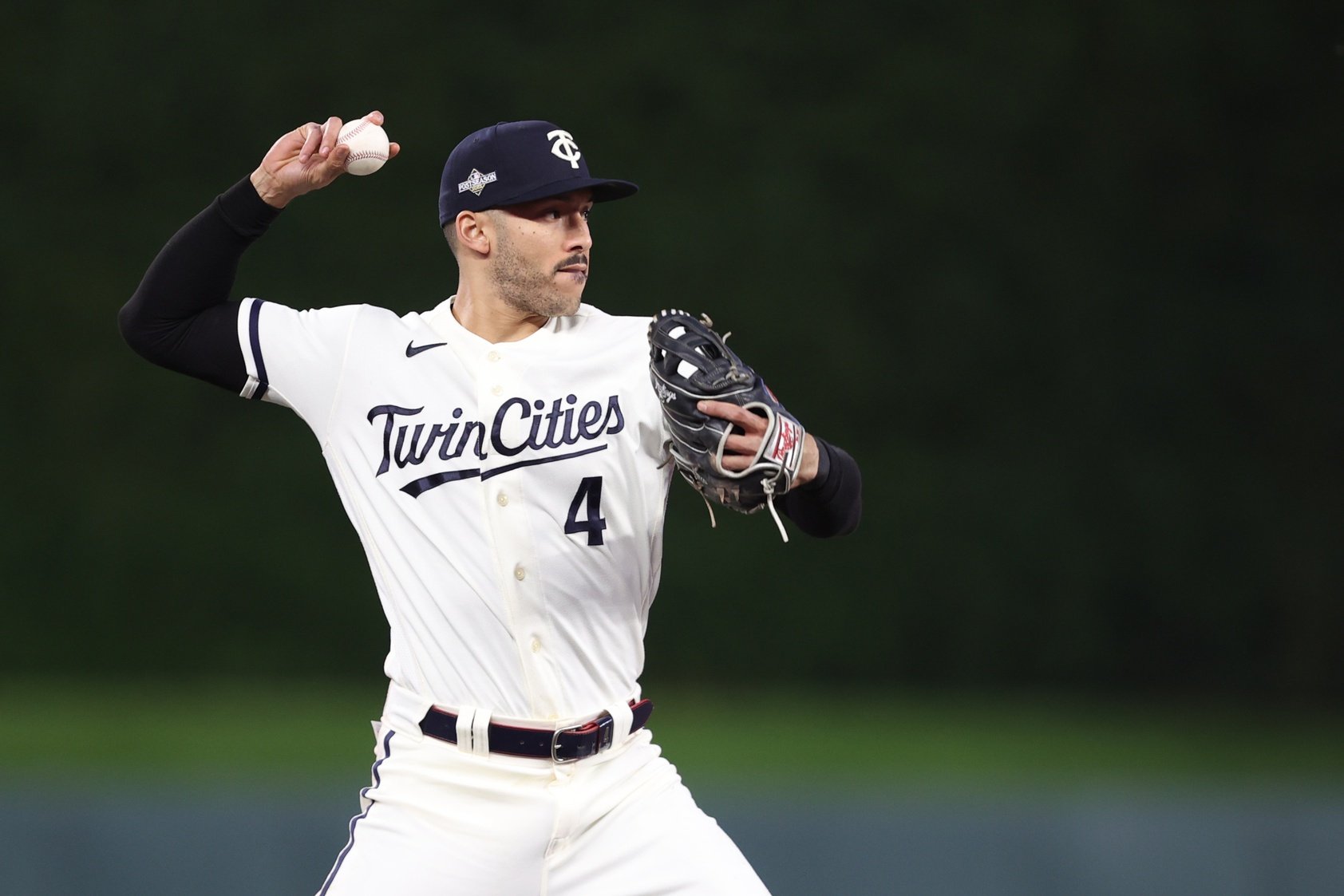
    Image courtesy of Jesse Johnson-USA TODAY Sports

    Twins Video

    When it comes to defense in baseball, often the defensive metrics just don't match up to the eye test or general consensus. One famous example would be Derek Jeter, who won five Gold Gloves in his career and was widely considered a premier shortstop, despite the fact that fielding statistics consistently rated him as below-average. 

    Carlos Correa, conversely, is not a player whose fielding has been overrated relative to statistics. If anything, the opposite is true. Or it was. 

    Metrics like Outs Above Average (OAA) and Defensive Runs Saved (DRS) consistently viewed Correa as one of the most impactful shortstops in the league throughout most of his career. From 2018 through 2021, here's where Correa ranked among shortstops in OAA, and among all MLB players as a percentile factor.

    • 2018: 23 OAA – 2nd in MLB, 100th percentile
    • 2019: 11 OAA – 7th in MLB, 96th percentile
    • 2020: 4 OAA – 9th in MLB, 94th percentile
    • 2021: 10 OAA – 6th in MLB, 96th percentile

    Genuinely elite defense, year after year. Aided by his incredible arm, quick reactions, and strong instincts, Correa overcame a lack of standout foot speed to continually rank as one of the rangiest shortstops in the game. Culminating with a Platinum Glove award in 2021 that recognized him as the best overall defender in the game, fielding was a huge part of Correa's value proposition when the Twins signed him in 2022, and then re-signed him to a historic long-term deal in 2023.

    Yet, ever since joining the Twins, Correa's defensive metrics have been completely out of line with his previous track record. In his first season here, Statcast had Correa producing negative-3 Outs Above Average, which ranked 32nd among shortstops (100+ attempts) and in the 18th percentile among all big-leaguers. 

    We all wondered if perhaps that 2022 season would prove to be an outlier, and Correa's defensive numbers would bounce back toward career norms this year. Turns out he did, a little. Correa ranked 25th among shortstops with 1 OAA, a figure that placed him in the 64th percentile for big-leaguers. 

    Not bad, but much more average than great, and probably not a result that lines up to the eye test for most Twins fans and (apparently) Gold Glove voters. 


    Elsewhere, signs of a sudden yet sustained drop-off are even more vivid. Here's how Correa has rated out according to FanGraphs' Defensive Runs Above Average (DEF) metric over the past six years:

    • 2018: 17.3 in 110 games
    • 2019: 9.6 in 75 games
    • 2020: 5.6 in 58 games
    • 2021: 14.5 in 148 games
    • 2022: 2.1 in 136 games
    • 2023: 3.5 in 135 games

    What to make of this stark decline in statistical defensive proficiency? It's hard to say that the metrics are missing something in Correa's performance given how consistently they assigned him massive defensive value prior to his time with the Twins. 

    I think there are a few different reasons that Twins fans might perceive Correa's defense as more positively impactful than it has verifiably been. One is simply reputation. When you're treated by media and popular narratives as a great defender, it's a rep that tends to gain traction and stick, regardless of evidence to the contrary. Jeter benefited from this.

    Another thing is that Correa is just a really good, smart, smooth ballplayer. He doesn't commit many errors. It may not be all that visibly noticeable when he misses a grounder that he'd have gathered a few years ago, or that some of the other top shortstops in the league would get to. On any given play, the incredible caliber of his arm alone could easily convince someone he's a top-tier defensive SS regardless of any other data.

    There's also this: Correa is a clutch. He steps up and makes big plays in big moments. We certainly saw that in the playoffs. 


    The Athletic's Eno Sarris wrote this week about the concept of clutchness in baseball. His data-driven analysis is an interesting one, but what I find most striking is the way performances in big moments shape our memories and perceptions. 

    As Eno put it in a radio interview, "If you have an emotion tied to a memory, you're going to remember it more." In this light, it's easy to see why momentous plays like Correa's game-ending backhand stab in Houston, or his heady throw home against Toronto – not to mention all those big-time highlights in years past – have an outsized influence on the way we think of him.


    Emotions and subjectivity have a major impact on the so-called eye test, which is why many observers are prone to overrate Correa's current defensive impact just as they did with Jeter throughout his career.

    So what does this all mean? Not a ton in the short term, necessarily. Even if you agree, based on the evidence, that Correa is no longer quite as strong defensively as his Gold Glove nomination would suggest, no one's arguing that Correa is a liability at shortstop, or that he should be moved somewhere else next year. 

    Even as his range diminishes, Correa remains a steady and sure-handed infield captain. His leadership and intelligence at a position where smart split-second decision-making is invaluable will help C4's continue to be an asset at shortstop even if his physical tools are beginning to dullen.

    But the undeniable data trend does lead you to wonder. What's at the root of this statistical defensive decline? Is he already showing signs of aging at 29? Are the health concerns in his lower body – an ankle that's structurally worrisome, and now a nagging case of plantar fasciitis – taking their permanent toll?

    These will be things to keep an eye on moving forward. It is worth noting that Correa was ready to move to third base if he signed in New York, and the nature of his contract with the Twins (salaries declining quickly in the later years) seems to imply that an eventual position switch is expected from all parties. 

    Everyone seems to understand that it's a matter of if, not when, Carlos Correa will stop playing shortstop. Even if he wins a Gold Glove this year, a deeper look his declining defensive value – not to mention the physical state of his body – makes clear that the day could come sooner than many anticipate.

    Follow Twins Daily For Minnesota Twins News & Analysis

    Recent Twins Articles

    Recent Twins Videos

    Twins Top Prospects

    Marek Houston

    Cedar Rapids Kernels - A+, SS
    The 22-year-old went 2-for-5 on Friday night, his fourth straight multi-hit game. Heading into the week, he was hitting .246/.328/.404 (.732). Four games later, he is hitting .303/.361/.447 (.808).

    User Feedback

    Recommended Comments


    Featured Comments

    12 minutes ago, DJL44 said:

    Got it. You believe all the general managers in baseball are wrong and they're paying too much for free agents.

    I guess that's an opinion but you're the one not rooted in reality. Fangraphs is just taking the $$ actually spent (reality) and dividing it by the performance (also reality). Nobody gets $66M a season but plenty of players get $33M a season with the expectation that the last years of the contract will be paying $33M for nothing. When you divvy up the pool of money it ends up at $9M/WAR.

    One thing I don't like about how they present the data is "value" is always in context to current market value, not market value in that particular year but that's a nitpick especially when $$/WAR was pretty much the same in 2022 as 2023.

    Jurickson Profar's "value" this year was $-15 mil.  Does this mean he should have paid the club 15 million bucks?  Has this ever happened in the history of the sport?  If not, why, again, do you think this statistic has any particular meaning?  It's simply a WAR multiplier.

    Also WAR doesn't represent "reality" or "performance" either...topic for another day...


    7 minutes ago, Woof Bronzer said:

    Jurickson Profar's "value" this year was $-15 mil.  Does this mean he should have paid the club 15 million bucks? 

    No, it means the team shouldn't have given him playing time. It's a failure of management to have a player rack up negative value.

    5 hours ago, Parfigliano said:

    Lets see how he grades defensively and his offensive production next year when hopefully not dealing with the plantar fasciitis problem.

    I think this is the explanation.  What we got this year is a preview of a couple years down the road when he actually loses a step.  Still a darn good shortstop.  Knock on wood that he comes back to full speed next year. 

    The arm and the glove are great obviously but what sets him apart is the scouting, positioning and anticipation.  Adjusting for age is easier than adjusting for injury because its consistent.  Those traits should allow him to stay at shortstop for quite a while.  Barring injury, by the time Correa is ready to move off short Royce and Brooks will no longer be options either. 

    Interesting mention of just 6 errors, I distinctly remember two odd missed catches down the stretch that were completely out of character.  I went back to the MLB video library and there were 3 catches that looked like a high schooler should have made.  They were August and Sept as the foot and season had to have been grinding on him but he could have very easily had a 3 error season where his mobility was compromised.  Pretty, prettty good.

    His down year on defense is as good as most guys best years.  We should not be looking to move him to 3rd anytime soon.

    Can’t really expect a premium year with plantar fasciitis; in the field or at the plate. Hopefully he feels better next year, and maybe gets some extra rest days. In some ways he’ll never live up to his contract, and in others he already has. I’m happy with what we have, and I’m glad we have two great foundation blocks in Correa and Lopez to build around. (I remember some metric rating his arm as average last year; cracked me up no end.)

    I don't know how they factor defensive metrics, but I can't look at errors and think it's the end all of stats. Let's say I'm playing SS. I'm 62 and not very quick. I might never make an error unless they hit the ball right at me because I have no range. CC on the other hand, is going to dive for balls I have no business getting to, but he's going to make a few errors because he's getting to stuff most of us can't get to. Plus, there's fielding errors, throwing errors, and mental errors. Maybe they need to split those up in the stats.  In short, CC has better defense than me, despite my idiot little league coach who put me there.

    6 hours ago, Fire Dan Gladden said:

    I do not know how Fangraphs came up with that number, but if you polled 100 knowledgeable people, I would bet 100 would say that Correa's production value did not come close to his salary last year.

    2023 OPS+
    Correa 94
    Gallo 101

    Gallo had to be worth $40M, right?
     

    ANY stat showing Joey Gallo to be above average (i.e. better than the average, I don't need confirmation that he is a world-class hacker...) is instantly worthless in evaluation...

    7 hours ago, Fire Dan Gladden said:

    I do not know how Fangraphs came up with that number, but if you polled 100 knowledgeable people, I would bet 100 would say that Correa's production value did not come close to his salary last year.

    2023 OPS+
    Correa 94
    Gallo 101

    Gallo had to be worth $40M, right?
     

    I imagine they included his playoff value too which I'm sure is pretty high with how he performed there.  I'm not arguing your call on offense.  but the only real drop in offense from Correa this year vs past years is his batting average.  His power numbers and walk numbers were close to norms.  I'll also point out his GIDP numbers sure didn't help his value either. 


    Nobody has stopped and considered DRS and OAA are counting stats and are based on opportunity.   Houston during Correa’s time there had  one of the highest GB rates.  The Twins have one of the lowest during his time here. That would explain some of the drop off 

    On 10/20/2023 at 8:27 AM, DJL44 said:

    Fangraphs has him worth $34.8M last year and he got paid $35.1M. That's not "drastically overpaid".

    Why. Because he's good in the clubhouse. Hope that's worth 15 million because a 227 batting average and pretty good defense would have half the league getting 35 million a year.

    25 minutes ago, saviking said:

    Why. Because he's good in the clubhouse. Hope that's worth 15 million because a 227 batting average and pretty good defense would have half the league getting 35 million a year.

    Why does it sound like you pine for the days of Denny Hocking at shortstop? 

    Defense is just hard to measure. Positioning, arm strength, instincts and "making the right play" should all figure in. We have known since Correa was acquired (the first time) that he is not speedy (below average sprint speed), but that his reach (6'4") and big arm made up for the lack of range. 

    Correa makes all the plays and has excelled at turning outs into outs. Probably he doesn't get enough credit for that. Or maybe whoever does the analysis of defense automatically penalizes whoever goes to the Twins. In the last several years, the Twins have added three guys regarded as elite defenders--Andrelton Simmons, Josh Donaldson and Correa--and each has seen their defensive stats suffer (Donaldson's rebounded when he went to NY).

    With all due respect this is one of the dumbest articles in a long time. Correa is better than anything the Twins have ever had. With only a few exceptions his only errors were on balls that most shortstops don't get too! They would be through for hits. He knocks them down and gets penalized for errors.

    2023 OPS+
    Correa 94
    Gallo 101

    That comparison shows how wildly un-useful the new wave of metrics, advanced metrics, SABR stats are and a massive failure in lending any instructive insights into the game of baseball. Correa was 10,000 times the player Gallo was. Gallo’s season had to be one of the worst of all time.

    If one has followed baseball for many years and seen many average, good and great players the eye test is all you need. 

    I’ll give an example from basketball. Luckily basketball hasn’t been afflicted with an avalanche of unscientific new stats like baseball but what f somebody told you that someone somewhere (like who’s responsible for OAA, Zone ratings and all these defensive stats and offensive stats that skew toward power hitters? Who created it? Who voted on all these stats saying, yes, these are more valuable than Terry Francona, Dick Bremer, Alex Rodriguez, Justin Morneau and Roy Smalley’s eye tests and scores of fans who have seen the 72-74 Oakland A’s play and the 75-76 Reds , the 35-5 Tigers, both generations of Orioles teams with stifling pitching. Seen Omar Vizquel, Ozzie Smith, Cal Ripken, Jason Bartlett, Greg Gagne, Carlos Correa, Freddie Patek, U.L Washington, Dave Concepcion and Bert Campaneris).

    Like everything else in life, experience matters. How could anybody be fooled by neophyte, gravely flawed statistics when the answer is right in front of their eyes.

    Back to my basketball analogy. I feel like people telling me that Outs above average and these other new defensive metrics that try to measure range and errors all in one, i.e. the unmeasurable - that Gio Urshela and Carlos Correa last year were below average because of OAA would be like (I lived in Chicago for 21 years) telling me that Michael Jordan was overrated. That his assists above average was never near the top of the league and that he was below average on defense because his field goals allowed by other team while he was on the floor and his 3 pt field goals allowed was below average.

    Don’t use the eye test!

    None other than Carlos Correa offered just one argument that demolishes OAA. He said, I’m playing for a primarily Flyball pitching staff. How in the world could he lead the league playing on a flyable pitching staff? More likely a poor fielder who plays behind a roundball pitching staff would lead the league in OAA.

    I read a  description of how they get OAA and it was so convoluted and full of flaws that it was almost laughable.

    I mentioned how Bill James, in retrospect, wrote an article in late 2021 about another new stat that is very flawed. James gave a very logical presentation and concluded that WAR should be renamed WAG for Wild Ass Guess. I mentioned that to someone on Twitter and they just attacked James as a bitter old fart or something like that. But James is right.

    Well, I and every other Bulls and basketball fan used the eye test to judge Jordan. And for Scottie Pippin. Also for players like Magic Johnson,  I used the eye test for Wilt Chamberlain, Bill Russell and Oscar Robertson. Lebron. Bird. All eye tests. Even in basketball, the most basic, unchallenged stat recently told basketball fans a little fib. The secret is Kareem Abdul Jabbar played when there was no 3 point rule. So, if you take away that extra point from Lebron, he’s likely way behind Kareem in baskets made. 

    Correa made only 6 errors at SS this year. That’s historically low. The lowest Hall of Fame SS Ozzie Smith ever had in a season where he played 1144 or more innings is 8. I’ve always considered Ozzie Smith to be the best defensive SS of my lifetime. and he never matched Correa’s excellence at the only defensive stat that is a true empirical measurement of an observable event.


    Bottom line is Carlos Correa had a great defensive season. As far as I recall,I watched every game this year and my eye test says Correa is the best in baseball. One man’s opinion to mix in with all the others.


    On 10/21/2023 at 12:36 AM, TFelton said:

    He passes my eye test.  IF the ball is hit, he is one of 2 I hope it is hit to (MAT).

    Amen, brother! And I watched Terry Felton pitch extensively at Toledo. He had a smoking fastball. I thought he was gonna be good in MLB.

    On 10/21/2023 at 11:21 AM, saviking said:

    Why. Because he's good in the clubhouse. Hope that's worth 15 million because a 227 batting average and pretty good defense would have half the league getting 35 million a year.

    Why are so many posters in this thread having such a hard time figuring out what year this is? Is it legal weed?


    Create an account or sign in to comment

    You need to be a member in order to leave a comment

    Create an account

    Sign up for a new account in our community. It's easy!

    Register a new account

    Sign in

    Already have an account? Sign in here.

    Sign In Now

×
×
  • Create New...