


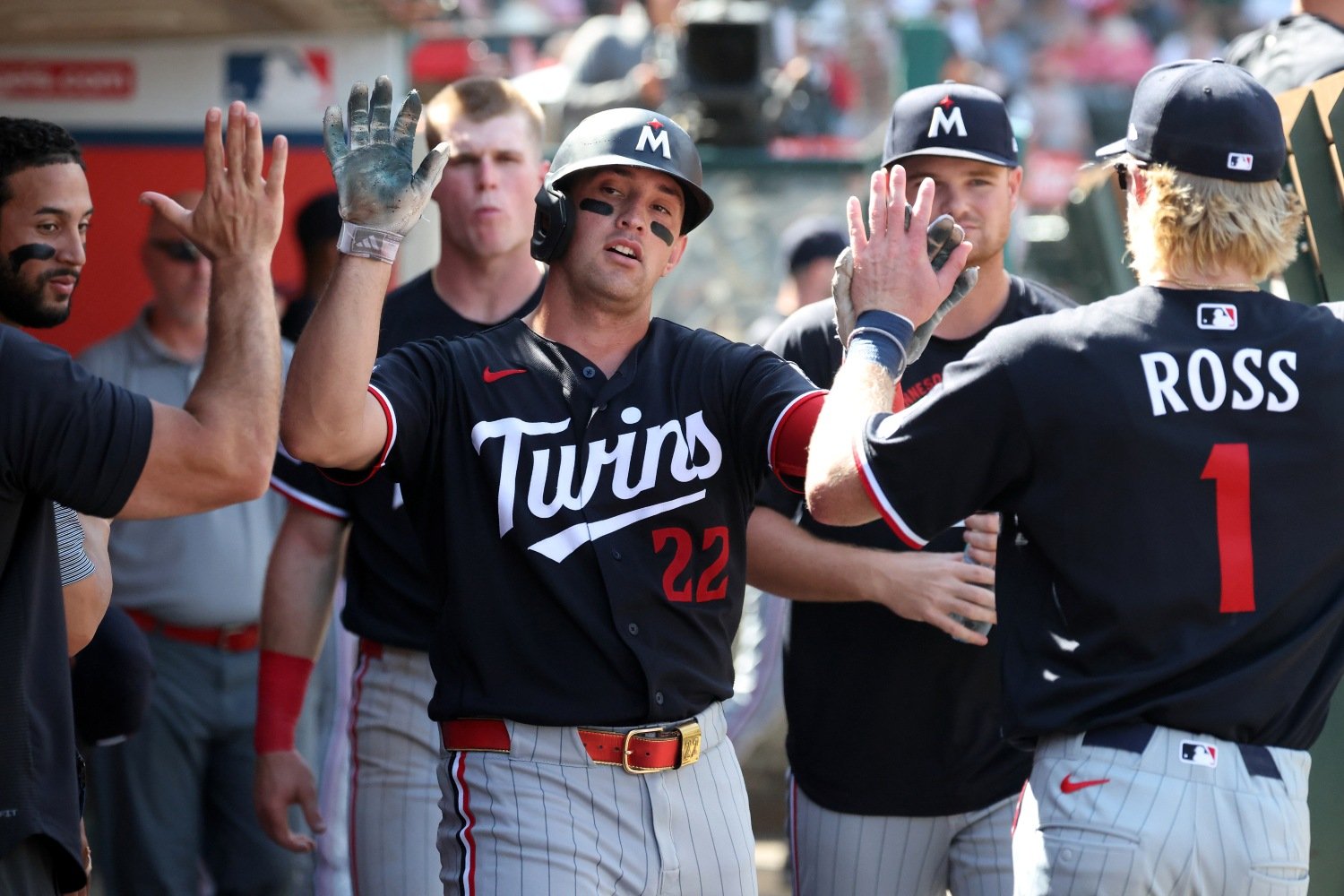
Image courtesy of Kiyoshi Mio-Imagn Images
Twins Video
Brooks Lee broke out in 2026. There’s no debate around that. There is, howev debate about what qualifies as a “breakout campaign,” yes, but Lee’s case is clear-cut. Over his first 712 plate appearances, Lee managed only a 71 wRC+, where 100 is average and higher is better. He was similarly dreadful in the field, netting -6 Outs Above Average (OAA) while splitting his time between second base, third base, and short. As a result, the former first-round pick was worth 0.0 Wins Above Replacement at FanGraphs (fWAR) over 189 games.
Despite being an offensive and defensive liability in his first two seasons in the majors, Lee flashed the raw talent that led to him getting selected eighth overall in the 2022 MLB Draft and to his rapid progression through the minors, showing plus power and plate discipline. His skill set was realized in 2026, with the 25-year-old hitting .253/.300/.407 with 24 home runs and a 101 wRC+ over 631 plate appearances.
The driving factor behind Lee’s offensive turnaround was the switch-hitter’s ability to produce while hitting left-handed, earning a 120 wRC+ over 424 plate appearances in 2026 (compared to a combined 69 wRC+ over 482 plate appearances the prior two seasons). He regressed from the right side of the plate (63 wRC+ in 2026, compared to a combined 77 wRC+ the prior two seasons), but that failure is less consequential because he took roughly 200 fewer plate appearances from the right-handed batter’s box—no coincidence, of course, since most pitchers are right-handed.
He also significantly improved defensively, transitioning from the primary shortstop to full-time third baseman in late May. Lee went from being one of the worst shortstops in baseball to an elite third baseman, netting 6 OAA over 284 attempts. Taking everything into account, Lee generated his first positive season at the plate and in the field, netting 2.9 fWAR.
Lee generated the second-most fWAR on the Twins, second only to Luke Keaschall, who earned 3.0. If we strip away all context and analyze Lee’s performance by strictly looking at the metrics, he was the Twins' second-best player. Of course, that doesn’t feel true, and it probably isn’t. Byron Buxton is better than Lee, but he was hurt for a significant portion of the season. The same goes with Ryan Jeffers. Also, Joe Ryan is a better starting pitcher than Lee is a position player. However, injuries and a late-season collapse derailed his fWAR totals, placing him below Lee.
Still, Lee was almost Minnesota’s most productive player this season. Yes, the club was bad, but that doesn’t happen by accident. He had to make meaningful improvements to take such a pronounced step forward—and he did, defensively. Yet, his underlying hitting metrics suggest he was largely the same player as in 2024 and 2025, making his 20-point jump in wRC+ feel unsustainable. He had poor bat speed again. He kept chasing pitches outside the zone. He rarely walked, and he made a ton of weak contact, similar to his first two seasons in the majors. So, what changed? Why was he a dramatically better hitter in 2026 than in 2025 and 2024?
Despite most of his underlying metrics remaining unimpressive, he made a monumental shift in hitting philosophy in 2026, prioritizing quality of contact over contact itself. He matured into a quality-over-quantity bat. He was able to hit strikes in the air far more often in 2026 than the prior two seasons, resulting in more doubles and home runs (49) in 2026 than 2024 and 2025 combined (40). By seasoning his raw skills with a maturing approach at the plate, Lee became the hitter Twins Territory had long yearned for him to become. Combining that with an elite defensive profile, there’s no surprise he was almost a 3-WAR player.
That said, his underwhelming underlying metrics shouldn’t be ignored. If his approach reverts to his pre-2026 form, he'll regress to a sub-replacement-level bat in 2027; that is a reality we must confront. And if that happens, there's a real chance he could hit his way out of being a full-time player. Moving to third and excelling at the position raises his floor, but still, a postseason-contending team can’t play a 69 wRC+ hitter every game. Alternatively, Lee could build off his breakout 2026 campaign, playing at an All-Star-caliber level early next season, solidifying himself as a core member of the next good Twins team.
Either outcome is well within reason. Yes, this level of variance is (theoretically) possible for every major-league player. We just watched Cal Raleigh regress from an MVP-caliber catcher to one of the sport’s worst hitters in one season. Yet, Lee feels like one of the most volatile position players in baseball. Again, I say "feels" because this is largely a vibes-based analysis, but his underlying metrics make these doubts reasonable. Three seasons in, I don’t know what to make of Lee. He could regress into a bench bat; continue his current slightly above-average pace; or be the AL’s starting third baseman in the 2027 All-Star Game. None of these outcomes would shock me. That's not great news for the Twins, because it means one of their most-improved players this year can't be counted on to sustain that improvement next year. But it also underscores the upside of the roster, in microcosm.








Recommended Comments
Create an account or sign in to comment
You need to be a member in order to leave a comment
Create an account
Sign up for a new account in our community. It's easy!
Register a new accountSign in
Already have an account? Sign in here.
Sign In Now