


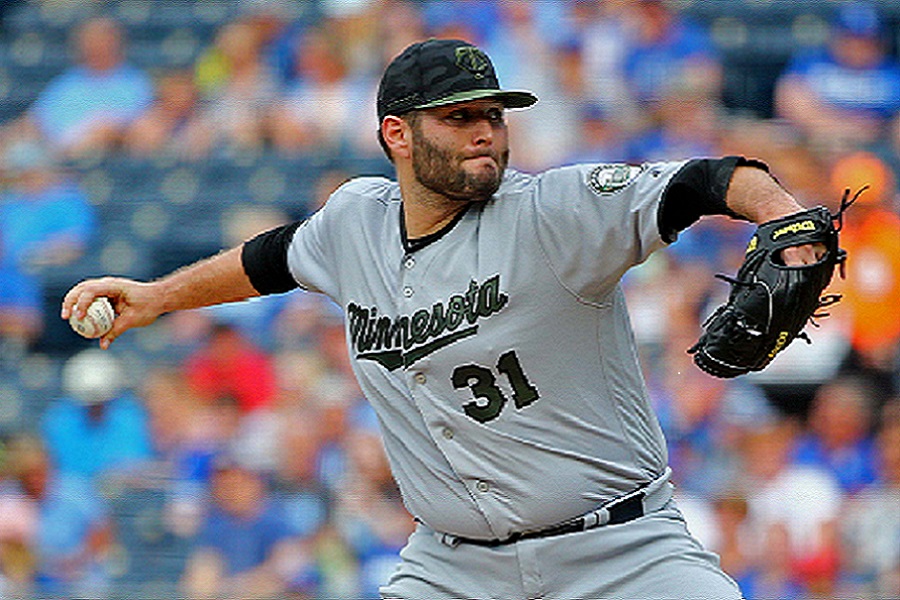
Twins Video
Lynn eventually ended up signing with the Minnesota Twins in the middle of March for a 1-year deal that will be worth between $3.4 million and $5.4 million less than the qualifying offer he rejected four months earlier.
When Lynn first signed this deal, some wondered if his missing a month of spring training would affect his performance early in the season. At first, I didn’t buy much into this theory, but when you look at the numbers you can’t help but feel that there was something to that.
During the month of April, Lynn was a mess, pitching to the tune of an 8.37 ERA with a 6.56 FIP and a walk rate of 8.75 BB/9 over 23 2/3 innings. However, since turning the calendar to May, Lynn has been a whole new pitcher with a 3.20 ERA, a 3.07 FIP and a walk rate down to a more respectable 3.60 BB/9 over 45 innings.
So, what has caused this sudden turnaround from Lance Lynn? Well, as I already pointed out, Lynn has had a sharp decline in his walk rate. Over his five starts in April, Lynn walked a combined 23 batters, but in his eight starts since Lynn has walked just 18.
There have been two big factors in Lynn’s decreased walk rate. This first has been by simply throwing more pitches in the strike zone. During his five April starts, Lynn had thrown just 32.9 percent of his pitches in the zone. However, since then his rate has increased to 37.8 percent. Lynn still has some work to do to get closer to the roughly 43 percent league average, but it’s a definite step in the right direction.
The other thing that is helping Lynn lower his walk rate is opposing batters are swinging at a higher percentage of his pitches outside of the strike zone, as Lynn has seen his chase rate increase from 28.5 percent to 31.3 percent.
In addition to finding better control with his pitches, Lynn has seen his fastball velocity tick up as the season has progressed. Here is a look at both Lynn’s four-seam fastball and sinker average velocity on a per start basis.


In addition to Lance Lynn increasing his fastball velocity, he has also seen his changeup velocity drop which has helped him create a bigger gap between the two pitches.

So, what are some of the benefits that Lance Lynn is getting from his improved control and increased fastball velocity? Perhaps the biggest improvement has been in Lynn’s home run rate. Back in April, Lynn had given up a home run 27.8 percent of the time he gave up a fly ball, which resulted in five home runs in just five starts. However, since then, Lynn has given up just two home runs after decreasing his home run to fly ball rate down to 5.6 percent. As the season continues I would expect that number to settle in somewhere slightly above his career 9.3 percent rate given the current home run environment.
Another significant improvement in Lynn’s game has been his stranded runners rate. After allowing 35 percent of runners that reached base to score during April, Lynn has cut that down to just 22 percent of base runners during May and June. For his career Lynn has allowed 24 percent of base runners to eventually score, so it appears that Lynn has returned to form in that regard.
Part of the concern around Lance Lynn when the Twins first signed him was his .244 Batting Average on Balls in Play (BABIP) last season, which was the lowest mark of any qualified pitcher in Major League Baseball. This mark was much lower than the .299 career average that Lance Lynn had allowed, and lead some to believe that he would show some regression this year as that number came back to Earth.
Well, not only did that number come back to Earth, but it blew way past it and swelled all the way up to .349 during the month of April. This was the 14th highest mark among the 134 pitchers who threw at least 20 innings by the end of April. Since then, Lynn has seen his BABIP reverse course back to Earth and dropped to .323 during May and June. Not only is this a step in the right direction, but it would suggest that Lynn still has a little more room for improvement as that number continues to move back towards his career average.
Entering the season, the Twins had high hopes that Lance Lynn would help lead their starting rotation, especially with the loss of Ervin Santana, and so far this year it appears as Lynn goes so does the Twins pitching staff. Through the first month of the season, the Twins ranked 28th in Major League Baseball with a 5.29 ERA. However, since the beginning on May, the Twins pitching staff has improved to 9th place with a 3.49 ERA.






Recommended Comments
Create an account or sign in to comment
You need to be a member in order to leave a comment
Create an account
Sign up for a new account in our community. It's easy!
Register a new accountSign in
Already have an account? Sign in here.
Sign In Now