


Twins Video
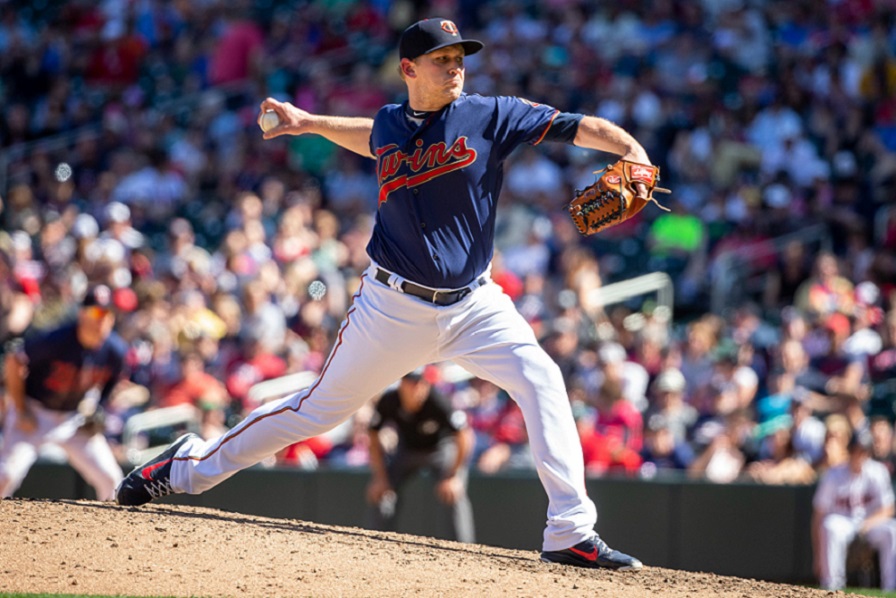
When Tyler Duffey was coming up through the minor leagues, he was very much the Terry Ryan era sinker-slider type pitcher who relied heavily on getting groundballs instead of strikeouts. When Duffey was first called up in 2015, he was an effective starting pitcher with a 3.10 ERA in 10 starts. However, 2016 didn’t go so well for Duffey, and he was transitioned to the bullpen for the 2017 season. Over his first two seasons as a reliever, Duffey didn’t see much improvement, pitching primarily in a mop up role.
Tyler Duffey started this season in Triple-A Rochester and was lights out for the Red Wings. Before his call-up to the Twins, Duffey made seven relief appearances, throwing 13 and 2/3 innings while giving up just two runs on eight hits and five walks. What was noticeably different with Duffey, was the rate at which he was striking out opposing hitters. In his career, prior to 2019, Duffey was only striking out 7.8 hitters per nine innings, between both the minor and major leagues. In those 13 and 2/3 innings in Rochester, Duffey struck out 22 opposing hitters.
After he got called up to the Majors on April 16th, Duffey continued his great start to the season. So far, in 22 and 2/3 innings for the Twins, Duffey has a 1.99 ERA and has struck out 32 hitters with just six walks. Duffey has held opposing hitters to a .220 batting average and just a .280 wOBA. However, according to Statcast, Duffey’s numbers should be even better, as he has an expected batting average of .193 and an expected wOBA of .251. For context, among the 355 pitchers who have faced at least 100 batters this season, Duffey ranks 27th in expected batting average and 19th in expected wOBA, leading all Twins pitchers in both categories.
There are a few of factors that have helped Tyler Duffey become an entirely different pitcher in 2019, than he was in prior seasons. The first, and most substantial factor, is his fastball. Previously, Duffey featured an even mix with both his four-seamer and his sinker, having thrown them 29 and 27 percent of the time respectively. In 2019, Duffey has all but ditched his sinker in favor of his four-seamer. Duffey is now throwing his four-seamer 54 percent of the time, compared to his sinker which he throws three percent of time. This goes a long way towards explaining Duffey’s jump in strikeout rate, as he has a 20 percent whiff rate in his career with his four-seamer, compared to just an 11 percent career whiff rate with his sinker. Another thing that has helped Duffey improve with his fastball is his uptick in velocity. The chart below shows Tyler Duffey’s average velocity on his four-seamer throughout his career.

(Chart via Baseball Savant)
From this chart we see that Tyler Duffey's fastball velocity spiked when the Twins transitioned him to the bullpen in 2017, but even after that move, Duffey has continued to add velocity as he has matured. Now at age 28, Duffey has matured physically to the point where he should be throwing his fastball harder than he ever has before.
In addition to his change in repertoire with his fastball, he has also mixed things up with his breaking ball. In the early part of his career, Duffey exclusively threw a curveball when he threw a breaking pitch and threw it on 37 percent of his pitches in total. In 2018, he started experimenting with a slider, which he threw seven percent of the time last year. This year his slider has become a much bigger part of his pitching arsenal as he is throwing it 25 percent of the time, compared to just 18 percent of the time with his curveball. This has been a big improvement as Duffey is allowing opposing hitters to hit a .148 batting average and a .193 wOBA against his slider, compared to the .254 batting average and .283 wOBA he has allowed with his curveball in his career. A big part of that can also be explained by Duffey’s whiff rates with the two pitches. So far this year, opposing hitters have a 55 percent whiff rate against his slider, compared to a career 32 percent whiff rate against his curveball.
Another big factor that has played into Tyler Duffey’s success this season is his improved command with his pitches. Looking at Duffey’s walk rate, it might not be as apparent because, at six percent in 2019, Duffey is right in line with his career norms. However, when you look at a heat map of where Duffey is throwing his pitches in 2019, it is telling a different story. The below charts show Duffey’s pitch heat map in each of his five season in the big leagues.


(Chart via Baseball Savant)
You can see from the first four seasons of Duffey’s career, he was primarily pitching in the heart of the zone, and opposing hitters were teeing off on him. This year, Duffey is locating around the edges of the strike zone with his pitches a lot more often. In the 2019 heat map, we can see a spot starting to form down and away from right-handed hitters because he is locating there with his slider quite a bit. This is the ideal location to throw a slider, as it appears that it will be a strike, and then ends out of the zone, enticing hitters to swing and miss at the pitch at a much higher rate.
As we can clearly see, Tyler Duffey is not the same pitcher that he was prior to 2018, and he has developed into one of the most effective relievers, in not only the Twins bullpen, but in all of Major League Baseball in 2019. With the Twins in dire need of some more support at the back end of the bullpen, it is time for Rocco Baldelli to start giving Tyler Duffey more opportunities in high leverage situations.






Recommended Comments
Create an account or sign in to comment
You need to be a member in order to leave a comment
Create an account
Sign up for a new account in our community. It's easy!
Register a new accountSign in
Already have an account? Sign in here.
Sign In Now