


Jump to content
Twins Daily
  • Create Account
  • Twins News & Analysis

    Home-Plate Umpires Have Favored Twins Opponents in 2023 Playoffs


    Cody Christie

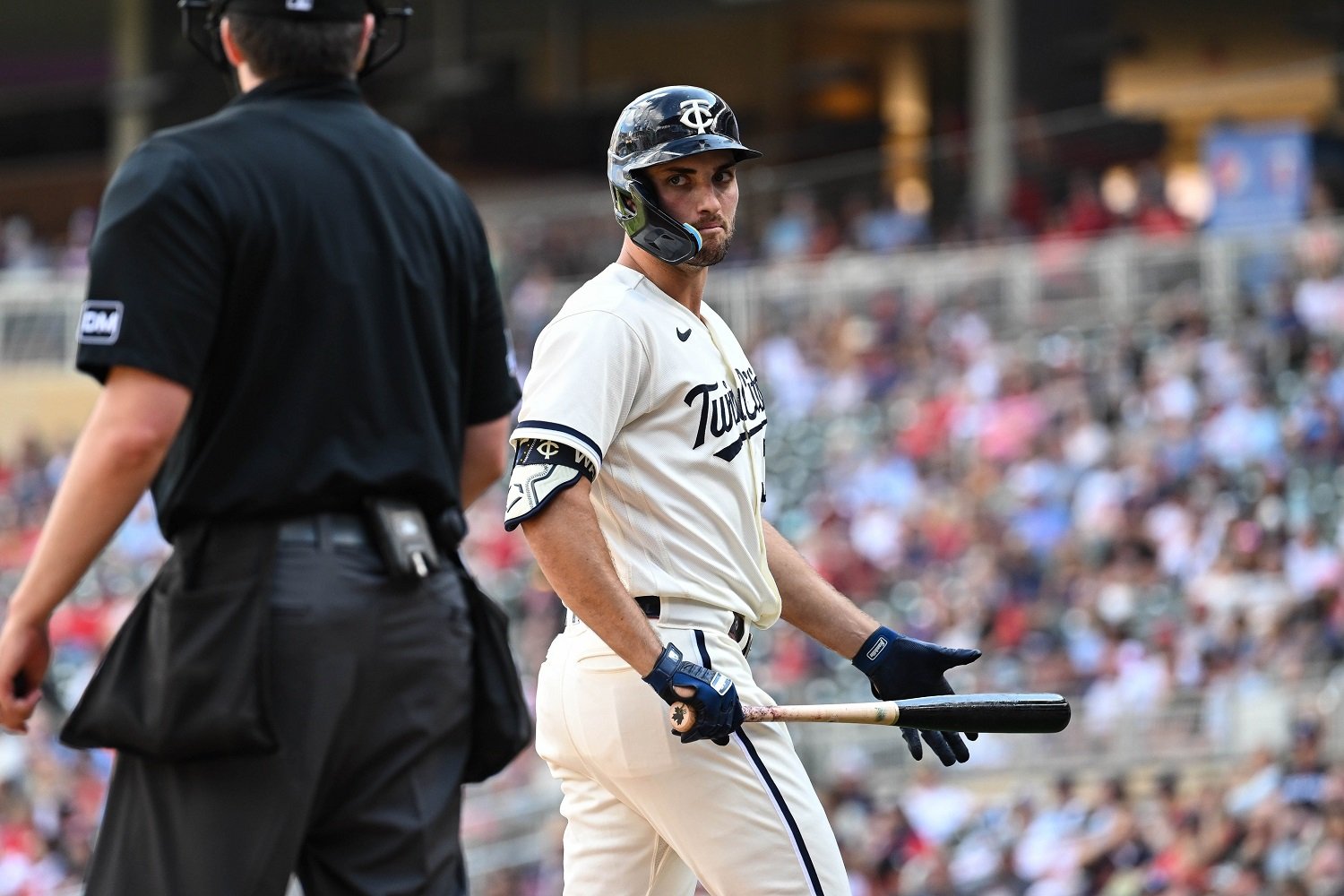
    Each playoff game can hinge on one pitch that is called a ball or a strike. During the 2023 postseason, umpires have tended to favor Twins opponents. Let's explore the numbers.

    Image courtesy of Jeffrey Becker-USA TODAY Sports

    Twins Video

    Being a major-league umpire is no easy task. It takes years of hard work and dedication to reach the big leagues, where pitchers throw triple-digit fastballs and breaking pitches with significant movement. There are also replays from multiple angles that show whether a pitch is a ball or a strike. Major League Baseball has experimented with automated strike zones and challenge systems in the minor leagues, but the human element is still part of America's Pastime.

    Umpires are evaluated throughout the regular season to earn spots on the field in the playoffs. These umps are supposed to be the best of the best, but teams and fans get even more upset with perceived bad calls in October. 

    Umpire Scorecard on X (formerly known as Twitter) tracks umpire performance throughout the season. According to their website, "The @UmpScorecards platform relies on three key metrics to analyze umpire performance: accuracy (and expected stats), consistency, and favor. These metrics are calculated in house using algorithms inspired by others in the baseball community and developed by the @UmpScorecards team."

    Here's how the home plate umpires have fared so far in Minnesota's 2023 playoff games. 

    Wild Card Series: Game 1
    Umpire: Andy Fletcher
    Overall Favor (Runs): +1.46 Toronto

    Umpire Scorecard's model said Fletcher favored the Blue Jays by nearly 1.5 runs, including two of the three most influential calls going against the Twins. Edouard Julien should have drawn a walk with two runners on in the bottom of the second inning. His overall accuracy was slightly below the expected accuracy, but there were rough called strikes on both sides of the zone.

    Wild Card Series: Game 2
    Umpire: Adam Hamari
    Overall Favor (Runs): +0.96 Toronto

    In Game 2, all three impactful missed calls went against the Twins, which made a tight game even closer. Sonny Gray was impacted the most by missed calls with two balls that should have been strikes, changing the trajectory of plate appearances. Hamari missed five calls on taken pitches during the game, which hurt the Twins more than the Blue Jays.

    ALDS: Game 1
    Umpire: Brian Knight
    Overall Favor (Runs): +0.43 Houston

    Minnesota attempted to mount a late-inning comeback when Justin Verlander was awarded the most prominent missed call in Game 1. Carlos Correa batted with two outs and a runner on first base in the sixth inning. He was rung up on a ball significantly out of the strike zone. Overall, Knight missed four pitches, and the two biggest went against the Twins.

    ALDS: Game 2
    Umpire: D.J. Reyburn
    Overall Favor (Runs): +0.77 Houston

    The top three missed calls all went against the Twins for the second time in the playoffs. Willi Castros' at-bat with the bases loaded in the seventh inning could have extended the lead and allowed the Twins to rest some of the club's high-leverage bullpen arms. The bottom of the strike zone was particularly bad for Reyburn, who incorrectly identified 13 pitches during th
    e game.

    ALDS: Game 3
    Umpire: Ben Miller
    Overall Favor (Runs): +0.31 Minnesota

    Tuesday's game at Target Field was the only time during the 2023 postseason where the home plate umpire favored the Twins. Even in this game, the most impactful missed call went against the Twins with Lewis' bases loaded at-bat in the fifth inning, starting with a called strike that was a ball. Miller missed most of his calls in the upper part of the zone, but his overall zone was relatively accurate, especially compared to some of the other umpires in the postseason.

    It will be interesting to see if this trend continues in however many playoff games remain for the Twins. Will umpires continue to make more calls against Minnesota? Will a bad call eventually cost the Twins a win? Could the Twins have won Game 1 in Houston with better umpiring? One can hope that umpiring will improve as teams move deeper into the playoffs, but the Twins have been on the wrong side of every playoff game so far. 

    What are your thoughts on the calls discussed above? Has umpiring impacted any of the Twins' results so far? Leave a COMMENT and start the discussion. 

    Follow Twins Daily For Minnesota Twins News & Analysis

    Recent Twins Articles

    Recent Twins Videos

    Twins Top Prospects

    Marek Houston

    Cedar Rapids Kernels - A+, SS
    The 22-year-old went 2-for-5 on Friday night, his fourth straight multi-hit game. Heading into the week, he was hitting .246/.328/.404 (.732). Four games later, he is hitting .303/.361/.447 (.808).

    User Feedback

    Recommended Comments


    Featured Comments

    1 hour ago, Aggies7 said:

    Consistency is at least as important as accuracy 

    Both are important, and robo umps are better at both than humans. Moreover, humans will never experience an improvement in performance and robo umps will.

    1 hour ago, Mike Sixel said:

    See tennis....

    This, to me, is possibly the best argument.  I'm not certain how many on here regularly watch tennis, but the line calls in tennis are the closest comparison to ball-strike calls that MLB umps are forced to make.

    These calls are impossible to get consistently correct by utilizing the human eye.  The margins are just too fine.  Because of this, participants in both sports argue about calls on the margins.

    With the move to robo umps in tennis, the arguments have almost entirely ceased.  Players (and fans) tend to accept the calls as shown on the camera replay, even when a ball is in or out by a fraction of an inch.  It's hard to argue with a camera.  The era of John McEnroe going off on a chair ump is over.

    The exception is at Wimbledon, which so far has stayed with human calls, while all of the other major tournaments have switched.  And Wimbledon is now being rather heavily criticized for this decision, because the new system works so well at the other tournaments..

    40 minutes ago, Riverbrian said:

    However, pitch number two to Dozier made the count 1-1. It didn't end the AB. Which is what should have happened to Didi. 

    You are right... we can do this all day. And that's the point. It takes a lot of moments to do this all day and that's the problem.

    I get your point and in this instance it was not apples to apples - you're 100% right.  

    On the last sentence - is it actually a problem?  Fans like talking about sports, and arguing about strategy, lineups, calls, etc - it's all part of it.  Sports are messy and unpredictable and that's why they're fun.  If everything always goes according to plan and the human element gets diminished I think the entertainment value suffers.  

    And believe me, implementing robo umps won't give fans hours of their time back - they'll have no problem finding things to argue about.  Get ready for complaining about robo strike zones, software issues, conspiracy theories about hardware that failed at an inconvenient time... it'll never end...

    1 hour ago, Woof Bronzer said:


    Fans don't want fair umpiring.  They want the bad calls that hurt them to go away, and they want the bad calls that help them to stay.  

    Show us these studies that show how umpiring in the long run has benefitted certain teams at the expense of others.  If you think 95-99% accuracy is "bad" please don't look into robo ump technology because it's NOT 100% accurate by any stretch of the imagination.  Maybe it'll get there in time, but it's not there yet.  

    The same pattern plays out in every sport:  implement replay "to get the calls right".  When it becomes obvious that replay doesn't actually do this, they open up replay to more and more things.  The problem is never solved, and the game becomes less human - and less interesting - as a result.  


    I don't think those first 2 sentences are true. Is it true for some fans? Sure. But, I think, overall, most fans just want the calls to be right so the game is decided by the players, and not the refs/umps/whatever. 

    And it's not about benefitting certain teams at the expense of others over years, or even multiple games. It's about benefitting one team over another in each individual game. "The NFL wants the Chiefs to win so they get more calls" type arguments come from a very small, but often very loud, segment of the population. Arguing against those people is pointless. There's no argument that can be made that missed calls are balanced between the teams in each game, though. That simply isn't true. 1 team always gets the benefit in each particular game. Whether from bad calls, missed calls, or a combination of both. Some of us just want to take as much of that out of the equation as possible. And often time the advantage is very small, and not even worth really discussing.

    You'll never find me claiming the refs/umps/whoever cost a team a game. But pretending that one team doesn't benefit more than another in any given game is ignoring reality. And when you get into the playoffs that disparity is naturally looked at more closely. Especially in a sport like football where 1 game not going your way ends your season. Or game 3/5/7 in a series where you know 1 team is going home at the end of the game.

    I don't think I agree with your layout of the replay timeline in sports, either. The leagues expand replay after it does work, not after it doesn't. I can't think of 1 league that implemented it, watched it fail, and said "the answer is more replay!" The NFL tried to replay certain penalty calls and stopped after it clearly didn't work. MLB started with just fair/foul replay, found success, and expanded to calls on the bases, etc. The leagues keep expanding replay because they are getting more calls right. Which seems like a pretty logical process to me.

    11 minutes ago, Road trip said:

    This, to me, is possibly the best argument.  I'm not certain how many on here regularly watch tennis, but the line calls in tennis are the closest comparison to ball-strike calls that MLB umps are forced to make.

    I disagree.  Where a ball hits relative to a clearly marked line is simply a manner of camera resolution.  The strike zone is not a clearly marked line.  It is invisible, and dependent on the size of each hitter and the hitter's stance.  Apples and oranges.  

    8 minutes ago, Woof Bronzer said:

    I get your point and in this instance it was not apples to apples - you're 100% right.  

    On the last sentence - is it actually a problem?  Fans like talking about sports, and arguing about strategy, lineups, calls, etc - it's all part of it.  Sports are messy and unpredictable and that's why they're fun.  If everything always goes according to plan and the human element gets diminished I think the entertainment value suffers.  

    And believe me, implementing robo umps won't give fans hours of their time back - they'll have no problem finding things to argue about.  Get ready for complaining about robo strike zones, software issues, conspiracy theories about hardware that failed at an inconvenient time... it'll never end...

    I'm just hoping to fix baseball. 

    I have no hope fixing the human condition. 😉

    7 minutes ago, Woof Bronzer said:

    I disagree.  Where a ball hits relative to a clearly marked line is simply a manner of camera resolution.  The strike zone is not a clearly marked line.  It is invisible, and dependent on the size of each hitter and the hitter's stance.  Apples and oranges.  

    The sides of the strike zone are a hard line, independent of any other variables. Those are the calls that bug me. High and low stuff is different. But the side of the strike zone is a hard line that a robot could absolutely get perfect at calling.

    8 minutes ago, chpettit19 said:

    I don't think those first 2 sentences are true. Is it true for some fans? Sure. But, I think, overall, most fans just want the calls to be right so the game is decided by the players, and not the refs/umps/whatever. 

    If this was the case TD would have at least 1 article complaining about calls that went the Twins way and calling for "fairness".  If you can find one please pass it along.  

    10 minutes ago, chpettit19 said:

    And it's not about benefitting certain teams at the expense of others over years, or even multiple games. It's about benefitting one team over another in each individual game

    And over time it evens out. 

    11 minutes ago, chpettit19 said:

    The leagues keep expanding replay because they are getting more calls right

    Ask any NFL fan if the refs get everything right even with replay.  I'm guessing not a single one will say yes.  It's actually the opposite. When replay first came up the league said "subjective calls like pass interference will never be reviewed."  One bad call in a playoff game and now suddenly it's reviewable.  Review has so complicated football that fans can't even tell you what a catch is, and it has slowed down games dramatically.  And it has yet to accomplish the one and only thing is was intended to accomplish: "getting all the calls right".  

    Just now, Woof Bronzer said:

    If this was the case TD would have at least 1 article complaining about calls that went the Twins way and calling for "fairness".  If you can find one please pass it along.  

    And over time it evens out. 

    Ask any NFL fan if the refs get everything right even with replay.  I'm guessing not a single one will say yes.  It's actually the opposite. When replay first came up the league said "subjective calls like pass interference will never be reviewed."  One bad call in a playoff game and now suddenly it's reviewable.  Review has so complicated football that fans can't even tell you what a catch is, and it has slowed down games dramatically.  And it has yet to accomplish the one and only thing is was intended to accomplish: "getting all the calls right".  

    That first sentence is nonsense. There's an imbalance of calls in every game that we all currently have to accept. Not complaining about the calls that go our way is in no way the same thing as wanting those calls to stay while the ones that go against us go away. Those are not the same thing. There are absolutely posts on TD acknowledging that the Twins got a break on certain calls. There's posts on this very thread about the Polanco call. Those of us in favor of more technology to get calls right aren't saying that call should've stood. In fact there's someone who's already questioned why it isn't reviewable. I want that call gone as long as the calls that go against the Twins are gone too.

    Sure, it likely does even out over time. But does that mean we should accept a bad call changing the result of the World Series? That's why I pointed out the postseason. "Hey, you got that call on June 12th in the 5th inning against the Padres so don't be mad that the call that ended the World Series went against you" isn't an argument many people are going to be good with. The postseason shrinks the sample size and the equation. It just does. That's the point of the postseason. Have to be at the top of your game everyday or your season ends.

    Nobody has said they get it all right. You claimed they expanded replay after things with replay went poorly. They no longer review pass interference calls in the NFL because replay for it didn't work. They get more calls right now than they used. Your argument at the end there is basically "it's not 100% right so it's not helpful and we should get rid of it even though it's improved the number of calls they get right." Setting your standard as "100% or it's a failure" is awfully aggressive and unrealistic.

    The ump last night was excellent. If I was mlb I would provide the box they use to grade umpires to all the tv networks as the boxes are different. I’m sure several pitches would be graded differently. Plus mlb allow a small buffer zone where either call is deemed acceptable. I’m not saying umpiring isn’t bad but it may be less bad than what we see. By allowing this difference they are denigrating their own product. 

    1. The premise of the article being based on "umpire score cards" off Twitter is questionable at best. 

    There's an assumption of validity here that I don't think is warranted. It's not official and is based on pretty questionable assumptions.


    2. On the larger subject of an automated strike zone, it's inevitable. It's coming.

    Personally, I don't think that's a good thing, but I realize I'm probably in a minority of fans with that opinion. I doubt it'll be much better, and I worry it'll change the game in subtle but negative ways. I find it interesting most player interviews one reads don't seem in favor. Maybe I'm missing some.

    It most certainly won't stop fans batching.


    48 minutes ago, Woof Bronzer said:

    If this was the case TD would have at least 1 article complaining about calls that went the Twins way and calling for "fairness".  If you can find one please pass it along.  

    And over time it evens out. 

    Ask any NFL fan if the refs get everything right even with replay.  I'm guessing not a single one will say yes.  It's actually the opposite. When replay first came up the league said "subjective calls like pass interference will never be reviewed."  One bad call in a playoff game and now suddenly it's reviewable.  Review has so complicated football that fans can't even tell you what a catch is, and it has slowed down games dramatically.  And it has yet to accomplish the one and only thing is was intended to accomplish: "getting all the calls right".  

    Definitely screwed catch rules.

    13 minutes ago, USAFChief said:

    1. The premise of the article being based on "umpire score cards" off Twitter is questionable at best. 

    There's an assumption of validity here that I don't think is warranted. It's not official and is based on pretty questionable assumptions.

    The reason I favor robo umps has nothing to do with Twitter-based scorecards, which I think are indeed based on questionable assumptions. I favor them because they do a statistically significantly better job than humans at calling strikes according to the strike zone as specified in the official rules of the game.


    16 minutes ago, USAFChief said:

    2. On the larger subject of an automated strike zone, it's inevitable. It's coming.

    Personally, I don't think that's a good thing, but I realize I'm probably in a minority of fans with that opinion. I doubt it'll be much better, and I worry it'll change the game in subtle but negative ways.

    Before this season I felt the same way about the pitch clock and related rules, although I didn't think the changes would be subtle. I now feel that the impact of those rule changes has been overwhelmingly positive. When this change is implemented I'm confident that you will similarly admit you were wrong, and I'm confident about that in two ways: one, that the change will be overwhelmingly positive and, two, that you will be man enough to accept and embrace the overwhelming positivity of the change.

    4 minutes ago, Nine of twelve said:

    The reason I favor robo umps ... because they do a statistically significantly better job than humans at calling strikes according to the strike zone as specified in the official rules of the game.


    Do they? How would we know?

    ...

    Also, thanks. Appreciate it. I guess we'll see. 

    If you were inventing a sport from scratch in 2023, with a predictable activity that happened in a certain spot, oh, say, 250 times a game, you'd automate the judgment of that activity if you could.

    A hundred years from now if baseball's still around, fans could be told that in the early days balls and strikes were called manually, and they would be all, "whoa, didn't they even have motion detecting cameras back in those old-timey days? 

    Dr McCoy had that quote about stone knives and bearskins in one of the better Star Trek episodes.

    1 hour ago, Woof Bronzer said:

    If this was the case TD would have at least 1 article complaining about calls that went the Twins way and calling for "fairness".  If you can find one please pass it along.  

    And over time it evens out. 

    Ask any NFL fan if the refs get everything right even with replay.  I'm guessing not a single one will say yes.  It's actually the opposite. When replay first came up the league said "subjective calls like pass interference will never be reviewed."  One bad call in a playoff game and now suddenly it's reviewable.  Review has so complicated football that fans can't even tell you what a catch is, and it has slowed down games dramatically.  And it has yet to accomplish the one and only thing is was intended to accomplish: "getting all the calls right".  

    Arguing we shouldn't make things better because we can't make them perfect is a terrible argument across all facets of life no one is arguing for perfection, we're arguing for better. 

    1 hour ago, Nine of twelve said:

    Before this season I felt the same way about the pitch clock and related rules, although I didn't think the changes would be subtle. I now feel that the impact of those rule changes has been overwhelmingly positive.

    The pitch clock and not allowing the batters to take a walk-about every pitch made the game shorter and not annoying hour longer than they should be; not even remotely related to an electric computer umpire.

    2 hours ago, Woof Bronzer said:

    If this was the case TD would have at least 1 article complaining about calls that went the Twins way and calling for "fairness".  If you can find one please pass it along.  

    And over time it evens out. 

    Ask any NFL fan if the refs get everything right even with replay.  I'm guessing not a single one will say yes.  It's actually the opposite. When replay first came up the league said "subjective calls like pass interference will never be reviewed."  One bad call in a playoff game and now suddenly it's reviewable.  Review has so complicated football that fans can't even tell you what a catch is, and it has slowed down games dramatically.  And it has yet to accomplish the one and only thing is was intended to accomplish: "getting all the calls right".  

    I disagree with pretty much everything you have ever posted. I agree with most of this. 
     

    you do see on TD fairly regularly “it was a bad call, but it went the Twins favor so I won’t complain”

    replay absolutely sucks.

    First of all, ANY sort of NFL reference is bogus on many fronts. There is, on almost any  play, SOME mild form of holding involved. Interference and other calls are open to interpretation as well. Calling for greater consistency on many different calls made, and not made, would probably ruin the game and make every game 4hrs or so if some super AI could watch and calculate every single angle of every single play. So let's just keep the arguement where it belongs. 

    The Tennis analogy in regard to line calls is accurate for baseball. 

    As a sports fan, I will, naturally, take a call that helps my team. But AS a sports fan, I despise aggregious calls for my team as I figure they will get burned later on by a similar call against them. All I want is fairness. And I think most fans want the same.

    MLB has generally gotten the replay right. In regard to balls and strikes, they aren't horrible, at large. And the box you see in games is a computer graphic that is different than the 1" or so allowance that umpires are allowed for interpretation and human error.

    I've been hesitant for removing the human element for balls and strikes for various reasons previously. But I've also grown tired of missed calls outside that are ridiculous, and missed inside calls...where the ump is looking right over the shoulder of the catcher...equally ridiculous. And the thing is, greater accuracy should be FAIR for BOTH teams. So why is "fair" a dirty word?

    MY issue with the robo ump is I don't think it's polished or "smart" enough yet. Countless players and pitchers have stated that the robo ump calls things different than at the ML level. I think the high strike has been one of the major concerns. 

    Every batter is a different height, with a different stance. And some might change their stance slightly depending on the count. And should the computer/AI also allow a 1" margin in addition to all 3 dimensions that happen with every single pitch for a margin of error?

    I am now in favor of the robo ump, WHEN it seems like they've ironed some more facets out. Maybe 2025? The human umps still have a really important place within the context of games. Just maybe not balls and strikes going forward. But I want to see a few more tweaks for ultimate accuracy for future use at the ML level.


    7 hours ago, RickOShea said:

    I believe the strike zone is calibrated by the stance the batter uses, not solely on his height.

    It starts at the knees. Ends where ever. Used to be the letters although the high strike has been gone for some time. And the stance is not supposed to have anything to do with the strike zone. 

    21 minutes ago, Schmoeman5 said:

    It starts at the knees. Ends where ever. Used to be the letters although the high strike has been gone for some time. And the stance is not supposed to have anything to do with the strike zone. 

    False.

    The strike zone is defined by when the batter is in his stance.

    Midpoint between  shoulders and top of pants to a point just below the kneecaps.


    https://www.mlb.com/glossary/rules/strike-zone

    18 minutes ago, USAFChief said:

    False.

    The strike zone is defined by when the batter is in his stance.

    Midpoint between  shoulders and top of pants to a point just below the kneecaps.


    https://www.mlb.com/glossary/rules/strike-zone

    Vertical stance yes. But I'm talking about a hunched over stance Ala Ricky Henderson 

    10 hours ago, FlyingFinn said:

    Bring on the robo ump strike/ball calls. In a game of inches and with teams so close, favoring veterans or teams must end. We have the technology now to make the game more fair.

    Yep.  The question is not if the robo ump is perfected, the question is whether it is better than we now have.  

    Hitters will arrive at the stadium knowing what the strike zone will be that day.  Pitchers won't have to nibble the edges to find out.  Most importantly, catchers won't be yanking pitches out of the zone to fool the robot.  

    The sooner the better.  

    8 hours ago, chpettit19 said:

    I don't think those first 2 sentences are true. Is it true for some fans? Sure. But, I think, overall, most fans just want the calls to be right so the game is decided by the players, and not the refs/umps/whatever. 

    And it's not about benefitting certain teams at the expense of others over years, or even multiple games. It's about benefitting one team over another in each individual game. "The NFL wants the Chiefs to win so they get more calls" type arguments come from a very small, but often very loud, segment of the population. Arguing against those people is pointless. There's no argument that can be made that missed calls are balanced between the teams in each game, though. That simply isn't true. 1 team always gets the benefit in each particular game. Whether from bad calls, missed calls, or a combination of both. Some of us just want to take as much of that out of the equation as possible. And often time the advantage is very small, and not even worth really discussing.

    You'll never find me claiming the refs/umps/whoever cost a team a game. But pretending that one team doesn't benefit more than another in any given game is ignoring reality. And when you get into the playoffs that disparity is naturally looked at more closely. Especially in a sport like football where 1 game not going your way ends your season. Or game 3/5/7 in a series where you know 1 team is going home at the end of the game.

    I don't think I agree with your layout of the replay timeline in sports, either. The leagues expand replay after it does work, not after it doesn't. I can't think of 1 league that implemented it, watched it fail, and said "the answer is more replay!" The NFL tried to replay certain penalty calls and stopped after it clearly didn't work. MLB started with just fair/foul replay, found success, and expanded to calls on the bases, etc. The leagues keep expanding replay because they are getting more calls right. Which seems like a pretty logical process to me.

    Indeed, important calls in any game almost never even out; one team inevitably suffers more from bad calls than the other, so fairness should be sought as much as can possibly expected. Kepler got called out on a pitch that was outside for the final out of today's game. He either walks there or strikeouts. The Twins are down by one with Correa coming up. Would he drive Kepler in? We'll never know the answer to that question because it was taken from us by the umpire.

    13 hours ago, RpR said:

    The pitch clock and not allowing the batters to take a walk-about every pitch made the game shorter and not annoying hour longer than they should be; not even remotely related to an electric computer umpire.

    I think most people understood my point but I apologize for not making it clear enough for you to understand. I wasn't trying to say the two issues are related. They are not. My point is that I originally didn't like the pitch clock rules but after seeing the positive effect they had on the game I changed my mind. Now I think the rule change was good. And I think the same thing will happen for many people who currently don't want robo umps.

    I did not look up the scorecard for last night's game, but there was some called strikes well outside the zone against the Twins.  The fact it was a 1 run game each called strike well outside the zone is an issue.  I really hope we get at minimum a challenge system.  Julien gets burned so much taking pitches in off the plate that get called for strikes, so often strike 3 too.  That has to be so frustrating for a hitter, you know you take a ball and get called out, then you get to see that it was confirmed the ump was wrong, but you get nothing but a K for it. I am not saying the Twins did not get some in their favor, but as the score card indicates, more important ones went against the Twins. 

    The first called strike against Lewis was huge with the bases loaded in game 3.  Falling behind 1-0 instead of up 0-1 for a pitcher with bases loaded is huge.  Even more so for Mr. Grand Slam.

    10 hours ago, Joey Self said:

    Most importantly, catchers won't be yanking pitches out of the zone to fool the robot.

    Thanks for bringing this up. It's a huge point. 

    Framing skills would no longer be necessary. Maybe catchers that can actually hit becomes more important in the search for a backstop.  


    21 hours ago, Schmoeman5 said:

    I don't believe this at all. The automated strike zone in the minor league is set up with cameras and a box that changes batter by batter. A 6' 4" guys strike zone being different than a guy who is 6'. The box on TV which these guys are breaking down the calls is a close proximity but not exact. So how can these umpire scores be taken seriously? And besides. The MLB mandate of Screw the Twins at all costs is as real as the boogeyman and sasquatch.

    There is truth to what you are saying but only for top and bottom of the zone. Inside and outside shoukd be the same regardless of height and that's usually how Julien and Kepler get screwed..


    Create an account or sign in to comment

    You need to be a member in order to leave a comment

    Create an account

    Sign up for a new account in our community. It's easy!

    Register a new account

    Sign in

    Already have an account? Sign in here.

    Sign In Now

×
×
  • Create New...

