Nick Nelson
-
Posts
8,319 -
Joined
-
Last visited
-
Days Won
56
Content Type
Profiles
News
Minnesota Twins Videos
2026 Minnesota Twins Top Prospects Ranking
2022 Minnesota Twins Draft Picks
Minnesota Twins Free Agent & Trade Rumors, Notes, & Tidbits
Guides & Resources
2023 Minnesota Twins Draft Picks
The Minnesota Twins Players Project
2024 Minnesota Twins Draft Picks
2025 Minnesota Twins Draft Pick Tracker
2026 Minnesota Twins Draft Tracker: Picks & Bonuses
Forums
Blogs
Events
Store
Downloads
Gallery
Everything posted by Nick Nelson
-

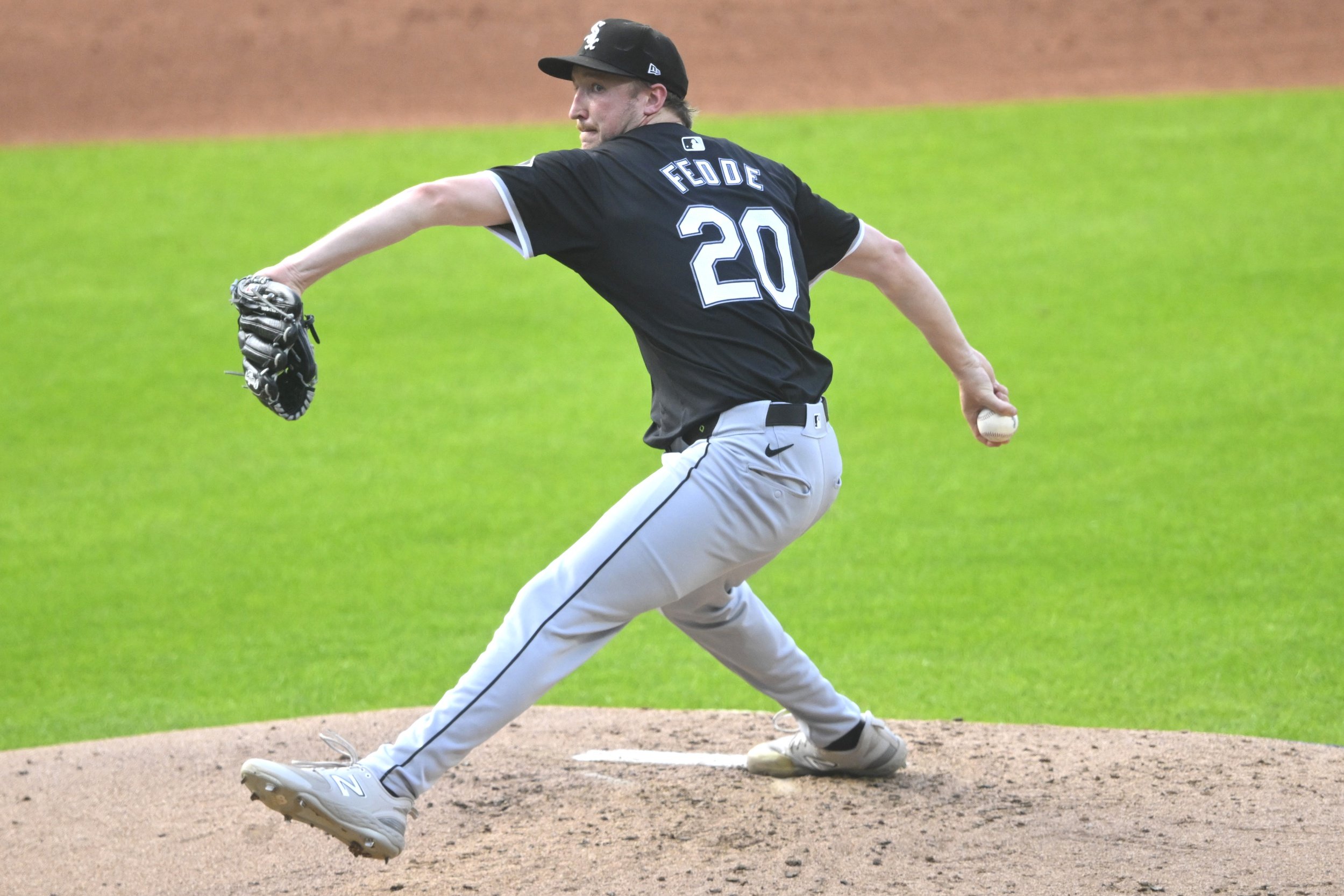 It's unfortunate that the Twins missed out on their last chance to add significant outside help for the stretch run and (hopefully) into the playoffs. The fact that an ownership-imposed unwillingness to spend was primarily responsible for this inaction makes it all the more upsetting. Frustration from fans is more than justified. However, there were other things at play in stymying the front office. You can make a case that even if they had some level of spending flexibility, the Twins would've been wise to bypass any significant moves that were available. The reality is, given their circumstances, opportunities did not line up very well for Minnesota at this trade deadline. Here are three factors that, from my view, likely contributed to the front office standing pat. The market was limited (and ultimately ridiculous) for the upgrades they needed Although they definitely came nowhere close to meeting it, the threshold for what really qualified as a meaningful upgrade for the Twins was pretty high. They have a balanced, complete lineup and a solid bench. They have at least three very good starting pitchers. They have a handful of relievers who've proven capable in the late innings. To really get better, the Twins needed a legit No. 3 or above starter, and maybe a high-caliber back end reliever. There weren't too many of those guys available on the market, especially once teams like Texas opted not to sell. And seeing the prices for some who were moved ... no thanks. Toronto's Yusei Kikuchi was one of the names most commonly connected to the Twins as a make-sense target, and it sounds like they did actively pursue him to some degree, but Kikuchi ended up going to Houston for a prospect haul that Minnesota's front office rightfully came nowhere close to beating out. Look, Kikuchi is a talented pitcher with some solid peripherals. But he also has a 4.75 ERA this year (4.72 career) and the Blue Jays didn't trust him to start in the playoffs last year, coming off his best season. What really is the reasonable upside for this two-month rental? Trading away a 23-year-old starting pitcher with any level of ability, let alone two additional prospects, for that kind of underwhelming addition is hard to view as a savvy move, but it's one that the Astros were pressed into making because they had a much greater need. The Twins will likely welcome the chance to face the lefty Kikuchi in the playoffs, if it comes to that. Beyond Kikuchi, some the most compelling deadline options happened to be on teams that apparently had little interest in doing business with the Twins: AL Central sellers were reluctant to trade within the division As Dan Hayes of The Athletic explained in an appearance on Foul Territory TV, the White Sox took a hardline approach against trading with their rival, setting a laughable asking price for Erick Fedde when the Twins inquired. The notion of giving up Walker Jenkins, Brooks Lee or Emmanuel Rodriguez for a rental arm was rightfully laughed off. Frankly, I'm a little troubled that they would've considered even Luke Keaschall, if true. It sounds as though similar dynamics were at play with the Tigers and Jack Flaherty. "[The Twins] got the sense, with both Detroit and Chicago, that they just didn't want to trade in-division," Hayes shared. "That does make it difficult. You don't want to see your rivals win." The Twins were evidently willing to wade into those waters, despite the stakes being a bit higher for them as well. If, say, Fedde doesn't pitch brilliantly down the stretch and make a big difference in the playoffs (low likelihood, honestly), and you traded Keaschall for him, you're looking at a level of potential lingering follow-up pain that would make Spencer Steer blush. Chris Paddack got hurt and Max Kepler's play has tailed off substantially This last factor, I guess, does come back to money. But it also illustrates the way various trends played out against the front office in their deadline quest. Given the impetus to maintain a neutral payroll with any moves, unloading current commitments was going to be requisite for any significant add. The two most sensible candidates to dangle in a balanced salary swap? Paddack, owed about $9 million through next year, and Kepler, owed about $4 million through the rest of this year. If Paddack were healthy and pitching the way he was at times earlier in this season, he might have been appealing as a target for another playoff-minded team. Perhaps that played some role in motivating the Twins to activate him from the injured list in mid-July to showcase him ahead of the All-Star break. Whatever the reasoning, that decision didn't work out, as Paddack flashed the same inconsistent stuff and then quickly landed back on the injured list. The idea of trading Kepler might have been appealing for two reasons. First: they have high-quality lefty hitters for both corners in Trevor Larnach and Matt Wallner. Second: it would give them an opportunity to get something now for Kepler instead of nothing after the season, since they surely won't extend a qualifying offer. If he was still mashing the way he did in the second half last year, or the early weeks of this season, Kepler may have stood out to another contending club, opening the door for a creative need-versus-need deal. But the outfielder's power stroke has gone amiss and he's reverted to mediocre form offensively, with a .244/.295/.349 slash line in his past 60 games. My understanding is that the Twins did explore some conversations with others teams involving Kepler, but obviously, nothing ended up coming together. The good news, I suppose, is that Kepler and Paddack both have a chance to help the Twins get where they want to go this year. That's the overall outcome of another fruitless deadline: they Twins will need to rely on what they've already got. "I believe in our group," Derek Falvey told reporters after coming up empty. "I feel like this is a group that we want to go to battle with.” Let's hope he's right. Then again, what choice did he have?
- 84 comments
-
- 10
-

-
- max kepler
- yusei kikuchi
- (and 3 more)
-
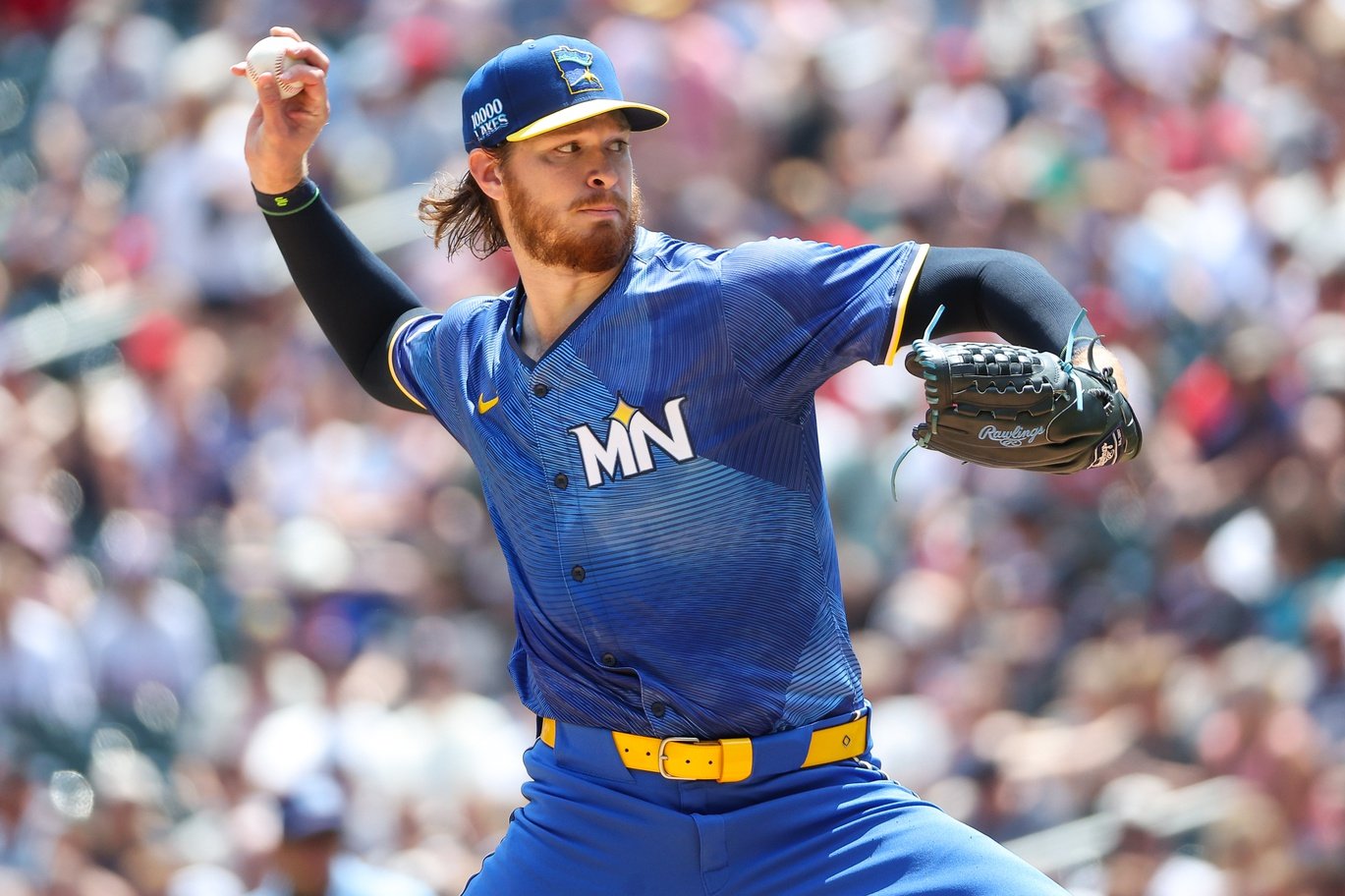 When I was down in Ft. Myers for spring training back in March, one of the players who intrigued me most was Bailey Ober. He felt so integral to the viability of a post-Sonny Gray rotation: a pitcher with legit frontline ability who just needed to prove it out over a bigger sample, and carry it through the finish line. Ober had pitched up to the level of a top-tier starter, but when push came to shove, the Twins didn't really trust him to start a playoff game. Changing that felt critical to the 2024 team's outlook. In camp, there were positive signs. Ober was pitching brilliantly in the Grapefruit League, as he experimented with a new cutter and flashed unprecedented levels of velocity. Following one of this strong outings, I asked manager Rocco Baldelli what it would take for Ober to take the next step. "Bailey’s a difficult one to talk about in that conversation because he does a lot of different things really well, and has from truly the day he walked in the door at the big-league level," Baldelli said. "Could he go from exceptional to very exceptional? It's like, I don't know, maybe." The point was well taken. Ober entered this season with a 3.63 ERA in nearly 300 major-league innings. That's a track record many would envy. At the same time, the Twins still didn't want to ride him last October, with everything on the line, so he couldn't have been viewed as that exceptional. Right? Rocco's riff really seemed to get to the heart of the matter: Ober's last remaining hurdle was indeed making that leap from good to great; from exceptional to very exceptional. He didn't get off to a good start in this pursuit, to say the least. Ober's first start of the 2024 season was almost unimaginably bad; he was clubbed by the Royals in Kansas City for eight earned runs in 1 ⅓ innings. But the right-hander instantly turned the page and has pitched like a true frontline force ever since. In 19 starts since flushing that Kauffman clunker, Ober has a 3.17 ERA and 3.40 FIP, holding opponents to a .197 batting average. He's only gotten better as the season has progressed, with Ober's hot streak reaching new heights in his latest start, perhaps the finest of his career. On Sunday he mowed down the Tigers over eight innings of shutout, one-hit ball, setting a personal record with 11 strikeouts. Ober's newly added cutter has become an integral part of his arsenal, accounting for 22% of pitches thrown. And while it's been a solid offering in its own right, generating a 22% whiff rate and holding opponents to a .253 average, the cutter's biggest value might be simply bringing another offspeed variant that makes his accompanying changeup and slider even harder to pick up. Those pitches are the ones Ober is really using to dominate – opponents are whiffing 39% of the time against his changeup and batting .096 against his slider. Sunday's outing added to a solidifying trend we've seen from Ober – he's not just pitching well, he is flat-out dominating, like never before. Sunday's start was the third in his past six where Ober tallied 20+ swings and misses. He'd previously done so once in his career. Since the midpoint of June he leads all MLB pitchers in swinging-strike rate, and check out his company at the top: Bailey Ober, 17.3% Cole Ragans, 16.4% Logan Gilbert, 15.8% Tarik Skubal, 15.7% Max Scherzer, 14.7% Corbin Burnes, 14.5% That group below Ober includes four All-Stars, and all pitchers who could or will start in the playoffs. In fact there are several Game 1 caliber starters. Maybe it's time we started talking about Ober in that conversation. Of course, this is putting the cart in front of the proverbial horse. The real final hurdle for the 29-year-old is proving he can sustain and maintain his excellence through the end of a long MLB season and beyond. That's been a sticking point. In 2022, injuries limited Ober to just 56 innings with the Twins. Last year he powered through 26 starts, but the team felt wary enough of his diminishing stamina late in the season that they sent him down to Triple-A for a spell in September, and then gave him a short leash in a three-inning ALDS start. The lack of faith was justified based on Ober's postseason results. Between that Game 1 start and a relief appearance in the Game 3 blowout loss, he gave up six earned runs on four homers in 4 ⅓ innings. It surely left a sour taste in his mouth, and maybe that plays a role in driving his inspired play this season. We'll see if it can fuel him to the finish line, and from there, his shot at Oct-Ober redemption.
 -
When it comes to starting pitchers, there is a certain threshold that divides the good from the great – the guys you want starting in the playoffs and the guys that you don't. We seem to be watching Bailey Ober cross that threshold before our very eyes. Image courtesy of Matt Krohn-USA TODAY Sports When I was down in Ft. Myers for spring training back in March, one of the players who intrigued me most was Bailey Ober. He felt so integral to the viability of a post-Sonny Gray rotation: a pitcher with legit frontline ability who just needed to prove it out over a bigger sample, and carry it through the finish line. Ober had pitched up to the level of a top-tier starter, but when push came to shove, the Twins didn't really trust him to start a playoff game. Changing that felt critical to the 2024 team's outlook. In camp, there were positive signs. Ober was pitching brilliantly in the Grapefruit League, as he experimented with a new cutter and flashed unprecedented levels of velocity. Following one of this strong outings, I asked manager Rocco Baldelli what it would take for Ober to take the next step. "Bailey’s a difficult one to talk about in that conversation because he does a lot of different things really well, and has from truly the day he walked in the door at the big-league level," Baldelli said. "Could he go from exceptional to very exceptional? It's like, I don't know, maybe." The point was well taken. Ober entered this season with a 3.63 ERA in nearly 300 major-league innings. That's a track record many would envy. At the same time, the Twins still didn't want to ride him last October, with everything on the line, so he couldn't have been viewed as that exceptional. Right? Rocco's riff really seemed to get to the heart of the matter: Ober's last remaining hurdle was indeed making that leap from good to great; from exceptional to very exceptional. He didn't get off to a good start in this pursuit, to say the least. Ober's first start of the 2024 season was almost unimaginably bad; he was clubbed by the Royals in Kansas City for eight earned runs in 1 ⅓ innings. But the right-hander instantly turned the page and has pitched like a true frontline force ever since. In 19 starts since flushing that Kauffman clunker, Ober has a 3.17 ERA and 3.40 FIP, holding opponents to a .197 batting average. He's only gotten better as the season has progressed, with Ober's hot streak reaching new heights in his latest start, perhaps the finest of his career. On Sunday he mowed down the Tigers over eight innings of shutout, one-hit ball, setting a personal record with 11 strikeouts. Ober's newly added cutter has become an integral part of his arsenal, accounting for 22% of pitches thrown. And while it's been a solid offering in its own right, generating a 22% whiff rate and holding opponents to a .253 average, the cutter's biggest value might be simply bringing another offspeed variant that makes his accompanying changeup and slider even harder to pick up. Those pitches are the ones Ober is really using to dominate – opponents are whiffing 39% of the time against his changeup and batting .096 against his slider. Sunday's outing added to a solidifying trend we've seen from Ober – he's not just pitching well, he is flat-out dominating, like never before. Sunday's start was the third in his past six where Ober tallied 20+ swings and misses. He'd previously done so once in his career. Since the midpoint of June he leads all MLB pitchers in swinging-strike rate, and check out his company at the top: Bailey Ober, 17.3% Cole Ragans, 16.4% Logan Gilbert, 15.8% Tarik Skubal, 15.7% Max Scherzer, 14.7% Corbin Burnes, 14.5% That group below Ober includes four All-Stars, and all pitchers who could or will start in the playoffs. In fact there are several Game 1 caliber starters. Maybe it's time we started talking about Ober in that conversation. Of course, this is putting the cart in front of the proverbial horse. The real final hurdle for the 29-year-old is proving he can sustain and maintain his excellence through the end of a long MLB season and beyond. That's been a sticking point. In 2022, injuries limited Ober to just 56 innings with the Twins. Last year he powered through 26 starts, but the team felt wary enough of his diminishing stamina late in the season that they sent him down to Triple-A for a spell in September, and then gave him a short leash in a three-inning ALDS start. The lack of faith was justified based on Ober's postseason results. Between that Game 1 start and a relief appearance in the Game 3 blowout loss, he gave up six earned runs on four homers in 4 ⅓ innings. It surely left a sour taste in his mouth, and maybe that plays a role in driving his inspired play this season. We'll see if it can fuel him to the finish line, and from there, his shot at Oct-Ober redemption. View full article
-
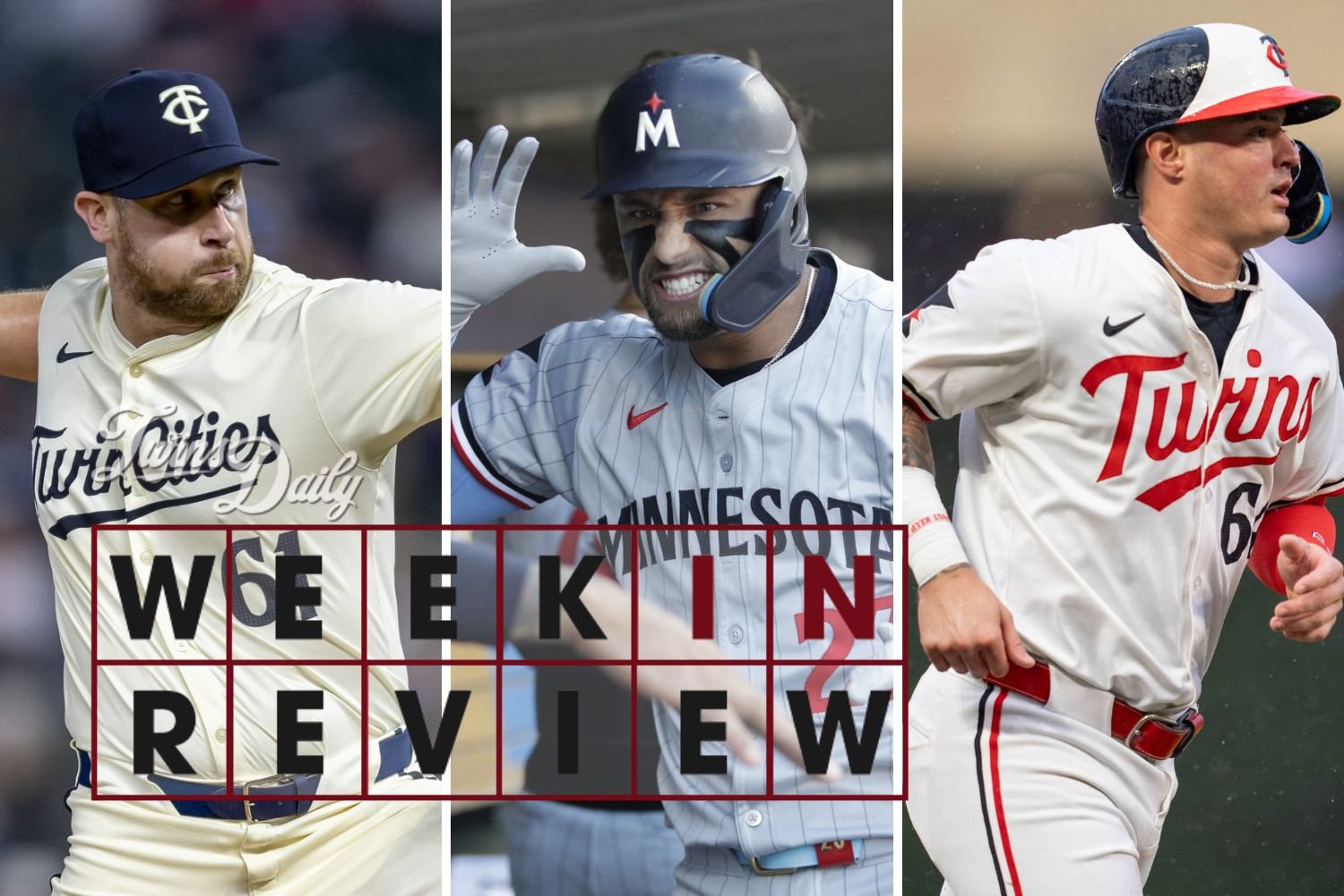 Weekly Snapshot: Mon, 7/22 through Sun, 7/28 *** Record Last Week: 4-2 (Overall: 58-46) Run Differential Last Week: +9 (Overall: +51) Standing: 2nd Place in AL Central (4.5 GB) Last Week's Game Results: Game 99 | MIN 7, PHI 2: Ober, Twins Win Convincingly Over High-Powered Phils Game 100 | PHI 3, MIN 0: Wheeler Shuts Down Offense, Duran Lapses Late Game 101 | MIN 5, PHI 4: Kepler Caps Comeback With Walk-Off Single in Ninth Game 102 | MIN 9, DET 3: Twins Bury Tigers Behind Pablo and Power Hitting Game 103 | DET 7, MIN 2: Offense Goes Silent After Lewis's Early Blast Game 104 | MIN 5, DET 0: Another Ober Gem Helps Clinch Another Series IF YOU'D RATHER LISTEN TO THE WEEK IN REVIEW THAN READ IT, YOU CAN NOW FIND IT IN PODCAST FORM. GET THE LATEST EPISODE HERE. ALSO AVAILABLE ON APPLE AND SPOTIFY. NEWS & NOTES As expected, the Twins got back three crucial roster pieces over the past week in a wave of game-changing roster reinforcements. First up was Brock Stewart, activated for the final game of the Phillies series on Wednesday. To make room for Stewart's activation from the 60-day IL, infielder Diego Castillo was designated for assignment; he passed through waivers and returned to Triple-A. Stewart looked a bit rocky in two appearances, allowing four earned runs over 1 ⅔ innings (that's one more run than he'd allowed in his first 41 outings as a Twin), but hopefully it's more a reflection of rustiness than any lingering arm issues. Friday brought the much-anticipated activation of Royce Lewis, who'd been sidelined since early July with an adductor strain. To make room for Lewis, who started at third and batted cleanup in the series opener against Detroit, Jair Camargo was optioned back to St. Paul. Lewis went 3-for-9 with a homer and a double in two games against the Tigers before sitting on Sunday (though he did draw an intentional walk as a pinch-hitter in the ninth). On Saturday it was José Miranda rejoining the fray, coming off the injured list following his bout with a lower back strain. He replaced Edouard Julien, who was sent back to Triple-A following a very discouraging stint in the majors. Miranda went 1-for-4 in his first game back, then took a fastball to the helmet in his first at-bat on Sunday and exited the game. A scary moment. He passed preliminary testing for a concussion, and was diagnosed with a head contusion. Hoping all is well and Miranda can get back into the lineup relatively quickly. We wondered last week who would fill in for injured Chris Paddack in the fifth rotation spot, which fell on Wednesday against the Phillies. It turned out to be David Festa, although he didn't make a traditional start, instead entering midway through the first inning to relieve opener Steven Okert. Festa pitched very well, allowing just one run in 4 ⅓ innings with seven strikeouts. Ronny Henriquez shuttled back to Triple-A to make room for Festa, who may stick around for a bit depending on what plays out at the deadline. Also arriving in St. Paul last week: Justin Topa, whose rehab assignment is progressing toward completion. The 33-year-old righty, who posted a 2.83 ERA out of the Mariners bullpen last year before being sent to Minnesota in the Jorge Polanco trade, has yet to make a regular-season appearance, bothered by knee issues since spring. But he's positioning himself as another potential sneaky second-half reinforcement. HIGHLIGHTS With the trade deadline now bearing down on us, there's plenty of talk about the need to add another starter – and rightfully so – but the rotation acquitted itself very nicely over the past week. The back half came through brilliantly in a daunting matchup against the Phillies, with Bailey Ober, Simeon Woods Richardson and Festa combining to allow only three runs in 17 ⅓ innings. On Friday, Pablo López fired seven innings of two-run ball against Detroit, improving to a 2.84 ERA with only three homers allowed in his past six starts. Joe Ryan delivered another quality start on Saturday, striking out eight Tigers with only one walk allowed. Then Ober capped the week with another gem against Detroit on Sunday. Ober is on top of his game like we've never seen before. He gave up a two-run homer to Bryce Harper in the first inning on Monday (that'll happen), but then locked in to fire 14 consecutive scoreless frames against Philadelphia and Detroit, allowing just two hits. Ober has quietly emerged as one of the most dominant starting pitchers in the big leagues, pairing an elite bat-missing capability with his signature top-notch command to stymy opposing lineups. In his last seven starts, Ober is 5-1 with a 1.86 ERA and 59-to-9 K/BB ratio in 48 ⅓ innings. Matt Wallner keeps on crushing to jolt an offense that has been lagging around him at times. The outfielder went 5-for-12 last week with two doubles, two homers, and three walks. He leads the team in OPS since returning from Triple-A in early July, and deservingly made his first MLB start as No. 3 hitter on Sunday. A couple of other noteworthy offensive performances: Christian Vázquez made the most of his 12 plate appearances, notching five hits (including a home run) and two walks, while Carlos Santana put forth another strong week with three multi-hit games. Also: Byron Buxton notched three more extra-base hits; he's slugging .684 in July. LOWLIGHTS The lineup hasn't been clicking like it once was, and that starts at the top. Willi Castro was mired in a big slump prior to reaching base four times in Sunday's win, with a .189 average in July. He has only three extra-base hits over the past month, all doubles, and continues to be one of the league's worst hitters with RISP. Castro's defensive struggles at shortstop have caused him to seemingly cede the interim starter job there to Brooks Lee (who's looked pretty good!). None of this is meant to downplay Castro, who's played to the utmost of his ability and been hugely valuable. But he's not a flawless player, and he's been getting maximum exposure as an everyday leadoff man with constantly fluctuating defensive assignments. Some of those flaws are bound to come through. At the plate, it's now a matter of adjustments being made on his part, and maybe we started to see that on Sunday. Lee is another once-hot hitter who's cooled off here in the thick of the summer. He did produce a three-hit game on Friday, but was otherwise 2-for-19 and he has gone 11 straight games without an XBH, often battling to get the ball out of the infield. The MLB learning curve spares almost no man, even those as polished and talented as Lee, who is likely in line to return to the minors once Carlos Correa is activated. That might still give him a couple of weeks to turn around the skid. As Vázquez keeps showing signs of life at the plate, Ryan Jeffers is trending in the opposite direction. He was 3-for-18 last week and had a number of rough at-bats. It's been a stark drop-off for Jeffers, who was a dangerous power bat early in the season and now poses little threat at the plate. Pitchers are making quick work of him by taking command of undisciplined, reactive at-bats. Jeffers is swinging at a career-high 32% of pitches outside the zone. In fairness, the offense was good enough for the Twins to win both their series this past week. They're going to get a boost as Lewis and Miranda fully work their way back in, and Correa's return is hopefully not too far off. But for this team to reach its full potential in the second half and overcome their deficit in the division, the Twins need to get back to the baseline of consistent contributions up and down the lineup, with everyone chipping in. On the pitching front, as good as the starting rotation has looked, Minnesota's bullpen is showing its warts. Jhoan Durán delivered perhaps his worst outing of the season on Tuesday, entering in the ninth inning of a tie game and allowing three earned runs to take the loss. Durán was all over the place, throwing just 11 of 27 pitches for strikes while allowing four base runners and recording only two outs. He did bounce back with a scoreless inning on Wednesday. Josh Staumont has allowed five earned runs in his past five appearances after allowing zero in his first nineteen. Okert inspires no confidence – he gave up three hits and a walk while recording two outs in his two appearances, and has a 7.59 ERA since the start of June. Stewart was uncharacteristically human in his first week back from a prolonged IL stint, splashing cold water on the idea that he'd immediately slot back in and bolster the back end of the bullpen. One way or another, this relief corps is going to need some help for the stretch run, whether internal or external. They do have some bullets in the chamber with Louie Varland still starting at Triple-A (for now), Topa on the comeback trail, and Paddack theoretically back at some point. But then there is also the following option. TRENDING STORYLINE The trade deadline arrives on Tuesday, with multiple reports of spending limitations throwing a damper on Minnesota's outlook. Bob Nightengale of USA TODAY suggested last week that the Twins are "hamstrung in their pursuit of trade acquisitions unless they’re able to dump a contract," which matches up to earlier reporting from ESPN's Jeff Passan that the Twins front office is forced to walk an "add-and-subtract" tightrope in trying to add at the deadline. Following an offseason in which the Twins slashed payroll by $35 million, this sucks to hear. It's another morale-crushing development at a time where ownership could do themselves a big favor by investing in their product and helping push a legitimate contender to the next level. But up until 5:00 PM on Tuesday, that's all just words and hearsay. Actions speak louder. This certainly seems like an opportunity for this franchise to make a positive statement, rather than further diminishing their brand and the enthusiasm of their fans. To prep yourself for the next couple of days, here are some recommended trade deadline previews and analysis from our writers. There will of course be plenty more coverage in the next couple of days. Prospects, Players, or Patience? The Twins Must Choose, by Cody Christie Chris Paddack’s Injury Necessitates Action for Twins, by Greggory Masterson Three Uncontrollable Factors Are Helping the Twins' Competitors, by Eric Blonigen Jack Flaherty Is the Ideal Trade Deadline Acquisition For the Twins, by Cody Schoenmann These 5 Twins Will Be More Important Down the Stretch Than Any Trade Additions, by Ted Schwerzler Twins Establish GoFundMe for Trade Deadline, by Randballs Stu (🤣) LOOKING AHEAD The Twins head from Detroit to New York, where they're set to face off against a resurgent Mets team that has heated up to push into playoff contention. Notably, the Twins are scheduled to face a pair of lefty starters in that series. Afterward, it's back to Target Field for a softer matchup against the White Sox, who've lost nine of 10 to Minnesota this season. Chicago's two best starters are on the docket in Erick Fedde and Garrett Crochet, but we'll see if one or both are gone by the time that series rolls around. Fedde and Crochet are hot commodities on the trade market with the Sox in clear seller mode. MONDAY, JULY 29: TWINS @ METS – RHP Simeon Woods Richardson v. LHP Jose Quintana TUESDAY, JULY 30: TWINS @ METS – RHP David Festa v. LHP Sean Manaea WEDNESDAY, JULY 31: TWINS @ METS – RHP Pablo Lopez v. RHP Luis Severino FRIDAY, AUG 2: WHITE SOX @ TWINS – RHP Erick Fedde v. RHP Joe Ryan SATURDAY, AUG 3: WHITE SOX @ TWINS – LHP Garrett Crochet v. RHP Bailey Ober SUNDAY, AUG 4: WHITE SOX @ TWINS – RHP Chris Flexen v. RHP Simeon Woods Richardson
- 18 comments
-
- 4
-
-
- royce lewis
- jose miranda
- (and 2 more)
-
The Twins got back three key players from the injured list last week, and now the front office will set its sights on further additions for the stretch run as the clock ticks down on the trade deadline. Image courtesy of Jesse Johnson, Brian Bradshaw Sevald, Matt Blewett-USA TODAY Sports Weekly Snapshot: Mon, 7/22 through Sun, 7/28 *** Record Last Week: 4-2 (Overall: 58-46) Run Differential Last Week: +9 (Overall: +51) Standing: 2nd Place in AL Central (4.5 GB) Last Week's Game Results: Game 99 | MIN 7, PHI 2: Ober, Twins Win Convincingly Over High-Powered Phils Game 100 | PHI 3, MIN 0: Wheeler Shuts Down Offense, Duran Lapses Late Game 101 | MIN 5, PHI 4: Kepler Caps Comeback With Walk-Off Single in Ninth Game 102 | MIN 9, DET 3: Twins Bury Tigers Behind Pablo and Power Hitting Game 103 | DET 7, MIN 2: Offense Goes Silent After Lewis's Early Blast Game 104 | MIN 5, DET 0: Another Ober Gem Helps Clinch Another Series IF YOU'D RATHER LISTEN TO THE WEEK IN REVIEW THAN READ IT, YOU CAN NOW FIND IT IN PODCAST FORM. GET THE LATEST EPISODE HERE. ALSO AVAILABLE ON APPLE AND SPOTIFY. NEWS & NOTES As expected, the Twins got back three crucial roster pieces over the past week in a wave of game-changing roster reinforcements. First up was Brock Stewart, activated for the final game of the Phillies series on Wednesday. To make room for Stewart's activation from the 60-day IL, infielder Diego Castillo was designated for assignment; he passed through waivers and returned to Triple-A. Stewart looked a bit rocky in two appearances, allowing four earned runs over 1 ⅔ innings (that's one more run than he'd allowed in his first 41 outings as a Twin), but hopefully it's more a reflection of rustiness than any lingering arm issues. Friday brought the much-anticipated activation of Royce Lewis, who'd been sidelined since early July with an adductor strain. To make room for Lewis, who started at third and batted cleanup in the series opener against Detroit, Jair Camargo was optioned back to St. Paul. Lewis went 3-for-9 with a homer and a double in two games against the Tigers before sitting on Sunday (though he did draw an intentional walk as a pinch-hitter in the ninth). On Saturday it was José Miranda rejoining the fray, coming off the injured list following his bout with a lower back strain. He replaced Edouard Julien, who was sent back to Triple-A following a very discouraging stint in the majors. Miranda went 1-for-4 in his first game back, then took a fastball to the helmet in his first at-bat on Sunday and exited the game. A scary moment. He passed preliminary testing for a concussion, and was diagnosed with a head contusion. Hoping all is well and Miranda can get back into the lineup relatively quickly. We wondered last week who would fill in for injured Chris Paddack in the fifth rotation spot, which fell on Wednesday against the Phillies. It turned out to be David Festa, although he didn't make a traditional start, instead entering midway through the first inning to relieve opener Steven Okert. Festa pitched very well, allowing just one run in 4 ⅓ innings with seven strikeouts. Ronny Henriquez shuttled back to Triple-A to make room for Festa, who may stick around for a bit depending on what plays out at the deadline. Also arriving in St. Paul last week: Justin Topa, whose rehab assignment is progressing toward completion. The 33-year-old righty, who posted a 2.83 ERA out of the Mariners bullpen last year before being sent to Minnesota in the Jorge Polanco trade, has yet to make a regular-season appearance, bothered by knee issues since spring. But he's positioning himself as another potential sneaky second-half reinforcement. HIGHLIGHTS With the trade deadline now bearing down on us, there's plenty of talk about the need to add another starter – and rightfully so – but the rotation acquitted itself very nicely over the past week. The back half came through brilliantly in a daunting matchup against the Phillies, with Bailey Ober, Simeon Woods Richardson and Festa combining to allow only three runs in 17 ⅓ innings. On Friday, Pablo López fired seven innings of two-run ball against Detroit, improving to a 2.84 ERA with only three homers allowed in his past six starts. Joe Ryan delivered another quality start on Saturday, striking out eight Tigers with only one walk allowed. Then Ober capped the week with another gem against Detroit on Sunday. Ober is on top of his game like we've never seen before. He gave up a two-run homer to Bryce Harper in the first inning on Monday (that'll happen), but then locked in to fire 14 consecutive scoreless frames against Philadelphia and Detroit, allowing just two hits. Ober has quietly emerged as one of the most dominant starting pitchers in the big leagues, pairing an elite bat-missing capability with his signature top-notch command to stymy opposing lineups. In his last seven starts, Ober is 5-1 with a 1.86 ERA and 59-to-9 K/BB ratio in 48 ⅓ innings. Matt Wallner keeps on crushing to jolt an offense that has been lagging around him at times. The outfielder went 5-for-12 last week with two doubles, two homers, and three walks. He leads the team in OPS since returning from Triple-A in early July, and deservingly made his first MLB start as No. 3 hitter on Sunday. A couple of other noteworthy offensive performances: Christian Vázquez made the most of his 12 plate appearances, notching five hits (including a home run) and two walks, while Carlos Santana put forth another strong week with three multi-hit games. Also: Byron Buxton notched three more extra-base hits; he's slugging .684 in July. LOWLIGHTS The lineup hasn't been clicking like it once was, and that starts at the top. Willi Castro was mired in a big slump prior to reaching base four times in Sunday's win, with a .189 average in July. He has only three extra-base hits over the past month, all doubles, and continues to be one of the league's worst hitters with RISP. Castro's defensive struggles at shortstop have caused him to seemingly cede the interim starter job there to Brooks Lee (who's looked pretty good!). None of this is meant to downplay Castro, who's played to the utmost of his ability and been hugely valuable. But he's not a flawless player, and he's been getting maximum exposure as an everyday leadoff man with constantly fluctuating defensive assignments. Some of those flaws are bound to come through. At the plate, it's now a matter of adjustments being made on his part, and maybe we started to see that on Sunday. Lee is another once-hot hitter who's cooled off here in the thick of the summer. He did produce a three-hit game on Friday, but was otherwise 2-for-19 and he has gone 11 straight games without an XBH, often battling to get the ball out of the infield. The MLB learning curve spares almost no man, even those as polished and talented as Lee, who is likely in line to return to the minors once Carlos Correa is activated. That might still give him a couple of weeks to turn around the skid. As Vázquez keeps showing signs of life at the plate, Ryan Jeffers is trending in the opposite direction. He was 3-for-18 last week and had a number of rough at-bats. It's been a stark drop-off for Jeffers, who was a dangerous power bat early in the season and now poses little threat at the plate. Pitchers are making quick work of him by taking command of undisciplined, reactive at-bats. Jeffers is swinging at a career-high 32% of pitches outside the zone. In fairness, the offense was good enough for the Twins to win both their series this past week. They're going to get a boost as Lewis and Miranda fully work their way back in, and Correa's return is hopefully not too far off. But for this team to reach its full potential in the second half and overcome their deficit in the division, the Twins need to get back to the baseline of consistent contributions up and down the lineup, with everyone chipping in. On the pitching front, as good as the starting rotation has looked, Minnesota's bullpen is showing its warts. Jhoan Durán delivered perhaps his worst outing of the season on Tuesday, entering in the ninth inning of a tie game and allowing three earned runs to take the loss. Durán was all over the place, throwing just 11 of 27 pitches for strikes while allowing four base runners and recording only two outs. He did bounce back with a scoreless inning on Wednesday. Josh Staumont has allowed five earned runs in his past five appearances after allowing zero in his first nineteen. Okert inspires no confidence – he gave up three hits and a walk while recording two outs in his two appearances, and has a 7.59 ERA since the start of June. Stewart was uncharacteristically human in his first week back from a prolonged IL stint, splashing cold water on the idea that he'd immediately slot back in and bolster the back end of the bullpen. One way or another, this relief corps is going to need some help for the stretch run, whether internal or external. They do have some bullets in the chamber with Louie Varland still starting at Triple-A (for now), Topa on the comeback trail, and Paddack theoretically back at some point. But then there is also the following option. TRENDING STORYLINE The trade deadline arrives on Tuesday, with multiple reports of spending limitations throwing a damper on Minnesota's outlook. Bob Nightengale of USA TODAY suggested last week that the Twins are "hamstrung in their pursuit of trade acquisitions unless they’re able to dump a contract," which matches up to earlier reporting from ESPN's Jeff Passan that the Twins front office is forced to walk an "add-and-subtract" tightrope in trying to add at the deadline. Following an offseason in which the Twins slashed payroll by $35 million, this sucks to hear. It's another morale-crushing development at a time where ownership could do themselves a big favor by investing in their product and helping push a legitimate contender to the next level. But up until 5:00 PM on Tuesday, that's all just words and hearsay. Actions speak louder. This certainly seems like an opportunity for this franchise to make a positive statement, rather than further diminishing their brand and the enthusiasm of their fans. To prep yourself for the next couple of days, here are some recommended trade deadline previews and analysis from our writers. There will of course be plenty more coverage in the next couple of days. Prospects, Players, or Patience? The Twins Must Choose, by Cody Christie Chris Paddack’s Injury Necessitates Action for Twins, by Greggory Masterson Three Uncontrollable Factors Are Helping the Twins' Competitors, by Eric Blonigen Jack Flaherty Is the Ideal Trade Deadline Acquisition For the Twins, by Cody Schoenmann These 5 Twins Will Be More Important Down the Stretch Than Any Trade Additions, by Ted Schwerzler Twins Establish GoFundMe for Trade Deadline, by Randballs Stu (🤣) LOOKING AHEAD The Twins head from Detroit to New York, where they're set to face off against a resurgent Mets team that has heated up to push into playoff contention. Notably, the Twins are scheduled to face a pair of lefty starters in that series. Afterward, it's back to Target Field for a softer matchup against the White Sox, who've lost nine of 10 to Minnesota this season. Chicago's two best starters are on the docket in Erick Fedde and Garrett Crochet, but we'll see if one or both are gone by the time that series rolls around. Fedde and Crochet are hot commodities on the trade market with the Sox in clear seller mode. MONDAY, JULY 29: TWINS @ METS – RHP Simeon Woods Richardson v. LHP Jose Quintana TUESDAY, JULY 30: TWINS @ METS – RHP David Festa v. LHP Sean Manaea WEDNESDAY, JULY 31: TWINS @ METS – RHP Pablo Lopez v. RHP Luis Severino FRIDAY, AUG 2: WHITE SOX @ TWINS – RHP Erick Fedde v. RHP Joe Ryan SATURDAY, AUG 3: WHITE SOX @ TWINS – LHP Garrett Crochet v. RHP Bailey Ober SUNDAY, AUG 4: WHITE SOX @ TWINS – RHP Chris Flexen v. RHP Simeon Woods Richardson View full article
-
It was announced by the Minnesota Twins that Royce Lewis will be back in the lineup for the Friday night game against the Detroit Tigers.
-
It was announced by the Minnesota Twins that Royce Lewis will be back in the lineup for the Friday night game against the Detroit Tigers. View full video
-
Coming into this season, it appeared that Cole Sands, Trevor Larnach and Simeon Woods Richardson were all on the verge of potentially fizzling out from the Twins organization. But their resurgent seasons have cemented them as key parts of the team's present, and future. Image courtesy of Jesse Johnson and Matt Blewett – USA TODAY Sports Baseball is a sport filled with rises and falls. That's a big part of what makes it so enjoyable to follow. It's a game of ebbs and flows, of failure and redemption. While it's tough to watch players go through struggles and downswings (Edouard Julien, hello), we're constantly being reminded of why not to give up on them. On this year's Twins team, three key contributors serve as banner examples: outfielder Trevor Larnach, starter Simeon Woods Richardson and reliever Cole Sands. In spring training, none of these three were expected to make the team. Sands did make the Twins bullpen – somewhat surprisingly after he failed to impress last year – but seemingly only to provide a multi-inning arm in low leverage. Woods Richardson was sent back in Triple-A, where he posted an ugly 4.94 ERA in 2023. So was Larnach, who was left off the playoff roster following another injury-plagued, underwhelming season. Bobby Nightengale of the Star Tribune wrote last month that Larnach "felt he was at a make-or-break point in his career during the offseason," and that's a sentiment that was likely shared by both pitchers. Sands, who turned 27 a week ago, had failed to find meaningful traction or success in the big leagues, even after shifting to a full-time relief role. Woods Richardson is still only 23, but his prospect luster had faded away, and he appeared to be falling out of the long-term rotation picture. "There is nothing more frustrating than reaching your dream and seeing it slip away and not knowing why." Larnach told Nightengale. All three faced this frustration to some degree. But only through tribulation can one triumph, making their resurgent campaigns all the more sweet. The Twins are in playoff position and on a 90-win pace, with each of these three playing unexpectedly critical roles. Larnach's good-not-great production understates the premium quality of his at-bats and contact, which have earned him consistent placements in the No. 2 or 3 spots in order against right-handed pitchers. Sands has emerged as a top setup man alongside Griffin Jax in the bullpen, and he's dominating with a 3.38 ERA, 2.75 FIP and 7.5 K/BB ratio. Woods Richardson has been a lifesaver for the Twins rotation, posting a 3.27 ERA in 17 starts, including a shutdown performance against the Phillies on Tuesday night. These particular emergences have been much needed for the Twins, given how things have played out for the team. Larnach's impact left-handed bat is offsetting the lack of impact from Julien and Alex Kirilloff. (Even Max Kepler, whose power has totally tailed off.) Sands has been a vital fixture in the bullpen with one of Jhoan Durán or Brock Stewart sidelined throughout the first half. Woods Richardson replaced Louie Varland, who went 0-4 with a 7.65 ERA to open the season, and has led the Twins to a 12-5 record in his turns since. By coming through as they have this season, all three players have written themselves firmly into the team's future plans – something that was far from the case just a few months ago. Cost-controlled young starting pitching is gold, making Woods Richardson a valuable commodity, even if you view his upside more as mid/back of rotation as opposed to the front. Sands can contribute to a level of continuity in the relief corps, where he, Jax, Durán and Stewart are all under team control for at least three more years. Larnach is now locked into the heart of the lineup, and we still haven't seen him fully unleash – his wOBA is 20 points lower than his xwOBA. Instances like his first at-bat on Tuesday night, when Larnach crushed a 104-MPH drive to center (expected batting average: .860) only for it to find a glove, have been common. His best is yet to come if he keeps swinging the way he has. Hey, things can change. As we can see. But these are talented ballplayers who are finally seeing it come together after enduring setbacks and hardship, and right now all of their arrows are all pointing up. The implications for the future of the Twins, especially as the front office faces apparent financial limitations going forward, could be massive. View full article
-
These 3 Resurgent Twins Forced Their Way Right Back Into the Team's Plans
Nick Nelson posted an article in Twins
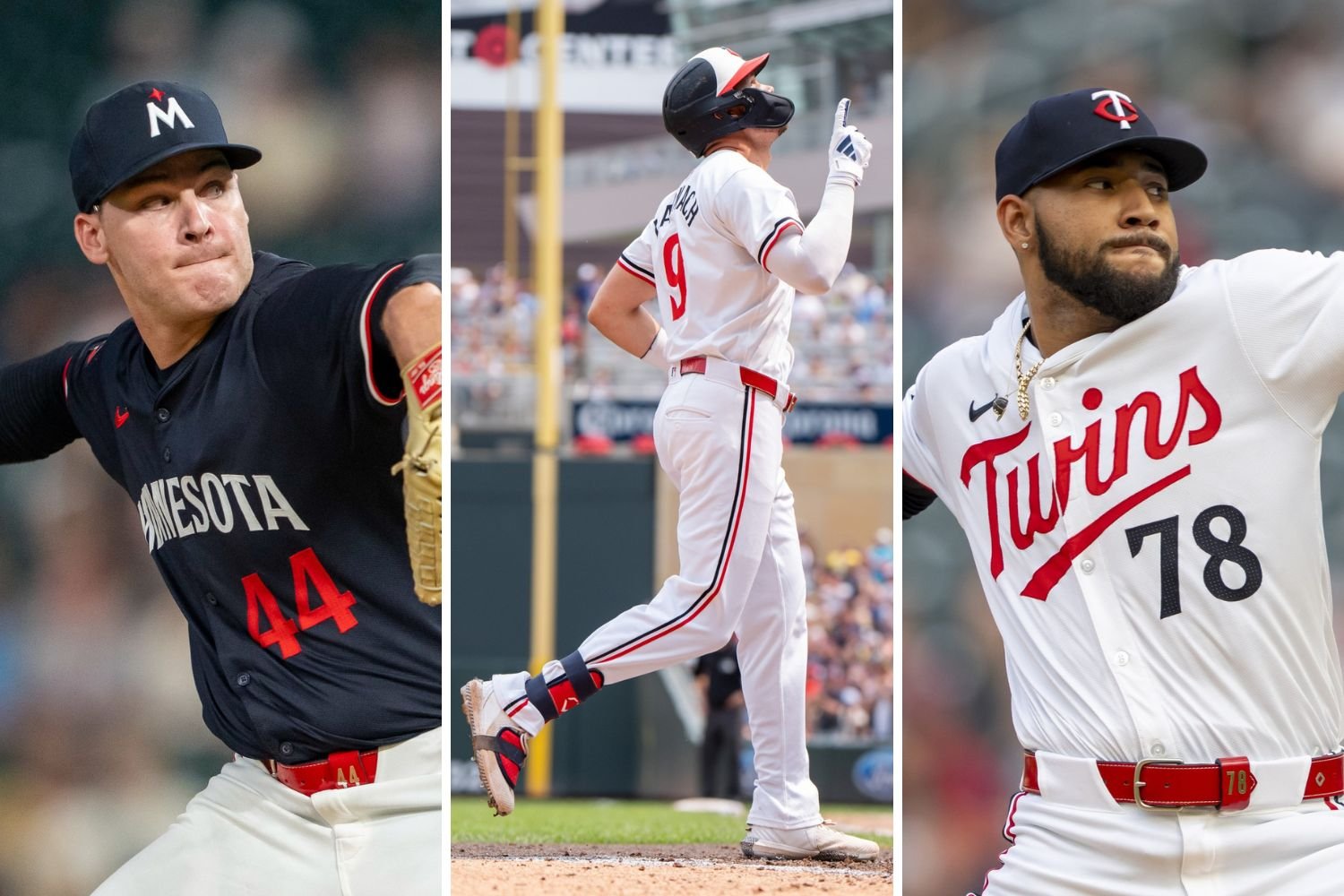 Baseball is a sport filled with rises and falls. That's a big part of what makes it so enjoyable to follow. It's a game of ebbs and flows, of failure and redemption. While it's tough to watch players go through struggles and downswings (Edouard Julien, hello), we're constantly being reminded of why not to give up on them. On this year's Twins team, three key contributors serve as banner examples: outfielder Trevor Larnach, starter Simeon Woods Richardson and reliever Cole Sands. In spring training, none of these three were expected to make the team. Sands did make the Twins bullpen – somewhat surprisingly after he failed to impress last year – but seemingly only to provide a multi-inning arm in low leverage. Woods Richardson was sent back in Triple-A, where he posted an ugly 4.94 ERA in 2023. So was Larnach, who was left off the playoff roster following another injury-plagued, underwhelming season. Bobby Nightengale of the Star Tribune wrote last month that Larnach "felt he was at a make-or-break point in his career during the offseason," and that's a sentiment that was likely shared by both pitchers. Sands, who turned 27 a week ago, had failed to find meaningful traction or success in the big leagues, even after shifting to a full-time relief role. Woods Richardson is still only 23, but his prospect luster had faded away, and he appeared to be falling out of the long-term rotation picture. "There is nothing more frustrating than reaching your dream and seeing it slip away and not knowing why." Larnach told Nightengale. All three faced this frustration to some degree. But only through tribulation can one triumph, making their resurgent campaigns all the more sweet. The Twins are in playoff position and on a 90-win pace, with each of these three playing unexpectedly critical roles. Larnach's good-not-great production understates the premium quality of his at-bats and contact, which have earned him consistent placements in the No. 2 or 3 spots in order against right-handed pitchers. Sands has emerged as a top setup man alongside Griffin Jax in the bullpen, and he's dominating with a 3.38 ERA, 2.75 FIP and 7.5 K/BB ratio. Woods Richardson has been a lifesaver for the Twins rotation, posting a 3.27 ERA in 17 starts, including a shutdown performance against the Phillies on Tuesday night. These particular emergences have been much needed for the Twins, given how things have played out for the team. Larnach's impact left-handed bat is offsetting the lack of impact from Julien and Alex Kirilloff. (Even Max Kepler, whose power has totally tailed off.) Sands has been a vital fixture in the bullpen with one of Jhoan Durán or Brock Stewart sidelined throughout the first half. Woods Richardson replaced Louie Varland, who went 0-4 with a 7.65 ERA to open the season, and has led the Twins to a 12-5 record in his turns since. By coming through as they have this season, all three players have written themselves firmly into the team's future plans – something that was far from the case just a few months ago. Cost-controlled young starting pitching is gold, making Woods Richardson a valuable commodity, even if you view his upside more as mid/back of rotation as opposed to the front. Sands can contribute to a level of continuity in the relief corps, where he, Jax, Durán and Stewart are all under team control for at least three more years. Larnach is now locked into the heart of the lineup, and we still haven't seen him fully unleash – his wOBA is 20 points lower than his xwOBA. Instances like his first at-bat on Tuesday night, when Larnach crushed a 104-MPH drive to center (expected batting average: .860) only for it to find a glove, have been common. His best is yet to come if he keeps swinging the way he has. Hey, things can change. As we can see. But these are talented ballplayers who are finally seeing it come together after enduring setbacks and hardship, and right now all of their arrows are all pointing up. The implications for the future of the Twins, especially as the front office faces apparent financial limitations going forward, could be massive.
- 29 comments
-
- 15
-
-
- trevor larnach
- cole sands
- (and 1 more)
-
The Twins returned from a long All-Star break and tangled at home with the first-place Brewers over the weekend in a hard-fought two-game series between a pair of contenders, dropping two close games. There was plenty of action to discuss in this brief but eventful series, and we also got a ton of updates on injured players and their timelines. Image courtesy of Matt Blewett-USA TODAY Sports Weekly Snapshot: Mon, 7/15 through Sun, 7/21 *** Record Last Week: 0-2 (Overall: 54-44) Run Differential Last Week: -5 (Overall: +42) Standing: 2nd Place in AL Central (5.0 GB) Last Week's Game Results: Game 97 | MIL 8, MIN 4: Thrilling Game Ends in Frustrating Fashion Game 98 | MIL 8, MIN 7: Pitching Letdown Leads to Sweep in Short Series IF YOU'D RATHER LISTEN TO THE WEEK IN REVIEW THAN READ IT, YOU CAN NOW FIND IT IN PODCAST FORM. GET THE LATEST EPISODE HERE. ALSO AVAILABLE ON APPLE AND SPOTIFY. NEWS & NOTES The Minnesota Twins didn't have too much representation at Tuesday's All-Star Game, although Willi Castro did appear in the eighth inning as designated hitter, grounding out in his lone at-bat. Due to the prolonged break, it was a very sparse week of games, with only two played by the Twins, but we received plenty of injury updates as the club returned to Target Field to open a home stand. Here's the latest on players who've been out of action, and their return timelines: The Twins placed Carlos Correa on the injured list due to the plantar fasciitis diagnosis that kept him from playing in the final two games before the break, as well as the All-Star Game. Correa is reportedly at home with a boot on his right foot, keeping the injured heel immobilized following a platelet-rich plasma injection to boost healing. The Twins have suggested that they envision his absence being more in the two-week range versus a month-plus, but that's a pretty tough determination to make at this point. Sounds like Castro will primarily handle shortstop in Correa's stead, with Brooks Lee mixing in. After being activated and making two starts last week, Chris Paddack landed right back on the IL coming out of the break, with what is now being termed a "right forearm strain" after he experienced tightness over the break. Rocco Baldelli downplayed the severity of the issue to reporters on Saturday, saying the injury "doesn't seem like anything major, to be honest. His elbow seems fine, the ligament seems fine, everything seems fine. It's some sort of muscle strain and should heal up." Even if true, the injury timeline puts Minnesota's front office in a bit of a crunch, with the trade deadline less than 10 days away. They won't get another look at Paddack until it's passed. Can they count on him the rest of the way? I think at this point you have to say no. Replacing Correa and Paddack on the roster are Edouard Julien and Austin Martin, meaning the Twins have shifted their balance of hitters and pitchers, although carrying only 12 arms is assuredly temporary. The Twins will be in need of another starter when the fifth turn in the rotation arrives on Wednesday. Who will it be? Louie Varland? David Festa? Zebby Matthews, who was promoted last week to join Varland and Festa in Triple-A, is not in the mix after making his first start for the Saints on Sunday, but he could put himself in this conversation quickly. Prior to their series finale against the Brewers, the Twins placed Kody Funderburk on the injured list with an oblique strain. Ronny Henriquez was called up to replace him in the bullpen, but that might be a short-term arrangement with Brock Stewart on his way back from a lengthy IL stint of his own. Stewart made his first rehab appearance at Triple-A on Friday, striking out two in a scoreless inning, and then struck out the side in a perfect inning on Sunday, reaching 97 MPH. He's getting very close. José Miranda was not activated from the IL on Sunday, his first day of eligibility, with the team sharing that he'll need a little more time to get past the lower back strain that bothered him in San Francisco. But Miranda is "close to returning," according to Dan Hayes of The Athletic, "and could potentially do so without going on a minor-league rehab assignment." A final exciting note: it sounds like Royce Lewis's return is also fairly imminent. He declared himself ready to go at Target Field over the weekend, though the team is inclined to take a slightly more cautious approach. So long as everything stays on track, Lewis is poised to embark on a brief rehab stint in the coming week. Tthe Saints are at home against Omaha starting Tuesday. HIGHLIGHTS Pablo López got his second half started the right way on Saturday, looking the part of a No. 1 starter in tossing seven innings of one-run ball against the first-place Brewers. López struck out seven and walked one, scattering four hits. He seems to have hopefully reined in his long-ball issues, having allowed only two homers in his past five starts. During that span, López has a 2.90 ERA and is holding opponents to a .505 OPS. Carlos Santana came through with another huge home run on Saturday night, a dramatic game-tying two-run blast with the Twins down to their last strike in the 11th inning. Santana's numbers this year don't jump off the page – a .241 average, .429 slugging, 14 homers and 43 RBI – but he's been so steady since the slow start, and clutch moments like this one are quickly raising his profile. Santana leads all Twins hitters in Win Probability Added this month. Byron Buxton was back in the lineup on Saturday and Sunday, thankfully, after missing the final two games of the first half. He moved into the No. 3 spot in the order, and launched a pair of homers in Sunday's game to extend his merciless power-hitting streak, which has seen the center fielder crush seven home runs and nine doubles in his past 17 games. His slugging percentage for the season is up to .510, ranking third on the team behind Miranda and Correa. Buxton is back. We just need him to stay healthy, now more than ever. LOWLIGHTS The sloppy defense and baffling mental mistakes unfortunately did not dry up for Minnesota over the All-Star break. Their first game after the five-day respite distinctly resembled their last one before it: the Twins admirably battled back in a hard-fought contest, only to lose at the end thanks to poor fielding and inexplicable decision-making. Minnesota's miscues are frequently coming at high-stakes moments in games, making them all the more tough to stomach. Saturday's game saw Milwaukee score the go-ahead run score in the 11th when Martin failed to make a clean throw him after a hard grounder was hit directly at him with a drawn-in infield. After Santana managed to erase the deficit in the bottom half of the inning, Twins pitchers managed to quickly load up the bases with no outs in the 12th, thanks to Steven Okert letting a popped-up bunt fall on the third base line, and then grabbing it before it could spin into foul territory. Legitimately one of the worst mental gaffes I've seen from a big-leaguer. This played a role in a meltdown inning that saw the Brewers score five runs to blow the game open. Okert didn't help himself in another shaky outing where he give up three runs (two earned) on two hits and a walk in two-thirds of an inning. His ERA is up to 4.40 on the season. With Funderburk now sidelined, Okert and Thielbar are the only left-handed relievers available, and neither one has done much to earn faith. These reliever lapses and fielding flubs are being magnified by an offense that has been unable to build comfortable leads. Prior to squeaking out seven runs on Sunday, the Twins had gone six straight games without scoring five or more, after doing so in 20 of their previous 27. They are hitting .205 in their past seven games, and over the weekend they were 3-for-26 in scoring opportunities. The run-scoring dropoff is understandable to a degree with so many key hitters now sidelined, but you'd still expect more from this offense given its depth. They're not running out bad lineups, there are just too many capable players failing to step up, aside from Buxton. Max Kepler is at the top of that list: He did bang a double off the overhang in the ninth inning on Sunday, but was otherwise 1-for-8 over the weekend. He has only three home runs in his past 50 games, to go along with roughly a .600 OPS. Where did the guy from last year's second half and the early weeks of this season go? Elsewhere, there are some really tough trendlines at play. Manuel Margot is now 0-for-23 as a pinch-hitter this season after coming up empty in a pair of chances against Milwaukee. Castro has a .157 average with runners in scoring position, the worst in the majors. Ryan Jeffers is batting .190 in his past 40 games. It's very difficult to remain prolific as an offense, down several stars, when the remaining guys are coming up short. TRENDING STORYLINE The impending returns of Lewis, Miranda and Stewart are the big storyline at a time where the Twins are struggling to produce runs and letting tight games slip away late. If all goes to plan, the team will be getting back two of their best hitters and one of their best relievers in time for the stretch run; if they can stay healthy the rest of the way, this trio can play a massive role in propelling the Twins to a division title and beyond. The corresponding roster moves seem mostly straightforward at this point, with Henriquez and Diego A. Castillo currently serving as placeholders in the bullpen and infield, and Jair Camargo going mostly unused as third catcher. It's all just a matter of when, and naturally, much of that may hinge on how things play out in St. Paul this week. In the case of Miranda, as mentioned, he might be able to skip a minor-league tuneup and rejoin the club as soon as he's ready. I wouldn't be surprised if all three were available for the weekend series in Detroit. LOOKING AHEAD From one formidable first-place National League opponent to another: On Monday the Twins will welcome the Philadelphia Phillies to town for a three-game series. The Phils have the best record in baseball and will present a daunting challenge for a Minnesota club that has gone 2-19 against teams with 57 or more wins currently (Baltimore, New York, Cleveland, Milwaukee, Los Angeles). It's time to lock in and change the narrative. The Twins can't afford to let the gap behind Cleveland in the standings get much wider, and frankly they've got much to prove in the face of these continual letdowns against top competition. On the bright side, Minnesota is in line to get back some crucial roster reinforcements, but probably not in time for the Phillies series. MONDAY, JULY 22: PHILLIES @ TWINS – LHP Ranger Suarez v. RHP Bailey Ober TUESDAY, JULY 23: PHILLIES @ TWINS – RHP Zack Wheeler v. RHP Simeon Woods Richardson WEDNESDAY, JULY 24: PHILLIES @ TWINS – RHP Aaron Nola v. TBD FRIDAY, JULY 26: TWINS @ TIGERS – RHP Pablo Lopez v. RHP Keider Montero SATURDAY, JULY 27: TWINS @ TIGERS – RHP Joe Ryan v. TBD SUNDAY, JULY 28: TWINS @ TIGERS – RHP Bailey Ober v. RHP Jack Flaherty View full article
-
 Weekly Snapshot: Mon, 7/15 through Sun, 7/21 *** Record Last Week: 0-2 (Overall: 54-44) Run Differential Last Week: -5 (Overall: +42) Standing: 2nd Place in AL Central (5.0 GB) Last Week's Game Results: Game 97 | MIL 8, MIN 4: Thrilling Game Ends in Frustrating Fashion Game 98 | MIL 8, MIN 7: Pitching Letdown Leads to Sweep in Short Series IF YOU'D RATHER LISTEN TO THE WEEK IN REVIEW THAN READ IT, YOU CAN NOW FIND IT IN PODCAST FORM. GET THE LATEST EPISODE HERE. ALSO AVAILABLE ON APPLE AND SPOTIFY. NEWS & NOTES The Minnesota Twins didn't have too much representation at Tuesday's All-Star Game, although Willi Castro did appear in the eighth inning as designated hitter, grounding out in his lone at-bat. Due to the prolonged break, it was a very sparse week of games, with only two played by the Twins, but we received plenty of injury updates as the club returned to Target Field to open a home stand. Here's the latest on players who've been out of action, and their return timelines: The Twins placed Carlos Correa on the injured list due to the plantar fasciitis diagnosis that kept him from playing in the final two games before the break, as well as the All-Star Game. Correa is reportedly at home with a boot on his right foot, keeping the injured heel immobilized following a platelet-rich plasma injection to boost healing. The Twins have suggested that they envision his absence being more in the two-week range versus a month-plus, but that's a pretty tough determination to make at this point. Sounds like Castro will primarily handle shortstop in Correa's stead, with Brooks Lee mixing in. After being activated and making two starts last week, Chris Paddack landed right back on the IL coming out of the break, with what is now being termed a "right forearm strain" after he experienced tightness over the break. Rocco Baldelli downplayed the severity of the issue to reporters on Saturday, saying the injury "doesn't seem like anything major, to be honest. His elbow seems fine, the ligament seems fine, everything seems fine. It's some sort of muscle strain and should heal up." Even if true, the injury timeline puts Minnesota's front office in a bit of a crunch, with the trade deadline less than 10 days away. They won't get another look at Paddack until it's passed. Can they count on him the rest of the way? I think at this point you have to say no. Replacing Correa and Paddack on the roster are Edouard Julien and Austin Martin, meaning the Twins have shifted their balance of hitters and pitchers, although carrying only 12 arms is assuredly temporary. The Twins will be in need of another starter when the fifth turn in the rotation arrives on Wednesday. Who will it be? Louie Varland? David Festa? Zebby Matthews, who was promoted last week to join Varland and Festa in Triple-A, is not in the mix after making his first start for the Saints on Sunday, but he could put himself in this conversation quickly. Prior to their series finale against the Brewers, the Twins placed Kody Funderburk on the injured list with an oblique strain. Ronny Henriquez was called up to replace him in the bullpen, but that might be a short-term arrangement with Brock Stewart on his way back from a lengthy IL stint of his own. Stewart made his first rehab appearance at Triple-A on Friday, striking out two in a scoreless inning, and then struck out the side in a perfect inning on Sunday, reaching 97 MPH. He's getting very close. José Miranda was not activated from the IL on Sunday, his first day of eligibility, with the team sharing that he'll need a little more time to get past the lower back strain that bothered him in San Francisco. But Miranda is "close to returning," according to Dan Hayes of The Athletic, "and could potentially do so without going on a minor-league rehab assignment." A final exciting note: it sounds like Royce Lewis's return is also fairly imminent. He declared himself ready to go at Target Field over the weekend, though the team is inclined to take a slightly more cautious approach. So long as everything stays on track, Lewis is poised to embark on a brief rehab stint in the coming week. Tthe Saints are at home against Omaha starting Tuesday. HIGHLIGHTS Pablo López got his second half started the right way on Saturday, looking the part of a No. 1 starter in tossing seven innings of one-run ball against the first-place Brewers. López struck out seven and walked one, scattering four hits. He seems to have hopefully reined in his long-ball issues, having allowed only two homers in his past five starts. During that span, López has a 2.90 ERA and is holding opponents to a .505 OPS. Carlos Santana came through with another huge home run on Saturday night, a dramatic game-tying two-run blast with the Twins down to their last strike in the 11th inning. Santana's numbers this year don't jump off the page – a .241 average, .429 slugging, 14 homers and 43 RBI – but he's been so steady since the slow start, and clutch moments like this one are quickly raising his profile. Santana leads all Twins hitters in Win Probability Added this month. Byron Buxton was back in the lineup on Saturday and Sunday, thankfully, after missing the final two games of the first half. He moved into the No. 3 spot in the order, and launched a pair of homers in Sunday's game to extend his merciless power-hitting streak, which has seen the center fielder crush seven home runs and nine doubles in his past 17 games. His slugging percentage for the season is up to .510, ranking third on the team behind Miranda and Correa. Buxton is back. We just need him to stay healthy, now more than ever. LOWLIGHTS The sloppy defense and baffling mental mistakes unfortunately did not dry up for Minnesota over the All-Star break. Their first game after the five-day respite distinctly resembled their last one before it: the Twins admirably battled back in a hard-fought contest, only to lose at the end thanks to poor fielding and inexplicable decision-making. Minnesota's miscues are frequently coming at high-stakes moments in games, making them all the more tough to stomach. Saturday's game saw Milwaukee score the go-ahead run score in the 11th when Martin failed to make a clean throw him after a hard grounder was hit directly at him with a drawn-in infield. After Santana managed to erase the deficit in the bottom half of the inning, Twins pitchers managed to quickly load up the bases with no outs in the 12th, thanks to Steven Okert letting a popped-up bunt fall on the third base line, and then grabbing it before it could spin into foul territory. Legitimately one of the worst mental gaffes I've seen from a big-leaguer. This played a role in a meltdown inning that saw the Brewers score five runs to blow the game open. Okert didn't help himself in another shaky outing where he give up three runs (two earned) on two hits and a walk in two-thirds of an inning. His ERA is up to 4.40 on the season. With Funderburk now sidelined, Okert and Thielbar are the only left-handed relievers available, and neither one has done much to earn faith. These reliever lapses and fielding flubs are being magnified by an offense that has been unable to build comfortable leads. Prior to squeaking out seven runs on Sunday, the Twins had gone six straight games without scoring five or more, after doing so in 20 of their previous 27. They are hitting .205 in their past seven games, and over the weekend they were 3-for-26 in scoring opportunities. The run-scoring dropoff is understandable to a degree with so many key hitters now sidelined, but you'd still expect more from this offense given its depth. They're not running out bad lineups, there are just too many capable players failing to step up, aside from Buxton. Max Kepler is at the top of that list: He did bang a double off the overhang in the ninth inning on Sunday, but was otherwise 1-for-8 over the weekend. He has only three home runs in his past 50 games, to go along with roughly a .600 OPS. Where did the guy from last year's second half and the early weeks of this season go? Elsewhere, there are some really tough trendlines at play. Manuel Margot is now 0-for-23 as a pinch-hitter this season after coming up empty in a pair of chances against Milwaukee. Castro has a .157 average with runners in scoring position, the worst in the majors. Ryan Jeffers is batting .190 in his past 40 games. It's very difficult to remain prolific as an offense, down several stars, when the remaining guys are coming up short. TRENDING STORYLINE The impending returns of Lewis, Miranda and Stewart are the big storyline at a time where the Twins are struggling to produce runs and letting tight games slip away late. If all goes to plan, the team will be getting back two of their best hitters and one of their best relievers in time for the stretch run; if they can stay healthy the rest of the way, this trio can play a massive role in propelling the Twins to a division title and beyond. The corresponding roster moves seem mostly straightforward at this point, with Henriquez and Diego A. Castillo currently serving as placeholders in the bullpen and infield, and Jair Camargo going mostly unused as third catcher. It's all just a matter of when, and naturally, much of that may hinge on how things play out in St. Paul this week. In the case of Miranda, as mentioned, he might be able to skip a minor-league tuneup and rejoin the club as soon as he's ready. I wouldn't be surprised if all three were available for the weekend series in Detroit. LOOKING AHEAD From one formidable first-place National League opponent to another: On Monday the Twins will welcome the Philadelphia Phillies to town for a three-game series. The Phils have the best record in baseball and will present a daunting challenge for a Minnesota club that has gone 2-19 against teams with 57 or more wins currently (Baltimore, New York, Cleveland, Milwaukee, Los Angeles). It's time to lock in and change the narrative. The Twins can't afford to let the gap behind Cleveland in the standings get much wider, and frankly they've got much to prove in the face of these continual letdowns against top competition. On the bright side, Minnesota is in line to get back some crucial roster reinforcements, but probably not in time for the Phillies series. MONDAY, JULY 22: PHILLIES @ TWINS – LHP Ranger Suarez v. RHP Bailey Ober TUESDAY, JULY 23: PHILLIES @ TWINS – RHP Zack Wheeler v. RHP Simeon Woods Richardson WEDNESDAY, JULY 24: PHILLIES @ TWINS – RHP Aaron Nola v. TBD FRIDAY, JULY 26: TWINS @ TIGERS – RHP Pablo Lopez v. RHP Keider Montero SATURDAY, JULY 27: TWINS @ TIGERS – RHP Joe Ryan v. TBD SUNDAY, JULY 28: TWINS @ TIGERS – RHP Bailey Ober v. RHP Jack Flaherty
- 17 comments
-
- 6
-
-
- carlos correa
- chris paddack
- (and 3 more)
-
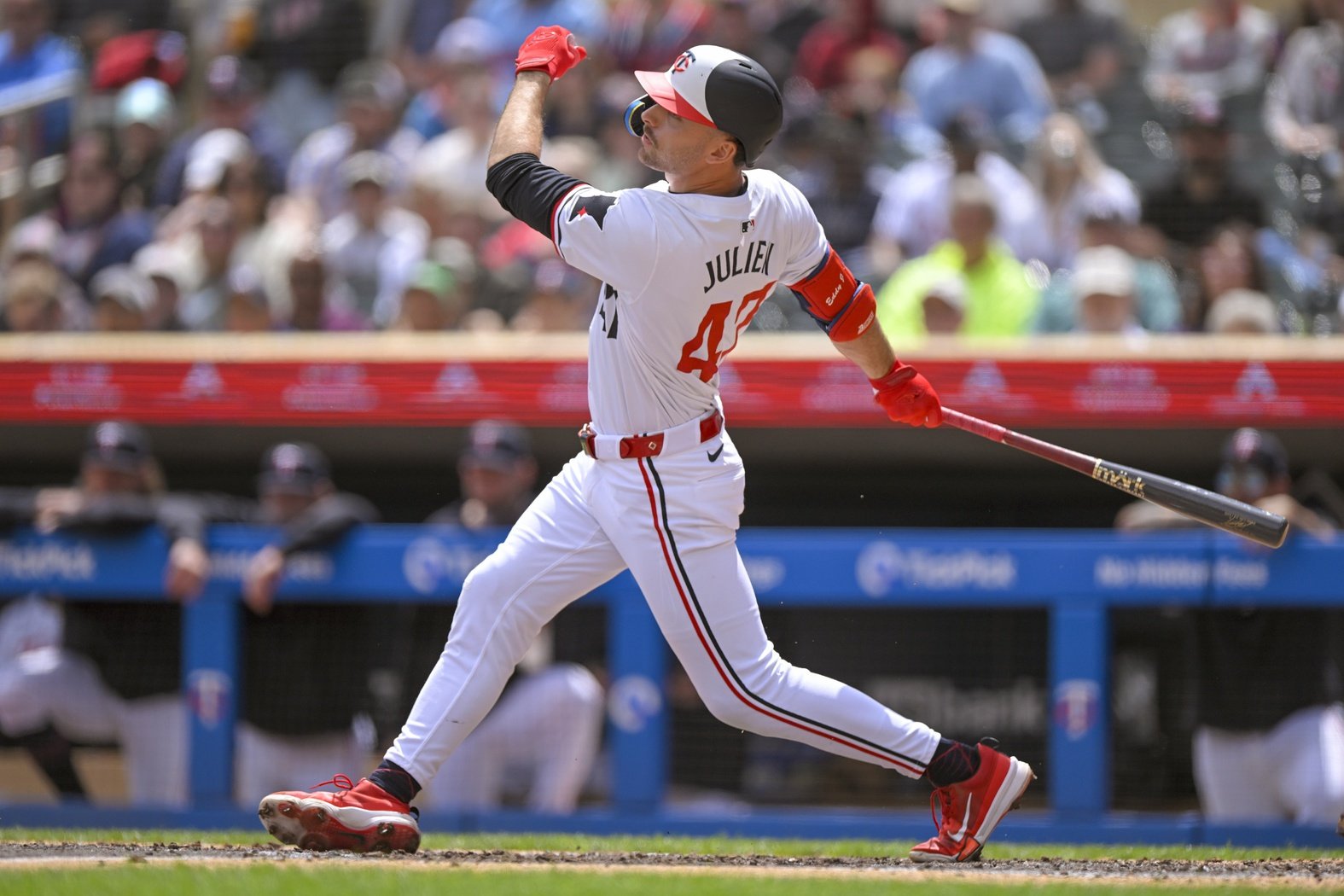 Last year, after his permanent promotion from Triple-A in mid-May, Edouard Julien was the straw that stirred the drink for the Minnesota Twins offense. He was the leadoff man for a top-notch lineup, posting a stellar .366 wOBA and ranking second among positon players in fWAR, behind only Max Kepler. Julien's immediate success in the majors was surprising, in a way, but also not. It's simply the continuation of a trend we've seen throughout his baseball career: he hits, everywhere. In college, in the minors, in spring training, in the World Baseball Classic, in the major leagues, in the postseason: no matter the setting, Julien has produced. That's what makes his 2024 season so jarring. We've never seen Julien fail like this. And to be clear, I use "fail" in a relative sense because he was sent down with a 91 OPS+, meaning he was just 9% worse than the average MLB hitter. But it is Julien's performance since the demotion that really raises concern. In 35 games at Triple-A, he has slashed .233/.400/.380. He got on base at an exceptional rate in the land of automated balls and strikes, but remained unable to generate much power at all. Over the past calendar month, Julien has an .850 OPS, but it's been driven almost entirely by walks. He has just five extra-base hits (two doubles, three homers) in 95 plate appearances during that span. And this is an environment where power is plentiful. We saw what guys like Matt Wallner and Brooks Lee did the pitching in this league. So Julien returns to the Twins as a major question mark. He hasn't visibly resolved the issues that plagued him early in the season, although it could be viewed as a positive that he's homered three times in the past nine games and has a .528 slugging percentage in July. It's a small sample but has the makings of an upward trend. You'd like to see the momentum develop a bit more, and I'm sure the Twins would have preferred it, but they didn't have much choice in the matter. He's clearly their highest-upside play in the absence of Carlos Correa, because we know from the long-term track record what a dominant hitter Julien can be. Presumably, the plan is to let the 25-year-old get some looks in the lower part of the order against right-handed pitchers, to take the pressure off and help him revive his aggressiveness in the box. If Julien can find it again, he'd be a massive difference-maker for an already elite lineup. With Correa sidelined, the Twins could badly use that jolt. What are your expectations for Edouard Julien in his return to the Twins lineup? Sound off in the comments.
 -
All things considered, the Twins offense had a very successful first half. And they did it without much contribution from arguably their best hitter a year ago. Now that he's back from the minors – called up on Saturday to replace an injured Carlos Correa in the infield – can Edouard Julien recapture his 2023 form? Image courtesy of Nick Wosika-USA TODAY Sports Last year, after his permanent promotion from Triple-A in mid-May, Edouard Julien was the straw that stirred the drink for the Minnesota Twins offense. He was the leadoff man for a top-notch lineup, posting a stellar .366 wOBA and ranking second among positon players in fWAR, behind only Max Kepler. Julien's immediate success in the majors was surprising, in a way, but also not. It's simply the continuation of a trend we've seen throughout his baseball career: he hits, everywhere. In college, in the minors, in spring training, in the World Baseball Classic, in the major leagues, in the postseason: no matter the setting, Julien has produced. That's what makes his 2024 season so jarring. We've never seen Julien fail like this. And to be clear, I use "fail" in a relative sense because he was sent down with a 91 OPS+, meaning he was just 9% worse than the average MLB hitter. But it is Julien's performance since the demotion that really raises concern. In 35 games at Triple-A, he has slashed .233/.400/.380. He got on base at an exceptional rate in the land of automated balls and strikes, but remained unable to generate much power at all. Over the past calendar month, Julien has an .850 OPS, but it's been driven almost entirely by walks. He has just five extra-base hits (two doubles, three homers) in 95 plate appearances during that span. And this is an environment where power is plentiful. We saw what guys like Matt Wallner and Brooks Lee did the pitching in this league. So Julien returns to the Twins as a major question mark. He hasn't visibly resolved the issues that plagued him early in the season, although it could be viewed as a positive that he's homered three times in the past nine games and has a .528 slugging percentage in July. It's a small sample but has the makings of an upward trend. You'd like to see the momentum develop a bit more, and I'm sure the Twins would have preferred it, but they didn't have much choice in the matter. He's clearly their highest-upside play in the absence of Carlos Correa, because we know from the long-term track record what a dominant hitter Julien can be. Presumably, the plan is to let the 25-year-old get some looks in the lower part of the order against right-handed pitchers, to take the pressure off and help him revive his aggressiveness in the box. If Julien can find it again, he'd be a massive difference-maker for an already elite lineup. With Correa sidelined, the Twins could badly use that jolt. What are your expectations for Edouard Julien in his return to the Twins lineup? Sound off in the comments. View full article
-
 Back in early May, I wrote about how the Twins were killing their brand, and it was painful to watch as an invested longtime follower of the team. They drastically reduced their payroll coming off a breakthrough season, they reneged on their promise to increase viewership availability, and to top it all off, the team really stumbled out of the gates in April. Fortunately, the Twins were able to turn the tides in a big way following a 7-13 start. They've since been one of the best teams in baseball, winning 18 of their 24 series behind a punishing and relentless offense. Minnesota's roster produced a pair of All-Stars (Carlos Correa and Willi Castro) with several others deserving of strong consideration. Their strong play has kept the Twins within five games of the division-leading Guardians, who have the best record in the American League. Despite all these on-field positives, the organization has seen a further drop in attendance, averaging 1,200 fewer fans per game than in 2023. They stand almost no chance of reaching their goal of 2 million tickets sold this year. "There’s room to quibble about how much each specific factor has led to the Twins’ decreased attendance," writes Aaron Gleeman at The Athletic, "but it’s undeniable that their television mess, on the heels of their inactive, payroll-slashing offseason, brought rising fan morale to a screeching halt and turned off many devoted followers in a way that reinforced their longstanding suspicions about ownership." Even as the team is succeeding and playing very entertaining ball, their brand crisis is only worsening. It's very unsettling to think about the long-term implications of this trend persisting; as Gleeman notes, this can become a vicious cycle where lower revenue leads to even less investment from the team, and thus less investment on behalf of the fan base. Right now, the Twins have a unique opportunity to win back some fan energy and perhaps change the course of their current downward plunge. A great second half leading into a meaningful postseason run could do much to draw back detached fans and casuals, while building palpable excitement heading into the offseason and 2025. If Minnesota were to reach the ALCS or even the World Series, it would be a game-changer in terms of the organization's perception (while also producing significant extra revenue). The opposite scenario is a scary one. If the Twins, say, hold onto the second wild-card spot and end up getting dispatched by the Yankees (whom they'd face in New York if the playoffs started today), that's only going to enflame the disgruntlement. If the Twins fizzle out and miss the postseason entirely, it's going to really rile up the rancor and foment fan disinterest. This feels like an outcome the Twins simply cannot afford as a business right now. Much is riding on the next two and a half months. The future of the Twins franchise could be greatly influenced by how things play out. No pressure or anything, boys.
 -
In the moment, of course it feels important for the Twins to stay on track in the second half, reach the playoffs and make some noise. When you zoom out, and consider the broader circumstances of this franchise, the stakes feel even higher. Image courtesy of Mark J. Rebilas-USA TODAY Sports Back in early May, I wrote about how the Twins were killing their brand, and it was painful to watch as an invested longtime follower of the team. They drastically reduced their payroll coming off a breakthrough season, they reneged on their promise to increase viewership availability, and to top it all off, the team really stumbled out of the gates in April. Fortunately, the Twins were able to turn the tides in a big way following a 7-13 start. They've since been one of the best teams in baseball, winning 18 of their 24 series behind a punishing and relentless offense. Minnesota's roster produced a pair of All-Stars (Carlos Correa and Willi Castro) with several others deserving of strong consideration. Their strong play has kept the Twins within five games of the division-leading Guardians, who have the best record in the American League. Despite all these on-field positives, the organization has seen a further drop in attendance, averaging 1,200 fewer fans per game than in 2023. They stand almost no chance of reaching their goal of 2 million tickets sold this year. "There’s room to quibble about how much each specific factor has led to the Twins’ decreased attendance," writes Aaron Gleeman at The Athletic, "but it’s undeniable that their television mess, on the heels of their inactive, payroll-slashing offseason, brought rising fan morale to a screeching halt and turned off many devoted followers in a way that reinforced their longstanding suspicions about ownership." Even as the team is succeeding and playing very entertaining ball, their brand crisis is only worsening. It's very unsettling to think about the long-term implications of this trend persisting; as Gleeman notes, this can become a vicious cycle where lower revenue leads to even less investment from the team, and thus less investment on behalf of the fan base. Right now, the Twins have a unique opportunity to win back some fan energy and perhaps change the course of their current downward plunge. A great second half leading into a meaningful postseason run could do much to draw back detached fans and casuals, while building palpable excitement heading into the offseason and 2025. If Minnesota were to reach the ALCS or even the World Series, it would be a game-changer in terms of the organization's perception (while also producing significant extra revenue). The opposite scenario is a scary one. If the Twins, say, hold onto the second wild-card spot and end up getting dispatched by the Yankees (whom they'd face in New York if the playoffs started today), that's only going to enflame the disgruntlement. If the Twins fizzle out and miss the postseason entirely, it's going to really rile up the rancor and foment fan disinterest. This feels like an outcome the Twins simply cannot afford as a business right now. Much is riding on the next two and a half months. The future of the Twins franchise could be greatly influenced by how things play out. No pressure or anything, boys. View full article
-
Here Comes Zebby: Twins Hottest Pitching Prospect Reaches Triple-A
Nick Nelson posted an article in Minor Leagues
 It's been quite a season so far for right-hander Daniel Zebulon (Zebby) Matthews, who ranked 20th in Twins Daily's preseason prospect rankings. After posting a combined 1.85 ERA between Single-A and Double-A, he's now been promoted to Triple-A St. Paul -- his second promotion of the season, putting him in position to potentially play a role for the Twins staff in the second half. Zebby Matthews has a good argument for being the best pitching prospect in the Twins system at this point. Certainly names like David Festa, Marco Raya and Charlee Soto are also in that conversation, but none have posted numbers anywhere like Matthews has this season: a 91-to-6 strikeout-to-walk with just three home runs allowed in 78 innings. Baseball America, in their latest top prospects update, has Matthews ranked 54th in all of baseball, and the top Twins pitcher. That's because Matthews's numbers are backed up by tremendously impressive raw stuff, which has advanced dramatically since he was drafted in the eighth round out of Western Carolina University in 2022. His deep arsenal features a fastball now routinely registering in the 96 MPH range, touching 99. The ability to throw that kind of heat while constantly being in the zone is rare, and it's why the well built 6-foot-5, 225 lb righty has been garnering all kinds of attention. "You’d be hard-pressed to find a pitcher with better command than Matthews, who didn’t walk a batter in 2024 until his seventh start of the season," per Baseball America. "Matthews is an arrow-up prospect who’s showing legitimate stuff. His fastball sits mid 90s with plus vertical ride, mixing a cutter, slider, changeup and curveball." Now he'll have a chance to showcase his game at the highest level of the minors, and in a very tough pitching environment. It's a big opportunity for Matthews, who can make a bid for a late-season promotion to the big leagues with a strong showing. Depending on how they handle the deadline, the Twins could be looking for impact additions from within as they prep themselves for a pennant push. That could mean Matthews factoring in at some point as a starter, but a debut as a reliever might make even more sense, enabling the young hurler to keep his innings in check while being used in tightly controlled matchups in the majors. With the way he's throwing, Matthews could be a key short-term asset out of the bullpen especially if he sees anything resembling a Louie Varland-esque boost in stuff. I think back to 2019 when the Twins aggressively called up Brusdar Graterol for the last month of the season to have him available in the playoffs. Obviously, I'm putting the cart ahead of the horse here, but it's the kind of situation worth monitoring as we turn our attention to the second half and the stretch run. Now that's earned his way to Triple-A, Zebby Matthews is firmly in the mix to reach the big leagues at any time. Learn more about Matthews: Twins Daily's Zebby Matthews Prospect Profile: Featuring a brief scouting report and monthly splits. Twins Daily's Zebby Matthews Draft Profile: Recapping scouting reports and signing data from when he selected back in 2022. Heads Up: The Twins have a Pitching Prospect Making The Leap: Certified prospect head Jamie Cameron wrote about Matthews's promotion to Double-A back in May. "He’s certainly showing the type of improvement and development you want to see in a future big-league arm." Share your thoughts on the promotion! What's your take on Zebby Matthews and his legitimacy as a prospect? Could an MLB debut be in the cards this year?
 -
On Tuesday the Twins announced that they've promoted ascendant pitching prospect Zebby Matthews to Triple-A, putting the 24-year-old on the doorstep of the majors, with a clear path to making a late-season impact in the majors. Here's what you need to know. Image courtesy of Ed Bailey, Wichita Wind Surge It's been quite a season so far for right-hander Daniel Zebulon (Zebby) Matthews, who ranked 20th in Twins Daily's preseason prospect rankings. After posting a combined 1.85 ERA between Single-A and Double-A, he's now been promoted to Triple-A St. Paul -- his second promotion of the season, putting him in position to potentially play a role for the Twins staff in the second half. Zebby Matthews has a good argument for being the best pitching prospect in the Twins system at this point. Certainly names like David Festa, Marco Raya and Charlee Soto are also in that conversation, but none have posted numbers anywhere like Matthews has this season: a 91-to-6 strikeout-to-walk with just three home runs allowed in 78 innings. Baseball America, in their latest top prospects update, has Matthews ranked 54th in all of baseball, and the top Twins pitcher. That's because Matthews's numbers are backed up by tremendously impressive raw stuff, which has advanced dramatically since he was drafted in the eighth round out of Western Carolina University in 2022. His deep arsenal features a fastball now routinely registering in the 96 MPH range, touching 99. The ability to throw that kind of heat while constantly being in the zone is rare, and it's why the well built 6-foot-5, 225 lb righty has been garnering all kinds of attention. "You’d be hard-pressed to find a pitcher with better command than Matthews, who didn’t walk a batter in 2024 until his seventh start of the season," per Baseball America. "Matthews is an arrow-up prospect who’s showing legitimate stuff. His fastball sits mid 90s with plus vertical ride, mixing a cutter, slider, changeup and curveball." Now he'll have a chance to showcase his game at the highest level of the minors, and in a very tough pitching environment. It's a big opportunity for Matthews, who can make a bid for a late-season promotion to the big leagues with a strong showing. Depending on how they handle the deadline, the Twins could be looking for impact additions from within as they prep themselves for a pennant push. That could mean Matthews factoring in at some point as a starter, but a debut as a reliever might make even more sense, enabling the young hurler to keep his innings in check while being used in tightly controlled matchups in the majors. With the way he's throwing, Matthews could be a key short-term asset out of the bullpen especially if he sees anything resembling a Louie Varland-esque boost in stuff. I think back to 2019 when the Twins aggressively called up Brusdar Graterol for the last month of the season to have him available in the playoffs. Obviously, I'm putting the cart ahead of the horse here, but it's the kind of situation worth monitoring as we turn our attention to the second half and the stretch run. Now that's earned his way to Triple-A, Zebby Matthews is firmly in the mix to reach the big leagues at any time. Learn more about Matthews: Twins Daily's Zebby Matthews Prospect Profile: Featuring a brief scouting report and monthly splits. Twins Daily's Zebby Matthews Draft Profile: Recapping scouting reports and signing data from when he selected back in 2022. Heads Up: The Twins have a Pitching Prospect Making The Leap: Certified prospect head Jamie Cameron wrote about Matthews's promotion to Double-A back in May. "He’s certainly showing the type of improvement and development you want to see in a future big-league arm." Share your thoughts on the promotion! What's your take on Zebby Matthews and his legitimacy as a prospect? Could an MLB debut be in the cards this year? View full article
-
The Minnesota Twins trail the Cleveland Guardians by 4 ½ games at the All-Star break. Overcoming the formidable division leaders in the second half will be no easy task, but here's why the Twins are capable of making it happen--and will. Image courtesy of Matt Marton, David Richard-USA TODAY Sports The 2024 AL Central race is giving vibes of the 2006 season. That year, the Twins went on a blistering run to reach 96 wins after a slow start, but all summer long, they struggled to gain ground on the division-leading Tigers, who were playing at a nearly 100-win pace themselves. One of the most unforgettable, microcosmic stretches came from Jun. 8 through Jun. 30 that year, during which the Twins won 18 of 20... and picked up exactly half of a game in the standings. Throughout July and into August, Minnesota kept rattling off wins and taking series, but they just couldn't put much of a dent in their division deficit, which fluctuated between nine and 12 games for most of the season. That held true, anyway, until the middle of August, when the Tigers finally started to relent. Detroit got as high as 40 games above .500 at the peak of their prowess -- for a good while, they were on pace for 110 wins, three years after losing 119 games -- but they began hurtling back to Earth during the stretch run. Minnesota capitalized. In their final 50 games, Detroit went 19-31, while the Twins went 30-20 to overcome a double-digit deficit and win the division on the final day. For the younger crowd that wasn't around to witness it, let me tell you: it was wild. This year, I believe history will repeat itself in the Central. It might not play out in such dramatic fashion, although that is no given. The bottom line is that Minnesota is the better team, and over the course of a long MLB season, the best team tends to come out on top. Let's break down three reasons I feel confident in this proclamation. Cleveland is good. They're not THAT good. I'm definitely not saying the Guardians aren't a good team. They have the best record in the American League; that's obviously nothing to scoff at. But when you investigate their success through any kind of deeper statistical lens, it becomes clear that fortune has strongly bent in their favor. A project called the MLB Deserve-to-Win-O-Meter, which attempts "to determine a team's 'luck' factor by how their hits were dispersed in a game vs many simulations," while also accounting for launch angle, exit velocity, and ballpark, recently pegged Cleveland as the luckiest team in baseball, by a pretty vast margin. The Guardians rank 10th in the majors in scoring, but are 23rd in xwOBA. Their hitters rank 10th in the majors in home runs, but rank 30th out of 30 teams in average home run distance. Their pitchers are eighth in ERA, but 15th in FIP. Their staff has the eighth-lowest BABIP in the majors and the second-highest strand rate. I'm not saying any of these numbers change what has happened. The wins are baked in, and the Guardians deserve credit for timely hitting and clutch pitching. But the underlying metrics do paint a different picture than the surface-level representations of Cleveland's true quality and expectations going forward. The Twins, conversely, have been luck-neutral at best according to almost any metric, and probably more on the unlucky side. I don't necessarily expect the Guardians to slump as badly as the 2006 Tigers did down the stretch, but then, the Twins don't need them to, since the division lead is not nearly as large. They simply need Cleveland to get into a prolonged stretch of playing .500 ball, and maybe that has already begun; the Guards are 6-7 here in July. So long as Cleveland keeps coming down from their 100+ win pace, the Twins will catch them. Here's why. Minnesota has the league's deepest and most unrelenting lineup. Over the course of this season, Minnesota's offense has evolved into the league's best. They've removed underperformers (Alex Kirilloff, Edouard Julien), added difference-makers (José Miranda, Brooks Lee), and seen players throughout the lineup perform brilliantly. The players you could've once pointed toward as laggards – Carlos Santana, Byron Buxton, Manuel Margot, even Christian Vázquez – have rounded into improved form, while Trevor Larnach and Willi Castro have reached new levels. At some point (hopefully soon), Royce Lewis will be back. And then at the heart of it all, you've got Carlos Correa, the team MVP and its driving force. He's an All-Star and he's been one of the most impactful players in the American League, offering leadership that goes beyond the field. Although the past weekend's plantar fasciitis diagnosis is alarming, word is that it's less serious than a year ago. In contrast to Cleveland, the underpinning of Minnesota's offensive success is quite sustainable: they consistently make contact and hit the ball hard. The Twins rank eighth among MLB teams in xwOBA for the season, and have been considerably better since their lineup reached its current state. They rank first in the American League in wOBA, wRC+ and position player fWAR over the past two months. Twins pitching will be good enough to get it done. Both the Guardians and Twins have dealt with a void atop their rotation this year. Cleveland ace Shane Bieber is out for the season following elbow surgery, while Pablo López has not pitched in a manner befitting a No. 1 starter. One of those things is correctable in the second half, and one isn't. Turning back to the lens of underlying metrics and expected numbers, everything about López screams "positive regression." His 5.11 ERA is vastly higher than his xERA (3.43) or his xFIP (3.22). He has the lowest strand rate of his career, the highest home-run rate on fly balls, and the second-highest BABIP. None of this guarantees anything, but they are indicators that López isn't pitching as badly as the numbers suggest. Visually, his stuff looks fine for the most part. We saw last year – especially in the playoffs – what López can be, and at times, he seems very close to unlocking it again. Cleveland, with no Bieber and Triston McKenzie in shambles, just doesn't have a starter with that kind of upside. That's not to say the Guardians have a bad pitching staff. It will continue to be a strength for them, undoubtedly. It's just a strength I think that the Twins can realistically match or even outshine the rest of the way. They've got the frontline depth with Joe Ryan, who was a borderline All-Star in the first half, and Bailey Ober, who's been their best starter for quite a while now. In terms of bullpens, these are two of the best in the game. I'm not sure I'd put Minnesota quite at Cleveland's level, but it's close, especially if the Twins get Brock Stewart back after the break and the front office pulls a few strings in August or September. (Late-season relief roles for Louie Varland, David Festa or Zebby Matthews?) How much does winning the division matter? To be clear, I expect both of these teams to make the playoffs. It would likely take a mammoth collapse for Cleveland to miss out even on a Wild Card berth. But the difference between a division title and a Wild Card can be the difference between playing at home or on the road--or even the difference between a first-round bye or a precarious best-of-three matchup to reach the ALDS. Granted, these circumstances don't dictate anything, as 2006 illustrated: Minnesota got swept in the first round by Oakland as division winners, while Detroit reached the World Series. But the playoff setup is much different from back then, with far more incentive to take the division title. For the Twins, the key goal over these final 66 games – aside from making sure they hang onto their playoff spot – is to overtake Cleveland and win the Central for a fourth time in six years. This time around, they're really going to have to earn it. I believe they're more than capable. This is what it's all about folks. It's gonna be a very fun and exciting second half. Strap in. View full article
-
 The 2024 AL Central race is giving vibes of the 2006 season. That year, the Twins went on a blistering run to reach 96 wins after a slow start, but all summer long, they struggled to gain ground on the division-leading Tigers, who were playing at a nearly 100-win pace themselves. One of the most unforgettable, microcosmic stretches came from Jun. 8 through Jun. 30 that year, during which the Twins won 18 of 20... and picked up exactly half of a game in the standings. Throughout July and into August, Minnesota kept rattling off wins and taking series, but they just couldn't put much of a dent in their division deficit, which fluctuated between nine and 12 games for most of the season. That held true, anyway, until the middle of August, when the Tigers finally started to relent. Detroit got as high as 40 games above .500 at the peak of their prowess -- for a good while, they were on pace for 110 wins, three years after losing 119 games -- but they began hurtling back to Earth during the stretch run. Minnesota capitalized. In their final 50 games, Detroit went 19-31, while the Twins went 30-20 to overcome a double-digit deficit and win the division on the final day. For the younger crowd that wasn't around to witness it, let me tell you: it was wild. This year, I believe history will repeat itself in the Central. It might not play out in such dramatic fashion, although that is no given. The bottom line is that Minnesota is the better team, and over the course of a long MLB season, the best team tends to come out on top. Let's break down three reasons I feel confident in this proclamation. Cleveland is good. They're not THAT good. I'm definitely not saying the Guardians aren't a good team. They have the best record in the American League; that's obviously nothing to scoff at. But when you investigate their success through any kind of deeper statistical lens, it becomes clear that fortune has strongly bent in their favor. A project called the MLB Deserve-to-Win-O-Meter, which attempts "to determine a team's 'luck' factor by how their hits were dispersed in a game vs many simulations," while also accounting for launch angle, exit velocity, and ballpark, recently pegged Cleveland as the luckiest team in baseball, by a pretty vast margin. The Guardians rank 10th in the majors in scoring, but are 23rd in xwOBA. Their hitters rank 10th in the majors in home runs, but rank 30th out of 30 teams in average home run distance. Their pitchers are eighth in ERA, but 15th in FIP. Their staff has the eighth-lowest BABIP in the majors and the second-highest strand rate. I'm not saying any of these numbers change what has happened. The wins are baked in, and the Guardians deserve credit for timely hitting and clutch pitching. But the underlying metrics do paint a different picture than the surface-level representations of Cleveland's true quality and expectations going forward. The Twins, conversely, have been luck-neutral at best according to almost any metric, and probably more on the unlucky side. I don't necessarily expect the Guardians to slump as badly as the 2006 Tigers did down the stretch, but then, the Twins don't need them to, since the division lead is not nearly as large. They simply need Cleveland to get into a prolonged stretch of playing .500 ball, and maybe that has already begun; the Guards are 6-7 here in July. So long as Cleveland keeps coming down from their 100+ win pace, the Twins will catch them. Here's why. Minnesota has the league's deepest and most unrelenting lineup. Over the course of this season, Minnesota's offense has evolved into the league's best. They've removed underperformers (Alex Kirilloff, Edouard Julien), added difference-makers (José Miranda, Brooks Lee), and seen players throughout the lineup perform brilliantly. The players you could've once pointed toward as laggards – Carlos Santana, Byron Buxton, Manuel Margot, even Christian Vázquez – have rounded into improved form, while Trevor Larnach and Willi Castro have reached new levels. At some point (hopefully soon), Royce Lewis will be back. And then at the heart of it all, you've got Carlos Correa, the team MVP and its driving force. He's an All-Star and he's been one of the most impactful players in the American League, offering leadership that goes beyond the field. Although the past weekend's plantar fasciitis diagnosis is alarming, word is that it's less serious than a year ago. In contrast to Cleveland, the underpinning of Minnesota's offensive success is quite sustainable: they consistently make contact and hit the ball hard. The Twins rank eighth among MLB teams in xwOBA for the season, and have been considerably better since their lineup reached its current state. They rank first in the American League in wOBA, wRC+ and position player fWAR over the past two months. Twins pitching will be good enough to get it done. Both the Guardians and Twins have dealt with a void atop their rotation this year. Cleveland ace Shane Bieber is out for the season following elbow surgery, while Pablo López has not pitched in a manner befitting a No. 1 starter. One of those things is correctable in the second half, and one isn't. Turning back to the lens of underlying metrics and expected numbers, everything about López screams "positive regression." His 5.11 ERA is vastly higher than his xERA (3.43) or his xFIP (3.22). He has the lowest strand rate of his career, the highest home-run rate on fly balls, and the second-highest BABIP. None of this guarantees anything, but they are indicators that López isn't pitching as badly as the numbers suggest. Visually, his stuff looks fine for the most part. We saw last year – especially in the playoffs – what López can be, and at times, he seems very close to unlocking it again. Cleveland, with no Bieber and Triston McKenzie in shambles, just doesn't have a starter with that kind of upside. That's not to say the Guardians have a bad pitching staff. It will continue to be a strength for them, undoubtedly. It's just a strength I think that the Twins can realistically match or even outshine the rest of the way. They've got the frontline depth with Joe Ryan, who was a borderline All-Star in the first half, and Bailey Ober, who's been their best starter for quite a while now. In terms of bullpens, these are two of the best in the game. I'm not sure I'd put Minnesota quite at Cleveland's level, but it's close, especially if the Twins get Brock Stewart back after the break and the front office pulls a few strings in August or September. (Late-season relief roles for Louie Varland, David Festa or Zebby Matthews?) How much does winning the division matter? To be clear, I expect both of these teams to make the playoffs. It would likely take a mammoth collapse for Cleveland to miss out even on a Wild Card berth. But the difference between a division title and a Wild Card can be the difference between playing at home or on the road--or even the difference between a first-round bye or a precarious best-of-three matchup to reach the ALDS. Granted, these circumstances don't dictate anything, as 2006 illustrated: Minnesota got swept in the first round by Oakland as division winners, while Detroit reached the World Series. But the playoff setup is much different from back then, with far more incentive to take the division title. For the Twins, the key goal over these final 66 games – aside from making sure they hang onto their playoff spot – is to overtake Cleveland and win the Central for a fourth time in six years. This time around, they're really going to have to earn it. I believe they're more than capable. This is what it's all about folks. It's gonna be a very fun and exciting second half. Strap in.
 -
Joe Mauer is about to be officially inducted into the Hall of Fame after being narrowly voted in on his first ballot. To celebrate, you can dig into this new set of seven essays reflecting and riffing on the local legend's unique journey. Image courtesy of Brock Beauchamp, Twins Daily Joe Mauer's upcoming enshrinement into the Hall of Fame provides a great opportunity to look back and appreciate his journey: from prep star at Cretin-Derham Hall to first overall draft pick to All-Star, MVP and now baseball immortality. Following his career was quite an experience for someone like myself, who grew up as his contemporary in the Twin Cities and watched it all play out. With nostalgia washing over us all in the build-up to Mauer's Hall of Fame induction, I decided to put together a little project, which I hope you'll take some time to enjoy. It's called "MAUER: Tribute to a Hometown Hall of Famer" and features seven different essays exploring Mauer's career and legacy, from what was to what might have been. The 29-page downloadable PDF is available via Gumroad, on a name-your-price basis ($10 suggestion). As an independent creator, contributions of any kind are much appreciated, but please feel free to grab a copy for free if you'd like. Mostly I just hope people read and get a kick out of it. Here the seven stories featured within: Growing Up in the Shadow of a Baseball Giant: Personal reflections on coming of age as a baseball-loving The 10 Most Unforgettable Moments of Joe Mauer's Career: Tracking the most memorable milestones in Mauer's 15-year career as a Twin, from his tone-setting debut to his tear-swelling farewell Baldelli and Mauer: Twin Paths That Never Crossed: The baseball journey of Minnesota's current manager bears striking parallels to Mauer's – and they nearly intersected NFL Draft Night 2005: Joe Mauer vs. Alex Smith vs. Aaron Rodgers: Reimagining the 2005 NFL Draft broadcast in an alternate reality where Mauer stuck with football instead of baseball A Review of Joe Mauer's Fictional Debut Rap Album: A scathing fabricated review of the hip-hop album Mauer never made Anatomy of a Hall of Famer: The swing, the eye, the arm, the legs, the mind: How it all came together to make Joe Mauer an all-time great Who's Got Next?: Which young star in the majors or minors has the best chance to become the next Hall of Famer wearing a Twins cap? Below, you can find the first essay, which more or less serves as an inspiration and introduction for the rest of the ebook. Here are a few things to know about me: I was born in October of 1985, and grew up in South Minneapolis. From a young age, I loved baseball: playing it, watching it, making up imaginary teams and batting lineups. So, that's the backstory that led to me obsessively writing about the game for about 20 years running now. Two years before I came along, a short distance away in St. Paul, another kid was born who would develop his own passion and aptitude for baseball. He went on to become far more successful at playing the game than myself, and just about everyone else you'll ever encounter. I had an interesting vantage of Joe Mauer in his journey toward becoming a nationally renowned high school superstar and number one overall draft pick – growing up two years younger, a few miles away, in the shadow of his greatness. As a kid in the Twin Cities who played ball as a youth or in high school, you couldn't help but hear tales that seemed almost mythical (and sometimes probably were). He famously struck out only a single time during his entire prep playing career. Batted over .500 every year. Once homered in seven straight games, setting a state record. When I was on the freshman baseball team at Minneapolis Washburn, our varsity team played a game against Cretin-Derham Hall at the Metrodome. As I recall overhearing, Mauer hit for the cycle with an extra triple for good measure as the Raiders trounced the Millers. (I can't verify if this was exactly true, but it's how my memory holds, and that's kind of the point?) The legend of Joe Mauer was already profound enough for any follower of baseball, let alone one from Minnesota: a kid who was legitimately born to play the game, with a picturesque swing described by Hall of Famer (and fellow Cretin alum) Paul Molitor as the best he'd ever seen. Then, on June 5th, 2001, after the stars aligned to gift the Twins with the first overall draft pick, they selected the homegrown hero and he instantly became their franchise centerpiece, setting into motion a legendary career during which he never left his own backyard. Twenty years later, with Mauer being rightfully enshrined as baseball royalty following an extraordinary, exceptional and occasionally heartbreaking career, I felt compelled to sit down and write this and six other short essays dedicated to the man, the myth, the Minnesota legend. This is my tribute to a hometown Hall of Famer. View full article
-
 Joe Mauer's upcoming enshrinement into the Hall of Fame provides a great opportunity to look back and appreciate his journey: from prep star at Cretin-Derham Hall to first overall draft pick to All-Star, MVP and now baseball immortality. Following his career was quite an experience for someone like myself, who grew up as his contemporary in the Twin Cities and watched it all play out. With nostalgia washing over us all in the build-up to Mauer's Hall of Fame induction, I decided to put together a little project, which I hope you'll take some time to enjoy. It's called "MAUER: Tribute to a Hometown Hall of Famer" and features seven different essays exploring Mauer's career and legacy, from what was to what might have been. The 29-page downloadable PDF is available via Gumroad, on a name-your-price basis ($10 suggestion). As an independent creator, contributions of any kind are much appreciated, but please feel free to grab a copy for free if you'd like. Mostly I just hope people read and get a kick out of it. Here the seven stories featured within: Growing Up in the Shadow of a Baseball Giant: Personal reflections on coming of age as a baseball-loving The 10 Most Unforgettable Moments of Joe Mauer's Career: Tracking the most memorable milestones in Mauer's 15-year career as a Twin, from his tone-setting debut to his tear-swelling farewell Baldelli and Mauer: Twin Paths That Never Crossed: The baseball journey of Minnesota's current manager bears striking parallels to Mauer's – and they nearly intersected NFL Draft Night 2005: Joe Mauer vs. Alex Smith vs. Aaron Rodgers: Reimagining the 2005 NFL Draft broadcast in an alternate reality where Mauer stuck with football instead of baseball A Review of Joe Mauer's Fictional Debut Rap Album: A scathing fabricated review of the hip-hop album Mauer never made Anatomy of a Hall of Famer: The swing, the eye, the arm, the legs, the mind: How it all came together to make Joe Mauer an all-time great Who's Got Next?: Which young star in the majors or minors has the best chance to become the next Hall of Famer wearing a Twins cap? Below, you can find the first essay, which more or less serves as an inspiration and introduction for the rest of the ebook. Here are a few things to know about me: I was born in October of 1985, and grew up in South Minneapolis. From a young age, I loved baseball: playing it, watching it, making up imaginary teams and batting lineups. So, that's the backstory that led to me obsessively writing about the game for about 20 years running now. Two years before I came along, a short distance away in St. Paul, another kid was born who would develop his own passion and aptitude for baseball. He went on to become far more successful at playing the game than myself, and just about everyone else you'll ever encounter. I had an interesting vantage of Joe Mauer in his journey toward becoming a nationally renowned high school superstar and number one overall draft pick – growing up two years younger, a few miles away, in the shadow of his greatness. As a kid in the Twin Cities who played ball as a youth or in high school, you couldn't help but hear tales that seemed almost mythical (and sometimes probably were). He famously struck out only a single time during his entire prep playing career. Batted over .500 every year. Once homered in seven straight games, setting a state record. When I was on the freshman baseball team at Minneapolis Washburn, our varsity team played a game against Cretin-Derham Hall at the Metrodome. As I recall overhearing, Mauer hit for the cycle with an extra triple for good measure as the Raiders trounced the Millers. (I can't verify if this was exactly true, but it's how my memory holds, and that's kind of the point?) The legend of Joe Mauer was already profound enough for any follower of baseball, let alone one from Minnesota: a kid who was legitimately born to play the game, with a picturesque swing described by Hall of Famer (and fellow Cretin alum) Paul Molitor as the best he'd ever seen. Then, on June 5th, 2001, after the stars aligned to gift the Twins with the first overall draft pick, they selected the homegrown hero and he instantly became their franchise centerpiece, setting into motion a legendary career during which he never left his own backyard. Twenty years later, with Mauer being rightfully enshrined as baseball royalty following an extraordinary, exceptional and occasionally heartbreaking career, I felt compelled to sit down and write this and six other short essays dedicated to the man, the myth, the Minnesota legend. This is my tribute to a hometown Hall of Famer.
 -
The extra-lengthy All-Star break arrives at a very good time for the Minnesota Twins, who experienced a wave of injuries in their final week of the first half. They still managed a 3-3 road trip with their thinned out roster; now they'll turn their attention to resting up, getting healthy, and overcoming a 4 ½ game division deficit in the second half. Image courtesy of John Hefti-USA TODAY Sports Weekly Snapshot: Mon, 7/8 through Sun, 7/14 *** Record Last Week: 3-3 (Overall: 54-42) Run Differential Last Week: -4 (Overall: +47) Standing: 2nd Place in AL Central (4.5 GB) Last Week's Game Results: Game 91 | MIN 8, CWS 6: Twins Take Back-and-Forth Game in Extras Game 92 | CWS 3, MIN 1: Offense Quiet in First Loss of Year to Sox Game 93 | MIN 3, CWS 2: Lee, Correa Homer, Duran Slams Door Game 94 | SF 7, MIN 1: Listless Defense and Missed Opportunities Game 95 | MIN 4, SF 2: Santana's Homer, Strong Pitching Lift Twins Game 96 | SF 3, MIN 2: Late Defensive Gaffes Lead to Walk-off Loss NEWS & NOTES After spending the minimum 15 days on the injured list due to right arm fatigue, Chris Paddack was activated on Monday and made his return to the mound. Josh Winder, who'd been called up a few days prior in place of David Festa, headed back to the minors to make room. Paddack made a pair of starts, yielding three earned runs over 10 innings. On Thursday, the Twins placed Kyle Farmer on the injured list with a right shoulder strain, recalling Jair Camargo as a third catcher to fill in, which proved to be an odd decision as he never saw the field. On Sunday, the team moved José Miranda to the IL and called up Diego Castillo (the infielder) to offset their sparse positional depth with Farmer, Miranda (back) and Carlos Correa (heel) all unavailable over the weekend. Things were bad enough on Saturday that Christian Vázquez had to start at third base. Hopefully it's just a minor issue for Miranda and the Twins are taking advantage of the All-Star break to get him some rest while missing minimal time. The fact that Castillo, and not Edouard Julien, was called up as interim replacement seems to hint at this. Miranda will be eligible to return next weekend. Pitcher Caleb Boushley was designated for assignment to make room on the 40-man roster for Castillo. On Sunday, the first day of the MLB Draft took place, with the Twins making four selections: a trio of left-side collegiate infielders and a left-handed high school pitcher. They used their top pick Kaelen Culpepper, a highly touted SS/3B from Kansas State. HIGHLIGHTS Matt Wallner has made a huge impact in his return to the Twins lineup. He was crushing the ball over this past week, notching hits in five of six games on the way to a 7-for-21 stretch that included two home runs and two doubles. His OPS stood at .584 when he was sent down back in April after 13 games, and is now up to .824, with a 132 OPS+ that is in line with his outstanding mark as a rookie (139). A big and much-needed turnaround for the lefty slugger. Correa wrapped up his All-Star first half in fitting fashion, notching six hits including a pair of homers in 17 at-bats. His .308 batting average ranks third in the AL and fifth in baseball as we reach the break. Some unfortunate health news will prevent Correa from participating in Tuesday's All-Star Game alongside Willi Castro, who was added as an injury replacement for Jose Altuve, but hopefully it won't prevent Correa from carrying his MVP-caliber production over into the second half. Carlos Santana missed out on a second career ASG nod, but was deserving of consideration, which is amazing to say given how the 38-year-old's season started. He only managed three hits in his five games last week, but he also drew three walks, and one of those hits was a critical go-ahead homer off the foul pole in San Francisco on Saturday. Byron Buxton is another player enjoying an All-Star caliber first half and he closed it out with a heater: he was 6-for-13 last week with three doubles, although like several other Twins players, Buxton also seems to be a little banged up so the break comes at a good time. The pitching staff deserves a lot of credit for helping the Twins avoid a losing record in a week where the short-handed offense was held to four or fewer runs in all but one game. Simeon Woods Richardson made it through only 4 ⅓ innings on Saturday but held the Giants to two runs with seven strikeouts, keeping the game close enough for Minnesota to squeak out a win. It's tough to overstate what crucial impact the righty has had; the Twins went 0-4 in Louie Varland's first four starts before replacing him with Woods Richardson, behind whom they've won 12 of 16. SWR doesn't always pitch brilliantly, but he does almost always pitch well enough to give the team a chance, as their .750 winning percentage in his starts indicates. It was another strong week for the bullpen, led by a hugely encouraging showing from Jhoan Durán, who allowed one hit and no earned runs over three innings in four appearances, picking up two saves and a win. On Saturday in San Francisco, Durán appeared to have finally rediscovered his missing fastball velocity, flashing 104 MPH on the radar gun for the first time all year while mixing in several 103s and 102s. Durán was again supported by some quality work from Minnesota's other righty relievers, including Griffin Jax (4 IP, 1 ER, 2 H, 5 K), Cole Sands (3.2 IP, 0 ER, 0 R, 4 K) and Jorge Alcalá (3.1 IP, 0 ER, 0 H, 2 K). Overall, the Twins bullpen allowed five earned runs in 22 ⅓ innings (2.02 ERA) with 23 strikeouts and seven walks. Dating back to June 1st, Twins relievers have the sixth-highest Win Probability Added in the majors. It's an underrated unit that should hopefully get even better with Brock Stewart working his way back in the minors – he made a pair of rehab appearances at Triple-A last week. LOWLIGHTS As good as their right-handed bullpen arms have looked, the lefties have inspired significantly less confidence. In 7 ⅓ combined innings last week, Steven Okert, Caleb Thielbar and Kody Funderburk managed five strikeouts to go along with three walks, an HBP and two earned runs allowed. Both Thielbar and Funderburk have ERAs over five on the season, and Okert is at 5.79 since the end of May. It's tough to trust any of these guys when the Twins have a matchup-based need, and there's little in the way of LHP options in the minors, making lefty relief help arguably the team's plainest need at the trade deadline. The front office could also seek to add another starter, depending on their level of faith in Paddack, who got solid results in his return from the injured list but continued to show a lack of consistent juice in his arsenal. His fastball was frequently back down in the 90 MPH range on Sunday, suggesting that his brief time on the shelf wasn't fully effective in restoring his strength. With the trade deadline suddenly only a couple of weeks away, the Twins front office will feel some pressure to reach a conclusion on what they can realistically expect from Paddack down the stretch and into the postseason. At his best he looks like a playoff-caliber starter. He just hasn't been at his best that often, and he's pacing toward a career-high workload of around 150 innings. Of course, Paddack and all of the other pitchers on the team will benefit from sharper defense being played behind them. It's been a recurring theme of late, and the Twins punctuated their first half with a display of sloppy fielding as multiple misplays contributed to San Francisco's walk-off hit on Sunday, aptly described by the Giants Twitter account as a "little league home run". Gotta clean it up. TRENDING STORYLINE The Twins were largely healthy throughout the first half, relative to past seasons, which has played a big role in their emergence as one of the best teams in the league. Unfortunately, the bad injury breaks began to mount in the home stretch leading up to the All-Star break. Royce Lewis is already sidelined (again). Theoretically we should get an update on his status next weekend. Miranda is now on the IL with a lower back strain. Buxton sat out both Saturday and Sunday after a wall collision in San Francisco. And on Sunday, we got one final gut punch for good measure with the news that Correa is once again is dealing with plantar fasciitis, the very same issue that tanked his 2023 season (albeit now in a different foot, and reportedly less severe). Needless to say, the Twins will need to navigate all of these situations with crucial players very carefully. I talked last week in this column about how my preference would've been to place Correa on the injured list following another HBP scare, so he could get off his feet and rest up for two weeks rather than participate in the road trip and All-Star break. I understand that's not such a simple premise, because the Twins need to prioritize winning each game and players want to play. But this development serves as another reminder as to why such precautions can be worth taking. Minnesota needs to be thinking big. They've got so much upside and potential with this team. And it hinges greatly on the continued availability and health of guys like Correa, who's been playing like an MVP most of the season, and Buxton, who's been playing like one lately with a .395/.432/.741 slash line in his past 22 games. Having these two on the field regularly in the second half will be crucial in addressing and correcting some of the aforementioned defensive issues that have plagued the Twins. LOOKING AHEAD The All-Star break is here. The Twins will thankfully have lots of time to lay back and lick their wounds, with their next game not coming until Saturday when they open a brief two-game weekend series at home against the Brewers. Pitching probables have not yet been announced for that series, though if the Twins pick up where they left off, it'll be Bailey Ober and Pablo López leading Minnesota into the second half. As a final note, Joe Mauer will be inducted into the Hall of Fame in Cooperstown next Sunday. If you're interested in some fun reading to celebrate the occasion, I put together an ebook featuring seven essays on his career and legacy, ranging from serious to silly. It's available here to download at any price of your choosing, including free. I'd love it if you grabbed a copy and let me know what you think! TUESDAY, JULY 16: MLB ALL-STAR GAME SATURDAY, JULY 20: BREWERS @ TWINS SUNDAY, JULY 21: BREWERS @ TWINS View full article
-
 Weekly Snapshot: Mon, 7/8 through Sun, 7/14 *** Record Last Week: 3-3 (Overall: 54-42) Run Differential Last Week: -4 (Overall: +47) Standing: 2nd Place in AL Central (4.5 GB) Last Week's Game Results: Game 91 | MIN 8, CWS 6: Twins Take Back-and-Forth Game in Extras Game 92 | CWS 3, MIN 1: Offense Quiet in First Loss of Year to Sox Game 93 | MIN 3, CWS 2: Lee, Correa Homer, Duran Slams Door Game 94 | SF 7, MIN 1: Listless Defense and Missed Opportunities Game 95 | MIN 4, SF 2: Santana's Homer, Strong Pitching Lift Twins Game 96 | SF 3, MIN 2: Late Defensive Gaffes Lead to Walk-off Loss NEWS & NOTES After spending the minimum 15 days on the injured list due to right arm fatigue, Chris Paddack was activated on Monday and made his return to the mound. Josh Winder, who'd been called up a few days prior in place of David Festa, headed back to the minors to make room. Paddack made a pair of starts, yielding three earned runs over 10 innings. On Thursday, the Twins placed Kyle Farmer on the injured list with a right shoulder strain, recalling Jair Camargo as a third catcher to fill in, which proved to be an odd decision as he never saw the field. On Sunday, the team moved José Miranda to the IL and called up Diego Castillo (the infielder) to offset their sparse positional depth with Farmer, Miranda (back) and Carlos Correa (heel) all unavailable over the weekend. Things were bad enough on Saturday that Christian Vázquez had to start at third base. Hopefully it's just a minor issue for Miranda and the Twins are taking advantage of the All-Star break to get him some rest while missing minimal time. The fact that Castillo, and not Edouard Julien, was called up as interim replacement seems to hint at this. Miranda will be eligible to return next weekend. Pitcher Caleb Boushley was designated for assignment to make room on the 40-man roster for Castillo. On Sunday, the first day of the MLB Draft took place, with the Twins making four selections: a trio of left-side collegiate infielders and a left-handed high school pitcher. They used their top pick Kaelen Culpepper, a highly touted SS/3B from Kansas State. HIGHLIGHTS Matt Wallner has made a huge impact in his return to the Twins lineup. He was crushing the ball over this past week, notching hits in five of six games on the way to a 7-for-21 stretch that included two home runs and two doubles. His OPS stood at .584 when he was sent down back in April after 13 games, and is now up to .824, with a 132 OPS+ that is in line with his outstanding mark as a rookie (139). A big and much-needed turnaround for the lefty slugger. Correa wrapped up his All-Star first half in fitting fashion, notching six hits including a pair of homers in 17 at-bats. His .308 batting average ranks third in the AL and fifth in baseball as we reach the break. Some unfortunate health news will prevent Correa from participating in Tuesday's All-Star Game alongside Willi Castro, who was added as an injury replacement for Jose Altuve, but hopefully it won't prevent Correa from carrying his MVP-caliber production over into the second half. Carlos Santana missed out on a second career ASG nod, but was deserving of consideration, which is amazing to say given how the 38-year-old's season started. He only managed three hits in his five games last week, but he also drew three walks, and one of those hits was a critical go-ahead homer off the foul pole in San Francisco on Saturday. Byron Buxton is another player enjoying an All-Star caliber first half and he closed it out with a heater: he was 6-for-13 last week with three doubles, although like several other Twins players, Buxton also seems to be a little banged up so the break comes at a good time. The pitching staff deserves a lot of credit for helping the Twins avoid a losing record in a week where the short-handed offense was held to four or fewer runs in all but one game. Simeon Woods Richardson made it through only 4 ⅓ innings on Saturday but held the Giants to two runs with seven strikeouts, keeping the game close enough for Minnesota to squeak out a win. It's tough to overstate what crucial impact the righty has had; the Twins went 0-4 in Louie Varland's first four starts before replacing him with Woods Richardson, behind whom they've won 12 of 16. SWR doesn't always pitch brilliantly, but he does almost always pitch well enough to give the team a chance, as their .750 winning percentage in his starts indicates. It was another strong week for the bullpen, led by a hugely encouraging showing from Jhoan Durán, who allowed one hit and no earned runs over three innings in four appearances, picking up two saves and a win. On Saturday in San Francisco, Durán appeared to have finally rediscovered his missing fastball velocity, flashing 104 MPH on the radar gun for the first time all year while mixing in several 103s and 102s. Durán was again supported by some quality work from Minnesota's other righty relievers, including Griffin Jax (4 IP, 1 ER, 2 H, 5 K), Cole Sands (3.2 IP, 0 ER, 0 R, 4 K) and Jorge Alcalá (3.1 IP, 0 ER, 0 H, 2 K). Overall, the Twins bullpen allowed five earned runs in 22 ⅓ innings (2.02 ERA) with 23 strikeouts and seven walks. Dating back to June 1st, Twins relievers have the sixth-highest Win Probability Added in the majors. It's an underrated unit that should hopefully get even better with Brock Stewart working his way back in the minors – he made a pair of rehab appearances at Triple-A last week. LOWLIGHTS As good as their right-handed bullpen arms have looked, the lefties have inspired significantly less confidence. In 7 ⅓ combined innings last week, Steven Okert, Caleb Thielbar and Kody Funderburk managed five strikeouts to go along with three walks, an HBP and two earned runs allowed. Both Thielbar and Funderburk have ERAs over five on the season, and Okert is at 5.79 since the end of May. It's tough to trust any of these guys when the Twins have a matchup-based need, and there's little in the way of LHP options in the minors, making lefty relief help arguably the team's plainest need at the trade deadline. The front office could also seek to add another starter, depending on their level of faith in Paddack, who got solid results in his return from the injured list but continued to show a lack of consistent juice in his arsenal. His fastball was frequently back down in the 90 MPH range on Sunday, suggesting that his brief time on the shelf wasn't fully effective in restoring his strength. With the trade deadline suddenly only a couple of weeks away, the Twins front office will feel some pressure to reach a conclusion on what they can realistically expect from Paddack down the stretch and into the postseason. At his best he looks like a playoff-caliber starter. He just hasn't been at his best that often, and he's pacing toward a career-high workload of around 150 innings. Of course, Paddack and all of the other pitchers on the team will benefit from sharper defense being played behind them. It's been a recurring theme of late, and the Twins punctuated their first half with a display of sloppy fielding as multiple misplays contributed to San Francisco's walk-off hit on Sunday, aptly described by the Giants Twitter account as a "little league home run". Gotta clean it up. TRENDING STORYLINE The Twins were largely healthy throughout the first half, relative to past seasons, which has played a big role in their emergence as one of the best teams in the league. Unfortunately, the bad injury breaks began to mount in the home stretch leading up to the All-Star break. Royce Lewis is already sidelined (again). Theoretically we should get an update on his status next weekend. Miranda is now on the IL with a lower back strain. Buxton sat out both Saturday and Sunday after a wall collision in San Francisco. And on Sunday, we got one final gut punch for good measure with the news that Correa is once again is dealing with plantar fasciitis, the very same issue that tanked his 2023 season (albeit now in a different foot, and reportedly less severe). Needless to say, the Twins will need to navigate all of these situations with crucial players very carefully. I talked last week in this column about how my preference would've been to place Correa on the injured list following another HBP scare, so he could get off his feet and rest up for two weeks rather than participate in the road trip and All-Star break. I understand that's not such a simple premise, because the Twins need to prioritize winning each game and players want to play. But this development serves as another reminder as to why such precautions can be worth taking. Minnesota needs to be thinking big. They've got so much upside and potential with this team. And it hinges greatly on the continued availability and health of guys like Correa, who's been playing like an MVP most of the season, and Buxton, who's been playing like one lately with a .395/.432/.741 slash line in his past 22 games. Having these two on the field regularly in the second half will be crucial in addressing and correcting some of the aforementioned defensive issues that have plagued the Twins. LOOKING AHEAD The All-Star break is here. The Twins will thankfully have lots of time to lay back and lick their wounds, with their next game not coming until Saturday when they open a brief two-game weekend series at home against the Brewers. Pitching probables have not yet been announced for that series, though if the Twins pick up where they left off, it'll be Bailey Ober and Pablo López leading Minnesota into the second half. As a final note, Joe Mauer will be inducted into the Hall of Fame in Cooperstown next Sunday. If you're interested in some fun reading to celebrate the occasion, I put together an ebook featuring seven essays on his career and legacy, ranging from serious to silly. It's available here to download at any price of your choosing, including free. I'd love it if you grabbed a copy and let me know what you think! TUESDAY, JULY 16: MLB ALL-STAR GAME SATURDAY, JULY 20: BREWERS @ TWINS SUNDAY, JULY 21: BREWERS @ TWINS
- 12 comments
-
- 4
-
-
- carlos correa
- byron buxton
- (and 3 more)
-
It was an extremely eventful week for the Minnesota Twins, who lost Royce Lewis to another significant injury and saw top prospect Brooks Lee burst onto the scene in his stead. But somehow José Miranda's historical hitting clinic managed to overshadow it all. Image courtesy of Matt Krohn-USA TODAY Sports Weekly Snapshot: Mon, 7/1 through Sun, 7/7 *** Record Last Week: 4-2 (Overall: 51-39) Run Differential Last Week: +10 (Overall: +51) Standing: 2nd Place in AL Central (6.0 GB) Last Week's Game Results: Game 85 | MIN 5, DET 3: Lewis Delivers Big Hit But Gets Hurt Game 86 | DET 9, MIN 2: Festa Struggles Again, Lee Debuts Game 87 | MIN 12, DET 3: Blowout Ends Early Under Rainfall Game 88 | HOU 13, MIN 12: Comeback Falls Short in Shootout Game 89 | MIN 9, HOU 3: Miranda Makes MLB History in Big Win Game 90 | MIN 3, HOU 2: Vázquez Walks It Off to Clinch Series IF YOU'D RATHER LISTEN TO THE WEEK IN REVIEW THAN READ IT, YOU CAN NOW FIND IT IN PODCAST FORM. GET THE LATEST EPISODE HERE. ALSO AVAILABLE ON APPLE AND SPOTIFY. NEWS & NOTES In a classic "monkey's paw" moment, Twins fans got their wish to see red-hot top prospect Brooks Lee reach the big-league stage ... at the expense of Royce Lewis. A right adductor strain suffered on Tuesday will likely sideline the Lewis for at least a month, with the Twins saying they'll re-evaluate him after the All-Star break. This is his fourth trip to the injured list since returning from his second ACL recovery last May, all of them for different soft-tissue strains: oblique, hamstring, quad, groin. Huge bummer, obviously. But the silver lining is real: Lee is now in the majors, and has wasted no time flashing his hitting talents on the big stage. In his MLB debut on Wednesday night, Lee notched a pair of hits, both singles back up the middle. The newcomer kept it rolling into the weekend, as we'll soon cover. Lee was not alone in joining the Twins roster after tearing up Triple-A. Matt Wallner finally got his return ticket on Sunday, recalled from St. Paul to replace Austin Martin, who landed on the injured list with an oblique strain. It's a well deserved promotion for Wallner, who had slashed .342/.417/.727 (1.144 OPS) with 12 home runs in 29 games since the start of June. The way he's been able to cut down on the strikeouts has been most convincing within this prodigious power showing. Wallner showcased his improved approach right away on Sunday, drawing a 10-pitch walk in his first AB back then rifling a 117-MPH single in his second. As Lee and Wallner made their way from St. Paul to Minneapolis, David Festa headed the opposite direction. The right-hander was sent back down to the minors on Friday following a rough introduction to the big leagues, and replaced temporarily on the roster by Josh Winder. It's expected that the team will activate Chris Paddack from the injured list to start on Monday after missing the minimum 15 days with his arm fatigue issue. On the bullpen depth front, Diego Castillo and Matt Bowman rejoined the organization on minor-league deals; noteworthy since both appeared for the Twins earlier this season. Zack Weiss moved to Ft. Myers on his rehab assignment. HIGHLIGHTS The Twins offense continues to churn out runs, with the luxury of Lee as a reinforcement almost entirely negating the massive loss of Lewis. Lee collected at least one hit in each of his first five major-league games and is batting .476 with six RBIs. He hit his first home run on Saturday night after launching seven in 20 games at Triple-A. Despite his dazzling debut, Lee couldn't quite steal the show from José Miranda, who set an expansion-era MLB record by notching hits in 12 straight at-bats, going 5-for-5 on Thursday and 4-for-4 on Friday. For the week, Miranda was 14-for-20 with four doubles and a homer. "Locked in" doesn't begin to describe it; the 26-year-old has struck out twice in his past 44 plate appearances. He's a bit short of qualifying for the batting title, but if he weren't, Miranda's .331 average would rank second in the majors behind Steven Kwan. Miranda led the charge this past week for a lineup that is thriving top to bottom. I can't stop marveling at the quality and depth. Even with Lewis unavailable, the Twins can plug in Miranda's scorching bat at the heart of the order alongside Carlos Correa, who homered twice and drove in five runs last week, and not miss a beat. Correa was named as the Twins' All-Star representative on Sunday. Byron Buxton, who typically finds himself sixth or seventh in the lineup, went 8-for-18 with a home run and three doubles last week. He's got his OPS up above .800, among the league leaders in center field. Even the catchers have been heating up at the plate – Ryan Jeffers and Christian Vázquez combined to go 10-for-23 with two doubles and three homers, with Vázquez delivering a stunning walk-off blast on Sunday. You add in Lee and Wallner, who are currently slotting in near the bottom of the order, and there's just no relief for opposing pitchers. We're seeing that play out in the results. The Twins scored 12 runs in back-to-back games, including one that was shortened to seven innings by rain. For the week they batted .344, tallying 15 doubles and nine homers while scoring 43 runs in six contests. The Twins had a solid showing against arguably the league's top pitcher in Tarik Skubal (3 ER in 6 IP) and they absolutely torched Josh Hader and the Astros staff at Target Field. Twins pitching was not as overpowering as the hitting last week, but there were some commendable performances, including Bailey Ober's fourth straight gem on Thursday: 6 IP, 1 ER, 8 K. Ober is throwing as well as we've ever seen him, with a 35-to-5 K/BB ratio and 1.65 ERA over 27 ⅓ innings in his past four starts, which have featured his three highest swinging-strike totals of the season. He set a career high with 22 whiffs on Thursday. The bullpen was largely very good, with relievers answering the call over and over again. Cole Sands appears to have rounded back into his strong early-season form, striking out five over three scoreless innings last week. He's gone seven appearances straight without allowing an earned run, and has a 9-to-1 K/BB ratio in that timeframe. Josh Staumont was reaching triple digits with his fastball on Sunday, as he logged his 18th appearance of the season while maintaining a 0.00 ERA. He's been just a huge find by this front office. Sands and Staumont combined with Jhoan Durán, Griffin Jax, Jorge Alcalá, and Caleb Thielbar to collectively allow zero runs on six hits in 13 ⅔ innings across Minnesota's six games. It's all clicking for the Twins right now. They have won five series in a row and seven of their past eight. Wednesday's 9-2 loss against Detroit was the only game in the last calendar month that Minnesota has lost by more than one run. Their performance this past weekend against a red-hot Astros team, which had won 12 of 14 coming in, was perhaps the most impressive showing of the season so far, and an emphatic counterargument against the knock that they can't step it up against quality competition. LOWLIGHTS While a majority of relievers contributed clean outings last week, the blemishes in Minnesota's bullpen performance were noticeable. Kody Funderburk was knocked around for five earned runs in three innings across two appearances, yielding a pair of homers and widening the team's deficits in losing efforts on Wednesday and Friday. His ERA is up to 5.97 on the season. Winder also got roughed up on Friday night, surrendering four runs (three earned) on five hits in two innings of work in his 2024 major-league debut. I can't imagine the Twins will be inclined to stick with Winder much longer, given that he hasn't shown much ability to be effective or stay healthy for multiple years now. He'll presumably head back to the minors when the Twins activate Paddack on Monday, and I'd guess his 40-man roster spot is very much at risk as Weiss and Brock Stewart work their way back from the 60-day IL. In a week where Brooks Lee made the initial transition from minors to majors look easy, Festa reminded us that in most cases, that's far from true. He was clobbered by the Tigers on Wednesday night, giving up seven earned runs on nine hits including three homers in five innings. Festa was cruising along until the third inning when everything fell apart, as Detroit broke the game open on a grand slam. Not the smoothest start to Festa's MLB career, of course, but from my view it wasn't the most concerning debut either. Looking past all the hard contact and the 10.50 ERA in two starts, he did show the ability to attack the zone and miss some bats. He knows what he needs to work on back in Triple-A. Pablo López's clunker on Friday night falls into the same category for me: disappointing, but not overly concerning. He did allow six earned runs in five innings in a loss to the Astros, but all eight hits he gave up were singles, many of which happened to string together. I get that the results are what they are – his ERA is back up over five as we approach the All-Star break – but if López is throwing heat, keeping the ball in the park and missing bats I'm not worried. He's still a No. 1 starter I'd be fairly confident matching up against any opponent. To bolster that confidence, though, it would be nice to see Pablo get into a sustained groove while eliminating these hiccups that seem to invariably come along every few starts. TRENDING STORYLINE For a second time in 10 days on Sunday, Correa appeared to dodge a bullet after a scary-looking HBP knocked him out of the game. X-rays on his hand came back negative, and the shortstop declared after the game that he'll be in the lineup on Monday. Far be it from me to question this: when the same events played out the previous week, Correa did indeed return the next day, and he hit a home run. But I can't help wondering if it wouldn't make sense to give him a respite, even if he avoided a serious injury here. The upcoming All-Star break would essentially provide an opportunity to give Correa two weeks off while only missing six games. He has now taken two painful fastballs to the hand/wrist in a span of two weeks, and generally speaking, it couldn't hurt to get him off his feet for a little bit at the midpoint of the season. It goes without saying that having Correa at full strength for the stretch run and into October is critical, so I'm on board with almost any precaution designed to protect his longevity, especially with Lee and Miranda playing the way they are on the left side. Correa clearly wants to play, this coming week and next week at the All-Star Game. I'm guessing the Twins are inclined to oblige him, so it may be a moot point in this case. But I guess my broader point is that this has the looks of a playoff-bound team, with enough quality depth to plan smartly for what's ahead. I'd like to see them making future-conscious decisions with an eye toward the postseason, even if that means a non-essential IL stint for Correa, or giving Paddack a bit of extra time off beyond the minimum, or taking the conservative route in bringing Lewis back from his latest injury. The Twins can afford to play things somewhat safe. LOOKING AHEAD The Twins close out their first-half schedule with a road trip that will take them through Chicago and San Francisco ahead of the All-Star break. Minnesota is 7-0 against the White Sox so far this year and the Giants have been under .500 since May. The Twins starter for Monday and Sunday is yet to be officially be announced, but it's assumed Paddack will return to take back that spot in the rotation. MONDAY, JULY 8: TWINS @ WHITE SOX – TBD v. RHP Chris Flexen TUESDAY, JULY 9: TWINS @ WHITE SOX – RHP Bailey Ober v. RHP Erick Fedde WEDNESDAY, JULY 10: TWINS @ WHITE SOX – RHP Pablo Lopez v. RHP Drew Thorpe FRIDAY, JULY 12: TWINS @ GIANTS – RHP Joe Ryan v. LHP Kyle Harrison SATURDAY, JULY 13: TWINS @ GIANTS – RHP Simeon Woods Richardson v. RHP Hayden Birdsong SUNDAY, JULY 14: TWINS @ GIANTS – TBD v. LHP Blake Snell View full article
-
 Weekly Snapshot: Mon, 7/1 through Sun, 7/7 *** Record Last Week: 4-2 (Overall: 51-39) Run Differential Last Week: +10 (Overall: +51) Standing: 2nd Place in AL Central (6.0 GB) Last Week's Game Results: Game 85 | MIN 5, DET 3: Lewis Delivers Big Hit But Gets Hurt Game 86 | DET 9, MIN 2: Festa Struggles Again, Lee Debuts Game 87 | MIN 12, DET 3: Blowout Ends Early Under Rainfall Game 88 | HOU 13, MIN 12: Comeback Falls Short in Shootout Game 89 | MIN 9, HOU 3: Miranda Makes MLB History in Big Win Game 90 | MIN 3, HOU 2: Vázquez Walks It Off to Clinch Series IF YOU'D RATHER LISTEN TO THE WEEK IN REVIEW THAN READ IT, YOU CAN NOW FIND IT IN PODCAST FORM. GET THE LATEST EPISODE HERE. ALSO AVAILABLE ON APPLE AND SPOTIFY. NEWS & NOTES In a classic "monkey's paw" moment, Twins fans got their wish to see red-hot top prospect Brooks Lee reach the big-league stage ... at the expense of Royce Lewis. A right adductor strain suffered on Tuesday will likely sideline the Lewis for at least a month, with the Twins saying they'll re-evaluate him after the All-Star break. This is his fourth trip to the injured list since returning from his second ACL recovery last May, all of them for different soft-tissue strains: oblique, hamstring, quad, groin. Huge bummer, obviously. But the silver lining is real: Lee is now in the majors, and has wasted no time flashing his hitting talents on the big stage. In his MLB debut on Wednesday night, Lee notched a pair of hits, both singles back up the middle. The newcomer kept it rolling into the weekend, as we'll soon cover. Lee was not alone in joining the Twins roster after tearing up Triple-A. Matt Wallner finally got his return ticket on Sunday, recalled from St. Paul to replace Austin Martin, who landed on the injured list with an oblique strain. It's a well deserved promotion for Wallner, who had slashed .342/.417/.727 (1.144 OPS) with 12 home runs in 29 games since the start of June. The way he's been able to cut down on the strikeouts has been most convincing within this prodigious power showing. Wallner showcased his improved approach right away on Sunday, drawing a 10-pitch walk in his first AB back then rifling a 117-MPH single in his second. As Lee and Wallner made their way from St. Paul to Minneapolis, David Festa headed the opposite direction. The right-hander was sent back down to the minors on Friday following a rough introduction to the big leagues, and replaced temporarily on the roster by Josh Winder. It's expected that the team will activate Chris Paddack from the injured list to start on Monday after missing the minimum 15 days with his arm fatigue issue. On the bullpen depth front, Diego Castillo and Matt Bowman rejoined the organization on minor-league deals; noteworthy since both appeared for the Twins earlier this season. Zack Weiss moved to Ft. Myers on his rehab assignment. HIGHLIGHTS The Twins offense continues to churn out runs, with the luxury of Lee as a reinforcement almost entirely negating the massive loss of Lewis. Lee collected at least one hit in each of his first five major-league games and is batting .476 with six RBIs. He hit his first home run on Saturday night after launching seven in 20 games at Triple-A. Despite his dazzling debut, Lee couldn't quite steal the show from José Miranda, who set an expansion-era MLB record by notching hits in 12 straight at-bats, going 5-for-5 on Thursday and 4-for-4 on Friday. For the week, Miranda was 14-for-20 with four doubles and a homer. "Locked in" doesn't begin to describe it; the 26-year-old has struck out twice in his past 44 plate appearances. He's a bit short of qualifying for the batting title, but if he weren't, Miranda's .331 average would rank second in the majors behind Steven Kwan. Miranda led the charge this past week for a lineup that is thriving top to bottom. I can't stop marveling at the quality and depth. Even with Lewis unavailable, the Twins can plug in Miranda's scorching bat at the heart of the order alongside Carlos Correa, who homered twice and drove in five runs last week, and not miss a beat. Correa was named as the Twins' All-Star representative on Sunday. Byron Buxton, who typically finds himself sixth or seventh in the lineup, went 8-for-18 with a home run and three doubles last week. He's got his OPS up above .800, among the league leaders in center field. Even the catchers have been heating up at the plate – Ryan Jeffers and Christian Vázquez combined to go 10-for-23 with two doubles and three homers, with Vázquez delivering a stunning walk-off blast on Sunday. You add in Lee and Wallner, who are currently slotting in near the bottom of the order, and there's just no relief for opposing pitchers. We're seeing that play out in the results. The Twins scored 12 runs in back-to-back games, including one that was shortened to seven innings by rain. For the week they batted .344, tallying 15 doubles and nine homers while scoring 43 runs in six contests. The Twins had a solid showing against arguably the league's top pitcher in Tarik Skubal (3 ER in 6 IP) and they absolutely torched Josh Hader and the Astros staff at Target Field. Twins pitching was not as overpowering as the hitting last week, but there were some commendable performances, including Bailey Ober's fourth straight gem on Thursday: 6 IP, 1 ER, 8 K. Ober is throwing as well as we've ever seen him, with a 35-to-5 K/BB ratio and 1.65 ERA over 27 ⅓ innings in his past four starts, which have featured his three highest swinging-strike totals of the season. He set a career high with 22 whiffs on Thursday. The bullpen was largely very good, with relievers answering the call over and over again. Cole Sands appears to have rounded back into his strong early-season form, striking out five over three scoreless innings last week. He's gone seven appearances straight without allowing an earned run, and has a 9-to-1 K/BB ratio in that timeframe. Josh Staumont was reaching triple digits with his fastball on Sunday, as he logged his 18th appearance of the season while maintaining a 0.00 ERA. He's been just a huge find by this front office. Sands and Staumont combined with Jhoan Durán, Griffin Jax, Jorge Alcalá, and Caleb Thielbar to collectively allow zero runs on six hits in 13 ⅔ innings across Minnesota's six games. It's all clicking for the Twins right now. They have won five series in a row and seven of their past eight. Wednesday's 9-2 loss against Detroit was the only game in the last calendar month that Minnesota has lost by more than one run. Their performance this past weekend against a red-hot Astros team, which had won 12 of 14 coming in, was perhaps the most impressive showing of the season so far, and an emphatic counterargument against the knock that they can't step it up against quality competition. LOWLIGHTS While a majority of relievers contributed clean outings last week, the blemishes in Minnesota's bullpen performance were noticeable. Kody Funderburk was knocked around for five earned runs in three innings across two appearances, yielding a pair of homers and widening the team's deficits in losing efforts on Wednesday and Friday. His ERA is up to 5.97 on the season. Winder also got roughed up on Friday night, surrendering four runs (three earned) on five hits in two innings of work in his 2024 major-league debut. I can't imagine the Twins will be inclined to stick with Winder much longer, given that he hasn't shown much ability to be effective or stay healthy for multiple years now. He'll presumably head back to the minors when the Twins activate Paddack on Monday, and I'd guess his 40-man roster spot is very much at risk as Weiss and Brock Stewart work their way back from the 60-day IL. In a week where Brooks Lee made the initial transition from minors to majors look easy, Festa reminded us that in most cases, that's far from true. He was clobbered by the Tigers on Wednesday night, giving up seven earned runs on nine hits including three homers in five innings. Festa was cruising along until the third inning when everything fell apart, as Detroit broke the game open on a grand slam. Not the smoothest start to Festa's MLB career, of course, but from my view it wasn't the most concerning debut either. Looking past all the hard contact and the 10.50 ERA in two starts, he did show the ability to attack the zone and miss some bats. He knows what he needs to work on back in Triple-A. Pablo López's clunker on Friday night falls into the same category for me: disappointing, but not overly concerning. He did allow six earned runs in five innings in a loss to the Astros, but all eight hits he gave up were singles, many of which happened to string together. I get that the results are what they are – his ERA is back up over five as we approach the All-Star break – but if López is throwing heat, keeping the ball in the park and missing bats I'm not worried. He's still a No. 1 starter I'd be fairly confident matching up against any opponent. To bolster that confidence, though, it would be nice to see Pablo get into a sustained groove while eliminating these hiccups that seem to invariably come along every few starts. TRENDING STORYLINE For a second time in 10 days on Sunday, Correa appeared to dodge a bullet after a scary-looking HBP knocked him out of the game. X-rays on his hand came back negative, and the shortstop declared after the game that he'll be in the lineup on Monday. Far be it from me to question this: when the same events played out the previous week, Correa did indeed return the next day, and he hit a home run. But I can't help wondering if it wouldn't make sense to give him a respite, even if he avoided a serious injury here. The upcoming All-Star break would essentially provide an opportunity to give Correa two weeks off while only missing six games. He has now taken two painful fastballs to the hand/wrist in a span of two weeks, and generally speaking, it couldn't hurt to get him off his feet for a little bit at the midpoint of the season. It goes without saying that having Correa at full strength for the stretch run and into October is critical, so I'm on board with almost any precaution designed to protect his longevity, especially with Lee and Miranda playing the way they are on the left side. Correa clearly wants to play, this coming week and next week at the All-Star Game. I'm guessing the Twins are inclined to oblige him, so it may be a moot point in this case. But I guess my broader point is that this has the looks of a playoff-bound team, with enough quality depth to plan smartly for what's ahead. I'd like to see them making future-conscious decisions with an eye toward the postseason, even if that means a non-essential IL stint for Correa, or giving Paddack a bit of extra time off beyond the minimum, or taking the conservative route in bringing Lewis back from his latest injury. The Twins can afford to play things somewhat safe. LOOKING AHEAD The Twins close out their first-half schedule with a road trip that will take them through Chicago and San Francisco ahead of the All-Star break. Minnesota is 7-0 against the White Sox so far this year and the Giants have been under .500 since May. The Twins starter for Monday and Sunday is yet to be officially be announced, but it's assumed Paddack will return to take back that spot in the rotation. MONDAY, JULY 8: TWINS @ WHITE SOX – TBD v. RHP Chris Flexen TUESDAY, JULY 9: TWINS @ WHITE SOX – RHP Bailey Ober v. RHP Erick Fedde WEDNESDAY, JULY 10: TWINS @ WHITE SOX – RHP Pablo Lopez v. RHP Drew Thorpe FRIDAY, JULY 12: TWINS @ GIANTS – RHP Joe Ryan v. LHP Kyle Harrison SATURDAY, JULY 13: TWINS @ GIANTS – RHP Simeon Woods Richardson v. RHP Hayden Birdsong SUNDAY, JULY 14: TWINS @ GIANTS – TBD v. LHP Blake Snell