


Twins Video
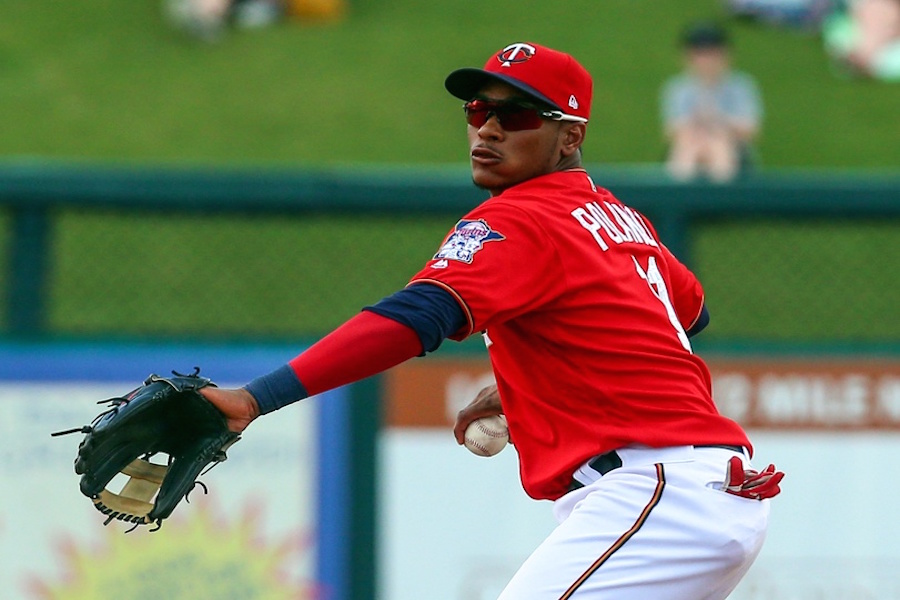
In 2017, Jorge Polanco became the 11th player in 12 years to make an Opening Day start at shortstop for the Minnesota Twins. So long as he avoids injury for the rest of this month, he'll join Pedro Florimon (2013-14) as the only players to do so in consecutive seasons since Cristian Guzman left town.
However, it is anything but assured that Polanco will be back at the position in 2019 and beyond.
Projected Starter: Jorge Polanco
Likely Backup: Ehire Adrianza
Depth: Eduardo Escobar, Erick Aybar, Nick Gordon
Prospects: Gordon, Royce Lewis, Wander Javier
THE GOOD
Around this time last year there was widespread skepticism surrounding Polanco's outlook as a major-league shortstop. By any fielding metric, his performance as a rookie in 2016 was brutal, magnifying the existing doubts tied to his defensive aptitude.
From early on last year, Polanco softened the harshness of critiques by showing significant improvement at short. Although still far from a stellar defender, he was no longer a liability at the heart of the infield.
His turnaround with the glove from 2016 to 2017 was overshadowed only by his emphatic rectification at the plate last summer following an utterly miserable first half.
Up until the All-Star break, Polanco slashed .224/.273/.323. For a long stretch in the middle of the summer, he was one of baseball's least effective hitters. His .276 OPS in July was the worst monthly mark for any MLB player (50+ PA) in two years.
Then, in August, Polanco went nuts, slashing a Troutian .373/.413/.686 with six homers to double his total from the previous fourth months combined. He came back to Earth in September with a .260/.345/.423 line that closely resembles his overall output in the majors (.266/.319/.415) and probably sets a fair baseline expectation going forward.
That absurd August notwithstanding, the switch-hitting Polanco doesn't profile as significantly above-average with the stick. Baseball Prospectus' PECOTA system pegs him at .246/.322/.415, which is perfectly adequate if he keeps making all the plays he needs to. But very soon the shortstop will be pressed by rising quality depth within Minnesota's system.
Twins Daily's 2018 top prospect list has three shortstops in the top 10: Royce Lewis (1), Nick Gordon (3) and Wander Javier (6). Teenagers Lewis and Javier aren't close to the majors yet, but have the makings of fast risers, and at 22 Gordon is knocking on the door.
Even fierce Polanco advocates would have to admit his skill set is more ideally suited for second base than short. If one of the prospects behind him establishes himself as a superior defender at the position, the door will be wide open after this year for Polanco to slide to the other side of the bag.
THE BAD
You get the question of, "Don't you guys think you have too many shortstops?" My response is, "I also don't have too much money in the bank." No, I will work with this problem of having too many shortstops.
General manager Thad Levine's response during an interview with Baseball Prospectus at Target Field last summer speaks to the luxury of possessing considerable depth at one of the most critical positions on the field.
His remark rings true for two seasons: 1) Shortstops are always in demand, and good ones will forever hold trade value in the event of a logjam; 2) Many outstanding athletes begin their pro careers at short, but a large percentage move away from the position as they ascend the ranks and standards increase.
That latter reality is weighing on Levine and the Twins even as they savor their present depth. Top-tier gloves at shortstop are huge difference-makers, and as discussed above, Polanco doesn't really have the upside to become one. Each of the upcoming talents in the system has his own set of question marks in this regard.
Javier probably has the fewest as a tremendous athlete with natural infield mechanics and a great arm, but he is 19 and hasn't yet played above rookie ball. Scouts lean more heavily toward Lewis – who didn't play shortstop until his senior year of high school – ending up in center field unless he can make serious strides in the infield (certainly not out of the question given his abilities). Gordon is closest to the majors of the three but may have the slimmest chance of sticking at short in the majors.
Mike Berardino of the Pioneer Press published an article last July, just ahead of Gordon's appearance in the All-Star Futures Game, that included plenty of lukewarm (at best) assessments of his defensive chops at short.
His hands? "Good enough. Special? Probably not. But good enough? Yeah. Good enough,” said VP of Player Personnel Mike Radcliff.
Levine's take: "There are some things about his game which belie your prototypical shortstop. It’s not well-above-average foot speed. The arm is, I think, consistent but it’s not explosive."
An anonymous scout was less charitable:
“Watching Gordon, he never seemed to get the good hop. For him, it was always the in-between hop. That’s instincts. That’s footwork. That’s hands ... For me, those things just aren’t there when I watch Nick Gordon."
None of these unflattering evaluations rule out the still-growing Gordon as a future shortstop, but they're in line with the rap on him (no pun intended) going back a ways. For what it's worth, he has made more than twice as many appearances at second as at short for the Twins this spring.
So while Minnesota technically has substantial depth at shortstop, we don't know that this is true in practical terms. In fact, it probably isn't.
THE BOTTOM LINE
Finding stability at the shortstop position has been a never-ending battle for the Twins. They've finally found at least some short-term steadiness with Polanco, but his hold on the job is only as strong his arm – which is to say not extremely.
With Dozier likely on his way out after this year, Minnesota appears poised to go with a keystone combo of Polanco and Gordon in 2019. As far as how the two will line up, that could well be dictated by the way things play out this summer. With Javier and Lewis in the rearview, neither will be able to get too comfortable.
Nothing is set in stone, but the organization's shortstop depth – for now – is rock solid.






Recommended Comments
Create an account or sign in to comment
You need to be a member in order to leave a comment
Create an account
Sign up for a new account in our community. It's easy!
Register a new accountSign in
Already have an account? Sign in here.
Sign In Now